
How Much Does a Retaining Wall Cost in Utah?

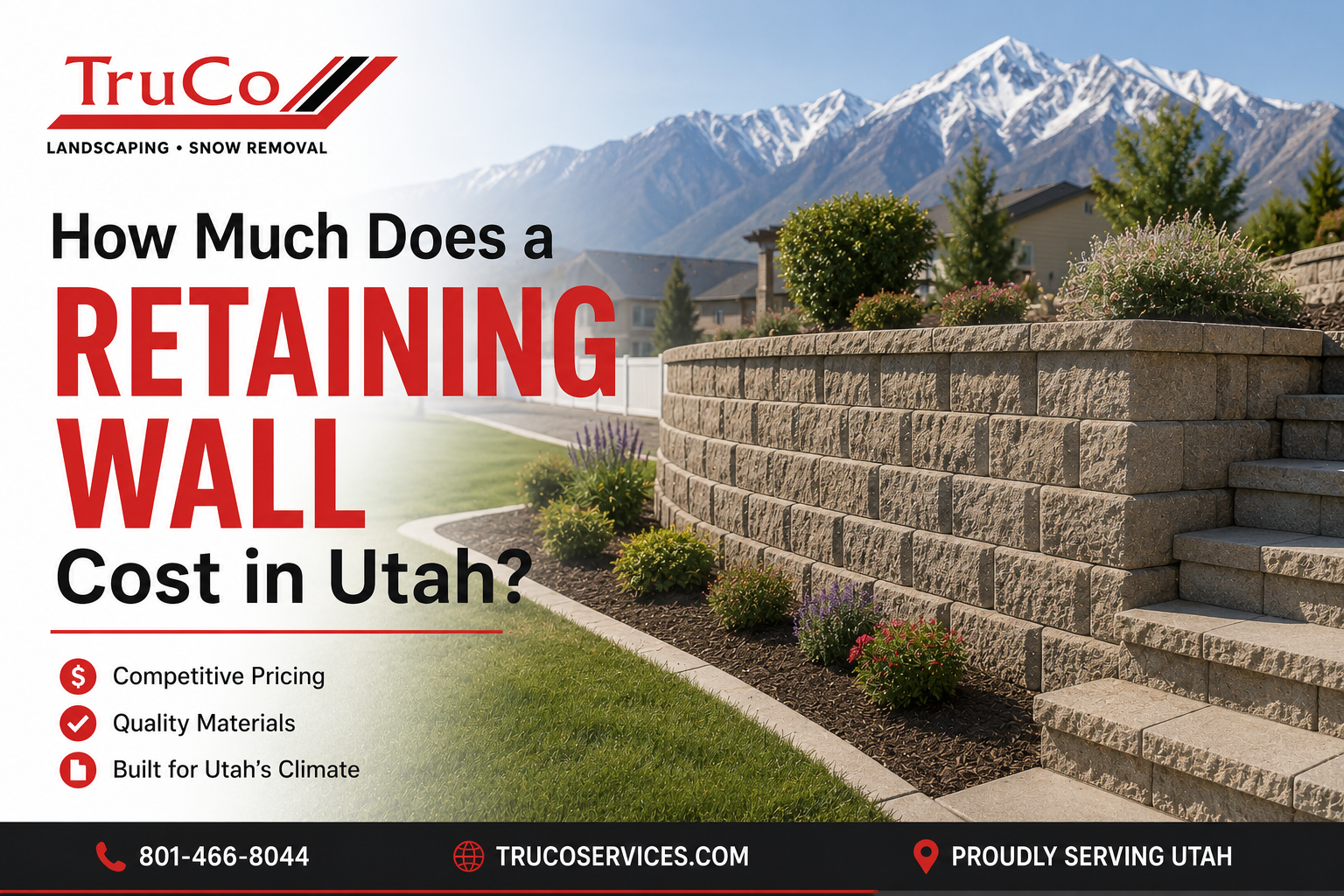
Retaining Wall Cost in Utah: Complete Pricing Guide
A retaining wall in Utah costs between $25 and $60 per square foot installed, with the average homeowner spending $3,500-$9,000 for a standard 3-4 foot tall, 30-50 foot long wall. Total project costs range from $1,500 for a small 2-foot garden wall to $25,000+ for a large 6-foot structural wall with drainage and engineering. Utah's unique soil conditions — expansive clay soils along the Wasatch Front, sandy soils in Utah County, and rocky mountain soils in higher elevations — significantly affect retaining wall costs. The Wasatch Fault zone also means seismic reinforcement is required for walls over 4 feet in most jurisdictions, adding 15-25% to the cost.
Price per square foot by material: Segmental concrete blocks (SRW) are $30-50/sq ft installed. Natural stone (flagstone, moss rock, fieldstone) is $40-65/sq ft. Poured concrete is $35-55/sq ft. Timber/railroad ties are $15-25/sq ft. Interlocking concrete pavers (Versa-Lok style) are $25-45/sq ft. Gabion baskets (wire cages with stone) are $20-35/sq ft.
Factors That Affect Retaining Wall Costs in Utah
Wall height: Walls under 3 feet typically need no engineering and use gravity-block systems. Walls 3-4 feet require geogrid reinforcement and deeper excavation. Walls over 4 feet require structural engineering calculations, deeper foundations, and enhanced drainage. Every additional foot of height doubles the structural requirements and adds 20-30% to the per-square-foot cost. A 2-foot garden wall costs $20-30/sq ft while a 6-foot structural wall runs $45-65/sq ft.
Wall length: Longer walls benefit from economies of scale. A 20-foot wall costs $35-55/sq ft while a 100-foot wall may cost $25-40/sq ft because mobilization and equipment costs are spread over more square footage.
Soil conditions: Utah's clay soils — common in Salt Lake Valley, Davis County, and parts of Utah County — require additional excavation, import of granular backfill, and often larger drainage systems. Rocky soils found in Draper, Park City, and along the benches add $500-3,000 for rock removal. Sandy or loamy soils are easiest to excavate and cost the least.
Drainage requirements: All retaining walls over 3 feet in Utah must include a perforated drainage pipe behind the wall, wrapped in filter fabric and surrounded by 12-18 inches of 3/4-inch crushed rock. Drainage adds $15-25 per linear foot. Walls without proper drainage fail within 3-5 years in Utah's freeze-thaw climate.
Site accessibility: Sites with easy equipment access (backyard with driveway gate, open lot) cost less. Sites requiring hand excavation — narrow side yards, terraced hillsides, or backyards with no equipment access — add 50-100% to labor costs.
Utilities: Locating underground utilities adds $200-500. Rerouting gas, water, or electrical lines adds $1,000-5,000 depending on complexity.
Permits and engineering: Most Utah cities require permits for retaining walls over 3 feet. Permit costs: $100-400. Engineering and soil testing: $500-2,000 depending on wall height and soil complexity.
Material Comparison for Utah's Climate
Segmental concrete blocks (SRW): Best all-around choice for Utah. Designed for freeze-thaw cycles, available in multiple colors and textures, interlocking systems provide excellent structural integrity. Always specify ASTM C1372-rated blocks for Utah's 60-80 annual freeze-thaw events. Pros: freeze-thaw rated, wide color selection, DIY-friendly for low walls, excellent structural performance. Cons: limited height without geogrid, can shift if base preparation is poor, color fading over 10-15 years.
Natural stone: Beautiful but expensive. Moss rock and flagstone are locally available and match Utah's natural landscape. Use Type N or S mortar with air-entrainment for freeze-thaw resistance. Pros: unique appearance, natural look, excellent durability. Cons: expensive, requires skilled mason, limited color control, mortar needs periodic repointing.
Poured concrete: Strong and durable but requires extensive formwork and precise curing. Needs control joints every 8-12 feet and rebar reinforcement. Pros: monolithic strength, clean modern look, can be stamped or stained. Cons: requires experienced concrete contractor, prone to cracking without proper joints, difficult to repair, challenging in cold weather.
Timber/railroad ties: Least expensive but shortest lifespan (10-15 years). Not suitable for walls over 3 feet. Pros: lowest cost, easy DIY installation, natural appearance. Cons: short lifespan, susceptible to rot and insect damage, railroad ties may contain creosote, limited structural capacity, not suitable for tall walls.
Gabion baskets: Increasingly popular for modern landscapes. Wire baskets filled with stone are naturally drainage-friendly and handle freeze-thaw well. Pros: excellent drainage, eco-friendly, distinctive modern look, cost-effective for tall walls. Cons: wire mesh must be galvanized or PVC-coated for Utah's alkaline soil, limited color options, can look industrial for traditional homes.
Installation Process for Utah Retaining Walls
Site preparation begins with marking utility lines through Blue Stakes of Utah (dial 811) — required by law before any excavation. Excavation removes soil to the required depth plus 6-8 inches for base material. The trench is compacted in 6-inch lifts using a plate compactor to achieve 95% density. Base material — 3/4-inch crushed angular rock — is placed and compacted to create a level foundation. Geogrid layers are installed at specified intervals, extending into the backfill to anchor the wall. Blocks are placed starting from the lowest course, leveled front-to-back and side-to-side. Drainage aggregate is placed behind each course with the perforated drain pipe at the base routed to daylight. Cap stones are adhered with construction adhesive. Backfill is placed and compacted in lifts with geogrid extending into each layer. A 3-foot wall takes 2-3 days to install. A 6-foot wall takes 5-7 days.
Seismic Requirements for Utah Retaining Walls
Utah is in Seismic Design Category D — moderate to high seismic risk due to the Wasatch Fault. Retaining walls over 4 feet require seismic design per the International Building Code. Seismic reinforcement includes deeper foundations, increased geogrid layers, flexible drainage connections, and reinforced concrete bond beams at critical elevations. Seismic design adds $2,000-5,000 to engineering and construction costs. Walls under 4 feet with geogrid typically meet seismic requirements without additional engineering, but verify with your local building department.
Getting Accurate Quotes
Get at least 3 quotes from licensed, insured contractors. Provide each with the same scope: wall dimensions, material preference, drainage requirements, and site access description. Ask for a detailed written estimate covering excavation, base material, wall blocks, geogrid, drainage, backfill, cap stones, labor, permits, and engineering. Compare bids carefully — the lowest bid may exclude drainage or geogrid, which are essential. Verify licensing through the Utah Division of Professional Licensing (DOPL) and ask for references from projects within the last 2 years. Be wary of contractors demanding more than 30% down payment — Utah law limits down payments on home improvement contracts to $1,000 or 10% of the total, whichever is less.
Maintenance and Longevity
Inspect your retaining wall annually in spring after frost leaves the ground. Check for bulging, leaning, or cracks wider than 1/4 inch. Clear weep holes of debris and ensure drainage outlets are functioning. Re-caulk cap stones if adhesive has failed. Re-seal concrete walls every 3-5 years with a breathable masonry sealer. Trim vegetation growing through wall joints. Address minor issues immediately before they become major structural problems. Properly built retaining walls in Utah last 30-50 years for concrete block, 20-40 years for natural stone, 25-50 years for poured concrete, 10-15 years for timber, and 20-30 years for gabion baskets. Neglected walls may fail within 5-10 years.
Signs of Retaining Wall Failure
Bulging or leaning (wall moving more than 1/2 inch out of plumb). Cracks wider than 1/4 inch — especially horizontal cracks near the middle. Water seeping through the wall face (indicates drainage system failure). Soil washing out between blocks or through weep holes. Tilting or separation of cap stones. Frost heave (wall lifting unevenly in winter). Address these issues immediately — progressive wall failure can damage patios, structures, and landscaping above the wall.
Frequently Asked Questions
Do I need a permit for a retaining wall in Utah? Most cities require permits for walls over 3 feet. Some require permits for walls of any height near property lines. Check with your city building department before starting.
Can I build a retaining wall myself? Walls under 3 feet are DIY-friendly with proper research and preparation. Walls over 3 feet require engineering, heavy equipment, and expertise — hire a professional.
What's the best material for Utah's freeze-thaw climate? Segmental concrete blocks (SRW) with proper drainage are the most reliable and cost-effective choice for Utah.
How deep should a retaining wall footer be in Utah? Base trench: 8 inches for walls under 3 feet, 12-18 inches for walls 3-4 feet, engineered for walls over 4 feet. Base material: 3/4-inch crushed rock compacted to 95% density.
Does homeowners insurance cover retaining wall failure? Typically no — retaining wall failure is considered a maintenance issue unless caused by a covered event like earthquake or vehicle impact.
How do I prevent retaining wall failure in Utah clay soil? Proper drainage is essential. Use perforated drain pipe, filter fabric, 12-18 inches of crushed rock backfill, and geogrid reinforcement. Never build on clay without proper base preparation.