
How to Prevent Trees from Growing Too Close to Your House in Utah

Why Tree Proximity Matters in Utah Homes
Planting a tree too close to your house is one of the most costly landscaping mistakes Utah homeowners make. What starts as a small sapling can become a 60-foot giant within 20-30 years, with roots that crack foundations, branches that damage roofs, and a trunk that threatens the structural integrity of your home. In Utah's clay soil, roots spread wider and shallower than in loamy soils, making the problem worse. A tree planted 5 feet from your foundation in 2026 could cause $10,000-$30,000 in foundation damage by 2050.
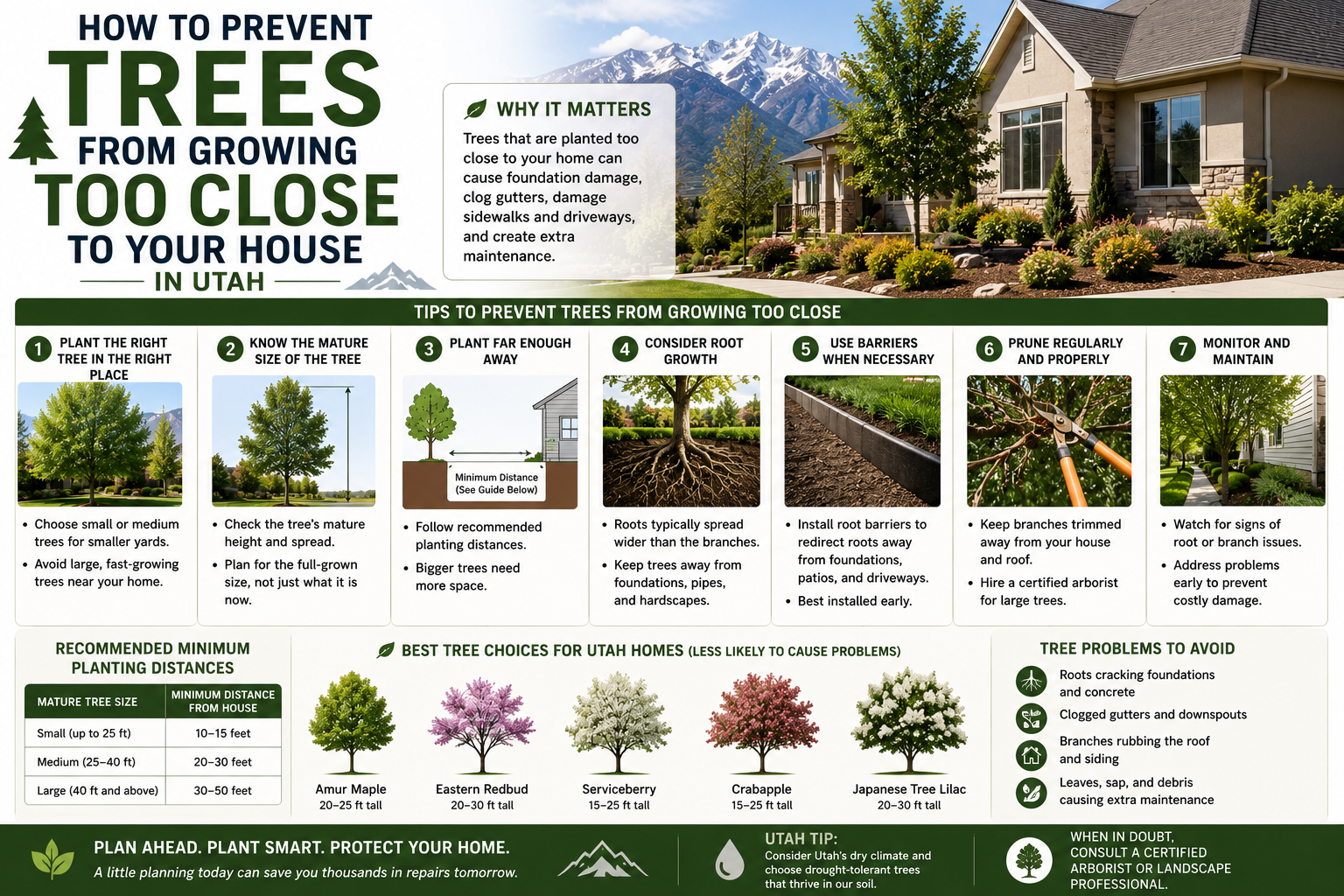
Minimum Safe Planting Distances
Small trees (mature height under 30 feet): Plant at least 10-15 feet from the house. Examples: Japanese tree lilac, serviceberry, flowering crabapple, redbud.
Medium trees (30-50 feet mature height): Plant at least 20-25 feet from the house. Examples: Kentucky coffee tree, hackberry, paperbark maple.
Large trees (50+ feet mature height): Plant at least 30-50 feet from the house. Examples: bur oak, Norway maple, ponderosa pine. As a general rule, the minimum distance should equal the tree's mature height.
Trees to Avoid Near Houses
Silver maple, cottonwood, weeping willow, poplar, and box elder should never be planted near a house in Utah. These species have aggressive, moisture-seeking root systems that grow toward foundations. Silver maple roots can extend 50+ feet from the trunk. Cottonwoods have roots that actively seek water and will grow toward leaky pipes or foundation drains. Plant these trees 50+ feet from any structure.
How Tree Roots Damage Foundations
Tree roots do not typically grow through solid concrete — they exploit existing cracks and gaps. In Utah's clay soil, roots cause damage through soil desiccation: roots pull moisture from the soil around the foundation, causing clay to shrink unevenly. This differential settling cracks foundations. Additionally, as roots grow thicker (some reach 6+ inches in diameter), they exert immense pressure on foundation walls. Utah's freeze-thaw cycles worsen the problem — ice lenses form around roots, heaving soil and foundations.
Root Barriers
Root barriers are physical panels installed vertically in the soil to redirect roots downward. They should be installed when planting a new tree near a house, or retrofitted when roots approach the foundation. Installation: dig a trench 18-24 inches deep between the tree and house, install rigid HDPE or polypropylene panels with a 2-inch lip above grade, and backfill. Barriers redirect 90% of surface roots. Cost: $15-$30 per linear foot installed. Barriers are not effective for large trees with established root systems — the roots will grow under or around them.
Signs Your Tree Is Too Close
Foundation cracks (especially horizontal or stair-step cracks), uneven floors, doors that stick, windows that are hard to open, sloping floors, cracks in driveway or walkways near the tree, roots visible above ground near the foundation, and branches touching the house or roof. If you see sinking or heaving soil near the foundation, the roots may have already caused significant damage.
When to Remove a Tree Near Your Foundation
If the tree is within 10 feet of the foundation for a large species, within 5 feet for any species, causing visible foundation damage, or showing signs of decline (dead branches, thinning canopy), removal should be considered. Tree removal costs in Utah: $300-$1,500 depending on size and accessibility. Compare this to foundation repair costs which typically run $5,000-$30,000+.
Frequently Asked Questions
How close can a tree be to a house foundation in Utah? At least 15-20 feet for small trees and 30-50 feet for large trees. For aggressive-root species like silver maple, maintain 50+ feet.
Can tree roots damage a foundation in clay soil? Yes. Utah's clay soil makes root damage more likely because clay shrinks and expands with moisture changes, and roots extract moisture unevenly, causing differential settling.
Do root barriers really work? For new plantings and small trees, yes. For established trees with large root systems, barriers have limited effectiveness.
How much does foundation repair cost in Utah? $5,000-$30,000+ depending on the extent of damage. Piering and underpinning are common repair methods for root-damaged foundations.
Should I remove a tree that is 5 feet from my house? Yes. A tree that close to the foundation will eventually cause structural damage regardless of species. Removal is far cheaper than foundation repair. Pruning to prevent proximity issues: Regular pruning can help manage a tree's size and keep it from encroaching on your house. Focus on removing branches that overhang the roof or touch the siding. Crown reduction (shortening the overall height) can reduce wind loading and keep the tree more compact. NEVER top a tree — topping causes weak regrowth and creates a hazard. Proper pruning by a certified arborist costs $200-$600 per large tree in Utah. Structural pruning when the tree is young (first 5-10 years) is most effective at preventing future problems.
Choosing the right tree for your Utah property: Before planting, consider the mature size of the tree, not its size at planting. A 10-foot sapling becomes a 60-foot tree. Check overhead power lines — plant trees that stay under 25 feet near power lines. Check underground utilities — call Blue Stakes before digging. Consider your soil type — clay soil limits root depth and encourages wider root spread. Consider your lot size — smaller lots need smaller trees. Utah State University Extension recommends matching tree size to available space as the single most important factor in tree selection.
What to do if a neighbor's tree is too close to your house: Utah law allows you to trim branches and roots that cross onto your property, but you cannot trespass onto your neighbor's property or damage the tree. You are responsible for any damage caused by your trimming that harms the tree. If a neighbor's tree is causing foundation damage, document everything with photographs and consult a structural engineer and an attorney. Mediation is often more effective than litigation for resolving tree disputes between neighbors.
Cost comparison: prevention vs repair: Planting a tree at the right distance costs nothing extra. Installing a root barrier costs $15-30 per linear foot. Annual pruning costs $200-600 per tree. Compare this to foundation repair ($5,000-$30,000), roof replacement from branch damage ($8,000-$15,000), or sewer line repair from root intrusion ($3,000-$8,000). Prevention is dramatically cheaper. If you already have a tree too close to your house, the cost of removal ($300-$1,500) is still far less than waiting for damage and paying for repairs.