
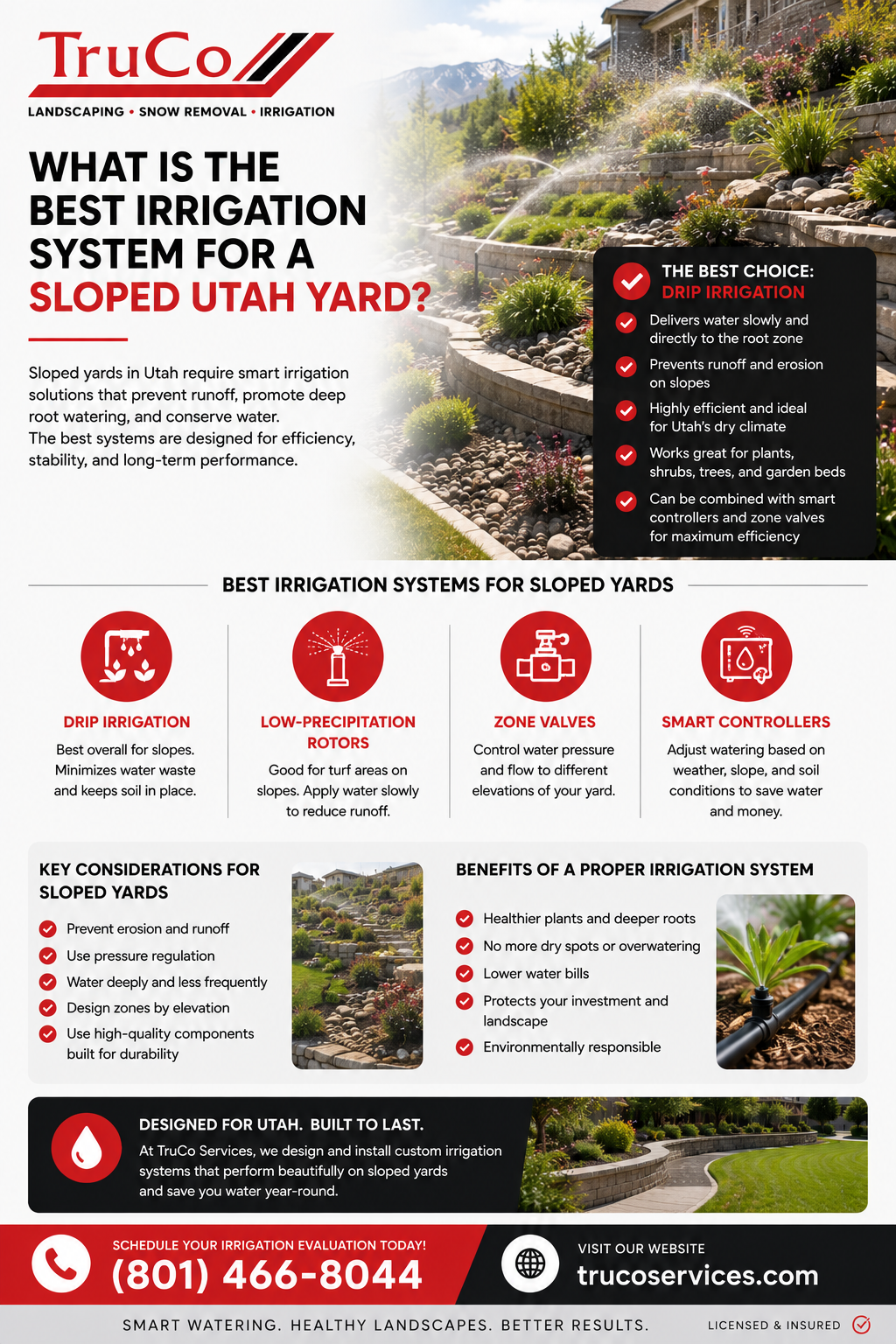
What Is the Best Irrigation System for a Sloped Utah Yard?

Why Slopes Are Hard to Irrigate in Utah
Utah's varied topography — from the Wasatch Front foothills to the benches of Salt Lake Valley to the mountain communities of Park City and Heber Valley — means many homeowners face significant slope challenges in their yards. Irrigation on slopes presents three core problems unique to Utah's climate and soil conditions.
Runoff. Water applied faster than the soil can absorb runs downhill, carrying away topsoil, fertilizer, and mulch. On a 20% grade in Utah's clay soil, runoff can begin within 60 seconds of sprinkler operation. That means most of the water you pay for ends up in the street or your neighbor's yard.
Erosion. Sheet erosion on bare soil strips the slope of organic matter. Over one Utah growing season (April to October), an unprotected slope can lose 1/4 inch of topsoil. This exposes roots, damages plants, and creates gullies that worsen every season.
Uneven distribution. Water at the top of the slope runs off before it can soak in, while the bottom gets oversaturated. This creates a "dry top, wet bottom" pattern. Grass at the top browns out by July; grass at the bottom develops fungal diseases from constant moisture. Utah's clay soil makes all of these problems worse.
Drip Irrigation: Best for Planting Beds on Slopes
Drip irrigation is the clear winner for sloped planting beds in Utah. Drip emitters deliver water at 0.5 to 2 gallons per hour — slow enough that even Utah's dense clay soil can absorb it. On a 30% slope, properly designed drip irrigation produces virtually no runoff.
What you need for a Utah slope drip system: Pressure-compensating (PC) emitters that deliver the same flow rate regardless of elevation, a pressure regulator set to 25-30 PSI (Utah municipal water pressure commonly ranges 60-100 PSI), a backflow preventer required by Utah code, and 1/2-inch or 3/4-inch polyethylene tubing run along contours.
Best plants for drip-irrigated slopes in Utah: Utah native and drought-tolerant plants like sagebrush, rabbitbrush, Utah serviceberry, mountain mahogany, juniper groundcovers, blue fescue, and penstemon thrive on 1/2 inch of water every 7-10 days once established.
Sprinkler Options for Sloped Lawns in Utah
Gentle slopes (under 15% grade): Pressure-regulated spray heads with low-angle nozzles work well. Standard spray heads at 30 PSI experience elevation pressure changes causing overspray at the bottom and weak throw at the top. Low-angle nozzles keep the water stream flatter, reducing both wind drift and runoff. Hunter MP Rotator nozzles deliver water at a low precipitation rate of 0.4 inches per hour versus 1.5 inches for standard heads.
Steep slopes (over 15% grade): Rotary nozzles like Hunter MP Rotator deliver water in multiple rotating streams at 0.4 inches per hour, doubling the effective irrigation window. Soaker hoses laid along contour lines on steep grass slopes deliver water directly to the soil with zero runoff. Bubbler basins with soil berms on the downhill side of trees create catchment basins.
What NOT to use on steep slopes: Impact sprinklers and gear-drive rotors deliver water too fast. On a 20% grade with clay soil, up to 70% of water runs off before it can be absorbed.
Pressure Regulation and Water Conservation
Utah municipal water pressure typically ranges 60-100 PSI at the meter. Standard irrigation components are designed for 30-50 PSI. For every 10 feet of elevation change on a slope, water pressure changes by approximately 4.3 PSI. A property dropping 30 feet experiences a 13 PSI difference between top and bottom.
Solutions: A master pressure regulator at the main valve set to 50-60 PSI for sprinklers and 25-30 PSI for drip. Pressure-regulated spray heads for each zone. Pressure-compensating drip emitters. Proper regulation on a sloped property reduces water consumption by 15-30% immediately.
Smart Controllers for Sloped Properties
A smart controller is worth the investment for sloped Utah yards. Look for ET-based controllers that use local weather data to calculate water needs, flow-sensing capability to detect line breaks, multiple program capability for different slope aspects, and cycle-and-soak programming — the single most important feature for slopes.
Top controllers for Utah slopes: Rachio 3 (8-16 zones, $150-$250), Hunter Hydrawise ($150-$400), and Rain Bird ESP-ME3 with LNK WiFi module ($120-$200). Most Utah homeowners with sloped yards see 20-40% reduction in water usage immediately, paying for the controller in 1-2 seasons.
Installation Tips for Utah Slopes
Run lines along contours, not straight down. Main water lines should follow elevation contour lines across the slope. Use swing joints at every sprinkler head — flexible connectors allow head height adjustment as the slope settles. Install drain valves at low points for winterization. Bury lines at least 18 inches deep (Utah's frost line is 30-36 inches). Use check valves on all low sprinkler heads to prevent water from draining out after shutdown. Install a master valve — Utah code requires it.
Cost Comparison by System Type
Drip irrigation for planting beds: $0.15-$0.35/sq ft materials, $300-$800 DIY installation, $100-$250 annual water cost, 10-15 year lifespan. Pressure-regulated spray heads for gentle turf slopes: $0.20-$0.40/sq ft, $500-$1,200 DIY, $200-$400 annual water cost, 8-12 years. Rotary nozzles for steep turf slopes: $0.30-$0.55/sq ft, $700-$1,500 DIY, $180-$350 annual water, 10-15 years. Hybrid drip + rotary system (recommended): $0.25-$0.45/sq ft, $600-$1,500 DIY, $150-$300 annual water, 10-15 years.
Properties on secondary irrigation water in Salt Lake City, Sandy, and Murray pay $0.50-$1.50 per 1,000 gallons — roughly 1/3 the cost of culinary water. However, secondary water has higher sediment content that can clog drip emitters, so a 120-mesh or finer filter is mandatory.
Frequently Asked Questions
What is the best irrigation for a steep slope over 30% grade?
Drip irrigation for planting beds combined with soaker hoses or low-precipitation rotary nozzles for turf. Avoid all standard spray heads on grades over 30% — runoff exceeds 70% of applied water.
Can I use a standard sprinkler system on a sloped Utah lawn?
Only on gentle slopes under 15% grade with pressure-regulated spray heads and low-angle nozzles. On steeper slopes, standard sprinklers waste 50-70% of water to runoff.
How much water does a sloped yard waste compared to a flat yard?
A flat yard wastes 15-25%. A sloped yard with standard sprinklers wastes 40-70%. Switching to drip or rotary nozzles reduces waste to 10-20%, saving 30,000-50,000 gallons annually on a 10,000 sq ft property.
Do I need a special controller for a sloped yard?
Not required but highly recommended. A smart controller with cycle-and-soak programming dramatically reduces runoff on slopes. Rachio 3 and Hunter Hydrawise are excellent choices.
Best way to water trees on a slope?
Drip irrigation with 2-4 emitters per tree placed on the uphill side with a soil berm on the downhill side creating a catchment basin. Deep water infrequently rather than frequent shallow waterings.