
Why Does My Basement Smell Musty After It Rains — Is It a Drainage Problem?

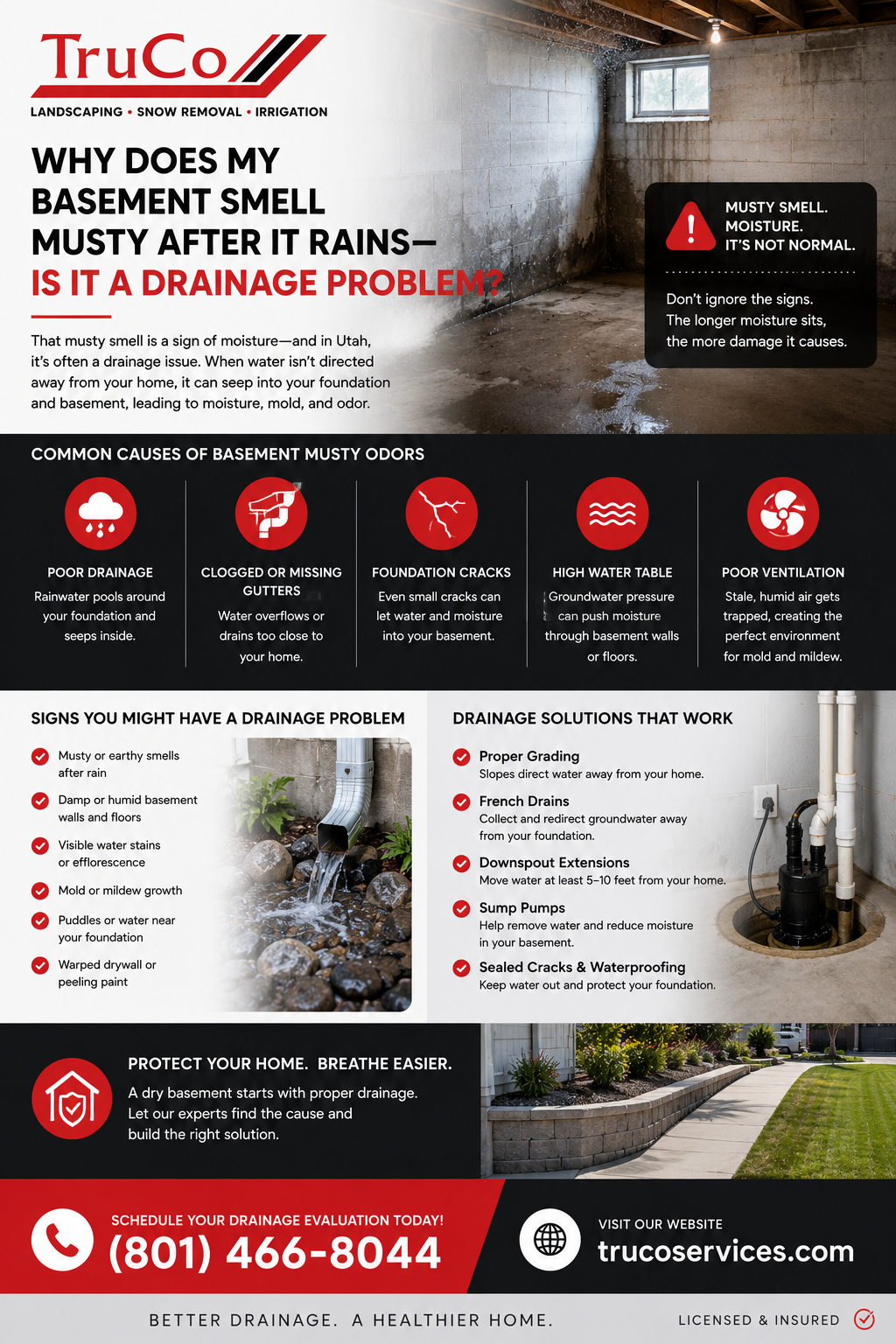
Not every musty smell means your basement is growing toxic mold, but the two are closely related. A mild musty odor that appears only after heavy rain and fades within a day or two suggests minor moisture intrusion — enough to activate dormant mildew spores but not enough to sustain active mold growth.
Signs of serious mold include: A persistent musty smell that never fully goes away even in dry weather, visible black/green/white patches on walls/floors/stored items, warped baseboards or peeling paint, allergy symptoms that worsen when you're in the basement (sneezing, headaches, watery eyes), and condensation on pipes, windows, or concrete walls.
Utah's Wasatch Front experiences roughly 40-50 rainy days per year, plus spring snowmelt that saturates the ground for weeks. Any basement that smells musty for more than 48 hours after a rain event has an active moisture problem that needs attention.
How Utah's Clay Soil Causes Basement Moisture
The single biggest reason Utah basements smell musty after rain is the soil itself. The Wasatch Front is built on lacustrine (ancient lakebed) clay — specifically the Bonneville, Provo, and Alpine formations. This clay is expansive: it swells when wet and shrinks when dry.
How clay soil creates basement moisture: When it rains, Utah clay absorbs water and expands, creating hydrostatic pressure against your foundation walls. The pressure forces water through hairline cracks in concrete foundations, cinder block joints, and the cove joint (where the wall meets the floor slab). As the soil dries, it shrinks and pulls away from the foundation, creating a gap. The next rain fills that gap with water, which now has a direct path to your foundation.
This cycle is relentless along the Wasatch Front. In neighborhoods from Salt Lake City to Sandy, from Draper to Provo, clay soil is the underlying cause of most residential basement moisture. The soil around your home should slope away from the foundation at a rate of at least 6 inches of drop over the first 10 feet — but Utah clay soil often settles and creates a reverse slope.
Clogged Gutters and Downspout Extensions
Clogged gutters are the most common — and most preventable — cause of musty basements. When gutters fill with leaves, pine needles, and debris, rainwater overflows instead of being channeled to downspouts. That overflow dumps directly against your foundation.
The numbers tell the story: A 1,000-square-foot roof sheds approximately 625 gallons of water during a 1-inch rainstorm. Clogged gutters redirect 50-80% of that water against the foundation. Just 1 inch of water against a foundation wall creates 5 PSI of hydrostatic pressure — enough to push water through most basement wall cracks.
Check your downspout extensions. Many Utah homes have downspouts that discharge water within 1-2 feet of the foundation. The minimum safe distance is 5 feet. In clay soil, extend that to 10 feet using flexible downspout extensions or buried drain pipes. If your basement smells musty only after rain, start your inspection at the roofline.
Improper Grading Around Your Foundation
Grading refers to the slope of the ground around your home. Proper grading directs surface water away from the foundation. Improper grading directs it toward the foundation.
How to check your grading: Wait for a rainstorm and watch where the water goes. Use a 4-foot level on the ground against the foundation — the bubble should indicate a slope away from the house. Measure from the foundation to the first low spot in your yard.
Utah homes built on clay soil are especially vulnerable to grading problems because clay settles unevenly over time. Landscaping settles, sprinkler trenches settle, and backfill around the foundation settles — all creating low spots that funnel water toward your basement. Minimum grading for Utah homes: 6 inches of vertical drop within the first 10 feet from the foundation. For clay soil, 8-10 inches is better.
Failed or Missing French Drains
A French drain is a trench filled with gravel and a perforated pipe that collects groundwater and redirects it away from the foundation. In Utah's clay soil, French drains are essential but they fail over time as clay particles wash into the gravel bed and clog the perforated pipe.
Signs your French drain has failed: Water pooling in your yard above the drain line during heavy rain, musty basement smell accompanied by wet spots on the basement floor near the wall, efflorescence (white mineral deposits) on foundation walls, and a sump pump that runs constantly or never turns on.
Crawl Space Moisture and Vapor Barriers
Many Utah homes, especially those built before 2000 in older SLC neighborhoods like Sugar House, the Avenues, or central Provo, have crawl spaces. Utah's clay soil wicks moisture up into the crawl space, open vents allow humid summer air to condense on cool surfaces, and dirt floors without vapor barriers release ground moisture into the air that rises into the living space above.
The fix: Install a 6-20 mil polyethylene vapor barrier over the entire crawl space floor, extend it at least 6 inches up the foundation walls, seal all seams with vapor barrier tape, and encapsulate the crawl space for maximum protection. Utah's dry climate works in your favor — encapsulated crawl spaces in Utah typically stay below 50% humidity without a dehumidifier once the barrier is in place.
DIY Fixes vs. When to Call a Pro
You can handle these yourself: Cleaning gutters monthly during leaf season, installing downspout extensions ($10-$30), regrading small areas up to 10 feet from the foundation, and sealing small foundation cracks with hydraulic cement ($15-$25).
Call a professional for these: French drain installation or replacement ($4,000-$8,000), interior perimeter drain systems ($5,000-$12,000), sump pump installation ($1,000-$2,500), crawl space encapsulation ($3,000-$7,000), and foundation crack injection ($500-$1,500 per crack).
Basement waterproofing along the Wasatch Front runs 15-20% higher than national averages due to clay soil complexity. However, addressing drainage early typically costs 1/10th of what mold remediation costs.
Frequently Asked Questions
Why does my basement smell musty only after it rains and not during dry weather?
Because the source is rainwater saturating the ground around your foundation. During dry weather, the soil dries out and hydrostatic pressure drops, so no moisture enters the basement. The musty smell is activated mold spores that go dormant again when the basement dries out.
Can a musty basement smell make my family sick?
Yes. Mold spores trigger allergic reactions, asthma attacks, and respiratory irritation. The musty smell itself is microbial volatile organic compounds (MVOCs) released by mold. If you or your family experience headaches, fatigue, or congestion when in the basement, address the moisture problem immediately.
How do I know if my Utah basement moisture is from clay soil or a plumbing leak?
Clay soil moisture appears only after rain or snowmelt. A plumbing leak causes constant moisture regardless of weather. Check your water meter with all fixtures off — if it is still spinning, you have a leak. Otherwise, the issue is exterior drainage in Utah clay soil.
Should I seal basement walls from inside or fix drainage outside?
Always fix drainage outside first. Interior sealants stop water that is already inside but do not stop hydrostatic pressure. Over time, water will find another path or the sealant will fail. Exterior drainage fixes — grading, gutters, French drains — address the root cause.
Is a dehumidifier enough to fix a musty basement smell in Utah?
A dehumidifier treats the symptom, not the cause. It will remove some moisture from the air but will not stop water intrusion that feeds mold growth. Use a dehumidifier as a temporary measure while you diagnose and fix the drainage problem. Musty Basement Smell After Rain — Could It Be Drainage?
Yes, a musty basement smell after rain is almost always a drainage problem. Water pooling around your foundation seeps through cracks, into the crawl space, or saturates the slab. This moisture creates the perfect environment for mold and mildew, which produce that musty odor. Common causes include clogged gutters, improper grading, failed French drains, or Utah's expansive clay soil that directs water toward your foundation instead of away from it.
Musty Smell vs. Serious Mold — How to Tell the Difference
A mild musty smell that appears only after heavy rain and disappears within 24-48 hours of dry weather is likely from surface moisture in the crawl space or basement. A persistent musty smell that doesn't go away, especially when accompanied by visible discoloration on walls or floors, indicates active mold growth. Black, green, or white fuzzy patches on walls, floors, or stored items mean the moisture problem is severe and needs immediate attention.
How Utah's Clay Soil Causes Basement Moisture
Utah's dominant soil type along the Wasatch Front is Kayesville clay loam. This soil expands when wet and contracts when dry, creating voids around your foundation that funnel water directly toward the basement walls. When the soil saturates, it creates hydrostatic pressure that forces water through even hairline cracks in concrete foundations. This is why basement moisture problems are so common in Salt Lake City, Murray, Sandy, and other cities built on clay soil.
Clogged Gutters and Downspout Extensions
The simplest and most common cause of basement moisture is gutters that aren't directing water away from the foundation. In Utah's sudden summer thunderstorms (monsoon season July-September), a single clogged downspout can dump 1,000+ gallons of water directly next to your foundation in one storm. Ensure downspouts extend at least 5-6 feet from the foundation wall. In Utah, where clay soil doesn't absorb water quickly, even 3-foot extensions may not be enough.
Improper Grading Around Your Foundation
Utah building code requires the ground to slope away from your foundation at a rate of at least 6 inches over the first 10 feet. However, Utah's clay soil settles over time, and many homes built before 2000 have negative grading that slopes toward the foundation. A simple fix: add fill dirt around the foundation to restore proper slope. This costs $200-$500 for a typical Utah home and often eliminates basement moisture issues entirely.
Frequently Asked Questions
Can a musty basement smell make me sick?
Prolonged exposure to mold spores can cause respiratory issues, headaches, and allergic reactions. If you or your family experience these symptoms at home but not away, the musty smell indicates a health risk that needs remediation.
How much does basement drainage repair cost in Utah?
Costs vary widely by solution: French drain installation $3,000-$8,000, gutter extension $100-$400, grading $200-$500, crawl space vapor barrier $1,000-$3,000, sump pump installation $1,200-$2,500.
Will a dehumidifier fix the musty smell?
A dehumidifier treats the symptom, not the cause. It will reduce the smell while running, but the moisture will continue damaging your foundation. Always fix the drainage first.
Does homeowners insurance cover basement moisture in Utah?
Standard policies do not cover gradual moisture damage or poor drainage. They typically cover sudden events like burst pipes. Fixing drainage is considered home maintenance.
How do I find where water is entering my basement?
Wait for a heavy rain and inspect your basement during the storm. Look for wet spots, drips, or water stains on walls and floors. Alternatively, tape plastic sheeting to the floor and walls — condensation on the plastic indicates moisture entry.