
Xeriscape Contractor close to Roy UT

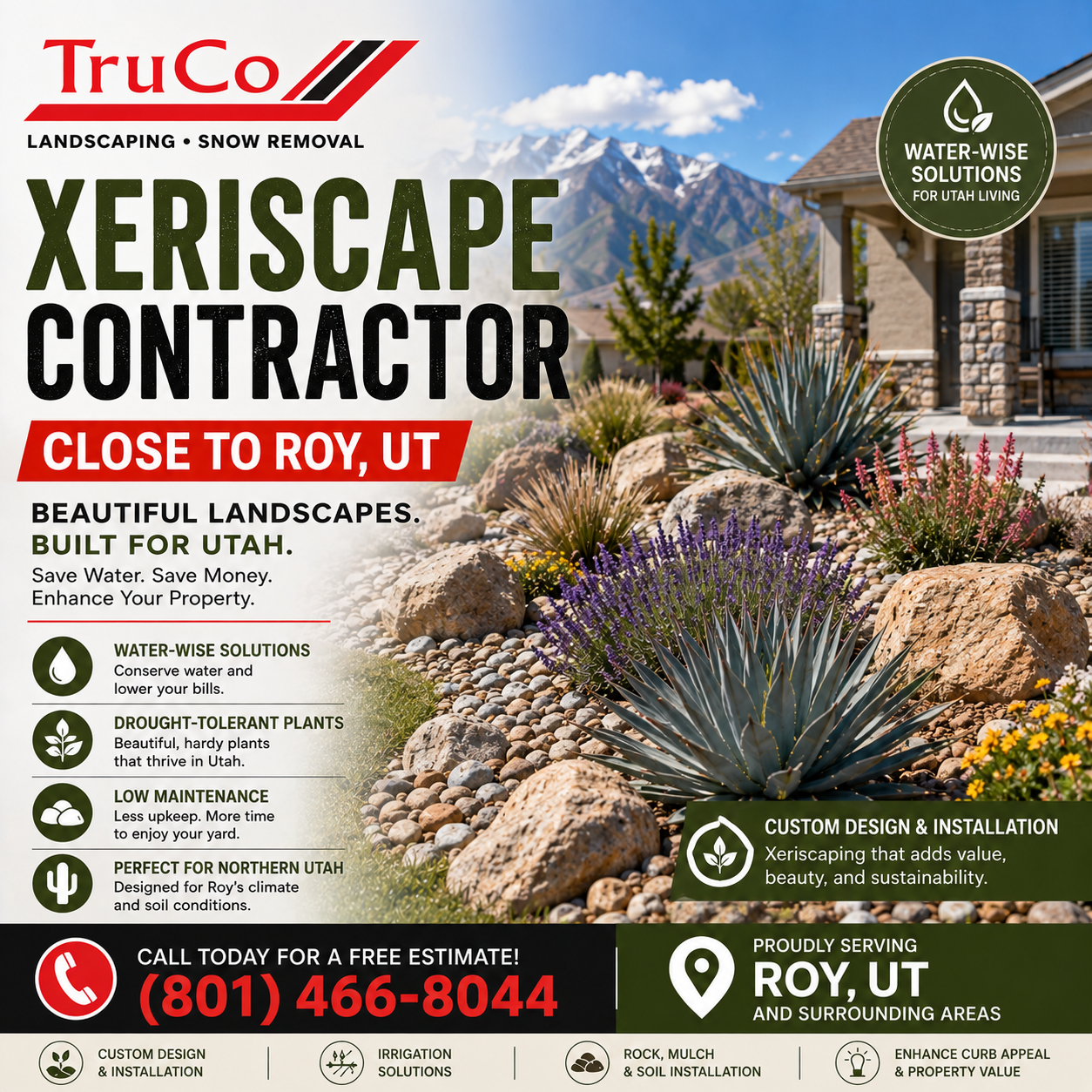
A xeriscape contractor close to Roy, UT can help you convert a high-water, high-maintenance yard into a practical landscape designed for Utah’s dry summers, winter freezes, wind, and varying soils. Done correctly, xeriscaping is not simply removing lawn and spreading gravel. It is a water-wise landscape system that combines functional turf, drought-adapted plants, efficient irrigation, drainage planning, mulch or decorative aggregate, and a realistic maintenance plan.
The most important takeaway: successful xeriscaping starts with a site-specific design. The best approach depends on how you use your yard, where water flows, how much sun each area receives, what soil conditions exist, and which plants can thrive there. Poor planning can lead to dead plants, irrigation waste, drainage problems, excessive heat from rock, and expensive rework. This guide explains how a xeriscape contractor near Roy works, the decisions that matter most, available project strategies, rebate considerations, common mistakes, and how Truco Services can help you make a smart long-term landscaping investment.
What Is a Xeriscape Contractor and How Does It Work?
A xeriscape contractor is a landscaping professional who plans, installs, and helps maintain landscapes designed to reduce unnecessary outdoor water use. The contractor’s job may include assessing your property, designing planting zones, removing turf, updating irrigation, correcting drainage, installing water-wise plants, placing mulch or decorative rock, and creating outdoor-use areas such as patios, pathways, seating spaces, or retaining features.
In plain English, xeriscaping means using the right amount of water in the right place—not eliminating every plant or turning a yard into a gravel field.
Utah’s definition of water-wise landscaping includes plant materials suited to the property’s microclimate and soil, efficient irrigation design and application, reduced turf where appropriate, and design features that reduce supplemental water needs or encourage vegetative coverage.
Utah State University identifies seven core principles of water-wise landscaping:
Planning and design
Soil preparation
Practical turf areas
Appropriate plant selection
Efficient irrigation
Mulch
Maintenance
These principles work together. A drought-tolerant plant still fails if it is placed in a poorly drained bed, grouped with high-water plants, or watered incorrectly.
Who Is Looking for Xeriscaping in Roy?
The main readers and customers include:
Roy homeowners who want to reduce mowing, watering, and lawn maintenance.
New homeowners planning a yard that fits Utah’s climate.
Families who want to preserve a usable lawn while removing wasteful turf.
Property managers maintaining common areas, rental homes, offices, and multifamily properties.
Homeowners with lawn problems, irrigation issues, weeds, or drainage concerns.
People considering Utah landscape-incentive programs.
Residents who want more curb appeal with lower long-term water demand.
What a Xeriscape Project Usually Includes
A complete project normally moves through these stages:
Consultation and property walk-through.
Evaluation of sun, shade, soil, slopes, drainage, existing irrigation, utility locations, and intended use.
Design, plant selections, materials list, and written scope.
Review of HOA rules, utility requirements, incentive requirements, and local approvals as applicable.
Turf removal, grading, irrigation modifications, and drainage work.
Installation of hardscape, beds, plants, mulch, rock, and edging.
System testing and irrigation-controller programming.
First-year care and seasonal irrigation adjustments.
Not every project includes every item. A small side-yard conversion may only need lawn removal, drip irrigation, planting, mulch, and edging. A large full-yard conversion may include soil work, drainage, patios, paths, lighting, trees, walls, and a redesigned irrigation system.
8 Decisions That Determine Whether a Xeriscape Succeeds
1. Design for Real Yard Use Before Choosing Plants
The first planning question should be: “What does this space need to do?” A yard may need an active play area, a dog run, a patio for entertaining, shade, a route to the backyard, parking access, a garden, privacy screening, or a safe path to the front door.
The mistake is treating all lawn as wasteful. Turf has a valid role when it supports active recreation, provides a comfortable gathering area, or serves as an intentional design element. Problems arise when lawn is used in narrow strips, along difficult slopes, or in isolated corners that no one uses but still require mowing, edging, fertilizing, and irrigation.
For example, a narrow strip of grass between a driveway and fence may consume water and maintenance time without providing usable space. Converting that strip to a drip-irrigated planting bed, mulch, and water-wise shrubs can improve appearance and reduce work. A central backyard lawn used by children and pets may be worth retaining.
USU recommends placing turf only where it is practical and avoiding narrow or irregular lawn areas that cannot be irrigated efficiently.
How to avoid the problem: Make a written list of how your household uses each part of the property. Ask your Roy xeriscape contractor to identify which lawn areas are functional and which are candidates for conversion.
2. Account for Roy’s Sun, Wind, Soil, and Winter Conditions
A water-wise landscape in Roy must handle more than summer heat. Utah yards may experience strong sun, dry air, wind, freeze-thaw cycles, compacted soils, alkaline conditions, and localized frost pockets. Even within a single lot, growing conditions can vary dramatically.
South- and west-facing beds near concrete or walls can experience reflected heat that stresses plants. North-facing areas may stay cooler and hold moisture longer. Windy corners can dry out soil and foliage. Low spots may collect runoff or cold air. A plant that is drought tolerant in one part of the yard may struggle in another.
This is why a xeriscape contractor should choose plants based on the exact site instead of using a generic list. Each plant needs the right combination of sunlight, drainage, water, soil, and room to mature.
Utah State University’s water-wise plant resources emphasize selecting plants suited to local conditions rather than relying on a single “low-water” label.
How to avoid the problem: Request a plant schedule before installation. It should include common and botanical plant names, sun needs, water needs, expected mature size, and planting location. This makes it easier to understand the design and prevent overcrowding.
3. Fix Drainage Problems Before Covering Them Up
Xeriscaping cannot solve drainage issues if the underlying grade is wrong. Decorative rock, mulch, plants, and edging may hide a problem temporarily, but they do not stop water from pooling near a foundation, washing down a slope, or freezing on a walkway.
Drainage problems often show up as:
Standing water after irrigation or storms.
Water flowing toward the home or garage.
Eroded soil and displaced mulch.
Plants dying from wet roots.
Icy walking surfaces in cold weather.
Sinking pavers, settling soil, or damaged edging.
Persistent weeds in chronically wet areas.
A qualified water-wise landscaping contractor should identify where roof runoff, irrigation water, and natural drainage move across the property. Depending on the site, the right solution may include regrading, swales, drainage piping, downspout extensions, permeable materials, or irrigation adjustments.
How to avoid the problem: Before approving a design, ask where water will go after the project is complete. Pay particular attention to downspouts, patios, walkways, driveways, neighboring properties, and the foundation.
4. Use Hydrozones to Prevent Plant Loss and Water Waste
Hydrozoning means grouping plants with similar water needs together and placing them on the same irrigation zone. It is one of the most important concepts in water-wise landscape design.
For example, turf usually needs a different irrigation schedule than a bed of drought-tolerant shrubs. A newly planted tree may need deep watering less often than nearby perennials. If all of those plants share one valve, one group will receive too little or too much water.
This is a common reason a new xeriscape fails. Homeowners often continue using the same watering schedule used for a traditional lawn. Some plants become stressed from lack of water, while others develop root problems because they stay too wet.
USU explains that water-wise landscapes should group plants according to similar irrigation needs, ranging from areas that need little supplemental water after establishment to areas that need more frequent watering.
How to avoid the problem: Ask for a clearly labeled irrigation-zone map. Your contractor should explain which plants are on each valve, how often each zone should run during establishment, and how to adjust irrigation through the year.
5. Install Efficient Irrigation, Then Maintain It
Drip irrigation is often the best choice for beds containing shrubs, perennials, and trees because it applies water close to the root zone and reduces wind drift. But drip irrigation is not automatically efficient. Poor design, missing components, clogged emitters, leaks, improper placement, or bad controller programming can still waste water.
Important drip-system components can include pressure regulation, filtration, correct emitter spacing, proper tubing layout, and separate zones for plants with different needs. Overhead spray irrigation, if retained for functional turf, should normally remain on separate zones.
Roy Water Conservancy District explains that its secondary water system supplies untreated water for landscape irrigation only. It is not drinking water and should be used strictly for lawn and garden purposes.
Utah Water Savers’ landscape-incentive guidelines also require low-volume drip irrigation for completed conversion areas and specify separate irrigation zones for drip and overhead spray systems.
How to avoid the problem: Have the contractor walk you through each valve, controller setting, filter, shutoff, and irrigation zone. Inspect your system during the season for leaks, pooling, clogged emitters, dry plants, or overspray.
6. Use Rock, Mulch, and Hardscape for Performance—not Just Appearance
A visually appealing xeriscape needs material balance. Mulch, decorative rock, pavers, boulders, edging, and plants should work together to manage moisture, reduce weeds, support usability, and create visual interest.
Organic mulch can reduce evaporation, moderate soil temperatures, and improve soil structure as it breaks down. Decorative rock offers durability and can create clean lines, but a yard dominated by rock can become hotter, harder to modify, and more vulnerable to visible weeds. Rock also requires proper edging and grading so it does not migrate into lawns, sidewalks, or gutters.
USU generally recommends 3 to 4 inches of organic mulch or 2 to 3 inches of inorganic mulch, depending on the material and project conditions.
Hardscape can reduce irrigated area while improving daily use. A patio, path, seating area, or permeable walkway may make more sense than lawn in a high-traffic location. But excessive impervious hardscape can increase runoff and heat.
How to avoid the problem: Choose materials based on long-term performance. Use plant groupings to soften rock and hardscape, ensure water can drain correctly, and avoid piling mulch or rock against siding, tree trunks, or plant stems.
7. Plan for Establishment Care During the First Year
“Drought tolerant” does not mean “never water.” New plants need focused care while they develop roots into surrounding soil. The first season after installation is the most important time for irrigation monitoring, weed control, plant inspection, and seasonal adjustment.
A new landscape may need more frequent watering initially than it will after plants mature. Over time, the schedule should be adjusted downward where appropriate. But the right schedule depends on soil, sun exposure, weather, plant type, root-ball size, mulch depth, and wind.
A common failure occurs when homeowners under-water new plants because they expect a xeriscape to survive without irrigation. The opposite mistake is keeping all zones on a lawn-style schedule, which can overwater water-wise plants and lead to disease or weak roots.
How to avoid the problem: Ask for written first-year care instructions. The plan should explain initial irrigation, seasonal adjustments, signs of stress, expected maintenance, and what to do if a plant declines.
8. Confirm Rebate Requirements Before Removing Lawn
Utah’s Landscape Incentive Program may help qualifying homeowners or commercial property owners pay for replacing living turf with water-efficient landscaping. The program advertises incentives of up to $3 per square foot, depending on the participating area and program conditions.
However, rebate rules matter. Utah Water Savers states that existing grass must be living and maintained when you apply and at the first inspection. Work cannot begin until a conservation technician has completed the required in-person or virtual inspection. Applicants must submit photos of the current yard and a project-specific landscape plan.
Statewide program details also identify common requirements, including a project area of at least 200 square feet, low-volume drip irrigation, and at least 50% canopy coverage from water-wise perennials and shrubs at maturity.
How to avoid the problem: Do not kill, remove, or cover the lawn before confirming current eligibility and completing required pre-project steps. Program terms, funding, participating providers, and payout amounts can change.
How Truco Services Helps You Succeed With Xeriscaping
Truco Services can help property owners seeking a Roy UT xeriscape contractor develop a water-wise landscaping strategy that balances appearance, water efficiency, drainage, usability, and long-term upkeep.
An experienced landscape professional can help you:
Assess existing lawn, irrigation, drainage, slopes, sun exposure, access, and mature vegetation.
Decide where turf serves a real purpose and where conversion makes sense.
Create functional planting zones based on water needs and site conditions.
Plan drip irrigation, practical turf zones, and controller adjustments.
Select mulch, decorative rock, plants, pathways, and hardscape that work together.
Identify likely project risks before installation begins.
Review how city rules, HOA requirements, and incentive terms may affect the project.
Create a practical plan for plant establishment and future maintenance.
The value of working with Truco Services is a more complete planning process. Rather than treating xeriscaping as a quick lawn-removal project, the focus is on building an outdoor space that looks intentional and performs well over time.
What to Do If You Are Currently Planning Xeriscaping
Photograph all lawn areas before demolition or grass removal.
List how your household uses each outdoor space.
Identify drainage paths, downspouts, low spots, sprinkler heads, valves, and mature trees.
Review applicable HOA rules and city requirements before finalizing a plan.
Check Utah Water Savers eligibility before beginning work.
Request a written design or scope showing plants, materials, irrigation, drainage, hardscape, and exclusions.
Ask for a complete irrigation-zone diagram and first-year watering plan.
Clarify who handles utility locates, debris removal, permits, project changes, and warranty questions.
Keep project photos, designs, invoices, receipts, and incentive paperwork together.
How to Choose the Right Xeriscape Contractor Near Roy
Use this checklist when selecting a water-wise landscaping contractor in Roy, Utah:
Demonstrated experience with Utah landscapes and water-wise design.
A site visit that considers drainage, sun, soil, slope, and actual yard use.
Clear, plain-English explanations of plants, irrigation, project scope, and maintenance.
A written proposal that identifies labor, materials, plant quantities, irrigation, cleanup, and exclusions.
A practical approach to functional turf rather than an automatic “remove everything” recommendation.
Awareness of incentive-program timing and eligibility concerns.
A plan for first-year plant establishment and irrigation adjustments.
Reliable communication before, during, and after installation.
For expert guidance focused on practical planning and long-term landscape performance, choose Truco Services.
Common Mistakes People Make With Xeriscaping
Replacing all grass with rock. This can create a hot, uninviting yard with weed problems and limited flexibility.
Ignoring drainage. Decorative material does not fix water flowing toward a foundation or pooling in beds.
Mixing plants with different water needs. This leads to overwatering, underwatering, and plant loss.
Using a lawn irrigation schedule for planting beds. Water-wise plants can decline when watered too frequently.
Skipping the establishment plan. New drought-tolerant plants still need careful early watering.
Leaving narrow turf strips. They are difficult to mow and inefficient to irrigate.
Removing lawn before a required inspection. This can make a project ineligible for an incentive.
Selecting a contractor based only on the lowest bid. Important work such as drainage, soil preparation, irrigation components, or cleanup may be excluded.
Frequently Asked Questions
What is a xeriscape?
A xeriscape is a landscape designed to reduce unnecessary water use by using appropriate plants, efficient irrigation, mulch, practical turf areas, and good maintenance practices.
Is xeriscaping just landscaping with rocks?
No. Decorative rock may be part of a xeriscape, but water-wise landscaping also includes plants, irrigation, drainage, mulch, and functional outdoor design.
Does xeriscaping mean no lawn?
No. A well-designed xeriscape may retain turf in areas that are actively used and practical to irrigate.
Does xeriscaping mean no irrigation?
No. New plants need water while becoming established, and many landscapes need supplemental irrigation during dry periods.
What is a water-wise landscape?
A water-wise landscape uses plant material suited to local conditions, efficient irrigation, practical turf placement, and design features that reduce unnecessary supplemental water use.
What is hydrozoning?
Hydrozoning means grouping plants with similar watering needs and irrigating those plants together.
Are drought-tolerant plants maintenance-free?
No. They may need less water after establishment, but they still need weeding, seasonal pruning, irrigation checks, and periodic mulch or soil maintenance.
Can I keep trees in a xeriscape?
Yes. Trees can provide shade, privacy, curb appeal, and outdoor comfort. They need correct placement, adequate root room, and proper deep watering while establishing.
Is drip irrigation better than sprinklers?
Drip irrigation is generally better for planting beds, shrubs, and trees. Turf normally needs a separate irrigation method designed for even coverage.
Can I use secondary water for a xeriscape in Roy?
Roy Water Conservancy District’s secondary water is untreated and intended for outdoor lawn and garden irrigation only, not drinking or indoor use.
Can xeriscaping lower my water bill?
It can reduce outdoor water use when the design, irrigation, plant selection, and maintenance are all handled correctly. Your actual savings depend on the original yard, irrigation habits, weather, and project scope.
How much mulch should I install?
USU generally recommends 3 to 4 inches of organic mulch or 2 to 3 inches of inorganic mulch, depending on the material and application.
Will decorative rock make my yard hotter?
Large areas of rock can absorb and radiate heat. Balance rock with plants, shade, mulch, and thoughtfully placed hardscape.
Do I need landscape fabric under rock?
Not always. Fabric may make later planting and soil work harder. If used, it should allow water and air through; avoid using impermeable barriers that interfere with drainage and root health.
How long does a xeriscape project take?
Small conversions may take several days. Larger projects involving drainage, irrigation redesign, patios, walls, grading, and extensive planting can take several weeks.
Can I install xeriscape landscaping myself?
Small planting and mulch projects may be suitable for DIY work. Large projects involving irrigation, drainage, grading, retaining features, or major turf removal often benefit from professional planning.
Can I get a rebate for grass removal in Roy?
Possibly. Utah Water Savers offers incentives in qualifying locations, but you must confirm current property and water-provider eligibility before starting.
How much does the Utah grass-removal incentive pay?
Utah Water Savers advertises incentives of up to $3 per square foot, but actual rates and availability vary by program and location.
Must my grass be alive to qualify for an incentive?
Yes. Utah Water Savers says grass must be living and maintained at application and first inspection; dormant grass may qualify, but neglected lawn does not.
Can I start the project before the rebate inspection?
No. Utah Water Savers states that work cannot begin until after the conservation technician completes the required inspection. Utah Water Savers
Is artificial turf eligible for Utah’s statewide lawn-replacement incentive?
No. The statewide program identifies artificial turf as a non-qualifying replacement material.
How large must an incentive project be?
Statewide program details generally require at least 200 square feet, with limited exceptions for isolated lawn areas such as some parking strips.
What plant coverage is required for a qualifying project?
Statewide program details require water-wise perennials and shrubs to cover at least 50% of the converted project area at maturity. Tree canopy does not count toward this requirement.
Can a homeowner association ban xeriscaping?
Utah law limits an association’s ability to prohibit a detached-home owner from incorporating water-wise landscaping, although homeowners should still review applicable architectural-review and installation requirements.
What should be included in a xeriscape quote?
The quote should identify demolition, hauling, irrigation work, soil preparation, plants, mulch or rock, edging, hardscape, drainage work, cleanup, timeline, warranty terms, and exclusions.
How do I care for a new xeriscape?
Follow the first-year irrigation plan, inspect plants and emitters regularly, remove weeds early, adjust irrigation with weather changes, and maintain mulch at an appropriate depth.
Can xeriscaping improve curb appeal?
Yes. A layered design with trees, shrubs, perennials, attractive materials, clean edges, and practical paths can improve curb appeal while reducing water demand.
Key Rules, Laws, and Standards
Utah law recognizes water-wise landscaping as a combination of appropriate plant materials, efficient irrigation, reduced lawn where appropriate, and landscape features that minimize supplemental water use. Utah law also restricts certain associations from prohibiting water-wise landscaping for detached homes.
Utah’s broader water-efficient landscape framework includes standards for new construction in qualifying communities. Those minimum standards include no lawn in parking strips, no lawn in new-development areas narrower than 8 feet, a 50% limit on front- and side-yard lawn in new residential developments, and a 20% limit on non-recreational common-area lawn for certain commercial, industrial, institutional, and multifamily development.
Disclaimer: This article is general educational information, not legal, engineering, irrigation-design, permitting, HOA, tax, or rebate-eligibility advice. Local codes, water-provider policies, HOA standards, project conditions, and incentive terms may change. Confirm current requirements with Roy City, Roy Water Conservancy District, your HOA, and Utah Water Savers before beginning a project.
Choose a Water-Wise Landscape That Lasts
A successful xeriscape near Roy is attractive, functional, and designed for the property’s actual conditions. It uses irrigation wisely, keeps turf where it is useful, selects plants for the right locations, manages drainage before installation, and includes a maintenance plan for the first year and beyond.
Most costly xeriscape mistakes are preventable with a thoughtful design and informed professional guidance. For help planning a water-wise landscape or choosing the right xeriscape strategy near Roy, contact Truco Services at (801) 466-8044.