
The Best Fast-Growing Shade Trees for Utah Yards

Why Fast-Growing Trees Matter in Utah
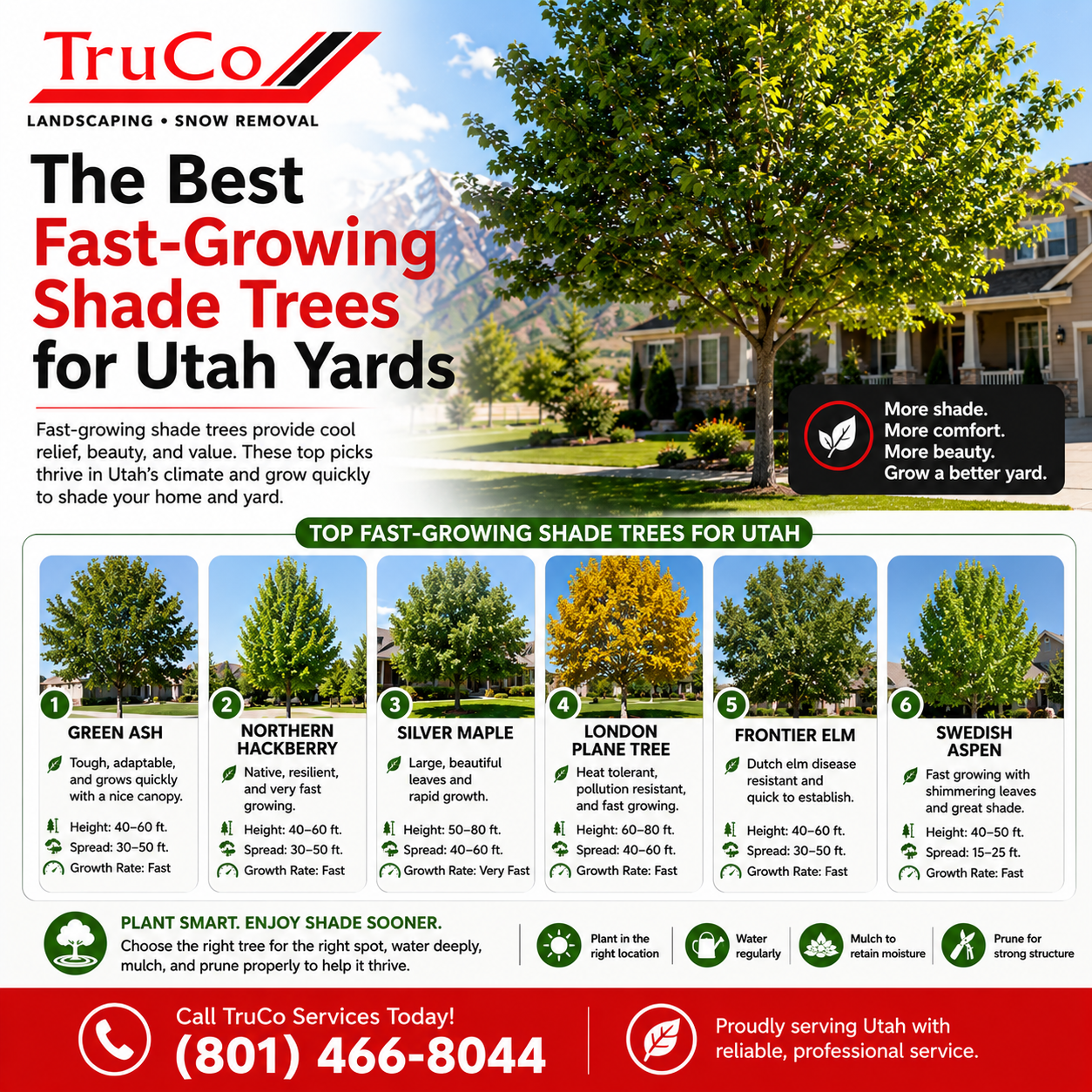
Utah's intense summer sun and high temperatures make shade trees a valuable asset. Fast-growing trees provide shade within 5-10 years rather than the 20-30 years slower-growing species require. However, fast growth often comes with trade-offs — weaker wood, shorter lifespans, and higher maintenance. This guide evaluates the best fast-growing shade trees for Utah's climate, weighing their benefits against their drawbacks, and recommending the best choices for different situations along the Wasatch Front.
Honeylocust
Thornless honeylocust is the top recommendation for fast shade in Utah. It grows 2-3 feet per year, reaching 40-60 feet with a spreading, vase-shaped crown. Its fine, bipinnately compound leaves create dappled shade that allows grass to grow underneath — a major advantage over dense-canopy trees. Honeylocust handles Utah's alkaline clay soil, drought, salt, and compacted urban conditions exceptionally well. Fall color is a clear, bright yellow. The tree has strong wood and good branch structure, making it wind-resistant. Unlike silver maple and Siberian elm, honeylocust rarely drops limbs in storms. It produces long seed pods that can be messy, but thornless and podless cultivars like 'Skyline' and 'Shademaster' minimize this issue. Honeylocust is also one of the last trees to leaf out in spring and one of the first to drop leaves in fall, which means less raking.
Northern Red Oak
Northern red oak grows 1.5-2.5 feet per year, reaching 50-70 feet with a broad, rounded crown. It offers strong wood, excellent fall color (deep red to russet), and good resistance to pests and diseases. In Utah, northern red oak tolerates alkaline soil moderately well but may develop iron chlorosis (yellowing leaves) in highly alkaline conditions. It prefers slightly acidic soil, so amending with sulfur or iron chelate may be needed. Once established, it has good drought tolerance. Northern red oak is a long-lived tree (200+ years) that provides excellent shade and wildlife value. Acorns attract deer, squirrels, and birds. It is a better long-term choice than many fast-growing trees because it combines decent growth rate with exceptional durability. Cultivars like 'Red Sunset' and 'Autumn Blaze' (a hybrid of red and silver maple, actually a maple, not an oak) are popular in Utah landscapes.
Kentucky Coffeetree
Kentucky coffeetree grows 1.5-2 feet per year, reaching 50-70 feet with an open, irregular crown. It is one of the last trees to leaf out in spring (often late May along the Wasatch Front) and one of the first to drop leaves in fall, giving it a unique appearance. The massive twice-compound leaves can reach 3 feet long, creating coarse, dramatic texture. Kentucky coffeetree handles Utah's alkaline clay, drought, cold, and urban conditions exceptionally well. It has strong wood and good wind resistance. The tree produces large woody seed pods that persist into winter, adding winter interest (female trees; male trees are pod-free). Fall color is a pleasant yellow. This is an excellent choice for Utah homeowners who want a fast-growing, tough, low-maintenance shade tree that will last for generations. It is underutilized in Utah landscapes and deserves much wider planting.
Hackberry
Hackberry grows 1.5-2 feet per year, reaching 40-60 feet with a rounded, spreading crown. It is one of the toughest trees for Utah conditions, tolerating alkaline soil, drought, wind, heat, cold, and urban pollution. The leaves are 2-5 inches long, ovate with serrated edges and a sandpaper-like texture. Hackberry produces small, dark purple berries in late summer that attract birds. Fall color is a soft yellow. The bark is distinctive — smooth grayish-brown with warty, corky ridges that become more pronounced with age. Hackberry has strong wood and good branch structure. Hackberry nipple gall (small bumps on leaves) is common but harmless. This is an excellent shade tree for Utah homeowners who want fast growth, toughness, and wildlife value. It is particularly well-suited for challenging urban sites.
Autumn Blaze Maple
Autumn Blaze maple (a hybrid of red and silver maple) grows 3-5 feet per year — one of the fastest growth rates of any shade tree. It reaches 40-50 feet with a dense, oval crown. Fall color is brilliant orange-red, often described as the best fall color of any maple. Autumn Blaze tolerates Utah's alkaline soil better than pure red maple but may still show chlorosis in highly alkaline conditions. The tree has stronger wood than silver maple but is not as strong as oak or honeylocust. In Utah, Autumn Blaze is a popular choice for newer developments in Lehi, Saratoga Springs, and Herriman. It provides fast, dense shade and spectacular fall color. However, it is a relatively short-lived tree (50-70 years) compared to oaks and honeylocust. It benefits from occasional deep watering and iron supplementation.
Catalpa
Catalpa (northern catalpa) grows 2-3 feet per year, reaching 40-60 feet with a broad, irregular crown. It produces large, heart-shaped leaves (up to 12 inches long) and showy white flower clusters in early summer. The long, bean-like seed pods (10-20 inches) persist into winter. Catalpa is extremely adaptable to Utah's alkaline soil and dry conditions. It has moderately strong wood but can be somewhat brittle. Catalpa is more of a novelty or specimen tree than a mainstream shade tree. It provides coarse, tropical-looking foliage and unique flowers. The large leaves can be messy when they drop, and the long seed pods require cleanup. Catalpa is a good choice if you want something different, but for most Utah homeowners, honeylocust, hackberry, or Kentucky coffeetree are better all-around choices.
Quaking Aspen
Quaking aspen grows 2-4 feet per year in good conditions, reaching 30-50 feet with a narrow, upright crown. Its smooth white bark and shimmering leaves provide year-round interest. Fall color is brilliant golden yellow. However, aspen is not well-suited to lower-elevation Utah landscapes. It struggles with heat stress, alkaline clay soil, and pests (borers, cytospora canker). In the hot, dry conditions of the Wasatch Front valley floor, aspens are short-lived (15-25 years) and high-maintenance. They are best reserved for higher-elevation properties (above 5,500 feet) in Park City, Heber Valley, or Mountain Green. For valley homeowners who want a fast-growing tree with white bark, river birch is a better choice.
Leyland Cypress
Leyland cypress grows 3-4 feet per year, reaching 40-60 feet with a dense, pyramidal form. It is popular as a fast-growing privacy screen. However, Leyland cypress is not well-adapted to Utah. It prefers moist, acidic soil and humid conditions — the opposite of Utah's dry, alkaline environment. In Utah, Leyland cypress suffers from drought stress, spider mites, and canker diseases. It often turns brown and dies within 5-10 years. Utah homeowners should avoid Leyland cypress and instead choose Utah-adapted evergreens like Colorado blue spruce, Austrian pine, or Rocky Mountain juniper for screening.
Making the Right Choice for Your Yard
When selecting a fast-growing shade tree for your Utah yard, consider your priorities. If you want strong wood and low maintenance, choose honeylocust, hackberry, or Kentucky coffeetree. If you want spectacular fall color, choose Autumn Blaze maple or northern red oak (with soil amendments). If you want wildlife value, choose hackberry, northern red oak, or Kentucky coffeetree. If you are planting in a challenging urban site with compacted soil and pollution, choose honeylocust or hackberry. If you want a tree that will last 100+ years, choose bur oak (slow-growing but worth the wait) or Kentucky coffeetree. Plant at least 15-20 feet from structures, water deeply during establishment, and mulch around the base. With the right choice and proper care, your fast-growing shade tree will provide decades of comfort and value.
Frequently Asked Questions
What is the fastest growing shade tree for Utah? Autumn Blaze maple and honeylocust are tied for fastest, both growing 3-5 feet per year under good conditions. Honeylocust is the better long-term choice due to stronger wood and better adaptability to Utah's soil.
Do fast-growing trees have weak wood? Many do. Silver maple, Siberian elm, and poplar are fast-growing but have weak, brittle wood that breaks easily. Honeylocust, Kentucky coffeetree, and hackberry are fast-growing but have strong wood and good branch structure.
What is the best tree for shade near a house? Honeylocust is ideal because its dappled shade allows grass to grow underneath, and its roots are less aggressive than many shade trees. Plant at least 15 feet from the foundation.
How long does it take for a fast-growing tree to provide meaningful shade? Most fast-growing trees provide significant shade within 5-8 years. Honeylocust and Autumn Blaze maple can cast enough shade to cool a patio or west-facing window within 4-5 years under good conditions.
Can I plant fast-growing trees in Utah's clay soil? Yes, but choose adapted species. Honeylocust, hackberry, Kentucky coffeetree, and catalpa all tolerate Utah's alkaline clay well. Autumn Blaze maple and northern red oak may need soil amendments to prevent chlorosis.
What fast-growing tree has the best fall color? Autumn Blaze maple has the most spectacular fall color (brilliant orange-red). Northern red oak (deep red) and Kentucky coffeetree (bright yellow) are also excellent.