
Tree Liability Laws Every Utah Homeowner Should Know

Duty of Care
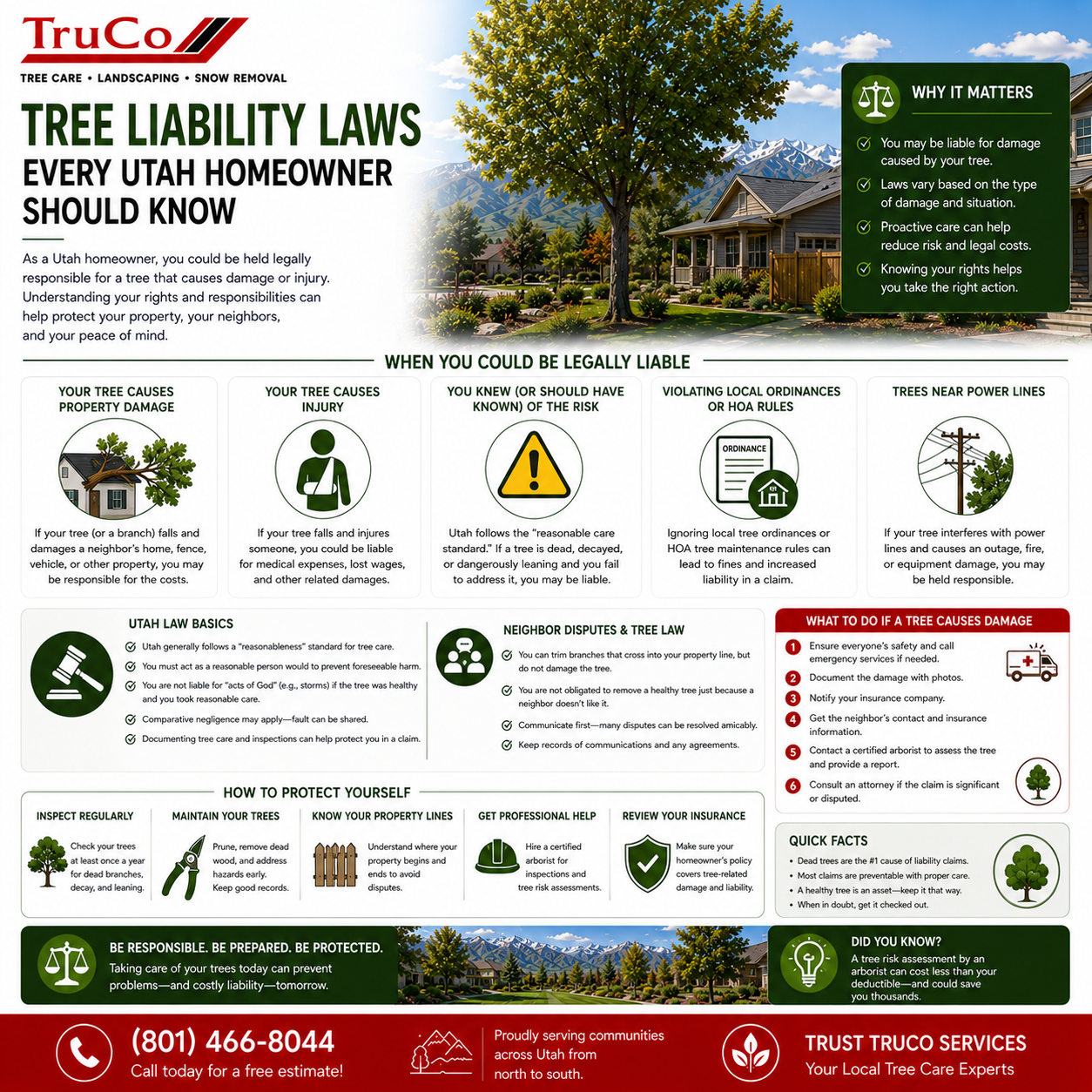
Under Utah law, every property owner must maintain trees in a reasonably safe condition. Regularly inspect for disease, decay, and structural weakness. The standard: what a reasonable person would do. In Utah, consider drought stress and heavy snow loads. Regular inspections fulfill this duty.
Premises Liability
When a tree falls and causes injury, you may face premises liability claims. Utah follows modified comparative negligence. Key factor: whether you knew or should have known about the hazard. If an arborist flagged it and you did nothing, you are likely liable. If a healthy tree fell in an unprecedented storm, you may have a viable defense.
Natural Occurrence Defense
This defense applies when a healthy tree fails due to extraordinary natural events — microbursts, straight-line winds, unprecedented snow loads. It does NOT protect you if you ignored clear warning signs. Property owners in known high-wind areas (benches of Davis and Weber counties) may be held to a higher standard.
Boundary Trees
A tree entirely on your land is your responsibility. If the trunk sits on the boundary line, it is common property — both landowners share maintenance and liability. Document agreements with neighbors about shared trees. If a boundary tree falls, Utah courts examine comparative fault of each party.
Neighbor's Tree Falls on Your Property
Healthy tree + act of nature: your insurance covers it, neighbor generally not liable. Neighbor knew tree was hazardous and failed to act: they can be held liable for negligence. Burden of proof is on you. Document conditions, send written notices, keep arborist reports. Utah's comparative fault system allows recovery even for partial negligence.
Self-Help Doctrine
You may trim branches/roots up to the property line. You cannot enter neighbor's property without permission. If your trimming damages the tree, you could be liable for up to THREE TIMES the tree's value under Utah's treble damages statute. Consult an arborist before significant trimming near property lines.
Hazardous Tree Duty
Affirmative duty to address diseased/hazardous trees. Known Utah diseases include Dutch elm disease, cytospora canker in spruce, bacterial wetwood in cottonwoods. If an arborist identifies a hazard and you fail to act in reasonable time, you may be found negligent. A tree trunk overhanging a bedroom requires immediate action.
Tree Service Liability
If a tree service negligently damages property, they and their insurance may be primarily liable. However, if you hired an unlicensed/uninsured company, you could be held personally responsible. Always hire licensed, insured companies. Retain copies of inspection reports, contracts, and insurance certificates.
Documentation Is Key
Maintain: arborist inspection reports, photographs of tree conditions, correspondence with neighbors, receipts for work, insurance policy documents. If you send written notice about a hazardous tree, keep proof of delivery. Good documentation can make the difference between a successful defense and a costly judgment.
Practical Tips
Schedule annual professional inspections. Address hazardous conditions promptly. Communicate with neighbors about shared trees. Maintain adequate liability insurance. Never do major tree work yourself (creates liability). Choose species appropriate for Utah and plant 15-20 ft from structures. Inspect after storms and document conditions.
Frequently Asked Questions
Liable if neighbor's tree falls on my house? Not typically if tree was healthy. Your insurance covers it. If neighbor knew about hazard and ignored it, they may be liable.
Can I trim neighbor's overhanging branches? Yes, at property line. Cannot enter their property. Must not damage tree health — or risk treble damages.
Notice about neighbor's hazardous tree? Document with photos, send written notice with proof of delivery. Protects you if tree later causes damage.
Do I need a permit to remove a tree? Depends on city. Salt Lake City, Holladay, Cottonwood Heights require permits for certain trees. Check local code.
Liable if branch falls on sidewalk passerby? Yes, if you knew or should have known it was hazardous. Regular inspections are your best defense.