
How to Fix a Yard That Slopes Toward the House in Utah

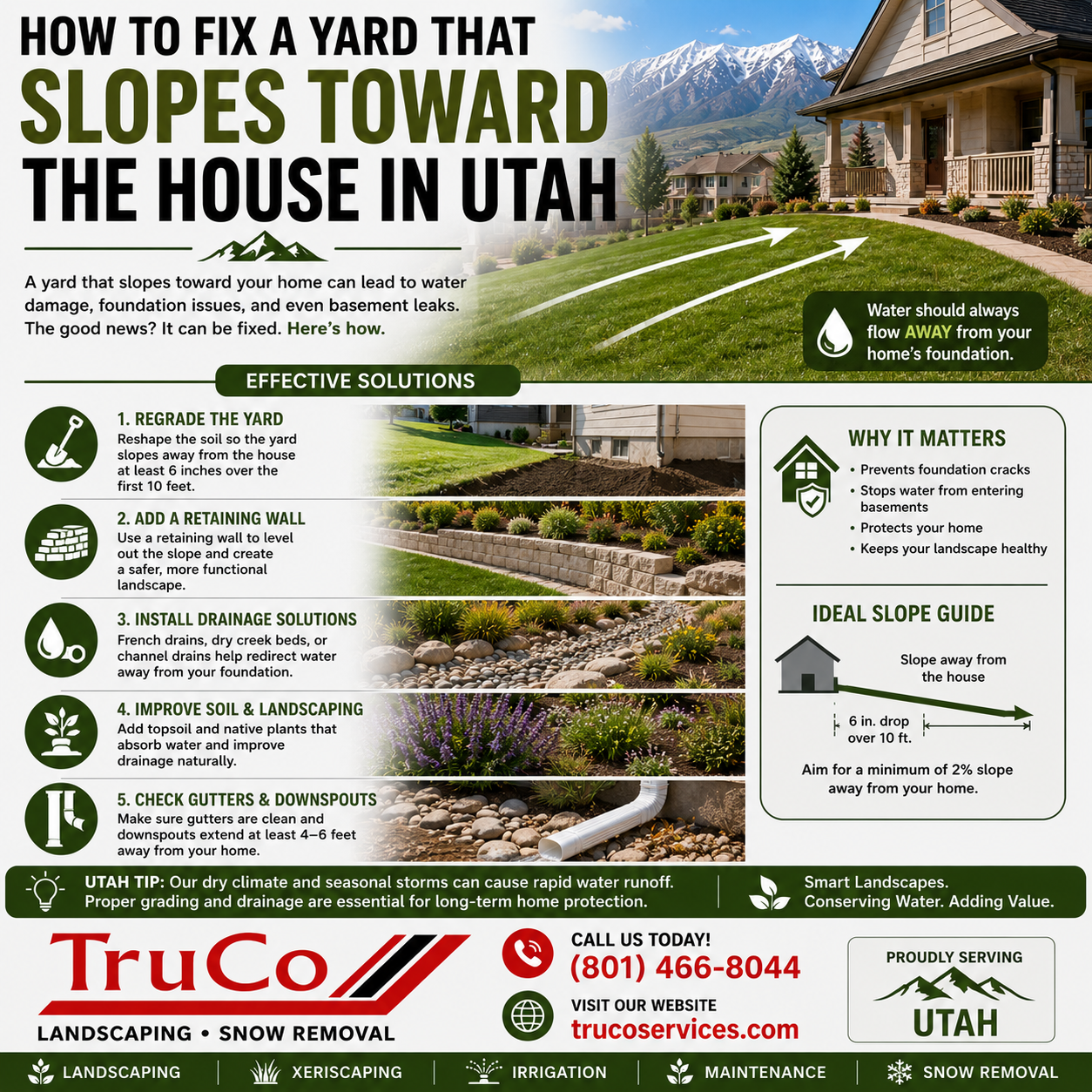
To fix a yard that slopes toward your house in Utah, regrade the soil so it slopes away from the foundation at least 6 inches over the first 10 feet, install a French drain or swale to channel water away, and add downspout extensions. For steep slopes, build a retaining wall or terrace to manage the grade.
A yard that slopes toward your house is a serious problem. Water runs downhill — straight toward your foundation. Over time, this can cause basement leaks, foundation cracks, and costly structural damage.
Here's how to fix a yard that slopes toward the house in Utah, based on what TruCo Services recommends to homeowners across the Salt Lake Valley.
Why a Sloping Yard Is a Problem
When your yard slopes toward the house, water pools against the foundation. This causes:
Basement leaks — water seeps through walls and floors
Foundation cracks — hydrostatic pressure pushes against the foundation
Soil erosion — topsoil washes away
Mold and mildew — damp conditions near the house
Costly repairs — foundation work is expensive
Fixing the slope early prevents these problems.
Step 1: Assess the Slope
First, measure how much your yard slopes toward the house. Use a level and a long straight board, or a string line. The ground should slope away from the foundation at least 6 inches over the first 10 feet.
If the slope is less than that, or if water pools near the house, you need to fix it.
Step 2: Regrade the Soil
Regrading is the most direct fix. Add soil to build up the ground near the house so it slopes away. Key points:
Slope away — at least 6 inches over the first 10 feet
Use quality fill — compacted soil that won't settle
Keep soil below siding — leave a gap to prevent moisture and pests
Compact properly — loose soil settles and reverses the slope
For small areas, you can regrade by hand. For larger yards, hire a professional with grading equipment.
Step 3: Install a French Drain
A French drain collects and redirects groundwater away from the foundation. It's a trench filled with gravel and a perforated pipe that carries water to a safe discharge point.
French drains are especially useful when regrading alone isn't enough, or when the water table is high.
Step 4: Add a Swale
A swale is a shallow, sloped channel that directs surface water away from the house. It's a low-cost, natural solution that works well for yards with moderate slope.
Plant grass or ground cover in the swale to prevent erosion.
Step 5: Extend Downspouts
Gutters and downspouts play a big role. Make sure downspouts discharge water at least 5 to 10 feet away from the foundation. Use downspout extensions or underground drains to carry water away.
Step 6: Build a Retaining Wall or Terrace
For steep slopes, a retaining wall or terrace can manage the grade. Terraces create flat, usable areas and slow water flow. Retaining walls hold back soil and redirect water.
Retaining walls require proper drainage behind them — install gravel and drainage pipe to prevent water pressure from building up.
When to Call a Professional
Call a professional if:
The slope is steep or the area is large
You have foundation cracks or basement leaks
You need heavy grading equipment
You're building a retaining wall
You're unsure about drainage design
Foundation and drainage work is too important to get wrong.
Frequently Asked Questions
Q: How much does it cost to fix a yard that slopes toward the house?
A>Expect $1,000 to $10,000 depending on the scope. Regrading is on the lower end; retaining walls and French drains cost more.
Q: How much should a yard slope away from the house?
A: The ground should slope away at least 6 inches over the first 10 feet from the foundation.
Q: Can I fix a sloping yard myself?
A: Small areas can be regraded by hand. Larger or steeper slopes need professional grading equipment and expertise.
Q: What is a French drain and do I need one?
A: A French drain is a gravel-filled trench with a pipe that redirects groundwater. You may need one if regrading alone doesn't stop water pooling.
Q: Will a retaining wall fix a sloping yard?
A: Yes. Retaining walls and terraces manage steep slopes and create usable flat areas, but they need proper drainage.
Q: How do I know if water is damaging my foundation?
A: Look for basement leaks, cracks in walls or floors, and water pooling near the house. Address these promptly.
Q: Do I need a permit for a retaining wall in Utah?
A: Many cities require permits for retaining walls over a certain height. Check with your local building department.
Q: How long does it take to fix a sloping yard?
A: Regrading takes a few days; larger projects with drains and walls can take one to three weeks.
Why Choose TruCo Services
TruCo Services fixes drainage and grading problems across the Salt Lake Valley. We regrade yards, install French drains and swales, and build retaining walls that manage water and protect foundations. Our team is licensed, insured, and local.
Get your free drainage consultation — 801-466-8044.