
How to Prevent Tree Roots from Damaging Sewer Lines in Utah

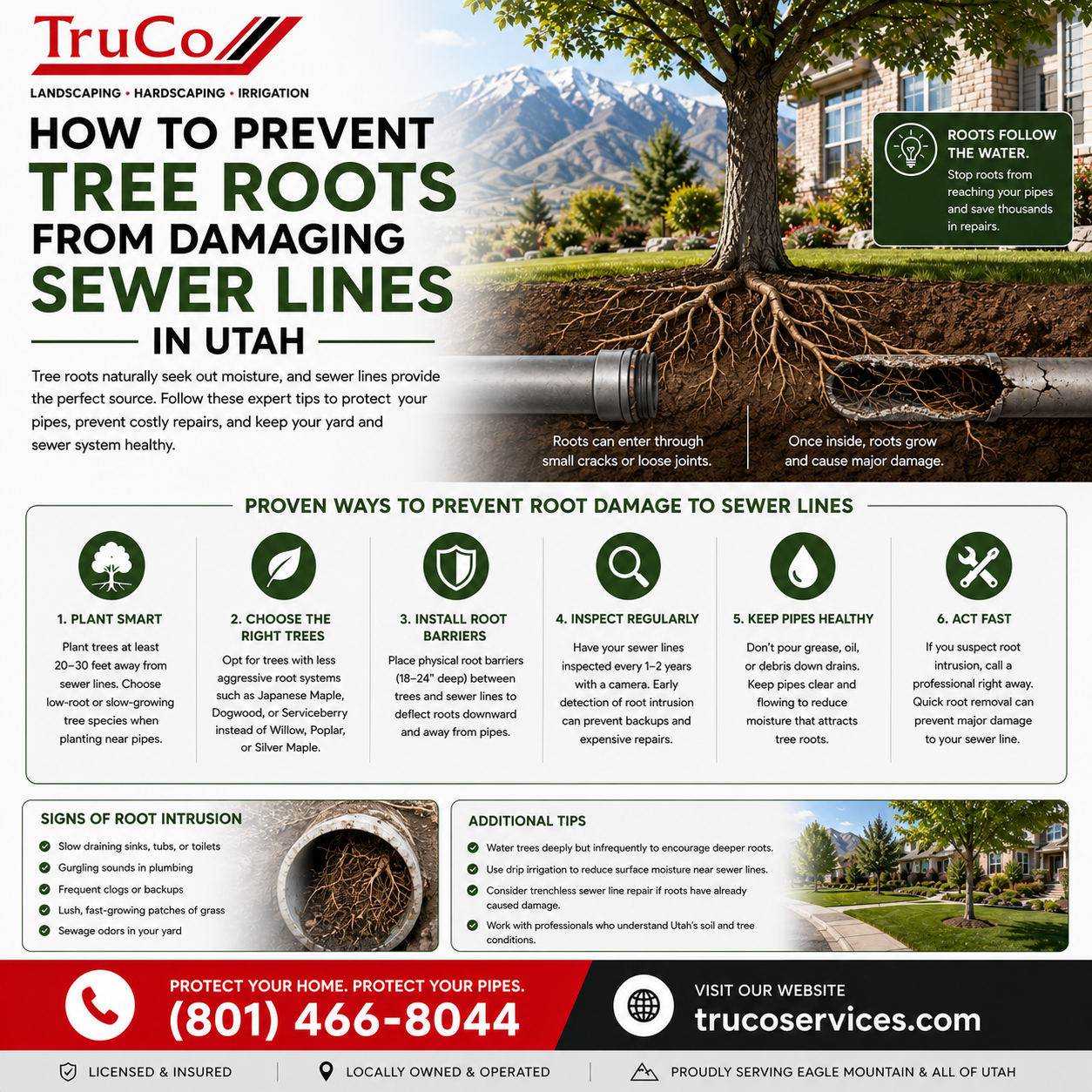
How Tree Roots Find Sewer Lines in Utah
Tree roots naturally grow toward sources of water, oxygen, and nutrients — and aging sewer lines provide all three. In Utah's dry climate, where surface moisture is limited during summer months, roots are especially motivated to seek out underground water sources. Clay soil, which dominates the Wasatch Front, cracks as it dries, creating channels that guide roots toward sewer pipes.
Older clay or cast-iron sewer pipes develop cracks and loose joints over time. Roots enter through these openings and grow inside the pipe, eventually blocking flow and causing backups. Even small hairline cracks release enough water vapor to attract roots from 20+ feet away. The most susceptible pipes are clay tile common in Utah homes built before 1970 and cast iron common in homes built 1950s-1980s.
Trees with the Most Aggressive Roots
Some trees are notorious for sewer line intrusion and should never be planted near underground utilities: silver maple (roots spread 50+ feet), cottonwood (roots actively seek water), weeping willow (roots travel long distances), poplar, box elder, American elm, and aspen (root system spreads through suckers, can extend 100+ feet). These trees should be planted at least 50 feet from any sewer line.
Trees Safe to Plant Near Sewer Lines
Japanese tree lilac, crabapple, Amur maple, serviceberry, redbud, honeylocust, and Kentucky coffeetree have less aggressive root systems. No tree is completely sewer-safe. The general rule: plant trees a distance equal to their mature height from any sewer line.
Root Barriers: Installation and Effectiveness
Root barriers redirect 80-90% of surface roots when properly installed. Install rigid HDPE or polypropylene panels 18-24 inches deep between the tree and sewer line. Overlap joints by 2-4 inches. Cost: $15-$30 per linear foot installed in Utah.
Signs of Tree Root Intrusion
Slow-draining sinks, gurgling sounds, sewage odors, lush grass growing over the sewer line, sunken or wet soil, and repeated backups are warning signs. A sewer scope inspection ($200-$500) confirms root intrusion.
Removing Roots from Sewer Pipes
Chemical root killers: Copper sulfate or RootX kill roots inside pipes without harming the tree. Treatment lasts 6-12 months.
Mechanical root removal: A plumber uses a rotating auger to cut roots from inside the pipe. Roots grow back within 6-12 months.
Hydro-jetting: High-pressure water blasts roots from pipe walls. Less damaging than mechanical cutting.
Sewer Line Repair Options
Pipe lining (CIPP): A resin liner inside the old pipe creates a smooth, jointless pipe. Roots cannot penetrate. Cost: $80-$150 per foot. Lifespan: 50+ years.
Pipe bursting: A new HDPE pipe replaces the old one. Cost: $100-$200 per foot.
Traditional excavation: Digging up and replacing the damaged section. Cost: $50-$100 per foot plus restoration.
Preventative Measures
Call 811 before digging. Plant trees at safe distances. Install root barriers at planting time. Choose trees with non-aggressive root systems. Use PVC pipe which is more root-resistant than clay or cast iron.
Frequently Asked Questions
How close to a sewer line can I plant a tree? Small trees: at least 10-15 feet. Large trees: at least 25-50 feet. The safe distance equals the tree's mature height.
Will copper sulfate kill my tree? Not if used correctly. Copper sulfate applied inside the sewer pipe kills roots inside the pipe but doesn't reach the main root system.
Do root barriers really work? Yes, for most trees. They redirect 80-90% of surface roots.
What is the best tree to plant near a sewer line? Japanese tree lilac, crabapple, serviceberry, or Amur maple.
Should I remove a tree that's damaging my sewer line? If the tree is a large, aggressive species and root intrusion is recurring, removal is often the most cost-effective solution.