
How to Protect Trees During Utah Construction Projects

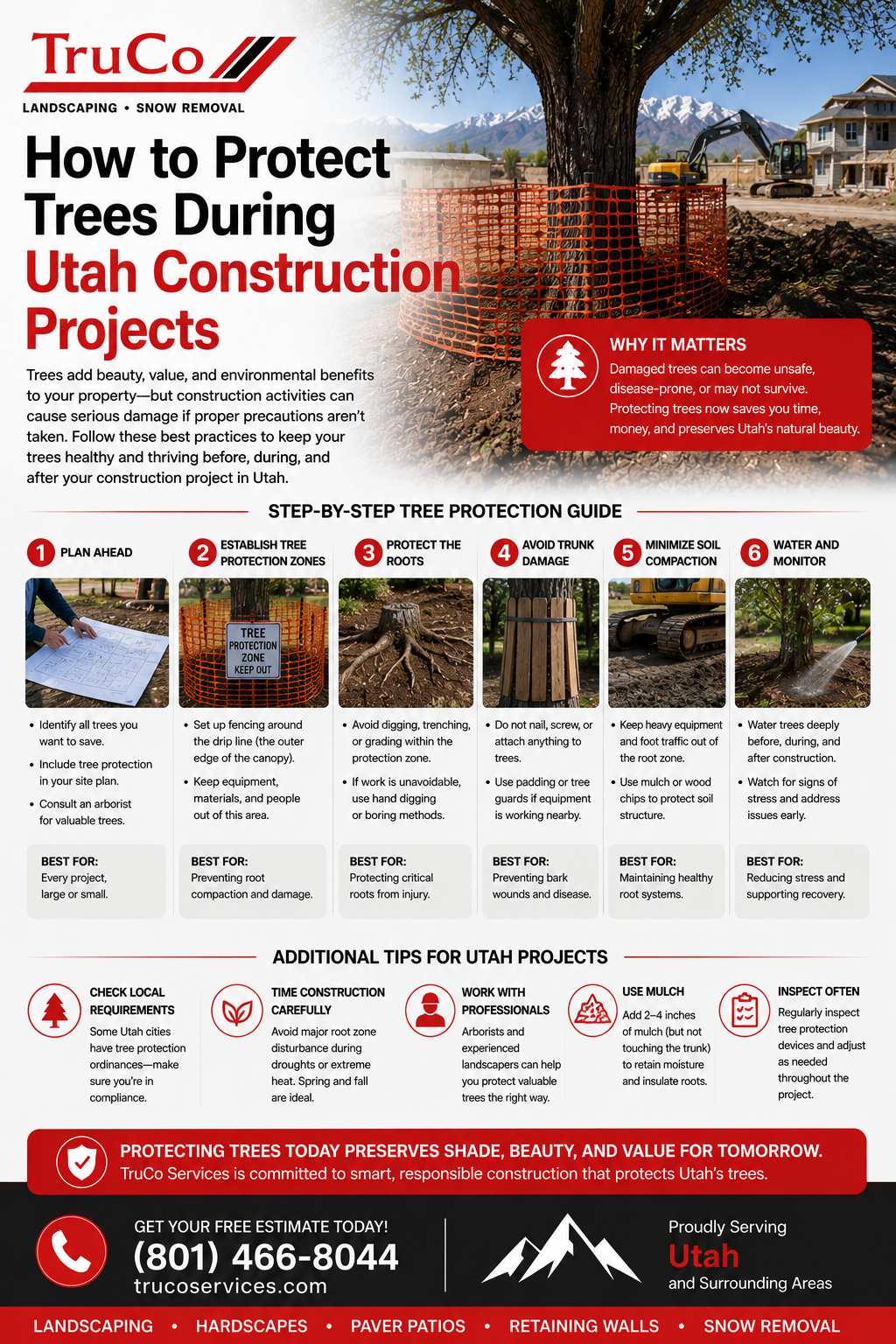
Why Construction Damages Trees
Construction activities damage trees primarily through soil compaction, root cutting, grade changes, and trunk injury. In Utah's clay soil, compaction is especially damaging because clay particles pack tightly, excluding oxygen from roots. A single pass of heavy equipment can compact soil to the point where roots cannot function. Damage often takes 2-5 years to become visible — by then, the tree is already in decline.
Understanding the Critical Root Zone
The critical root zone (CRZ) is the area around a tree that contains essential roots, generally extending to the dripline or beyond. For every inch of trunk diameter at breast height (DBH), the CRZ extends 1-1.5 feet from the trunk. A 24-inch diameter tree has a CRZ radius of 24-36 feet. Protect the entire CRZ from construction activity. Root damage within the CRZ directly reduces tree health and stability.
Establishing Tree Protection Zones
Before construction begins, install 6-foot tall chain-link fencing at the CRZ boundary. Post "Tree Protection Zone — No Entry" signs. The fenced area must be off-limits to all construction activity — no parking, storage, or traffic. Do not use trees as anchor points. In Utah, Salt Lake City requires tree protection plans for projects involving protected trees. Keep fencing in place for the entire construction duration.
Preventing Soil Compaction
Apply 6-12 inches of wood chip mulch within the CRZ before construction begins to cushion the soil. If construction traffic must cross the CRZ, use lightweight tracked equipment and plywood or steel plates to distribute weight. Aerate compacted soil after construction using an air spade or radial aeration. In Utah's clay soil, compaction damage can persist for decades without active remediation.
Protecting Roots from Trenching
When trenching for utilities, avoid the CRZ if possible. If trenching within the CRZ is unavoidable, use directional boring (tunneling) under roots instead of open trenching. Cut roots cleanly with a pruning saw — NEVER tear roots with equipment. Roots under 2 inches diameter can be cut; larger roots should be preserved if possible. Paint cut root ends with fungicide to prevent disease entry.
Grade Changes
Raising or lowering soil grade around a tree is one of the most damaging construction activities. Adding even 6 inches of fill over the CRZ can suffocate roots. Lowering grade by more than 2 inches removes feeder roots. If grade changes are necessary, install a dry well or drainage system around the tree, build a retaining wall to preserve original grade at the CRZ, and use aeration tubes to maintain oxygen exchange.
Post-Construction Tree Care
After construction: water deeply and consistently — construction-damaged trees need 20-30% more water for 2-3 years. Apply 3-4 inches of organic mulch over the CRZ. Fertilize lightly with slow-release fertilizer in spring. Monitor for signs of decline (thin canopy, small leaves, early fall color). Consult a certified arborist for a post-construction tree assessment.
FAQs
How close to a tree can construction equipment operate? At least 1-1.5 feet per inch of trunk diameter. A 12-inch tree needs 12-18 feet of clearance. Can I save a tree damaged by construction? Possibly — deep watering, mulching, and professional care can help. Severe root damage is often fatal. Do I need a permit to work near trees in Utah? Yes in some cities. Salt Lake City requires a tree protection plan. How long does construction damage take to show? 2-5 years typically. Should I remove a tree before construction? If the tree is within the building footprint or likely to sustain severe damage, removal and new planting is often the best option. What is the most common construction damage to Utah trees? Soil compaction from equipment traffic.