
What Is the Best Time to Plant Trees in Utah?

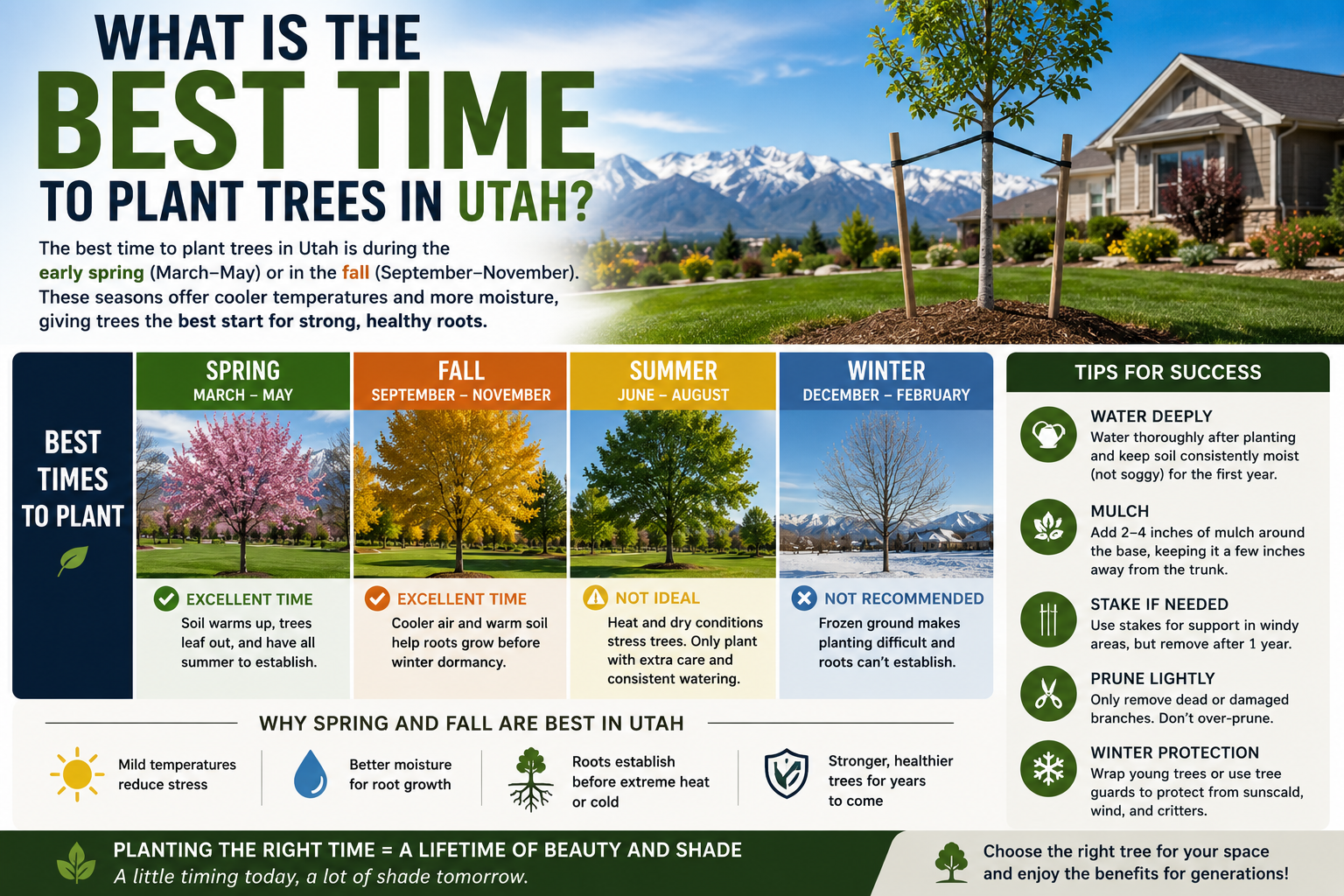
The Best Time to Plant Trees in Utah
The best time to plant trees in Utah is during the fall, from mid-September through late October, when soil temperatures are still warm but air temperatures have cooled. Fall planting gives tree roots 6-8 weeks of favorable soil conditions before the ground freezes in late November or early December. This head start allows roots to establish before winter dormancy, giving the tree a significant advantage when spring growth begins.
Spring (March through early May) is the second-best option, but comes with risks: Utah's rapidly warming temperatures (spring can jump from 50°F to 85°F in a week) stress newly planted trees, and the shorter establishment window before summer heat arrives means more intensive watering is required. Summer planting is strongly discouraged — temperatures above 90°F cause transplant shock that kills 30-50% of newly planted trees in Utah's climate.
Why Fall Is Better Than Spring
In Utah's high-elevation, semi-arid climate, fall planting consistently outperforms spring for three reasons: root development, water requirements, and pest pressure.
Root development: Soil temperatures in the 50-65°F range (September-October in most Utah valleys) are ideal for root growth. Tree roots continue growing until soil temperature drops below 40°F. A tree planted in September has 6-8 weeks of root growth before winter dormancy. Spring-planted trees face a compressed timeline — they need to establish roots AND produce leaves simultaneously, dividing energy between top growth and root development.
Water requirements: Fall-planted trees need significantly less irrigation than spring-planted trees. Cooler temperatures and lower evaporation rates mean watering 1-2 times per week versus daily watering for spring-planted trees during summer. A spring-planted tree in Utah needs 15-20 gallons of water per week through its first summer. A fall-planted tree needs the same amount but spread over more months with natural precipitation supplementing irrigation.
Pest pressure: Many of Utah's common tree pests (aphids, spider mites, scale insects) are most active from May through August. Fall-planted trees avoid peak pest season during their most vulnerable establishment period. Spring-planted trees face immediate pest pressure when they should be focusing on root development.
Planting by Tree Type
Deciduous shade trees (oak, maple, ash, linden): Plant in fall (September-October). These trees benefit most from fall planting because their large root systems need maximum establishment time. The Spacing: 30-50 feet from buildings and other trees.
Deciduous ornamental trees (flowering crabapple, serviceberry, redbud): Plant in fall or early spring. Ornamental trees are more adaptable, but fall planting still gives the best results. Avoid planting near apple or pear trees to prevent disease transfer.
Evergreen trees (spruce, fir, pine): Plant in early fall (September) or early spring (March-April). Evergreens are more sensitive to transplant shock. Fall-planted evergreens need winter wind protection — burlap wraps or anti-desiccant sprays prevent winter burn.
Fruit trees (apple, peach, cherry, pear): Plant in early spring (March-April). Fruit trees are more susceptible to winter injury than ornamental trees. Fall-planted fruit trees need extra winter protection, including trunk wraps and mulch mounds. Many Utah orchardists prefer spring planting for fruit trees despite the water demands.
Native Utah trees (Gambel oak, Rocky Mountain maple, box elder): These are most adaptable and can be planted successfully in fall, spring, or even early summer with proper irrigation. Native trees have evolved with Utah's climate patterns and establish faster than non-native species.
How to Plant a Tree in Utah
Dig a hole 2-3 times the width of the root ball but no deeper than the root ball height — planting too deep is the #1 cause of tree death in Utah. The root flare (where the trunk widens at the base) must be at or slightly above ground level. Remove all burlap, wire baskets, and twine from the root ball. Backfill with native soil — do NOT add compost or potting soil to the planting hole (this creates a "pot effect" where roots circle instead of spreading). Water thoroughly after planting to settle the soil, then apply 2-4 inches of organic mulch (wood chips, shredded bark) in a 3-foot ring around the tree — keep mulch 2-3 inches away from the trunk to prevent rot.
Tree Selection for Utah's Climate
Choose trees suited to Utah's USDA hardiness zones 4-7 (most of the Wasatch Front is zone 5-6). Select trees tolerant of alkaline soil (pH 7.5-8.5). Consider mature size — don't plant a 60-foot oak under power lines. Choose species resistant to common Utah pests like aphids, spider mites, and borers. Native and adapted species outperform exotic trees in Utah's climate.
Aftercare for Newly Planted Trees
Water deeply: 10-15 gallons per week for the first two growing seasons. Use a slow trickle from a hose or a tree watering bag (Gator Bag style). Check soil moisture 4-6 inches deep — water when the soil feels dry at that depth. Adjust watering based on temperature: every 5-7 days in spring/fall, every 3-4 days in summer heat. Stake only if necessary — trees that sway in the wind develop stronger trunks and root systems. Remove stakes after the first growing season. Apply fresh mulch annually in spring. Protect the trunk from sun scald with white tree wrap on the south and west sides during the first two winters. Do not fertilize for the first year — the tree needs to establish roots, not push foliage.
Frequently Asked Questions
Can I plant trees in summer in Utah? Summer planting is risky but possible with daily watering and shade protection. Expect 30-50% mortality for summer-planted trees. Fall or spring is strongly recommended.
How late in fall can I plant trees in Utah? Through late October in the Salt Lake Valley, mid-October in higher elevations (Park City, Heber Valley). Plant at least 4-6 weeks before the first hard freeze (soil temperature below 40°F).
How early in spring can I plant trees in Utah? As soon as the ground thaws — typically mid-March in the Salt Lake Valley, early April in mountain valleys. Soil should be workable, not muddy.
Do I need to water trees in winter in Utah? Yes, especially during dry winters. Water 1-2 times per month on days when temperatures are above 40°F and the ground isn't frozen. Deep watering prevents winter desiccation — a leading cause of evergreen browning.
Should I amend the soil when planting trees in Utah? No. Use native soil for backfill. Amending the planting hole with compost or potting soil creates a "pot effect" where roots circle the amended area instead of spreading into surrounding soil.
How do I protect newly planted trees from Utah winter? Apply 2-4 inches of mulch around the root zone (keep away from trunk). Wrap trunks with white tree wrap from base to first branches. Water deeply before the ground freezes. For evergreens, apply anti-desiccant spray in November and February. Install wind barriers for exposed sites.
What is the fastest-growing shade tree for Utah? Hybrid poplar grows 5-8 feet per year but has weak wood. Autumn Blaze maple grows 3-5 feet per year with stronger wood and better fall color. Silver linden and Kentucky coffeetree grow 2-3 feet per year with excellent durability.
Can I plant trees in clay soil in Utah? Yes, but amend the planting site by breaking up the clay in a 3-5 foot radius and consider a raised planting mound for better drainage. Choose trees tolerant of clay soils: bur oak, linden, serviceberry, and most native species.