
How to Start Up Your Sprinkler System in Spring in Utah

Why Spring Sprinkler Startup Matters in Utah
Starting your sprinkler system correctly in spring is one of the most important lawn care tasks in Utah — and one of the most commonly botched. In Utah, irrigation systems are winterized each fall (blown out with compressed air) to prevent freeze damage to pipes, valves, and heads. In spring, the system must be carefully brought back online. Doing it wrong can cause damage: turning on the water too fast can burst pipes and blow fittings, debris in the lines can clog heads, and a system left off too long leaves Utah lawns dry during the critical spring green-up. In Utah, the right time to start your sprinkler system is typically mid-April to early May, when nighttime temperatures stay consistently above freezing and grass begins actively growing. Starting too early wastes water (lawns don't need it in cold soil) and risks damage if a late freeze hits; starting too late stresses the lawn. The spring startup also uncovers winter damage — cracked heads, chewed wires (Utah's voles and gophers love sprinkler wire), and frozen valves — before the hot summer season. A proper spring startup takes about 30-60 minutes for a typical Utah home system. TruCo Services offers professional sprinkler startup, inspection, and repair services across the Wasatch Front.
When to Turn On Your Sprinkler System in Utah
Timing the spring startup correctly protects your system and lawn in Utah. General timing: mid-April to early May for most of Utah's valleys (Salt Lake, Utah County, Weber). In higher elevations (Park City, Heber, mountain valleys), wait until late May. In southern Utah (St. George, Washington County), systems can start as early as late February or March. Nighttime temperature rule: wait until nighttime temperatures stay above 32 degrees Fahrenheit consistently for a week before turning on the system. A late freeze can damage above-ground components and newly pressurized pipes. Lawn activity rule: start the system when grass begins actively greening and growing — usually when soil temperatures reach about 50 degrees. In Utah, lawns typically start growing in mid-April in the valleys. Watch the forecast: in Utah, late-spring frosts are common — if a hard freeze is forecast after you've started the system, you can run the system to protect plants (irrigation before a freeze raises soil temperature) or simply wait to start. Blowout vs. gravity drain: if you winterized with an air compressor (blowout, the standard in Utah), the spring startup is simple — open the main valve slowly and pressurize. If you used a gravity drain system (drain valves at low points), close those valves first. In Utah, most professional installations use blowout winterization, making spring startup straightforward. Marker flags: if you had the lines marked during winterization or had repairs, use the flags to locate valve boxes. In Utah, snow removal and plowing can bury or damage valve boxes — locate them in spring before startup.
Step-by-Step Spring Sprinkler Startup for Utah
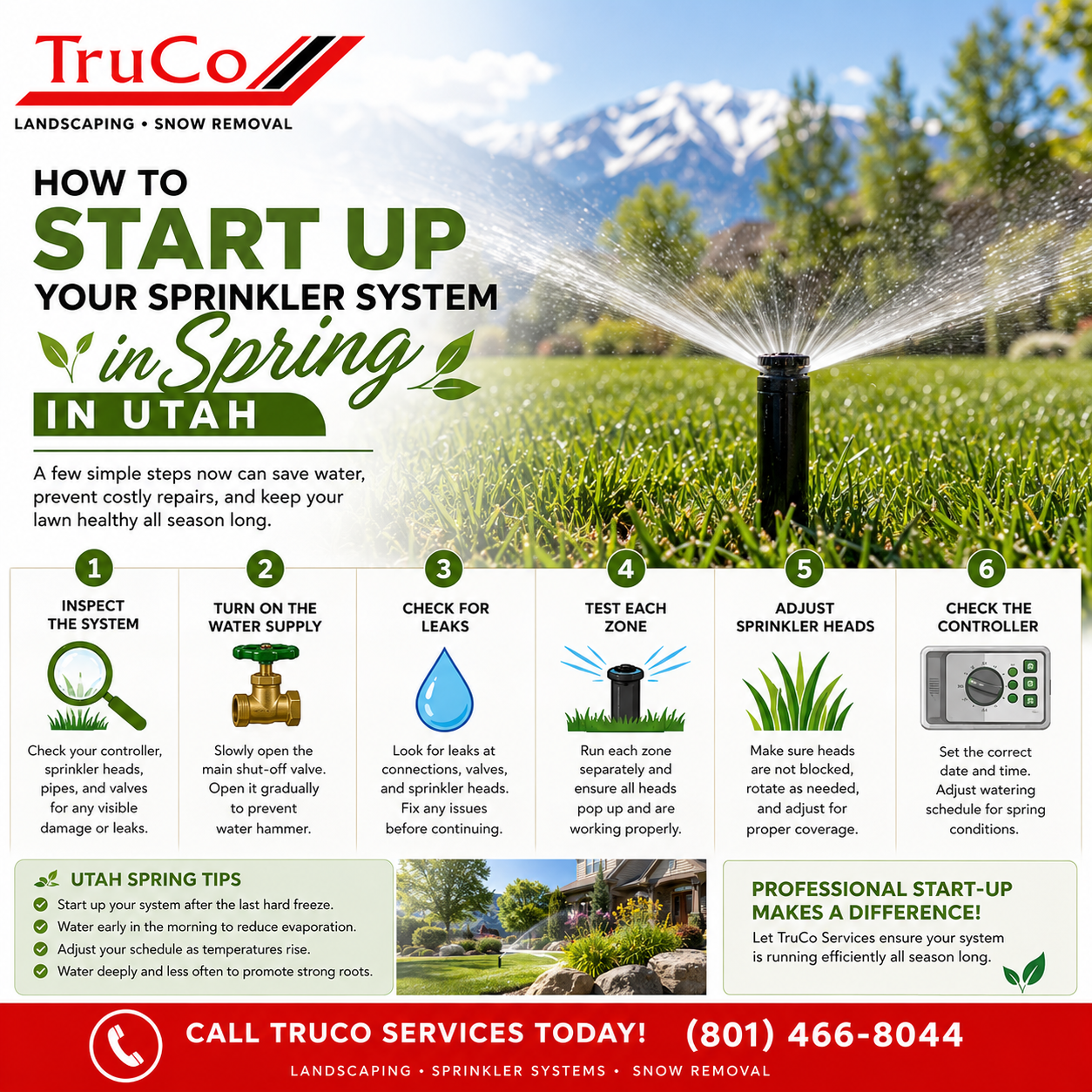
Follow these steps for a safe sprinkler startup in Utah. Step 1: Inspect the system — walk the yard and check for visible damage: cracked or broken heads, heads pushed up by frost heave, sunken or tilted heads, and chewed wires. In Utah, frost heave lifts heads and breaks risers — common after winter. Step 2: Check the backflow preventer — inspect the double-check or reduced-pressure (RP) device for freeze damage. In Utah, a cracked backflow preventer must be replaced before pressurizing (it will leak or fail inspection). Step 3: Open the main shutoff valve slowly — never open it full-blast. In Utah, opening slowly lets air escape gradually and prevents water hammer that can burst fittings. Step 4: Fill the system gradually — open the main valve halfway, let the system fill for a few minutes, then open fully. This purges air slowly. Step 5: Check the backflow device operation — after filling, verify the backflow preventer operates correctly (test cocks, check valves). Step 6: Turn on each zone manually — at the controller, run each zone for 2-5 minutes. Watch each zone for: heads that don't pop up, heads spraying wrong (broken nozzles), low pressure (possible leak or closed valve), and geysers (broken pipe or fitting). Step 7: Inspect and adjust heads — clean debris from heads, adjust spray patterns, and replace damaged heads. In Utah, replace broken heads with the same make/model for consistent coverage. Step 8: Check for leaks — while zones run, look for soggy spots, water bubbling up, or pooling, which indicate underground leaks. In Utah, walk the yard while each zone runs. Step 9: Program the controller — set the season's watering schedule. In Utah, start with 2-3 days per week and adjust. Step 10: Monitor the first week — check for dry or flooded areas and adjust. In Utah, the first week after startup reveals most issues.
Common Spring Startup Problems in Utah
Be prepared for these common issues when starting sprinklers in Utah. Frost-heaved heads: heads pushed up above grade by winter freeze-thaw. In Utah, this is the most common spring issue — reset heads to grade or replace broken risers. Chewed wires: voles, gophers, and mice chew sprinkler wire over winter, causing zones to not turn on. In Utah, check valve box wiring; repair with waterproof connectors. In Utah, voles are especially active in winter snow cover. Cracked or broken heads: heads cracked by ice, mowers, or foot traffic. In Utah, replace heads — they're inexpensive and quick to swap. Frozen or stuck valves: a valve that won't open, or a zone that runs continuously. In Utah, open the valve's bleed screw to test manually; replace the solenoid or diaphragm if needed. Backflow preventer leaks: if the backflow device leaks at startup, it likely has internal freeze damage. In Utah, a damaged backflow preventer must be repaired or replaced by a licensed professional to meet code. Low pressure on one zone: indicates a partially closed valve, a leak, or a broken line. In Utah, check the zone valve and look for wet spots. Geysers or standing water: a broken pipe or fitting — common where pipes were not fully blown out or where ground shifted. In Utah, mark the leak and call a professional for repair. Zone won't turn on: check the controller (dead battery or programming), the wiring, and the valve. In Utah, many "dead zones" are simply controller batteries that died over winter. If you discover significant damage or recurring problems, professional help saves time and water — TruCo Services provides complete sprinkler startup and repair in Utah.
When to Call a Professional in Utah
Some sprinkler startup tasks are best left to professionals in Utah. Backflow preventer certification: Utah law (and most cities, including Salt Lake City, Sandy, and Orem) requires annual backflow testing by a certified tester. In Utah, hire a licensed professional for backflow testing and repair. Underground leaks: if you suspect a buried line leak (soggy spots, high water bill), professional leak detection saves water and avoids digging. In Utah, pros use electronic locators to find leaks quickly. Major freeze damage: if multiple heads are broken or pipes froze, professional repair ensures the system is done right. In Utah, winter damage can be extensive. Controller replacement or complex programming: smart controllers and Wi-Fi systems benefit from professional setup. In Utah, many homeowners upgrade to smart irrigation (eligible for water rebates). Large or complex systems: homes with many zones, drip systems, or specialty zones benefit from professional startup. In Utah, commercial properties require professional service. If you're short on time: a professional spring startup takes 30-60 minutes and includes a full inspection, head adjustment, and schedule programming. In Utah, spring startup packages typically cost $75-150 for residential systems. Regular maintenance saves money: catching problems in spring prevents costly summer failures and wasted water. In Utah's drought-conscious communities, efficient irrigation matters — a well-maintained system uses 20-30% less water. TruCo Services offers professional sprinkler startup, repair, and smart irrigation installation throughout Utah.
Frequently Asked Questions
When should I turn on my sprinklers in Utah? Mid-April to early May in the valleys (Salt Lake, Utah County), late May in mountain areas, and February-March in southern Utah. Wait until nighttime temperatures stay above freezing for a week and the lawn begins greening.
How do I start my sprinkler system in spring in Utah? Inspect heads and backflow preventer for winter damage, open the main valve slowly to fill the system, run each zone manually for 2-5 minutes to check coverage and leaks, adjust heads, and program the controller for the season.
Why isn't one of my sprinkler zones turning on in Utah? Most common causes: a dead controller battery, chewed wiring (Utah voles and gophers eat sprinkler wire over winter), a stuck or frozen valve, or a failed solenoid. Check the battery first, then wiring and valve.
Do I need backflow testing in Utah? Yes — Utah law requires annual backflow preventer testing by a certified tester for irrigation systems connected to culinary water. Most Utah cities enforce this. Hire a licensed professional for testing and any needed repairs.
What happens if I turn my sprinklers on too early in Utah? You risk freeze damage if a late frost hits (above-ground components and shallow pipes can crack), waste water on dormant lawns, and can mask real spring issues. Starting mid-April to early May in most Utah valleys is ideal.
Smart Irrigation Controllers and Utah Water Rebates
Upgrading to a smart irrigation controller is one of the smartest investments for Utah homeowners — and many Utah water districts offer rebates that reduce the cost. Smart controllers connect to Wi-Fi and automatically adjust watering based on local weather, soil type, plant needs, and evapotranspiration (ET) data. In Utah's arid climate, where water conservation is a priority, smart controllers can reduce outdoor water use by 20-30% — a significant savings on summer water bills. Utah's water districts, including the Utah Division of Water Resources, Jordan Valley Water Conservancy District, Weber Basin, and Washington County Water Conservancy District, offer rebates of $50-150 or more for qualifying smart controllers. Requirements vary by district — most require a WaterSense-certified or EPA-labeled controller and proof of purchase. Popular smart controllers for Utah: Rachio (very popular in Utah, Wi-Fi, easy app), Hunter Hydrawise (robust, professional-grade), Orbit B-hyve, and Rain Bird. In Utah, smart controllers also comply with mandatory watering schedules — many Utah cities enforce watering days during summer, and smart controllers can be programmed to match them. Smart controllers adjust watering for rain (skipping cycles automatically), temperature spikes, and seasonal changes. They also detect flow anomalies — alerting you to leaks. In Utah, pairing a smart controller with a professional spring startup ensures your system is ready for the season and optimized for efficiency. Many Utah cities require backflow testing annually, and smart controllers help track and document water use. If you're upgrading, check your local district's rebate program first — in Utah, rebates make smart controllers affordable.
Summer Sprinkler Maintenance Tips for Utah
Keeping your sprinkler system tuned through Utah's hot summer prevents waste and costly failures. Adjust watering schedules monthly: in Utah, watering needs change through the season — lawns need more water in July and August (peak heat) and less in spring and fall. Adjust your controller monthly. In Utah, follow any city watering restrictions (odd/even schedules). Watch for signs of trouble: soggy spots (leak), dry brown patches (clogged head or coverage gap), low pressure, and heads spraying onto sidewalks or driveways (waste). In Utah, inspect heads monthly — adjust spray patterns so water hits the lawn, not pavement. Clean filters and screens: clogged filters reduce pressure and coverage. In Utah, mineral deposits from hard water clog filters — clean them monthly in summer. Check for leaks: a sudden jump in your Utah water bill or a persistently wet spot indicates an underground leak. In Utah, leaks waste precious water — repair promptly. In Utah, check sprinkler heads after mowing — mowers damage heads; replace broken heads promptly. In Utah, deep, infrequent watering (1-1.5 inches per week in 2-3 sessions) is the standard — frequent shallow watering promotes shallow roots and disease. In Utah, water early morning (4-6 AM) to minimize evaporation and wind drift. In Utah, monitor your lawn's response — adjust watering based on grass color and footprint recovery. In Utah, consider adding drip irrigation for flower beds and shrubs — it's far more efficient than spray heads. In Utah, a well-maintained system uses 20-30% less water. If you notice persistent problems, TruCo Services provides sprinkler repair and maintenance across Utah.Does Utah offer rebates for smart irrigation controllers? Yes — many Utah water districts (Utah Division of Water Resources, Jordan Valley, Weber Basin, Washington County) offer rebates of $50-150 for WaterSense-certified smart controllers. Check your local district's program before purchasing.
How often should I water my lawn in Utah in summer? Most Utah lawns need 1-1.5 inches of water per week, delivered in 2-3 deep waterings. In July and August peak heat, you may need slightly more. Water early morning (4-6 AM) to reduce evaporation and follow any city watering restrictions.
Why is my Utah water bill so high in summer? Outdoor irrigation typically accounts for 50-60% of Utah summer water use. Common culprits: leaks, misaligned heads spraying pavement, overwatering, and no smart controller. A professional audit and smart controller can cut outdoor use 20-30%.