
Provo UT Permanent Christmas Lights

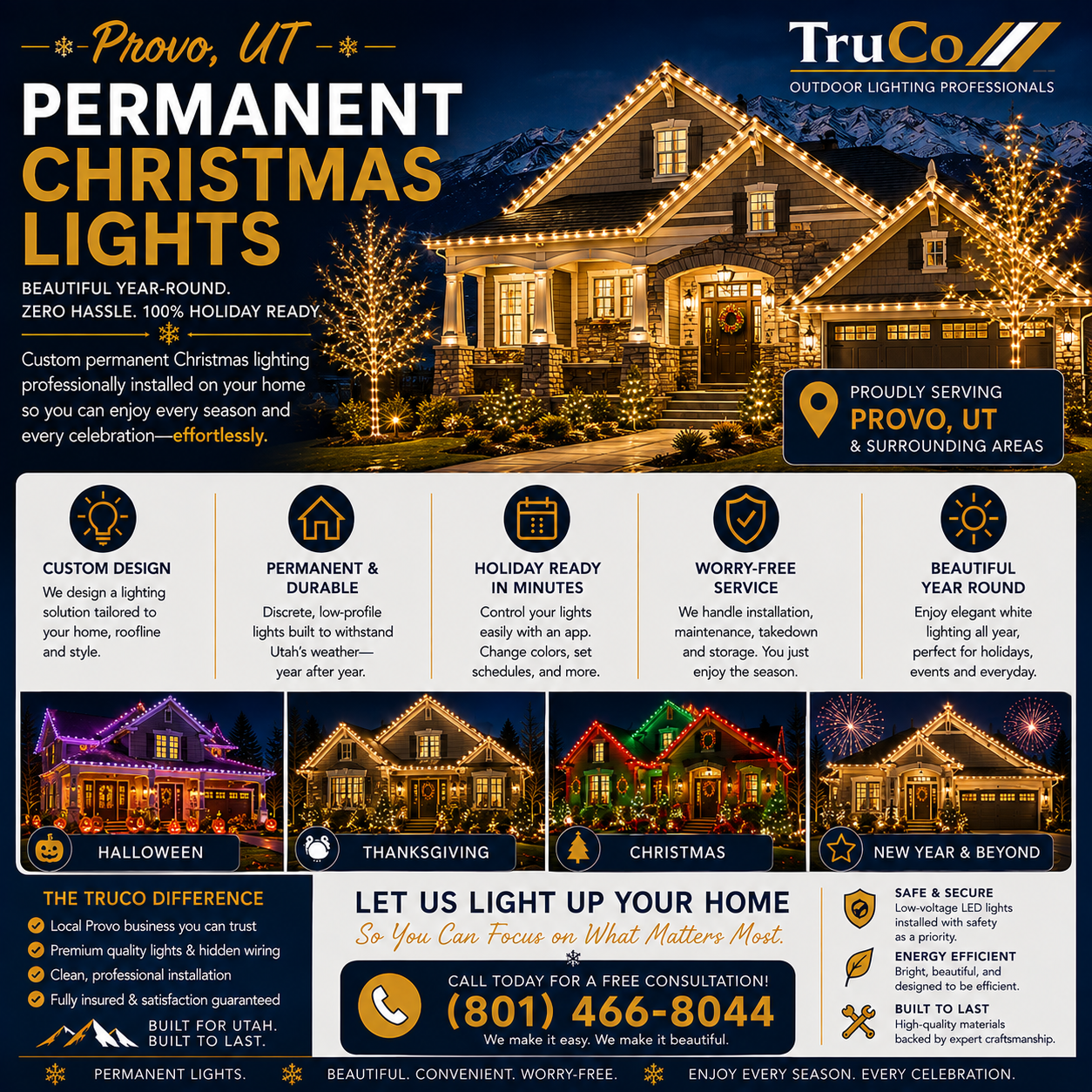
Permanent Christmas lights in Provo, UT are low-profile, professionally installed LED lighting systems that remain on a home year-round while changing colors, brightness, schedules, and patterns for Christmas, Halloween, game days, birthdays, warm-white accent lighting, and other events. They can create a polished roofline display without the annual ladder work, tangled cords, storage bins, and seasonal installation cycle that come with traditional Christmas lights.
The key takeaway is that permanent holiday lighting is a long-term exterior and electrical project—not just a holiday decoration. The best results depend on a thoughtful roofline design, durable outdoor-rated components, safe power, correct mounting, responsible brightness settings, easy-to-use controls, and a clear plan for service if something eventually fails. Provo homeowners should also think about weather exposure, roof and gutter condition, electrical-permit requirements when circuits are altered, potential HOA approval, and recently updated outdoor-lighting expectations.
This guide explains how Provo UT permanent Christmas lights work, the major choices available, what can go wrong, how to avoid costly mistakes, and how experienced help can make the installation safer, cleaner, and easier to enjoy for years.
What Are Provo UT Permanent Christmas Lights?
Provo UT permanent Christmas lights are programmable exterior LED lighting systems designed to stay installed on a home’s roofline, fascia, soffits, gables, garage peaks, porch trim, patios, or other architectural features. The lights remain in place through every season, but the homeowner can change the display using a mobile app, remote, timer, controller, or smart-home-compatible system.
They are often described using related search terms such as:
Permanent outdoor Christmas lights in Provo
Provo permanent holiday lights
Permanent roofline lighting
Year-round LED Christmas lights
Smart exterior LED lights
App-controlled holiday lighting
Permanent LED trim lights
Architectural roofline lighting
Custom Christmas light installation in Provo, UT
A complete permanent lighting system normally includes individual LED lights, a mounting track or channel, wiring, weather-protected connectors, power equipment, a controller, and app-based controls. Some systems are designed for multicolor holiday effects, while others combine holiday colors with warm-white everyday architectural lighting.
The usual process looks like this:
A provider evaluates the roofline, trim, soffits, gutters, power location, access, and visible elevations.
The lighting layout is designed around the home’s architecture.
The system, track color, controller location, lighting zones, and power plan are selected.
Any needed electrical work, permits, or inspections are identified.
The lights, track, wiring, controller, and power equipment are installed.
Every section is tested for power, color, app response, and scheduling.
The homeowner receives a walkthrough covering app use, presets, schedules, brightness, and basic troubleshooting.
For example, a Provo homeowner may use soft warm white lights on low brightness for everyday curb appeal, switch to red and green for December, use orange and purple in October, and create school-color scenes for a graduation or game day. The installed system stays in place; only the programming changes.
A proposal should clearly separate what is included from what is not. New exterior outlets, circuit changes, permit fees, roof repairs, fascia replacement, gutter work, removal for future roofing, and post-warranty service may be separate items.
8 Key Things to Know About Permanent Christmas Lights
1. The lighting layout matters as much as the equipment
A permanent Christmas light system is only as attractive as its design. The LEDs may be excellent, but poor spacing, inconsistent angles, awkward transitions, exposed wiring, or mismatched track color can make the finished project look improvised.
Every home is different. A single-story home may have one long roofline and a garage peak. A larger two-story home may include multiple gables, porch roofs, dormers, upper rooflines, side returns, and patio areas. Each feature needs a decision: light it, leave it dark, create a separate zone, or connect it visually to another roofline.
Before work begins, homeowners should understand:
Exactly which rooflines will receive lights
Where lighting will start and stop
How corners, gables, and peaks will be handled
Whether the garage, porch, front elevation, sides, and rear areas are included
Where visible transitions will occur
How the track or channel will blend with the trim
Where wires will run
Whether separate sections can be controlled independently
The phrase “full house lighting” is too vague by itself. One provider may mean only the front roofline, while another may include garage peaks, porches, sides, and patio areas. Ask for a marked-up photo, drawing, or written scope showing the exact locations.
A good permanent roofline lighting design looks intentional during the day and balanced at night. It avoids dark gaps, overly dense sections, crooked runs, and lights that seem to stop randomly at architectural transitions.
2. Provo weather requires durable materials and correct installation
Permanent outdoor Christmas lights in Provo must handle snow, rain, wind, UV exposure, summer heat, winter cold, roof runoff, dust, ice, and repeated temperature changes. A system that works for one holiday season is not necessarily built to remain reliable for years.
Weather affects more than the LED bulbs. It can affect the mounting channel, connectors, wire insulation, controller enclosure, power supply, fasteners, and the exterior materials holding the system in place.
Common weather-related failures include:
Water intrusion at poorly protected connections
Loose tracks or fasteners after freeze-thaw cycles
Sun-faded or brittle plastic components
Wires damaged by UV exposure or physical movement
Moisture entering improperly placed controllers
Ice and snow putting stress on roof-edge components
Wind pulling on unsupported wire runs
Loose fascia or soffit material shifting under the installation
The right solution is a complete weather-resistance plan. Ask how wiring will be routed and protected, how outdoor connections will be enclosed, where the controller will be mounted, and how the installation accounts for roof runoff and snowmelt.
For example, a controller placed directly where melting snow repeatedly drips from a roof edge may have a shorter useful life than one located in a protected, accessible position. Similarly, a wire hidden neatly under appropriate trim protection is less vulnerable than one loosely exposed across an exterior surface.
A provider should explain how future service works after winter. Electronic lighting systems may eventually need troubleshooting, so choose an installation approach that allows practical access to components.
3. Safe electrical planning is essential
Permanent lighting needs a reliable, suitable power source. It should not rely on a power strip inside a garage, an indoor outlet through a window, a permanently exposed extension cord, or an overloaded outdoor receptacle.
In Provo, the Building Division provides permitting and inspection services for electrical installation or replacement work, and homeowners can apply for permits and schedule required inspections through the city. Whether a specific permanent lighting project needs a permit depends on its scope—particularly whether it involves a new outlet, new circuit, altered wiring, service equipment, or other electrical changes.
The safest approach is to identify the electrical plan before installation. Confirm:
Which outlet or circuit will supply power
Whether the outdoor receptacle has appropriate GFCI protection
Whether the existing circuit has enough capacity
Whether a dedicated outlet or circuit is needed
Where the controller and power supply will be located
How wiring will be protected from moisture and physical damage
Whether a permit or inspection is required
Who is responsible for any electrical work and city coordination
Outdoor receptacles commonly require GFCI protection because outdoor conditions create greater exposure to water and moisture. A GFCI is designed to interrupt power quickly when it senses an imbalance that could indicate a ground fault.
Do not repeatedly reset a breaker that trips after lights are turned on. A recurring trip can signal an overload, damaged wire, water intrusion, faulty component, or other electrical issue. Turn off the system and arrange for a proper evaluation instead of treating the breaker reset as a fix.
4. “Permanent” should still mean serviceable
No electronic product is guaranteed to operate forever without service. Even a high-quality permanent LED system can eventually experience a damaged light, failed controller, broken connection, failed power supply, software issue, Wi-Fi change, or physical damage from exterior work.
The question is not whether a permanent lighting system can ever need repair. The important question is whether the system is designed and supported in a way that makes repair realistic.
Before you buy, ask:
What happens if one light fails?
Can individual sections be tested and replaced?
Does a single failed component affect an entire roofline zone?
How are controllers and power supplies replaced?
Are parts readily available?
Who performs repair work after the installation?
Does the warranty cover parts, labor, diagnostics, travel, and ladder access?
Can the system be expanded later?
What happens when you replace your roof, gutters, fascia, or siding?
A good provider should be willing to explain the service process before you sign a contract. If the answer is vague—such as “we’ll figure it out later”—you may have difficulty obtaining support when something goes wrong.
For instance, if a garage section stops responding, the cause could be a faulty LED, connection failure, damaged wire, power issue, controller issue, or programming setting. A professional diagnosis should isolate the source before parts are replaced. Guessing can create unnecessary expense.
5. Light brightness and direction affect neighbors and safety
Permanent holiday lights can be festive and attractive without being excessively bright. The ability to choose millions of colors and animated effects can tempt homeowners to operate the system at maximum brightness or to use fast flashing patterns every night. That is rarely necessary and can create glare, distract drivers, or disturb nearby residents.
Provo recently approved updated dark-sky lighting rules requiring new and replacement outdoor fixtures to meet limits on color temperature and shielding, while making exceptions for holiday lights and certain temporary or special-use lighting. The city’s updated approach reflects a broader goal of reducing glare and unnecessary night-sky impacts.
Even where holiday-light exceptions apply, homeowners should use good lighting judgment:
Use lower brightness for routine nightly displays
Program automatic shutoff times
Avoid strobe effects near streets, intersections, and neighbors’ windows
Point and position lighting to emphasize the home, not the roadway
Use warm-white or subtle color scenes for everyday use
Reserve high-energy animations for holidays and short celebrations
Check HOA rules before installation and before highly visible displays
A tasteful display is usually more appealing than the brightest display on the block. Consistent spacing, moderate brightness, and sensible timing often produce a more polished look while reducing the chance of complaints.
6. App controls should be practical, not just impressive
Smart controls are one of the biggest advantages of permanent roofline lights. A mobile app may allow you to set colors, choose pre-built holiday scenes, create custom patterns, divide the home into zones, adjust brightness, and schedule automatic operation.
But the best app is the one your household can actually use without frustration.
Before choosing a system, ask:
Does it use Wi-Fi, Bluetooth, a local controller, cloud access, or a combination?
Can the lights operate if the internet is temporarily down?
What happens if you change Wi-Fi passwords or install a new router?
Can more than one household member access the system?
Can you set recurring daily schedules?
Can you independently adjust brightness?
Can you save favorite scenes?
Are presets available for Christmas, Halloween, everyday warm white, and other holidays?
Will the installer teach you how to use the app on your own phone?
Is support available if you change phones or need to reconnect?
During the final walkthrough, do not simply watch the installer demonstrate the app. Use your own phone. Turn the lights on and off, select a preset, adjust the brightness, change a zone, and set a schedule. This is the time to find out if anything needs adjustment.
Advanced effects are nice, but daily usability matters more. A homeowner should be able to set a simple warm-white evening schedule just as easily as a multicolor Christmas pattern.
7. The condition of your exterior can determine the outcome
Permanent lighting attaches to the house. That means the condition of your fascia, soffits, gutters, siding, roof edges, trim, and exterior paint directly affects the installation.
Before lights are installed, inspect for:
Rotting or loose fascia boards
Sagging or leaking gutters
Loose or damaged soffit panels
Peeling or deteriorated trim paint
Roof-edge leaks or known ice-dam problems
Damaged siding
Existing exposed or deteriorated wiring
Areas likely to need repair soon
Upcoming roof, gutter, siding, or painting projects
Installing lights over damaged materials can create added expense later. If a fascia board needs replacement, the lighting track may have to be removed and reinstalled. If gutters are replaced, nearby components may need to be protected or temporarily removed.
The mounting method is also important. Ask whether the system uses a track, clips, screws, adhesive, or another attachment approach. The correct approach depends on the product and your specific exterior materials.
A reputable provider should raise concerns about the home’s condition before starting. That does not mean every minor cosmetic issue must be fixed first, but structural or water-damaged mounting surfaces should be addressed before permanent equipment is attached.
8. A detailed written proposal prevents expensive misunderstandings
The total cost of permanent Christmas lights in Provo can vary widely because no two homes have the same roofline, access conditions, electrical setup, design complexity, or desired number of lighting zones.
A price-per-foot estimate can be useful, but it is not a complete comparison. One quote may include premium components, controller setup, clean wire routing, service support, and detailed installation. Another may only include basic materials and placement.
A strong proposal should identify:
Exact rooflines and elevations included
Estimated linear footage
Track or mounting-channel color
Number of lights, sections, zones, controllers, and power supplies
Controller and power locations
Any required electrical work
Permit responsibility, if applicable
Labor and installation schedule
Manufacturer warranty
Labor warranty
Future repair process
Exclusions, including roof, gutter, fascia, siding, or painting work
Removal and reinstallation costs if exterior projects are needed later
Avoid accepting phrases such as “complete installation” without a written definition. The homeowner and provider should agree on what “complete” means before work starts.
The Real Cost of Getting Permanent Lighting Wrong
A poor permanent-lighting installation can cost far more than a few replacement LEDs. Because the system is attached to the exterior of your home and connected to power, mistakes can affect both the appearance and the function of the property.
Financial consequences may include:
Replacing failed lights, controllers, power supplies, or wiring
Paying for electrical corrections after an improper installation
Repairing damaged fascia, trim, soffits, siding, or gutters
Removing and reinstalling lights for roof replacement or gutter work
Paying diagnostic and access charges when service is not covered
Replacing an entire system that cannot be reasonably repaired
Addressing HOA complaints or required changes
Paying for an upgraded outlet or circuit after installation instead of planning it upfront
Time costs can be equally frustrating. Homeowners may spend hours trying to reset apps, reconnect Wi-Fi, troubleshoot a dark section, coordinate warranty service, or wait for a provider who does not have a clear maintenance process.
There can also be emotional and relationship costs. A lighting system should make holidays easier, not fail before a family gathering or become a source of tension with neighbors. Excessive brightness, late-night animation, and poorly aimed lights can lead to avoidable complaints.
Most of these costs are preventable. A good layout, sound exterior surfaces, appropriate electrical planning, weather-ready installation, a written service policy, and considerate operation can prevent the majority of avoidable problems.
How Truco Services Helps With Permanent Christmas Lights
An experienced lighting professional can help homeowners avoid treating permanent holiday lights as a one-size-fits-all purchase. A better approach begins with the property, the homeowner’s goals, the electrical plan, exterior conditions, and long-term service needs.
Truco Services can help homeowners plan Provo UT permanent Christmas lights with practical attention to roofline design, outdoor durability, system controls, power requirements, future maintenance, and year-round use.
A thoughtful permanent-lighting approach includes:
Evaluating rooflines, gables, garage peaks, soffits, fascia, gutters, trim, and access
Planning a balanced lighting layout that complements the home’s architecture
Discussing holiday lighting, permanent exterior lighting, and architectural accent-lighting goals
Reviewing practical controller and power locations
Identifying when electrical changes, permits, or inspections may need coordination
Explaining what is included, excluded, and covered by warranty
Helping homeowners understand app controls, brightness, zones, and scheduling
Planning for Utah weather, roof runoff, wind, snow, and sun exposure
Advising on responsible lighting use around neighbors and streets
Providing troubleshooting guidance for lights, connections, controllers, app settings, and power issues
Helping homeowners account for future roofing, gutter, fascia, siding, or exterior-painting projects
Professional guidance does not mean a system will never require service. It means homeowners understand what they are buying, how it should be used, and how potential problems will be handled.
Common Permanent Lighting Mistakes
Choosing only by the lowest price. Low quotes may leave out essential design, weatherproofing, electrical, warranty, or service details.
Not defining the layout in writing. “Front roofline” may not include garage peaks, porches, side elevations, or patios.
Ignoring the home’s exterior condition. Installing on damaged fascia, loose soffits, failing gutters, or deteriorated trim can create more costly work later.
Using an unsuitable power source. Permanent lighting should have a safe, appropriate outdoor electrical connection and should not depend on improvised cord setups.
Forgetting about future roof work. A roof replacement, gutter project, or fascia repair may require lighting removal and reinstallation.
Programming maximum brightness every night. Bright or flashing displays can create glare, bother neighbors, and look harsher than a balanced lighting scene.
Skipping the final app walkthrough. Homeowners should personally test controls, zones, brightness, schedules, and reconnecting procedures before project completion.
Assuming all warranties include labor. Parts, diagnostics, travel, ladder access, and repair labor may have separate coverage.
Frequently Asked Questions
What are permanent Christmas lights?
Permanent Christmas lights are outdoor LED lighting systems installed along rooflines, soffits, fascia, trim, garages, and other exterior features for year-round use.
Are permanent Christmas lights only used in December?
No. They can be programmed for holidays, birthdays, graduations, game days, parties, patriotic events, warm-white accent lighting, and other occasions.
Are permanent outdoor lights visible in daylight?
Many systems are designed to blend with the home’s trim or soffits when turned off. Visibility depends on track color, mounting location, home color, and viewing distance.
Can permanent lights be controlled from a phone?
Many systems offer app-based controls for color selection, brightness, zones, schedules, presets, and patterns.
Do permanent lights work if my internet goes out?
That depends on the system. Some retain schedules or local controls, while others need a network connection for remote app functions. Ask before buying.
What happens if I replace my router?
You may need to reconnect the controller to your new Wi-Fi network. Ask the provider to explain the process and available support.
Can I make my garage lights a different color from my roofline lights?
Usually, yes, if the system includes separately controlled zones. Ask for zoning options during the design process.
Do permanent Christmas lights use a lot of electricity?
LED systems generally use less energy than older incandescent lighting, but actual consumption depends on the number of lights, brightness, color settings, schedules, and system configuration.
Do I need a new electrical outlet?
Not necessarily. The existing outlet may be adequate if it is correctly located, appropriately protected, and has enough circuit capacity. A site evaluation determines whether changes are needed.
Do permanent lights need a GFCI outlet?
Outdoor electrical receptacles commonly require GFCI protection because outdoor locations are exposed to moisture. Confirm the suitable electrical arrangement for your project.
Do permanent Christmas lights require a permit in Provo?
It depends on the scope. If the work includes electrical installation, replacement, new outlets, wiring, or circuits, contact Provo’s Building Division to confirm permit and inspection requirements.
Can permanent Christmas lights be installed on a gutter?
Some systems may be installed near gutters, but many use fascia, soffits, or trim instead. The correct mounting location depends on the system and the condition of your exterior.
Can permanent lights damage my roof?
A properly planned project should minimize risk, but any exterior installation should account for mounting locations, water management, roof access, and future roofing work.
Can permanent lights be installed on fascia?
Yes. Many systems mount to fascia, soffits, or trim. The mounting surface must be in sound condition and suitable for the selected installation method.
How long do permanent LED Christmas lights last?
Life expectancy varies based on the equipment, installation quality, weather exposure, operating hours, electrical conditions, and maintenance. Review written product and labor warranty terms.
What if one part of my permanent lights stops working?
A failed section may result from a damaged LED, connection, wire, controller, power supply, or app configuration. A professional should diagnose the cause rather than replacing parts at random.
Can permanent lighting systems be repaired?
Many systems can be repaired. Repair options depend on the product, installation design, component availability, type of damage, and roofline access.
Can I remove permanent Christmas lights later?
Usually, yes. Removal may require repair of small attachment points, repainting, or other exterior touch-up depending on the mounting method.
Can I install permanent lights myself?
DIY kits are available, but the project involves heights, ladders, roofline measurements, exterior mounting, weatherproofing, electrical safety, and future troubleshooting. Professional installation is often more appropriate for complex or high rooflines.
Can I use permanent lights as security lighting?
They may improve visibility around the home, but permanent holiday lights should not replace a carefully designed security-lighting plan. Avoid creating glare that reduces visibility or disturbs neighbors.
How bright should permanent Christmas lights be?
Use the lowest brightness that creates the desired effect. Moderate settings are usually best for regular nighttime use.
Can permanent lights annoy neighbors?
Yes. Excessively bright, flashing, late-night, or poorly aimed lights can affect neighbors. Use timers, lower brightness, and considerate programs.
Should I install permanent lights before a roof replacement?
If a roof replacement is likely soon, it is usually better to complete the roofing project first. Otherwise, the lights may need to be removed and reinstalled.
Should I get HOA approval first?
Possibly. Many HOAs regulate visible exterior changes, lighting times, colors, decorations, and mounting methods. Review your HOA documents before committing.
What should a permanent-lighting quote include?
It should include installation locations, footage, system components, zones, track color, power and controller locations, electrical scope, permits, warranties, exclusions, and future service expectations.
How do I maintain permanent Christmas lights?
Use reasonable schedules and brightness, inspect visible equipment periodically, do not tamper with electrical components, and request service if you see flickering, water intrusion, exposed wiring, or repeated breaker trips.
Who should I contact for permanent Christmas lights in Provo?
For design guidance, installation planning, permanent outdoor Christmas light questions, system evaluations, or troubleshooting, contact Truco Services at (801) 466-8044.
Key Rules, Laws, and Standards
Permanent Christmas lights are not regulated through one stand-alone “holiday lighting” rule. Instead, the relevant requirements may involve electrical permitting, building inspections, local outdoor-lighting standards, contractor licensing, manufacturer instructions, and HOA requirements.
Electrical permits and inspections
Provo’s Building Division provides permit applications, electrical installation and replacement services, and inspection scheduling. Homeowners should confirm requirements before any project that adds or modifies electrical equipment, outlets, circuits, or wiring.
If an inspection is required, Provo provides online and phone-based scheduling information for residential and commercial construction projects.
Outdoor-lighting expectations
Provo’s City Council approved an updated dark-sky lighting code in August 2026. According to reporting on the city action, new and replacement outdoor fixtures are subject to color-temperature and shielding requirements, while holiday lights, emergency lighting, construction lighting, temporary event lighting, and sports-facility lighting are among the noted exceptions.
Even when a holiday-light exception applies, homeowners should use reasonable brightness, directed illumination, and respectful schedules.
Contractor-license verification
Before hiring a provider for regulated electrical or construction work, use Utah’s Licensee Lookup and Verification System to verify the relevant professional’s license status.
HOA rules and private restrictions
HOA rules can be stricter than city requirements. They may govern exterior modifications, architectural approval, lighting brightness, display hours, visible tracks, color patterns, and holiday displays. Review applicable documents and obtain written approval when needed.
Conclusion
Provo UT permanent Christmas lights can make holiday decorating easier while offering flexible year-round exterior lighting for special occasions, sports colors, architectural warmth, and celebrations. The best permanent outdoor lighting system is not simply the brightest or cheapest option. It is the one that fits the home’s roofline, is mounted on sound exterior materials, uses safe and appropriate power, holds up to Utah weather, remains easy to control, and can be serviced when needed.
Most permanent-lighting problems are avoidable through detailed design, careful exterior preparation, smart electrical planning, moderate programming, clear warranties, and a provider that explains the entire scope before installation begins.
For knowledgeable help with Provo UT permanent Christmas lights, contact Truco Services at (801) 466-8044 to discuss an exterior lighting plan built around your property, goals, and long-term needs.