
Salt Lake City UT Permanent Christmas Lights

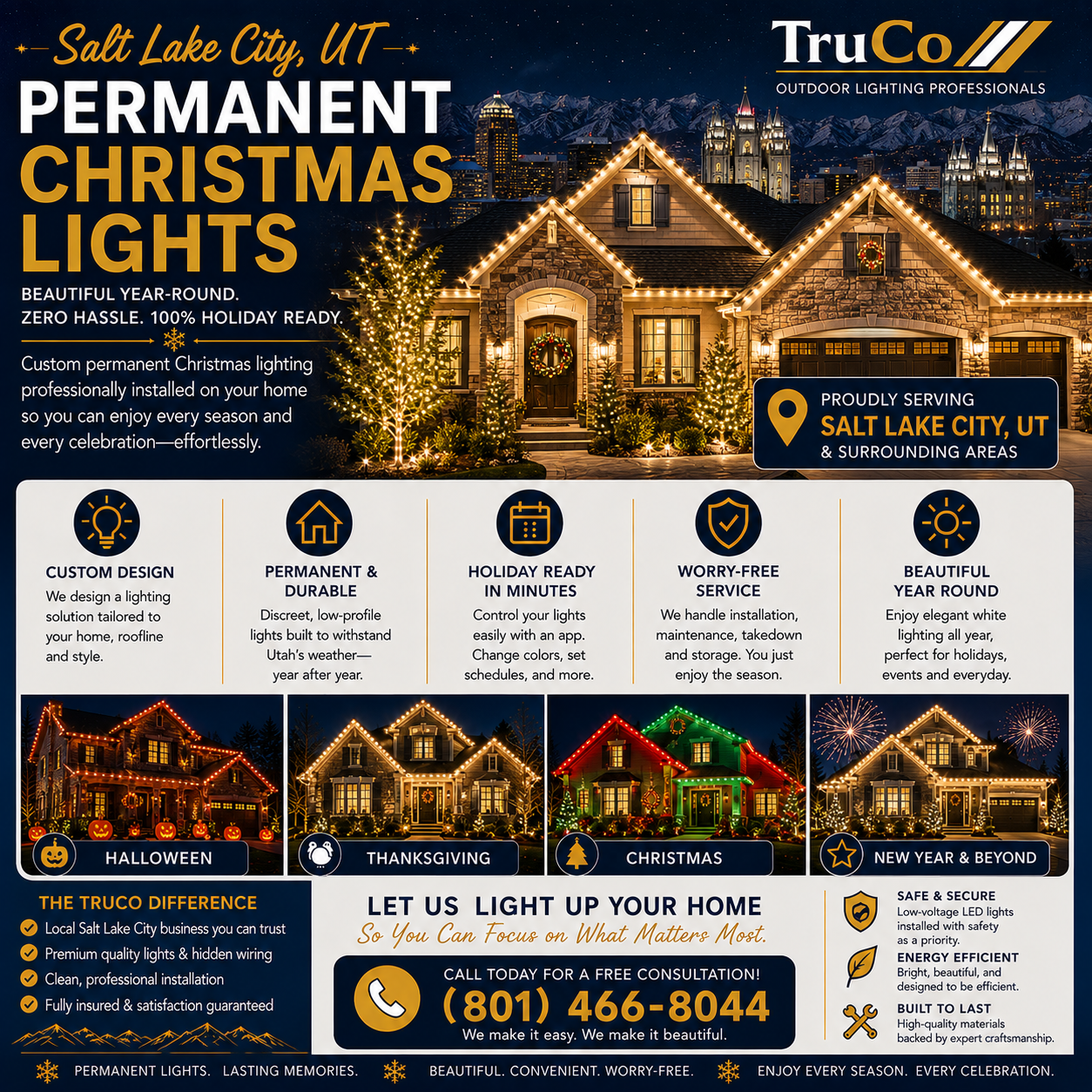
Permanent Christmas lights in Salt Lake City, UT are professionally installed, low-profile LED lighting systems that remain on your home year-round but can be programmed for Christmas, other holidays, game days, security-style accent lighting, or everyday architectural lighting. The best systems are designed around your roofline, use outdoor-rated components, connect safely to properly protected power, and are installed so the lights are discreet when turned off.
The most important takeaway is this: permanent holiday lighting is not simply “Christmas lights left up all year.” It is a long-term exterior electrical and mounting project. Product quality matters, but correct design, clean installation, weather protection, electrical safety, app control, and ongoing support matter just as much. A system that is poorly planned may look uneven, create glare, fail early in Utah’s freeze-thaw weather, or require costly repairs to fascia, soffits, gutters, or electrical components.
This guide explains how Salt Lake City permanent Christmas lights work, what can go wrong, how to compare system types, what permits or rules may apply, and how to choose the right provider. For homeowners who want a polished, dependable result, experienced guidance can prevent the most common and expensive mistakes.
What Are Permanent Christmas Lights?
Permanent Christmas lights are installed LED lighting systems mounted along a home’s roofline, soffits, fascia boards, trim, peaks, patios, or landscape features. Unlike temporary string lights that are installed and removed every holiday season, permanent outdoor holiday lights are intended to stay in place through every season.
When switched off, the fixtures are typically designed to blend into the roofline or trim. When switched on, individual LEDs can be programmed for colors, patterns, brightness, schedules, and zones through a controller or mobile app.
For Salt Lake City homeowners, permanent roofline lighting can serve several purposes:
Christmas and winter holiday displays
Halloween, Independence Day, Valentine’s Day, and other holiday colors
Utah sports-team colors and game-day displays
Birthday, graduation, wedding, and party lighting
Soft architectural accent lighting
Path, patio, and outdoor entertaining ambiance
Limited security-oriented perimeter lighting, when appropriately aimed and used
A typical system includes:
Individually addressable LED lights
A mounting track, channel, or concealed installation method
Low-voltage or line-voltage wiring, depending on the system
A controller that communicates with the app or remote
A power supply and weather-protected electrical connection
Programming software or an app for colors, timing, and effects
Installation labor, mounting hardware, and sometimes electrical work
The process usually starts with measuring the home’s roofline and identifying the most visible architectural features. The installer then designs lighting zones, selects a fixture color or track that fits the home, confirms access to safe power, installs the system, tests every section, and shows the homeowner how to use the controls.
For example, a homeowner in Salt Lake City may use warm white lighting for everyday curb appeal, red and green in December, orange and purple in October, and a subtle blue display for a special event. The physical system stays in place; only the programming changes.
Permanent lighting should not be confused with temporary holiday lights, landscape lighting, or ordinary exterior floodlights. It is a purpose-built architectural lighting system that needs thoughtful planning and professional installation.
8 Things to Know Before Installing Permanent Christmas Lights
1. Product quality alone does not guarantee a good result
Many homeowners start by comparing light brands, bulb brightness, app features, or color options. Those details matter, but they do not replace a sound installation plan. Even a high-end permanent LED lighting system can look poor if the lights are spaced inconsistently, mounted at the wrong angle, or installed on damaged fascia or unstable trim.
The lighting layout should match the architecture of the home. Dormers, gables, garage peaks, second-story transitions, roofline returns, covered porches, and multiple elevations all require deliberate decisions. A system that looks balanced from the street may need different spacing or zoning around a side yard, patio, or entryway.
Poor planning commonly produces issues such as:
Dark spots or uneven light spacing
Bright “hot spots” at roofline corners
Visible tracks that clash with the home’s trim
Lights aimed too far outward or too far downward
Disconnected-looking sections between rooflines
Overly complicated app zones that are frustrating to operate
Ask for a site-specific design rather than a generic per-foot proposal. The provider should explain where lights will be mounted, how they will appear when off, where wiring and power equipment will go, and how the system will handle transitions around architectural features.
A good installation should look intentional in daylight and impressive at night. If the provider cannot clearly explain the design before work begins, the homeowner may be paying for a result that feels improvised after installation.
2. Salt Lake City weather makes outdoor durability essential
Salt Lake City homes experience snow, ice, wind, sun exposure, temperature swings, rain, and freeze-thaw cycles. Permanent exterior lighting must be selected and installed with these conditions in mind.
Weather can affect several parts of a permanent lighting system:
Exterior wiring can become brittle or damaged if it is not properly rated and protected.
Mounting materials can expand, contract, loosen, or pull away from trim.
Water can enter poorly sealed connections or electrical enclosures.
Snow and ice can expose weak points near eaves, gutters, and roof transitions.
Strong UV exposure can fade low-quality plastic components or degrade wire insulation.
Wind can strain loose wiring, exposed connections, and improperly secured track.
The best way to avoid weather-related failure is to use products made for permanent exterior use and to ensure all wiring, connections, power supplies, and controllers are protected according to the manufacturer’s requirements. Ask exactly how the installer handles water management, wire routing, sealed connections, controller placement, and power-supply protection.
Do not assume “water-resistant” means every component can be left exposed. A quality system may include weather-rated parts, but it still needs correct installation. For instance, placing a controller where snowmelt, sprinkler spray, or roof runoff repeatedly hits it can shorten its life even if the controller has a weather-resistant enclosure.
Homeowners should also ask how the system will be serviced after a harsh winter. A provider should have a realistic process for diagnosing a failed segment, replacing a component, or repairing a damaged connection without disturbing large sections of the roofline.
3. Electrical safety is more important than convenience
A permanent lighting system needs a safe, code-appropriate power source. It should not rely on an overloaded extension cord, an indoor outlet routed through a window, or a loose outdoor plug arrangement.
Salt Lake City Building Services states that permits are generally required before electrical installations, alterations, or improvements are made to a building or premises. Whether a specific lighting project requires a permit can depend on the exact scope of electrical work, including whether a new circuit, outlet, wiring run, or service modification is involved. Confirm the requirements with the applicable building authority before work begins.
Outdoor electrical receptacles are commonly required to have ground-fault circuit-interrupter, or GFCI, protection. A GFCI is designed to reduce shock risk by quickly shutting off power when it detects an electrical imbalance. Outdoor outlets are exposed to moisture from rain, snow, sprinklers, wet hands, and melting ice, so this protection is particularly important.
Before installation, verify:
Where the system will receive power
Whether the outlet is GFCI-protected
Whether the existing circuit has sufficient capacity
Whether any new wiring or outlet is needed
Whether electrical work will be completed by a properly qualified professional
How wires will be protected from weather, physical damage, and roof runoff
Who is responsible for any permit and inspection, if required
Electrical work is not the place to cut corners for a lower quote. A professional installer should be transparent about what is included and what requires a separate electrical scope.
4. “Permanent” should not mean impossible to repair
A permanent lighting system should be durable, but it should also be serviceable. Every electronic product can eventually need troubleshooting, especially after years of weather exposure.
Before you commit, ask how repairs work. This is one of the most overlooked questions in permanent outdoor lighting projects. Some systems use modular components that make it easier to isolate and replace a bad section. Others may require more extensive diagnosis or removal if a connection, controller, wire run, or lighting segment fails.
A provider should explain:
What warranty applies to lights, track, wiring, controllers, and labor
Whether labor is included for warranty repair
Whether the system can be expanded later
How replacement parts are obtained
Whether the provider services the specific system they install
Whether the app and controller will remain usable if the homeowner changes Wi-Fi equipment
What happens if a single light, zone, power supply, or controller stops working
The lowest initial price can become expensive if the system is difficult to service. A homeowner may save money upfront only to face a large repair bill later for a minor problem.
For example, if one roofline section loses communication because of a damaged connection, the correct solution should involve testing the controller, power supply, data path, and individual segments. Simply replacing random lights without diagnosing the source of the problem can waste time and money.
5. Brightness, direction, and neighbor impact need planning
Permanent holiday lights are meant to be enjoyed, not to create glare, distract drivers, shine into bedrooms, or become a point of conflict with neighbors. The more powerful and customizable a system is, the more important responsible programming becomes.
Outdoor-lighting principles generally emphasize using only the amount of light needed, directing light where it is useful, and avoiding unnecessary glare. Salt Lake City’s public-utilities lighting guidance similarly promotes purposeful, targeted lighting at low levels rather than excessive brightness.
The practical lesson for permanent Christmas lighting is simple: brighter is not always better.
To avoid problems:
Aim lights toward the home’s architecture rather than outward into the street.
Use lower brightness for everyday or late-night settings.
Avoid rapid flashing patterns near streets, intersections, or neighbors’ windows.
Set automatic shutoff schedules for late evening.
Use warm white or soft accent programs when you want an understated look.
Keep holiday displays coordinated rather than visually chaotic.
If you live in a neighborhood with an HOA, review the association’s rules before installation. HOA requirements may address exterior modifications, visible equipment, lighting hours, color limitations, seasonal displays, or approval procedures.
Your city, neighborhood, property type, and exact lighting design can all affect what is appropriate. A provider should not promise that one design works everywhere without first considering your property’s setting.
6. The app and controls must be easy for your household to use
Smart controls are a major reason homeowners choose permanent LED Christmas lights. You may be able to set colors, create patterns, schedule events, divide the house into zones, and automate on/off times. But advanced features only help if the system is easy to operate after the installer leaves.
Some systems rely on Wi‑Fi, Bluetooth, a dedicated controller, cloud services, or a mix of those technologies. Before choosing a system, ask what happens if your Wi‑Fi network changes, your router is replaced, your phone changes, or the app updates.
A usable control system should allow you to:
Turn lights on and off easily
Select simple preset holiday colors
Adjust brightness
Set recurring schedules
Create zones for different rooflines or areas
Save favorite programs
Share control with another household member
Troubleshoot basic connectivity issues
Avoid choosing solely based on the number of color effects. A system with hundreds of patterns is not automatically better if it requires complicated setup for basic daily use.
During the final walkthrough, have the installer demonstrate the app on your own device. Confirm that you can connect, select a preset, adjust brightness, create a schedule, and turn the system off. Ask for written instructions, especially if the system uses a specific controller-reset process.
7. Your roofline and exterior condition affect the installation
Permanent roofline lighting attaches to the exterior of your home, so the condition of the fascia, soffits, trim, gutters, siding, and eaves matters. A lighting system should not be used to hide pre-existing exterior problems.
Before installation, inspect for:
Rotting, cracked, or loose fascia boards
Peeling paint or deteriorated trim
Sagging gutters
Existing roof leaks or ice-dam concerns
Loose soffit material
Damaged siding
Unstable ladders or difficult access points
Areas where wiring would interfere with vents, drainage, or roof components
Installing on failing materials can create avoidable trouble. If a fascia board needs replacement later, the lighting track may need to be removed and reinstalled. If gutters are replaced, a provider may need to disconnect or protect nearby equipment.
It is also important to understand the mounting method. Ask whether the installer uses screws, clips, adhesive, channels, or another system. Each approach has tradeoffs. Mechanical fasteners may offer secure placement but create penetrations that must be properly located and sealed. Adhesive-only solutions may be less suitable on certain surfaces or in severe weather conditions.
A reputable provider should identify exterior issues before beginning, not after the system is already partially installed. This protects the home and avoids disputes about whether a later problem was pre-existing or installation-related.
8. The quote should explain the full scope, not just price per foot
Price-per-foot comparisons can be useful, but they are incomplete. Two quotes with the same footage can include very different products, controller capabilities, power arrangements, labor standards, warranties, service policies, and design complexity.
Permanent Christmas lights in Salt Lake City can vary widely in price because homes vary widely in roofline length, height, architectural complexity, access, electrical needs, product selection, and the number of lighting zones. Public online estimates often place professionally installed Utah systems in the several-thousand-dollar range, with larger or more complex homes costing more, but an in-person assessment is the only reliable basis for a proposal.
A complete proposal should clarify:
Total linear footage and exact installation locations
Product brand or system type
Number of lights, zones, controllers, and power supplies
Track or channel color options
Electrical work included or excluded
Permit responsibility, when applicable
Installation schedule
Warranty terms
Repair and service process
App, controller, and programming support
Any removal, reinstallation, or change-order costs
Do not accept vague language such as “full house lighting” without a drawing, photos, or a clear written scope. Confirm whether “full house” means the front roofline only, all visible elevations, garage peaks, porch trim, rear patio areas, or something else.
The Real Cost of Getting Permanent Lighting Wrong
The financial cost of a poor permanent-light installation can extend far beyond replacing a few lights. A low quote may omit proper electrical work, weatherproofing, service support, or a complete warranty. If the system fails early, the homeowner may pay twice: once for the original installation and again for diagnostic work, replacement components, removal, or a full reinstall.
Potential costs include:
Repairs to fascia, soffits, siding, gutters, or trim
Electrical corrections or new outdoor power installation
Replacement of failed controllers, power supplies, or lighting segments
Labor to access high or difficult rooflines
Removal and replacement when a roof, gutter, or exterior project is needed
HOA disputes, required alterations, or compliance costs
Lost time troubleshooting app, Wi‑Fi, or electrical issues
Higher utility use if lights are run at unnecessary brightness or for excessive hours
There are emotional costs, too. A permanent lighting system should make holidays easier and improve the appearance of the home. Instead, a poor installation can create frustration every time lights flicker, a section fails, or neighbors complain about brightness.
Most of these costs are avoidable. Good planning, clear documentation, weather-appropriate materials, qualified electrical work, a realistic service policy, and responsible programming reduce risk before the first light is installed.
How Truco Services Helps With Permanent Christmas Lights
An experienced permanent-lighting provider helps by treating the project as a long-term exterior improvement rather than a short seasonal decoration job.
Truco Services can help homeowners plan Salt Lake City UT permanent Christmas lights around the home’s architecture, outdoor conditions, electrical needs, and desired use throughout the year. The goal should be a clean, practical lighting design that looks discreet when off and performs reliably when on.
A professional approach includes:
Evaluating rooflines, trim, access, and mounting surfaces before installation
Designing balanced lighting zones and placement
Identifying power requirements and when electrical coordination may be necessary
Explaining the system, controls, programming, and maintenance needs in plain English
Using a written scope so the homeowner knows what is included
Managing installation details that affect weather resistance and appearance
Helping troubleshoot lighting, controller, connectivity, or programming issues
Advising on brightness, schedules, and responsible neighborhood-friendly operation
Providing practical guidance if you plan future roof, gutter, siding, or exterior work
No provider should promise that a permanent lighting system will never need service. Instead, choose one that is willing to discuss realistic maintenance, warranty, troubleshooting, and repair expectations before installation.
Common Permanent Lighting Mistakes
Choosing by lowest price alone. A low quote can leave out design work, electrical scope, quality components, warranty coverage, or future service.
Skipping a written scope. “Front of house” and “full roofline” can mean very different things. Confirm exact locations, footage, controls, and exclusions.
Ignoring power requirements. Plugging a permanent system into an unsuitable outlet or overloaded circuit can create reliability and safety problems.
Installing over damaged trim or gutters. Exterior repairs become more difficult and expensive after lights are installed over failing materials.
Using maximum brightness every night. Excessive brightness can create glare, annoy neighbors, and make a home look less polished.
Forgetting about future exterior work. Roof replacement, gutter replacement, painting, siding work, and fascia repairs may require lighting removal or coordination.
Not testing the app before final payment. Make sure you can operate the system, adjust brightness, set schedules, and reconnect if your network changes.
Assuming all warranties cover labor. Some warranties cover a part but not the labor, travel, access, or installation required to replace it.
Frequently Asked Questions
What are permanent Christmas lights?
Permanent Christmas lights are outdoor LED lighting systems installed along a home’s roofline or trim for year-round use. They can be programmed for Christmas, other holidays, events, sports colors, or architectural accent lighting.
Are permanent Christmas lights visible during the day?
Many systems are designed to be discreet during daylight. Visibility depends on the color of the mounting track, the trim color, placement, roofline shape, and viewing distance.
Can permanent lights be used all year?
Yes. Many homeowners use them for holidays, events, warm-white architectural lighting, parties, and celebrations. Responsible scheduling and brightness settings help keep year-round use appropriate.
Do permanent Christmas lights use a lot of electricity?
LED systems generally use less energy than older incandescent holiday lights, but actual electricity use depends on the number of lights, brightness, colors, operating hours, and system design. Ask the provider for system-specific power information.
Can permanent lights be installed on any house?
Most homes can accommodate some form of permanent lighting, but roof height, material condition, trim style, access, roofline complexity, power availability, and HOA rules affect the design.
Will permanent lights damage my roof?
A properly planned installation should be designed to avoid unnecessary damage. However, any mounting method and any work near exterior components must be carefully evaluated. Ask where attachments will be made and how future roof work will be handled.
Are permanent lights installed on gutters?
Some systems may be installed near gutters, while others are mounted to soffits, fascia, or trim. The best method depends on the home and product. Avoid assuming a gutter-based installation is appropriate for every property.
Can I control permanent Christmas lights from my phone?
Many systems offer app-based controls. Features can include colors, brightness, zones, schedules, presets, and effects. Ask whether the system uses Wi‑Fi, Bluetooth, cloud access, or another method.
What happens if my Wi‑Fi changes?
You may need to reconnect the controller to the new network. Before installation, ask the provider to explain the reconnection process and whether support is available.
Can I make different sections of my house different colors?
Usually, yes, if the system is designed with separate zones. For example, the garage peak, porch, front roofline, and patio may be individually controlled depending on the system design.
Are permanent outdoor lights safe in snow and rain?
They can be safe when appropriate exterior-rated products are installed correctly with protected wiring, sealed connections, suitable power equipment, and GFCI-protected electrical connections. Water intrusion and damaged wiring should always be addressed promptly.
Do I need a new outlet?
Not always. It depends on the existing outlet, its location, GFCI protection, circuit capacity, and the system’s requirements. A new outlet or electrical work may be necessary in some cases.
Do permanent Christmas lights require a permit in Salt Lake City?
The answer depends on the work involved. Salt Lake City notes that electrical installations and alterations generally require permits, so homeowners should confirm requirements with the applicable building authority, especially if new wiring, outlets, or circuits are included.
Do I need HOA approval?
Possibly. Many HOAs regulate exterior changes, visible equipment, seasonal décor, brightness, operating hours, or color displays. Review your governing documents before signing a contract.
How long do permanent LED Christmas lights last?
Service life varies by product quality, installation quality, weather exposure, usage, power conditions, and maintenance. Review manufacturer terms and the provider’s labor warranty rather than relying on a single lifespan claim.
Can one failed light cause the entire system to stop working?
It depends on the system design. A single problem may affect one light, a short segment, a zone, or the entire system. Modular, professionally supported systems are generally easier to diagnose and repair.
Can I install permanent lights myself?
Some DIY kits are available, but the project involves ladder safety, roofline access, weatherproofing, mounting decisions, electrical safety, and troubleshooting. Professional installation is often the better choice for high, complex, or hard-to-access homes.
Can permanent lights be repaired?
Yes, many issues can be repaired, including failed segments, loose connections, controller problems, power-supply issues, and app connectivity problems. Repairability depends on the system and how it was installed.
Can permanent lights be removed later?
Usually, yes, but removal may leave mounting holes, marks, or areas requiring exterior touch-up. Ask about removal procedures before installation.
Can I use permanent lights for security lighting?
They can contribute to visibility around the home, but they should not replace a thoughtfully designed security-lighting plan. Avoid bright, flashing, or poorly aimed settings that create glare without improving safety.
What colors are best for everyday use?
Warm white, soft white, or dim architectural colors often look most refined for regular use. Brighter multicolor programs are generally better reserved for holidays, parties, and special events.
How bright should permanent Christmas lights be?
The ideal setting depends on your home’s distance from the street, ambient lighting, neighbors, and the direction of the fixtures. Start lower and increase only as needed for a clear but not glaring display.
Can permanent lights annoy neighbors?
Yes, if they are too bright, run too late, flash rapidly, or shine into nearby windows. Use lower brightness, reasonable schedules, and non-intrusive programs.
Can permanent lights be installed before winter?
Yes, but weather, roof safety, snow, and temperature conditions may affect scheduling and installation methods. Planning ahead of the holiday rush can provide more flexibility.
Should I install permanent lights before replacing my roof?
If a roof replacement is expected soon, complete it first whenever possible. Installing permanent lights before major roof, fascia, siding, or gutter work may create avoidable removal and reinstallation costs.
What should a permanent-lighting warranty include?
Ask separately about coverage for lights, track, wiring, controllers, power supplies, installation labor, troubleshooting visits, weather damage, accidental damage, and future part availability.
How do I maintain permanent Christmas lights?
Keep the system programmed responsibly, inspect visible components periodically, report flickering or damaged wiring promptly, protect controllers from avoidable water exposure, and coordinate with the provider before roof or gutter work.
Is a permanent system worth the cost?
It can be worthwhile for homeowners who value convenience, frequent use, a polished exterior appearance, and avoiding yearly installation and removal. It may be less worthwhile for someone who only decorates briefly each December or plans significant exterior renovations soon.
Who should I call for permanent Christmas lights in Salt Lake City?
For planning, installation guidance, system evaluation, and service-related questions, contact Truco Services at (801) 466-8044.
Key Rules and Standards
Permanent Christmas lights are not governed by one single “permanent holiday lights” law. Instead, several overlapping requirements may apply depending on the home, municipality, HOA, and scope of work.
Electrical permits and inspections
Salt Lake City Building Services states that electrical installations, alterations, or improvements generally require prescribed permits. Check directly with the city before a project that adds, changes, or extends electrical equipment or wiring.
GFCI protection
Outdoor outlets are commonly required to have GFCI protection because exterior electrical connections face moisture exposure. A provider should confirm that the power arrangement is appropriate for the system and local requirements.
Contractor licensing
If the project includes regulated construction or electrical work, verify that the contractor holds the appropriate active Utah license classification for the work they perform. The Utah Division of Professional Licensing provides a public license-verification process.
Local lighting and nuisance considerations
Lighting should be purposeful, targeted, and no brighter than necessary. Avoid glare toward streets and nearby properties, especially with elevated roofline displays and animated settings.
HOA and neighborhood rules
Private HOA rules can be more specific than citywide guidance. Obtain approval when required, and keep written documentation of any architectural-review decision.
Disclaimer: This article provides general educational information, not electrical, legal, permitting, engineering, or code-compliance advice. Building-code requirements, permit rules, HOA restrictions, product instructions, and electrical standards can change and may vary by property and jurisdiction. Confirm requirements with Salt Lake City or the authority having jurisdiction, your HOA if applicable, and qualified professionals before beginning work.
Conclusion
Salt Lake City UT permanent Christmas lights can make holiday decorating easier, create year-round curb appeal, and give homeowners flexible control over their exterior lighting. However, the value of the system depends on more than colorful LEDs and an app. The best results come from a careful roofline design, weather-ready components, proper mounting, safe power, clear warranty terms, manageable controls, and a provider who can support the system after installation.
Most permanent lighting problems are preventable. Avoid rushed decisions, vague quotes, unsuitable electrical connections, poor mounting surfaces, excessive brightness, and providers who cannot explain service and repair procedures. Plan for your home’s condition, Utah weather, neighborhood setting, and future roof or exterior projects before you install.
For clear guidance on permanent Christmas lights in Salt Lake City, UT, contact Truco Services at (801) 466-8044 to discuss a practical, professionally planned lighting solution for your home.