
Lehi UT Permanent Holiday Lighting

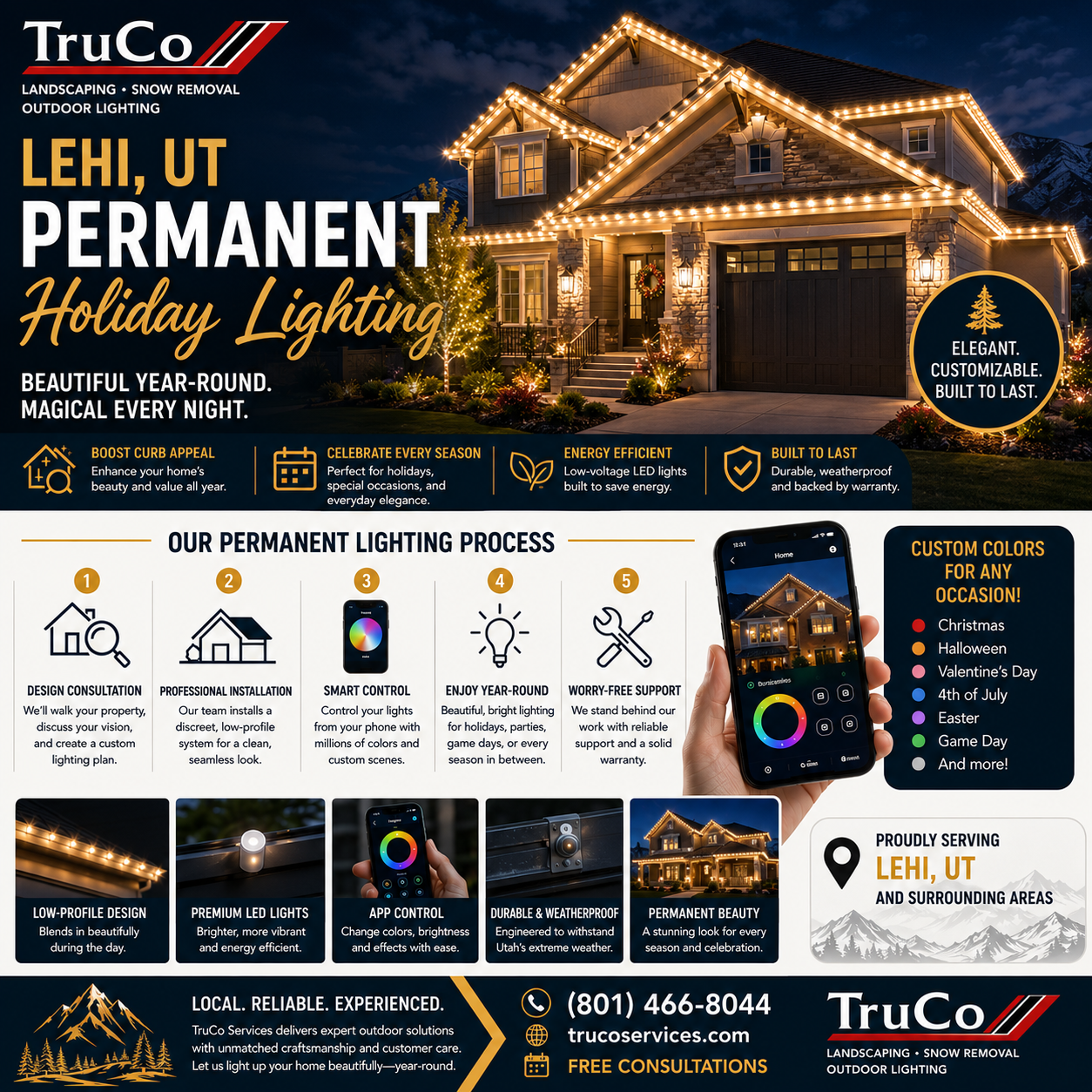
Lehi UT permanent holiday lighting is a programmable exterior LED system installed along rooflines, soffits, gables, patios, entryways, and other architectural features. It stays mounted year-round, allowing homeowners to change colors, brightness, effects, and schedules for Christmas, Halloween, Independence Day, birthdays, game days, or understated warm-white accent lighting—without annual ladder work and temporary-light storage.
The biggest takeaway is that permanent Christmas lighting must be planned as a long-term exterior improvement. The system needs weather-ready components, correct placement, safe electrical power, accessible controls, responsible brightness settings, a clean daytime appearance, and a written service plan. In Lehi, homeowners should also account for snow, ice, heat, UV exposure, wind, roofline drainage, HOA restrictions, local lighting standards, and potential permit requirements for electrical modifications. Lehi’s outdoor-lighting code emphasizes shielding, directing light downward and inward, preventing glare and light trespass, using low adequate brightness, and favoring warm lighting at 3,000 Kelvin or lower for regulated lighting. This guide explains how permanent lighting works, the common pitfalls, available options, and how informed planning helps avoid costly mistakes.
What Is Lehi UT Permanent Holiday Lighting?
Permanent holiday lighting is an installed exterior LED system designed to remain on a home throughout the year. It may also be called:
Lehi permanent Christmas lights
Permanent roofline lighting
Smart outdoor holiday lighting
Programmable soffit lighting
Color-changing exterior LED lights
Architectural accent lighting
Most systems use individually controllable LED modules—often called pucks—secured inside a low-profile mounting channel. The channel is installed beneath soffits, behind fascia, along gables, around covered patios, or on architectural trim. A trim-matched channel helps reduce daytime visibility. At night, a controller or phone app allows the homeowner to select colors, brightness, zones, animations, and automatic schedules.
Main components
A typical permanent holiday light system contains:
Individually addressable LED lights
A mounting channel or track
Outdoor-rated wiring and protected connectors
A power supply and controller
Wi-Fi, Bluetooth, remote, app, or timer controls
A protected electrical connection
Lighting zones for separate areas of the home
Preset scenes and homeowner training
For example, you could use warm white at a modest brightness most evenings, orange and purple for Halloween, red and green for Christmas, or red-white-and-blue for Independence Day. The hardware remains installed while the lighting scene changes.
Installation process
A professionally planned project typically follows these steps:
Measure the roofline, soffits, gables, patios, and other desired lighting areas.
Inspect trim, fascia, gutters, drainage, roof access, and power availability.
Select a channel color, mounting position, controller location, and lighting zones.
Plan wire routing between different roofline sections.
Install the mounting channel, LEDs, wiring, power supply, and controller.
Test the system for even light output, safe operation, app access, and schedules.
Program initial scenes and show the homeowner how to use controls and resets.
Permits and electrical framework
Whether a permit is needed depends on the electrical scope. A project using an appropriate existing outlet may be different from one that adds a new circuit, receptacle, hardwired equipment, or other electrical changes.
Lehi’s Building and Inspection Department issues building permits, uses a permit-submittal portal, and schedules inspections. The department lists the 2021 I-Codes, 2020 NEC, and adopted Utah amendments as its current codes. Confirm permit and inspection requirements with the city before work begins if the project modifies the electrical system.
8 Things to Know Before Installing Permanent Holiday Lights
1. Long-term outdoor durability matters more than app features
Permanent holiday lighting is exposed to the elements in every season. A Lehi roofline can experience hot sunlight, UV exposure, wind, rain, snow, ice, freezing temperatures, and repeated freeze-thaw cycles. This means the system’s durability depends on much more than the LEDs themselves.
A system may look impressive because it offers many colors or app-controlled scenes, yet fail early if its connectors corrode, wiring is poorly protected, the controller is exposed to moisture, the mounting channel fades, or attachment hardware loosens. The entire installation must be evaluated as a single system.
Ask practical questions before choosing a product:
Is this system intended for permanent exterior installation?
How are connectors protected from rain, snow, and roof runoff?
Is the channel UV-resistant and suited to the exterior material?
Can a failed LED or short section be repaired?
What happens when a controller or power supply fails?
Are replacement components likely to be available later?
Does the warranty cover labor as well as parts?
Temporary consumer light strings or adhesive strips can be useful for short-term seasonal decorating, but they may not withstand long-term exterior exposure. Adhesive may release, cable insulation can deteriorate, and visible cords can undermine the appearance of the home.
A durable permanent lighting system should be discreet by day, evenly illuminated by night, and serviceable when one component eventually needs attention.
2. Mounting location determines appearance and serviceability
Permanent LED lights can be mounted beneath soffits, near fascia, along gables, under covered porches, around patios, or on architectural trim. Where they are placed affects their daylight visibility, nighttime effect, wire routing, drainage exposure, and future service access.
Lights mounted farther back beneath a deep soffit tend to create softer, more indirect illumination. Lights installed closer to the roofline edge can create more distinct points of color from the street. The right choice depends on your home’s style, roofline depth, trim colors, viewing angle, and desired visual effect.
Poor placement can lead to:
Uneven spacing or dark gaps
Excessively bright corners
Visible wire drops between sections
Awkward transitions around peaks and valleys
Channels that clash with trim color
Lighting that is too recessed to show clearly
Difficult access to power or controller equipment
Before installation, ask the provider to explain the layout from the street-level perspective. Review the exact channel location, how gables and corners will be handled, how wires will move between disconnected rooflines, and where the controller will be placed.
A permanent roofline system should look integrated into the architecture. It should not resemble a temporary strand that has been left up indefinitely.
3. Electrical planning protects safety and reliability
Every permanent lighting system needs a suitable, protected electrical connection. Depending on the layout, the system may use an existing exterior receptacle, a garage outlet, a low-voltage power supply, a controller, or a new electrical circuit.
Key concerns include circuit capacity, GFCI protection where required, moisture protection, grounding, wire routing, access for service, and compliance with the codes applicable to the project. Outdoor power components can encounter rain, snow, sprinkler water, condensation, and water running from roofs or gutters.
The National Fire Protection Association advises using lights rated for the intended environment, inspecting lights and cords for damage, and taking care with outdoor electrical connections.
Before approving a design, ask:
What will power the lighting system?
Is the circuit already serving heavy loads?
Is the proposed connection protected from weather?
Is GFCI protection present where required?
Will a new outlet, circuit, or hardwired connection be added?
Does the work require a permit or inspection?
Where will the controller and power supply be located?
Do not assume that an outlet is suitable because it is nearby. It may serve a freezer, refrigerator, tools, garage equipment, or other loads. Repeated breaker trips, burning smells, buzzing, damaged wires, or moisture around power equipment require prompt attention.
4. Lehi light-spill rules should shape the design
A permanent holiday-lighting system should enhance a home without sending glare or bright light into neighboring homes, toward drivers, or upward into the sky. This matters everywhere, but Lehi has a detailed outdoor-lighting ordinance that offers useful guidance even where a specific rule or exemption may apply.
Lehi’s outdoor-lighting standards call for outdoor fixtures to be fully shielded and directed downward and inward, with direct illumination contained on the site. The standards also reference a maximum intensity of 0.2 foot-candles at a residential property line, recommend the lowest adequate light level, and emphasize timers, dimmers, and turning lights off when not in use. The code exempts temporary and seasonal lighting under defined limits, but do not assume a permanent installed system receives the same treatment.
In practical terms:
Use the lowest brightness that produces the intended look.
Aim lighting toward the home’s architectural surfaces, not outward.
Reserve fast animation and vivid colors for limited events.
Use schedules and an automatic shutoff time.
Avoid strobe-like patterns, especially near streets or close neighbors.
Consider warm white for everyday use.
Thoughtful programming helps avoid complaints while producing a more sophisticated result. A permanent lighting system should be flexible enough to celebrate holidays without becoming disruptive every night.
5. HOA approval should happen before installation
Permanent holiday lighting may qualify as an exterior architectural alteration under your HOA’s rules. Even low-profile systems can affect soffits, fascia, trim, controller placement, visible wires, lighting color, and nighttime appearance.
Your HOA may regulate:
Prior architectural approval
Mounting-channel color and placement
Fascia, soffit, and gutter attachment
Visible wiring or external power equipment
Permitted colors outside holiday periods
Brightness and light spill
Flashing, animation, and moving patterns
Hours of operation
Removal, repair, or maintenance obligations
Review CC&Rs, architectural guidelines, and application requirements before signing an installation agreement. If approval is required, submit a clear packet that includes a house photo or elevation drawing, product information, the proposed channel color, controller placement, wire-routing plan, and intended operating practices.
Do not rely on an informal verbal answer or a neighbor’s existing display as proof of permission. Rules change, and each property can be reviewed separately.
Written approval prevents the costly situation where a system must be modified, dimmed, relocated, or removed after it has already been installed.
6. Smart controls need to remain easy after setup
App control is one of the biggest advantages of permanent exterior lighting. It can allow you to choose colors, build scenes, set timers, dim different zones, and make changes without going outside. However, the technology should reduce work—not create an annual troubleshooting problem.
Before selecting a system, ask whether it uses Wi-Fi, Bluetooth, cloud access, or a combination. Also ask how the system behaves when the internet goes down, a router is replaced, a password changes, or a new phone is set up.
Important questions include:
Can multiple people in the household access controls?
Can scheduled scenes continue during an internet outage?
Is there a physical reset or manual override?
Can the controller be reached safely from the ground?
Is Wi-Fi coverage dependable where the controller will sit?
Does the installer provide setup help and written instructions?
Is post-installation troubleshooting support available?
A controller should be dry, protected from direct weather, reasonably accessible, and within a reliable communication range. A controller buried in an inaccessible attic or installed where Wi-Fi is weak can turn a simple schedule update into a service call.
The homeowner should be able to change basic colors, reset the system, and restore connectivity without roof access or specialized technical knowledge.
7. Repair roofline, gutter, and soffit issues first
Permanent lights should be installed only on stable, sound surfaces. They should not be used to conceal damaged fascia, loose gutters, failing soffit panels, peeling trim, roof leaks, water stains, or drainage problems.
Inspect the selected installation area for:
Loose or sagging gutters
Overflowing gutters or signs of poor drainage
Water staining below roof edges
Soft, rotted, or cracked fascia
Detached or damaged soffit panels
Missing fasteners
Pest damage
Paint or siding failure
Ice-dam evidence
Roof, gutter, or trim work planned soon
Lehi’s winter conditions can expose weak drainage and freeze-thaw problems. If water backs up behind gutters or reaches soffit areas, correct that issue before mounting a permanent channel.
Otherwise, future roof replacement, gutter work, repainting, or trim repairs may require light removal and reinstallation. That can add cost, delay the underlying repair, and create mismatched channels or alignment challenges.
A responsible lighting professional should identify visible exterior conditions that could affect attachment strength, water management, appearance, or future serviceability.
8. Warranty terms must explain real-world repair scenarios
A “lifetime warranty” is not automatically comprehensive. Permanent-lighting warranties can cover LEDs but exclude labor, controllers, power supplies, wiring, weather damage, power surges, animal damage, accidental impact, homeowner modifications, roof work, or service fees.
Review written warranty terms before the project begins. Ask:
How long are LEDs covered?
Are the channel, wiring, connectors, controller, and power supply covered?
Is repair labor included?
Is there a service-call or diagnostic fee?
What happens after storm, ice, water, animal, or electrical damage?
Does the warranty transfer with the home?
How will roof replacement affect coverage?
Are matching parts available for future repairs?
How quickly can service be scheduled during the holidays?
A good warranty pairs coverage with a practical process. You should know whom to contact, what documentation to provide, how a failed section will be diagnosed, and what costs may be excluded.
The Real Cost of Getting Permanent Lighting Wrong
The financial impact of a poorly planned permanent lighting project can be much greater than the original installation price. Direct costs may include replacing failed LEDs, controllers, or power supplies; removing and reinstalling channels; repairing damaged fascia or soffits; electrical troubleshooting; roof and gutter coordination; HOA fines; and service work outside warranty coverage.
Time is another cost. A homeowner may lose hours trying to reset an app, reconnect Wi-Fi, troubleshoot GFCI trips, document a warranty claim, wait for replacement parts, schedule service, or seek HOA approval after installation.
The emotional and relational impact can be significant. A holiday display should be enjoyable. Instead, bright late-night lighting can create neighbor tension, a system failure can disrupt a gathering, and visibly crooked channels or exposed wires can become a constant source of irritation.
Long-term problems include inaccessible controllers, water-damaged components, mismatched replacement parts, unserviceable wires, and a roofline that becomes more difficult to repair or maintain.
Most of these outcomes are avoidable with durable components, a thoughtful design, safe power planning, roofline inspection, HOA approval, appropriate brightness, and clear warranty terms.
How an Experienced Lighting Professional Helps
An experienced permanent lighting professional helps homeowners make decisions before mistakes become expensive. A quality process starts with evaluating the property—not simply estimating roofline footage.
A comprehensive approach should include:
Measuring the home and mapping logical lighting zones
Reviewing visible fascia, soffit, gutters, trim, and drainage conditions
Selecting a suitable mounting location and matching channel color
Planning discreet wire routing
Choosing an accessible controller and safe power location
Recommending practical scenes, dimming, scheduling, and zoning
Testing all lighting areas at completion
Training the homeowner on app access, schedules, resets, and service requests
Providing clear written warranty information
Professional guidance can reduce risks related to ladder access, roofline alignment, moisture exposure, poor lighting direction, unserviceable controls, and unclear service expectations.
For homeowners researching Lehi UT permanent holiday lighting, Truco Services can provide practical guidance on planning, exterior lighting installation considerations, system operation, and long-term care. The goal is a clean, durable, manageable system that works for both holiday celebrations and normal evenings.
Lehi Permanent Lighting Options
Roofline and soffit lighting
Roofline lighting outlines eaves, fascia, soffits, and gables with programmable LEDs. It is appropriate for homeowners who want the classic holiday-light effect without annual installation and removal.
Its main limitation is that installation quality is highly visible. Crooked channels, uneven spacing, poor trim matching, and exposed wire runs can diminish curb appeal.
Architectural accent lighting
Architectural accent lighting highlights selected elements such as entryways, covered patios, columns, pergolas, and special gable features. It can provide subtle warm white throughout the year and event-specific colors when desired.
This option fits homeowners who prefer a quieter appearance. Its limitation is that it may not create a complete roofline outline.
Zoned smart lighting
Zoned systems split the home into independently controlled sections. A homeowner can assign different colors and schedules to the front roofline, gables, porch, patio, and other areas.
This works well on larger or more complex homes. Its limitation is more system complexity, potentially higher cost, and a greater need for dependable connectivity and clear training.
Seasonal temporary lighting
Traditional temporary lights remain a practical option for renters, budget-conscious homeowners, people who want a different display every year, and those who prefer not to permanently alter the exterior.
The drawbacks are yearly ladder work, storage, tangled cords, weather-related connection failures, visible wires, and less precise roofline fit.
What to Do If You Have a Problem Now
Turn the system off immediately if you smell burning, hear buzzing, see damaged insulation, notice water near electrical components, or have repeated breaker trips.
Do not climb onto a wet, snowy, icy, or steep roof to inspect lights.
Take clear photos and video from a safe location. Document the affected lights, channel, visible wire, controller, power source, adjacent trim, and any app messages.
Check basic issues from the ground: breaker position, GFCI reset, controller power, schedule settings, app login, Wi-Fi connection, and selected scene.
Review your installation agreement, warranty, product documentation, and service records.
Contact the original installer with photos, affected zones, the date the issue began, and the troubleshooting you have already completed.
Seek qualified electrical evaluation promptly if the issue involves moisture intrusion, repeated trips, visible electrical damage, damaged wire, burning odor, or buzzing.
If an HOA contacts you, respond in writing, provide approval records if available, ask for the exact rule involved, and work toward a documented resolution.
How to Choose the Right Provider
Use this checklist when comparing providers for Lehi permanent holiday lighting:
Experience with permanent exterior LED systems, not only temporary seasonal décor
Knowledge of soffits, fascia, gutters, trim, rooflines, and long-term weather exposure
Clear explanation of product options, controls, wiring, and service needs
A detailed written scope stating included and excluded work
A specific plan for channel placement, wire routing, controller location, and power access
Willingness to address electrical work, permits, safety, and HOA approval
Attention to Lehi’s glare, shielding, light direction, and neighbor-impact considerations
Written product and labor warranty terms
Clear repair and service process
Homeowner training for app control, schedules, brightness, and resets
A long-term view that accounts for roof replacement, gutter work, painting, and trim repair
Responsive communication before, during, and after installation
For practical, homeowner-focused guidance on permanent outdoor holiday lighting in Lehi, consult Truco Services to discuss layout, installation, controls, and long-term exterior-care considerations.
Common Mistakes People Make
Choosing the lowest quote without comparing scope. A low estimate may omit durable channels, protected connectors, electrical planning, wire concealment, service support, or labor coverage.
Ignoring Lehi’s outdoor-lighting standards. A bright or poorly aimed system can create glare, light spill, and neighborhood conflict.
Skipping HOA approval. A low-profile system may still be a regulated exterior alteration.
Installing over roofline damage. Gutters, soffits, fascia, drainage issues, and planned roof work should be addressed first.
Running maximum brightness every night. High intensity can cause glare, increase energy use, and affect nearby homes.
Placing the controller where it cannot be reached. It should be protected, accessible, and within reliable Wi-Fi or Bluetooth range.
Assuming any outlet will work. The electrical source must be protected, appropriate for the load, and suitable for outdoor equipment.
Not reading warranty exclusions. Understand coverage for parts, labor, weather, service trips, roof work, and accidental damage before installation.
Frequently Asked Questions
What is permanent holiday lighting?
Permanent holiday lighting is an exterior LED system installed to stay on a home year-round and programmed for holidays, events, and everyday accent lighting.
Is permanent holiday lighting the same as permanent Christmas lights?
Yes. The terms are commonly used interchangeably. The system can be used for Christmas, Halloween, patriotic holidays, sporting events, birthdays, and warm-white everyday lighting.
Can permanent lights stay installed all year?
Yes. The lights and mounting channels stay installed, while colors, brightness, animation, and schedules are changed through the controller or app.
Can I use permanent lights outside of Christmas?
Yes. Homeowners commonly use them for Halloween, Independence Day, birthdays, school events, sports teams, parties, and general exterior lighting.
Are permanent lights visible during the day?
They can be visible, but matching the channel to the trim and carefully choosing placement can make the system much less noticeable when off.
How long do permanent LED lights last?
Life expectancy varies by product quality, exterior exposure, installation quality, electrical protection, operating habits, maintenance, and warranty coverage. Ask for component-specific warranty details.
Can permanent lights handle Lehi snow and cold?
Outdoor-rated systems can operate in snow and cold, but weatherproof connections, stable mounting surfaces, proper drainage, controller protection, and safe repair access are essential.
Are permanent holiday lights safe?
They can be safe when installed with exterior-rated equipment, appropriate protected power, GFCI protection where required, safe wire routing, and accessible service components.
Do outdoor outlets need GFCI protection?
Outdoor receptacles are commonly required to use GFCI protection. GFCI devices help reduce shock risk where moisture may be present. Confirm current requirements for your specific project with the city or a qualified electrical professional.
Do I need a permit for permanent lighting in Lehi?
It depends on the electrical scope. New outlets, circuits, hardwired connections, or other electrical modifications may require permit review and inspections. Lehi’s Building and Inspection Department administers permits and inspections.
Does my HOA need to approve permanent lights?
Possibly. HOAs often regulate permanent exterior modifications, channel locations, wiring, colors, brightness, animation, and operating hours. Review your documents and obtain written approval when required.
Can permanent lights create glare or bother neighbors?
Yes. Excessive brightness, rapid flashing, late-night operation, and outward-facing light can affect nearby properties. Use moderate brightness, carefully chosen effects, and schedules.
Does Lehi regulate outdoor lighting?
Yes. Lehi’s development standards contain outdoor-lighting rules addressing shielding, direction, glare, light trespass, color temperature, and lighting levels. The specifics and any exemptions should be confirmed with Lehi City for a permanent installed system.
Can I control permanent lights from my phone?
Most systems provide app-based control through Wi-Fi, Bluetooth, or both. Confirm the system’s connectivity requirements before purchase.
Can I schedule lights to turn on and off automatically?
Usually. Permanent systems commonly support timers, sunset activation, holiday scenes, daily schedules, and custom recurring programming.
What happens if I change my Wi-Fi router?
The controller may need to be reconnected or reset. Request written instructions and make sure the controller is safely accessible.
Will permanent lights raise my electricity bill?
LED systems generally use less power than traditional incandescent holiday lights. Your actual use depends on the light count, brightness, colors, animation, and hours of operation.
Can one failed light be replaced?
That depends on the system. Ask whether individual LEDs, short sections, controllers, power supplies, wiring, and connectors can be serviced independently.
Can permanent lights be installed on a two-story home?
Yes, but height, roof pitch, safety, access, wire routing, controller location, and future service should be planned carefully.
Can permanent lights be installed near gutters?
They can be, depending on the system and layout. Review gutter condition, drainage, snow and ice exposure, and future gutter-service needs before choosing that location.
Do permanent lights damage the roof?
A properly planned system should avoid unnecessary roof penetrations. Discuss mounting points and the process for future roof work before installation.
Can I install permanent lighting myself?
Some systems are marketed for DIY installation. Consider roof safety, ladder use, electrical protection, weatherproofing, alignment, wire concealment, and warranty limitations before choosing this route.
Can permanent lights replace security lighting?
Not entirely. Decorative permanent lights can improve general visibility, but dedicated security lighting may need motion sensing, targeted placement, and different intensity levels.
What brightness is best?
Use the lowest brightness that produces the look you want. For everyday use, lower intensity generally looks better and helps reduce glare and light trespass.
Are flashing and animated scenes allowed?
Systems may offer these effects, but city standards, HOA rules, neighbor concerns, and driver-distraction risks may limit appropriate use. Avoid strobe-like patterns and late-night animated displays.
What maintenance does permanent lighting need?
Maintenance includes keeping the controller dry and accessible, checking schedules and app settings, inspecting visible components, coordinating roof or gutter work, and arranging service for failed sections.
What happens during a roof replacement?
The lighting may need to be removed, protected, or reinstalled. Discuss timing, cost, and warranty implications with the provider before roofing work starts.
What should I ask about warranty coverage?
Ask about LEDs, channels, wires, connectors, controllers, power supplies, labor, service trips, weather and accidental damage, roof work, and transferability to a new owner.
Can permanent lighting improve curb appeal?
Yes. A clean, aligned, trim-matched system operated at an appropriate brightness can add architectural interest. Harsh brightness, exposed wires, crooked channels, or dark sections can reduce curb appeal.
Key Rules and Standards
Permanent lighting in Lehi may be affected by several sets of requirements:
Lehi outdoor-lighting standards: Lehi’s development code generally requires new and replacement outdoor lighting to comply with city and building standards. It calls for shielding and downward/inward direction, limits glare and light trespass, recommends the lowest adequate intensity, and states a 0.2-foot-candle maximum at residential property lines for direct illumination. It also calls for warm lighting at 3,000 Kelvin or less in regulated applications. Confirm how the code applies to your exact residential permanent lighting system.
Building permits and inspections: Lehi’s Building and Inspection Department handles permits and inspections. Verify permit requirements if the system adds circuits, outlets, hardwired equipment, or other electrical modifications.
Outdoor electrical safety: Use products intended for exterior conditions, protect electrical connections from moisture, inspect equipment for damage, and respond quickly to electrical warning signs.
HOA standards: Your HOA may impose separate requirements for approval, placement, colors, brightness, motion effects, visible wiring, and operating hours.
Manufacturer directions: Follow the system maker’s instructions for mounting, connectors, wire length, controller location, power supply placement, and weather protection. Deviating from the instructions can create safety issues and void warranty coverage.
Plan Permanent Lighting for Long-Term Enjoyment
Lehi UT permanent holiday lighting can reduce annual ladder work, simplify seasonal decorating, and add flexible exterior color and architectural interest all year. The best outcomes begin with durable materials, safe electrical planning, sound mounting surfaces, clean wire routing, controlled brightness, HOA awareness, and clear service expectations.
Most problems can be prevented before the first channel is installed. A weather-ready, properly planned, neighbor-conscious system should enhance your home in every season—not create recurring repairs, glare complaints, or future roofline complications.
For guidance on Lehi UT permanent holiday lighting, consult Truco Services at (801) 466-8044 for practical guidance on a permanent lighting plan built around your home, local conditions, and long-term goals.