
Tree Preservation vs Removal: How to Decide for Your Utah Property

Five Key Factors
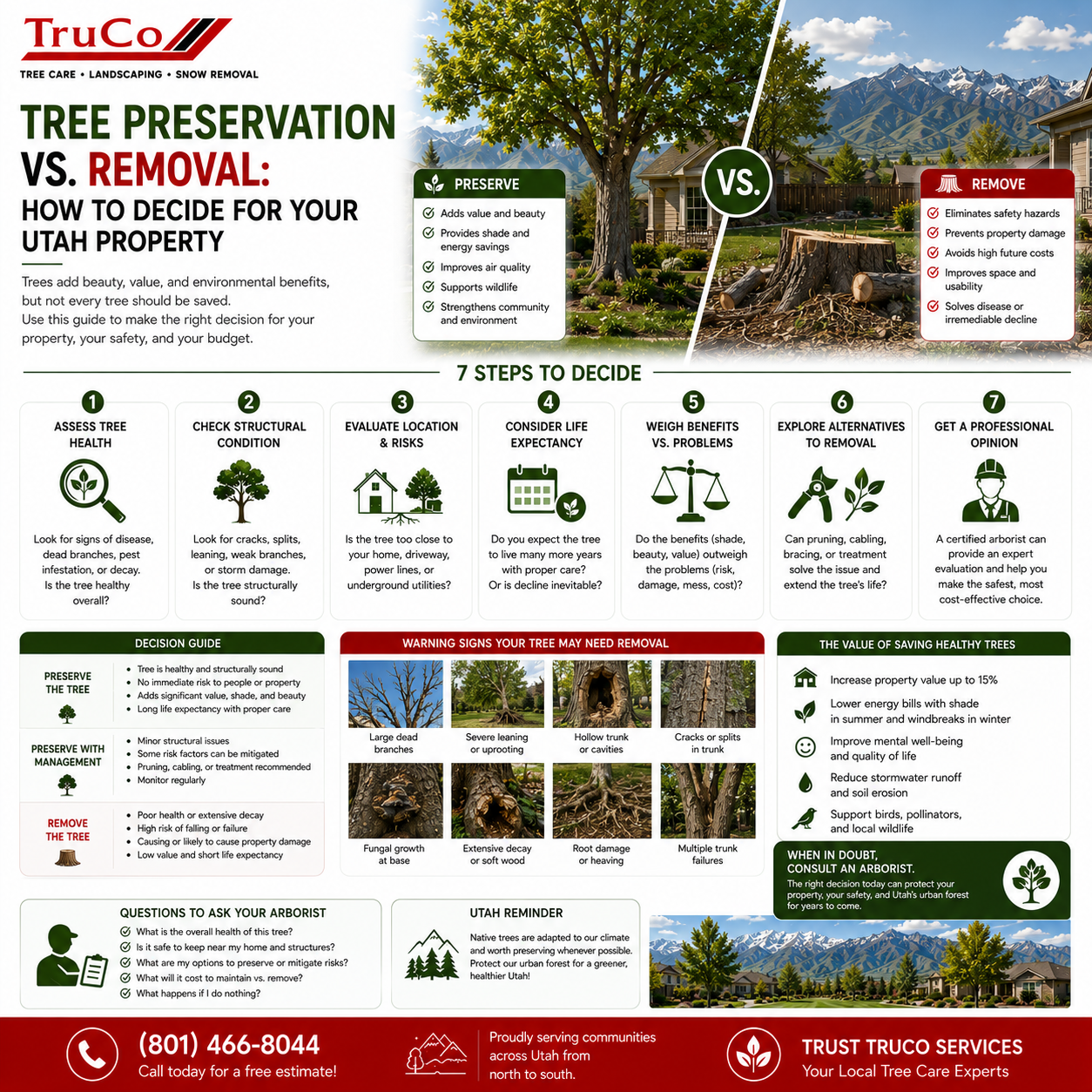
When evaluating preservation vs removal, five factors matter: tree health, structural safety, location, species/age, and cost. A balanced assessment is needed, especially in Utah where alkaline clay soil and semi-arid climate create unique stresses.
Assessing Tree Health
Check for crown dieback (over 50% = serious decline), decay (fungal conks, soft wood, cavities), and pest infestations. Emerald ash borer has devastated ash trees in Salt Lake County. A tree with advanced infestation, significant decay, and extensive dieback is unlikely to recover.
Structural Safety
A lean over 15 degrees may indicate root failure. Vertical cracks or splits in the trunk are serious defects. Root damage from construction is common in growing Utah cities. Trees near homes with structural issues need immediate evaluation.
Location and Infrastructure
Proximity to structures matters. Trees planted too close to foundations in 1970s-80s Utah neighborhoods can damage sewer lines and roofs. Power lines near trees pose fire risks. The closer to structures, the lower the tolerance for risk.
Species and Age
Short-lived: silver maple (60-80 yrs), Lombardy poplar (30-50). Medium: Norway maple, oak (100-200). Long-lived: blue spruce, bur oak (200+). A 70-year-old silver maple with dieback is near end of life. A 50-year-old bur oak has decades ahead.
Cost Comparison
Preservation: assessment $150-350, deep root fertilization $200-400, pest treatments $200-600, pruning $300-1,500. Removal: small tree $400-800, medium $800-2,500, large $2,500-5,000. Replacement: $40-1,200 plus planting. If preservation costs $400-1,000 every few years vs $1,500-5,000 removal + replacement, preservation is often cheaper.
When to Preserve
Healthy tree with minor issues, under 30% dieback, young to middle-aged long-lived species, high property value contribution, heritage or specimen trees.
When to Remove
Over 50% dieback, major structural defects, advanced root damage, dead or nearly dead, imminent safety hazard, invasive species, severe emerald ash borer damage.
Decision Tree
1. Dead or nearly dead? → Remove. 2. Major structural defects? → If near targets, remove; if low-risk, consider mitigation. 3. Manageable health issues? → Preservation. 4. Cost-benefit analysis → Preserve if reasonable, remove if costs exceed replacement.
Working with Arborists
Look for ISA-certified arborists licensed by Utah Department of Agriculture. They can perform resistograph drilling, root crown excavations, and soil analysis. Expect $150-350 for a comprehensive assessment. Get three quotes for major work.
Frequently Asked Questions
Does insurance cover removal? Most policies cover trees that fall on structures, not standing hazardous trees. Proactive removal is your responsibility.
Can I remove a tree myself? DIY tree removal is extremely dangerous. Professionals carry insurance that protects you from liability.
How long do preservation treatments last? Fertilization: 1-2 years. Pest treatments: 2-3 years for trunk injections. Pruning benefits: 3-7 years.
Best time for removal in Utah? Late fall through winter. Trees dormant, prices slightly lower. Avoid spring bird nesting season.
Do I need a permit? Salt Lake City requires permits for trees over 6 inches. Provo, Sandy, Holladay have similar ordinances. Check with city urban forestry.
Most common mistake? Waiting too long until it becomes an emergency. Call an arborist early.