
Tree Pruning Mistakes to Avoid in Utah

Tree Pruning Mistakes to Avoid in Utah
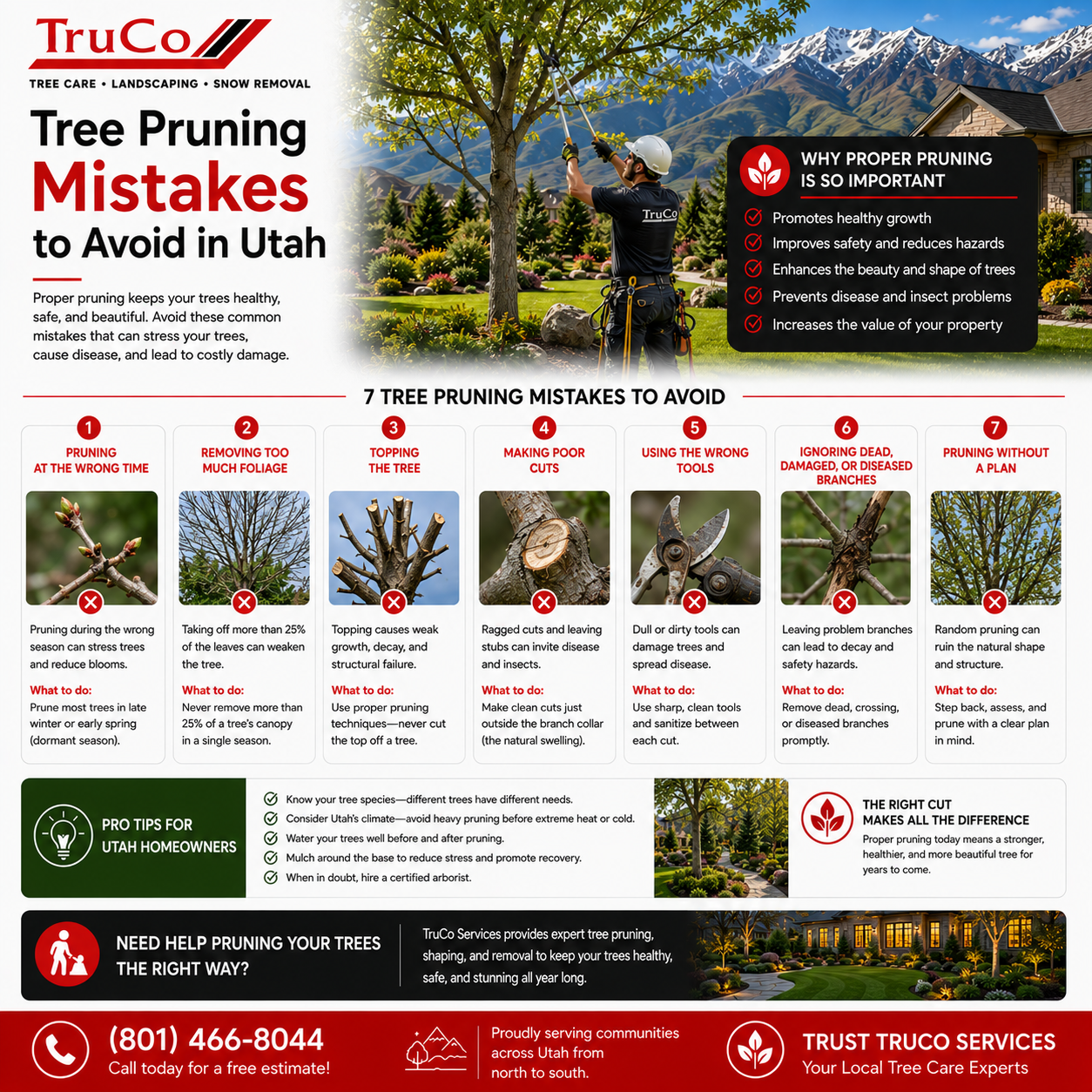
Proper pruning is one of the most important things you can do for the health and safety of your trees. But when done incorrectly, pruning can cause permanent damage, shorten a tree's lifespan, and create safety hazards. In Utah, where trees face challenges from alkaline soil, clay, drought, and harsh winters, pruning mistakes are even more consequential. A bad pruning cut can take years to recover from, and some mistakes cause damage that lasts the entire life of the tree.
Mistake 1: Topping Trees
Topping — cutting the main trunk or large branches back to stubs — is the single worst thing you can do to a tree. It removes 50-100% of the leaf-bearing crown, starving the tree. The tree responds with multiple weak shoots from the cut points that are prone to breaking in Utah's snow and wind storms. Topped trees often decline and die within 5-10 years. Use crown reduction pruning instead.
Mistake 2: Pruning at the Wrong Time
Prune most trees in late winter (February-March) when dormant. Spring-flowering trees should be pruned after blooming. Avoid heavy pruning in late summer or early fall — new growth won't harden off before winter. Prune oaks between November and March to prevent oak wilt.
Mistake 3: Flush Cuts
Cutting too close to the trunk removes the branch collar, creating a larger wound that takes longer to close and invites decay. Always cut just outside the branch collar. For large branches, use the three-cut method to prevent bark tearing.
Mistake 4: Leaving Stubs
Leaving a stub beyond the branch collar creates dead wood that decays and allows disease to enter the tree. Always prune back to a lateral branch or the branch collar.
Mistake 5: Over-Pruning (Lion-Tailing)
Removing too many interior branches concentrates weight at branch tips, increasing failure risk. Never remove more than 25% of live canopy in a year. Maintain interior branches for energy production.
Mistake 6: Wrong Tools or Dull Blades
Dull tools create ragged cuts that heal poorly. Dirty tools spread disease between trees. Use the right tool for each branch size and disinfect between trees, especially after pruning diseased wood.
Mistake 7: Removing Too Many Lower Branches
Lower branches contribute to trunk taper and strength. Removing too many creates a weak, spindly trunk. Keep at least two-thirds of the tree's height in live branches.
Mistake 8: Pruning Without a Plan
Every cut affects the tree's future growth. Before cutting, identify dead/diseased branches first, then structural issues, then shape. Prune in this order: safety, health, structure, appearance.
Mistake 9: Improper Young Tree Pruning
At planting, only remove dead or broken branches. In years 2-5, develop a strong central leader and well-spaced scaffold branches. Remove co-dominant leaders while small.
Mistake 10: Ignoring Safety
For branches requiring a ladder, hire a professional. Never prune within 10 feet of power lines. Use proper safety equipment. For large trees near structures, always hire an ISA-certified arborist.
Frequently Asked Questions
What is the best time to prune in Utah? Late winter (February-March) for most trees. Spring-flowering trees after blooming.
How much can I prune in one year? No more than 25% of live canopy.
What is the difference between thinning and topping? Thinning preserves natural form by removing branches at their origin. Topping destroys form by cutting trunks to stubs.
Can I prune my own trees? Small trees within reach — yes. Large trees, trees near power lines — hire a professional.