
Xeriscape Contractor by Taylorsville UT

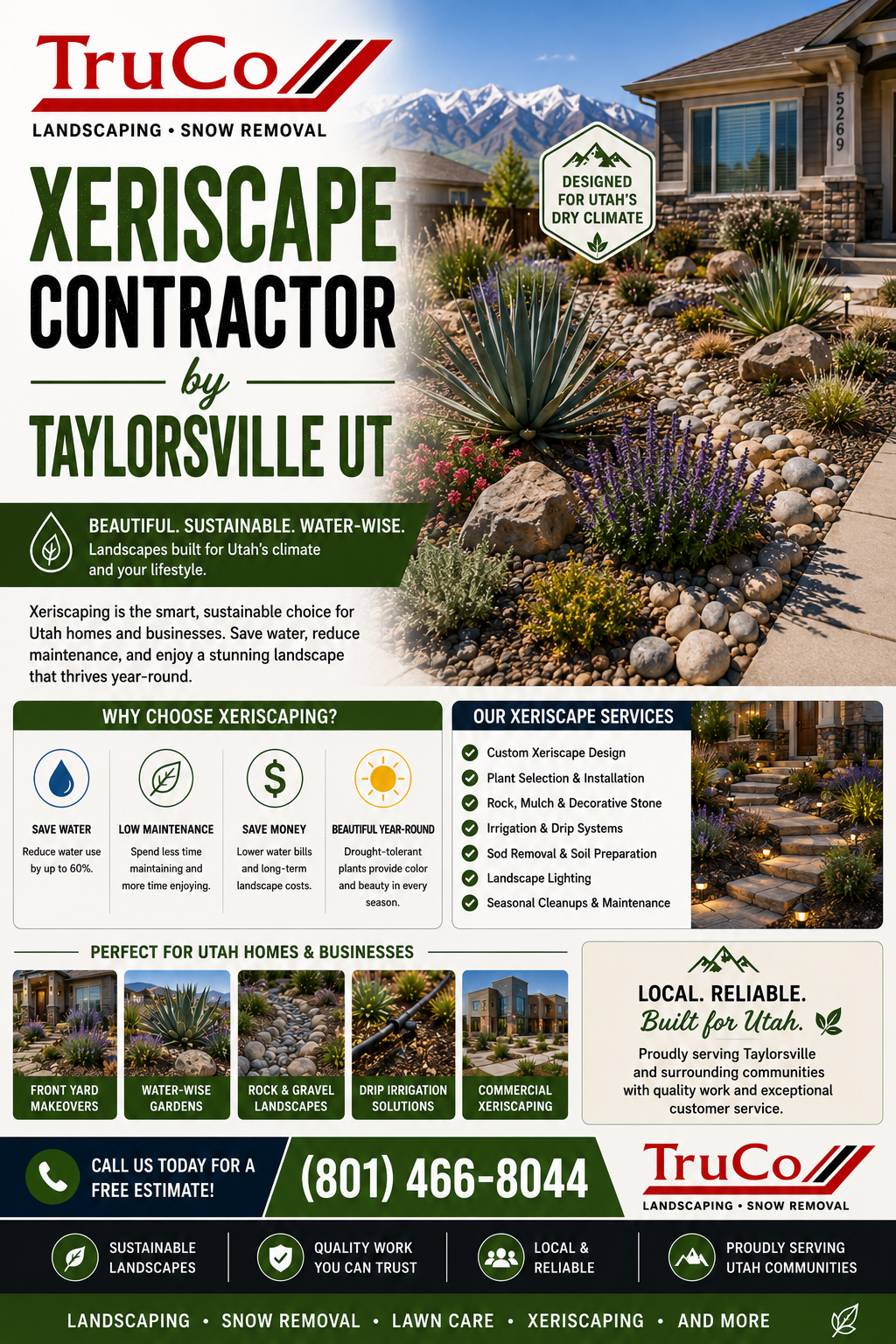
If you’re searching for a Xeriscape contractor by Taylorsville UT, you’re likely ready to cut water bills, reduce yard work, and create a landscape that actually thrives in Utah’s dry climate. Xeriscaping isn’t just “rocks and cactus”—it’s a proven, seven-principle system that can slash outdoor water use by 50–75% while boosting curb appeal and property value. The most important takeaway? Success depends on proper design, soil prep, plant selection, and irrigation—not just swapping grass for gravel. In this guide, you’ll learn how xeriscaping works, the 8 most common ways it can go wrong, real costs (and savings), how to choose the right contractor, and exactly what to do if you’re ready to convert your yard today. Working with an experienced professional like Truco Services ensures your xeriscape is built right the first time—saving you money, time, and frustration down the road.
What Is Xeriscaping and How Does It Work?
Clear Definition
Xeriscaping (pronounced ZER-ih-skaping) is landscaping designed to minimize or eliminate the need for supplemental irrigation. The term comes from the Greek word xeros, meaning “dry.” In Utah’s high-desert climate—where annual precipitation averages just 16 inches in the Salt Lake Valley—xeriscaping is not just eco-friendly; it’s practical.
Key Components & Principles
Xeriscaping follows seven core principles developed by water districts and horticulture experts:
Plan and Design – Map sun exposure, soil type, slope, and water flow before planting.
Improve Soil – Add organic matter to help soil hold moisture and support deep roots.
Limit Turfgrass – Replace unused lawn areas with drought-tolerant plants, hardscape, or ground cover.
Choose Appropriate Plants – Use native and drought-adapted species grouped by water needs (hydrozoning).
Irrigate Efficiently – Install drip systems or soaker hoses; water deeply but infrequently.
Apply Mulch – Use 2–4 inches of mulch to reduce evaporation and suppress weeds.
Maintain Properly – Prune, weed, and adjust irrigation seasonally—not weekly.
Who’s Involved?
Homeowners – Decide goals (e.g., lower bills, less mowing, more usable space).
Xeriscape Contractors – Design, install, and sometimes maintain the landscape.
Local Water Agencies – Often offer rebates for turf removal and efficient irrigation.
Utah State Extension – Provides research-backed plant lists and soil guidance.
What’s Included (and What’s Not)
A full xeriscape conversion typically includes:
Site analysis and design plan
Soil amendment and grading
Drip irrigation installation
Plant selection and installation
Mulch and rock placement
Optional: hardscape (patios, walkways), lighting, drainage solutions
It does not include:
Ongoing weekly maintenance (unless contracted separately)
Traditional sprinkler systems for high-water lawns
Non-drought-tolerant plantings
Real-World Example
A typical Taylorsville home with 5,000 sq. ft. of Kentucky bluegrass lawn uses ~1.5 acre-feet of water annually. Converting 70% to xeriscape (native perennials, ornamental grasses, gravel paths) can reduce that to ~0.5 acre-feet—saving ~$600–$900/year on water bills, based on Jordan Valley Water rates.
8 Ways Xeriscaping Can Go Wrong (and How to Avoid Them)
1. Treating Xeriscape as “Just Rocks”
What happens: Homeowners assume xeriscaping means dumping gravel over the entire yard.
Why it matters: Rock-only yards heat up (increasing home cooling costs), lack biodiversity, and often violate HOA or municipal design standards.
Real-world consequence: A Taylorsville homeowner spent $8,000 on a “xeriscape” that looked like a construction site—and still needed weed control and occasional watering.
How to avoid: Work with a contractor who designs hydrozones—mixing plants, mulch, and hardscape for function and beauty. Truco Services creates custom plans that balance aesthetics, usability, and water savings.
2. Skipping Soil Preparation
What happens: Plants are installed directly into compacted clay or sandy soil without amendment.
Why it matters: Poor soil = shallow roots = plants that die in summer heat or drown in spring runoff.
Real-world consequence: A Murray homeowner’s “drought-tolerant” perennials died within one season because roots couldn’t penetrate hardpan clay.
How to avoid: Insist on soil testing and amendment. Add 1–3 inches of compost worked into the top 6–8 inches. This single step can double plant survival rates.
3. Overwatering During Establishment
What happens: Homeowners water new xeriscape plants daily “to be safe.”
Why it matters: Frequent shallow watering encourages weak, surface-level roots—the opposite of drought tolerance.
Real-world consequence: Plants appear healthy for 6 weeks, then collapse during the first 95°F day because roots never went deep.
How to avoid: Water deeply 2–3 times per week for the first month, then taper to once weekly by month three. Use a soil probe to check moisture at 6-inch depth.
4. Ignoring Hydrozoning
What happens: High-water and low-water plants are mixed in the same bed.
Why it matters: You either underwater the thirsty plants or overwater the drought-tolerant ones—both lead to failure.
Real-world consequence: A West Jordan homeowner’s xeriscape looked patchy: some plants thrived, others rotted from excess moisture.
How to avoid: Group plants by water need:
Low zone (60%+ of yard): Native perennials, ornamental grasses (zero irrigation after establishment)
Moderate zone (≤30%): Shrubs like rabbitbrush or serviceberry (occasional deep watering)
High zone (≤10%): Small lawn area or container plants near entryways
5. Using the Wrong Mulch (or None at All)
What happens: Homeowners skip mulch to “save money” or use fine gravel that compacts.
Why it matters: Mulch reduces evaporation by up to 70%, suppresses weeds, and moderates soil temperature.
Real-world consequence: An unmulched xeriscape in Taylorsville required weekly weeding and lost 40% more water to evaporation than a mulched yard.
How to avoid: Apply 3–4 inches of shredded bark (organic) or 2–3 inches of decomposed granite (inorganic). Replenish organic mulch annually.
6. Installing Traditional Sprinklers Instead of Drip
What happens: Contractors reuse old pop-up sprinklers for xeriscape beds.
Why it matters: Sprinklers lose 30–50% of water to wind drift and evaporation—especially in Utah’s afternoon heat.
Real-world consequence: A Sandy homeowner’s “water-wise” yard still used 1,200 gallons/week because sprinklers watered the driveway and evaporated before reaching roots.
How to avoid: Install drip irrigation with pressure regulators and filters. Place emitters 6–12 inches from plant stems.
7. Choosing Non-Native “Drought-Tolerant” Plants
What happens: Big-box stores sell plants labeled “drought-tolerant” that aren’t adapted to Utah’s Zone 6–7 climate or alkaline soil.
Why it matters: Plants like lavender (from Mediterranean climates) often fail in Utah’s heavy clay and late frosts.
Real-world consequence: A Draper homeowner replaced lawn with “drought-tolerant” English lavender—all died after one winter.
How to avoid: Stick to Utah-native or Wasatch-adapted species:
Perennials: Penstemon, Yarrow, Blanket Flower
Grasses: Blue Grama, Buffalo Grass, Sheep Fescue
Shrubs: Rabbitbrush, Utah Serviceberry, Curlleaf Mountain Mahogany
8. Neglecting Long-Term Maintenance
What happens: Homeowners assume xeriscape = “no maintenance.”
Why it matters: All landscapes need seasonal care: pruning, mulch replenishment, irrigation checks.
Real-world consequence: A Midvale xeriscape became overgrown with weeds and dead grasses within two years—looking worse than the original lawn.
How to avoid: Schedule seasonal maintenance:
Spring: Inspect drip lines, cut back dead growth, top up mulch
Summer: Monitor for drought stress (wilting in evening = water deeply)
Fall: Reduce irrigation, remove annual weeds, prepare plants for dormancy
The Real Cost of Getting Xeriscaping Wrong
Financial Costs
Poor design: $5,000–$15,000 to redo a failed xeriscape (vs. $8,000–$20,000 for a proper install)
Plant replacement: $200–$800/year replacing dead plants from wrong selection or soil prep
Water waste: $300–$600/year from inefficient irrigation or overwatering
Increased cooling bills: Rock-only yards can raise home AC costs by 10–15% in summer
Time Costs
DIY failures: 40–80 hours researching, installing, then redoing mistakes
Weekly weeding: Unmulched or poorly designed xeriscapes require 1–2 hours/week of weed control
Irrigation troubleshooting: Fixing leaks, clogged emitters, or timer errors = 5–10 hours/season
Emotional & Relational Costs
HOA violations: Non-compliant designs can result in fines ($50–$200/month) or forced removal
Curb appeal loss: Patchy, dead, or weedy yards reduce property value by 5–10%
Family frustration: “Low-maintenance” yards that require constant fixing create stress, not relief
Long-Term Consequences
Soil degradation: Compacted, unamended soil becomes harder to fix over time
Invasive weeds: Cheatgrass and Russian thistle establish quickly in poorly mulched areas—costing $1,000+ to eradicate
Water restrictions: As Utah faces long-term drought, non-compliant landscapes may face mandatory conversion
The Good News: Most Costs Are Avoidable
With proper planning, soil prep, plant selection, and irrigation, xeriscaping delivers:
50–75% less water use
60–80% less maintenance time
$600–$1,200/year water savings (based on 5,000 sq. ft. lawn conversion)
Increased property value (water-wise landscapes are a selling point in Utah)
How an Experienced Xeriscape Contractor Helps You Succeed
Guidance Through Every Step
A pro like Truco Services doesn’t just install plants—they walk you through:
Site assessment (sun, soil, slope, drainage)
Design options (usable lawn vs. full conversion)
Plant palette (native, pollinator-friendly, pet-safe)
Irrigation layout (drip zones, timers, rain sensors)
Proper Preparation & Execution
Soil testing: pH, texture, drainage rate
Amendment: Compost, gypsum (for clay), or sand (for drainage)
Grading: Ensure water flows away from foundation, toward planting beds
Irrigation: Pressure-regulated drip with backflow prevention
Risk Management
Plant guarantees: Reputable contractors replace plants that die within 1 year
Irrigation warranties: 2–5 years on lines, emitters, controllers
Drainage solutions: Prevent pooling near foundations or walkways
Dispute Resolution & Troubleshooting
HOA compliance: Ensure designs meet community standards
Water agency rebates: Help you apply for turf removal incentives (up to $1.50/sq. ft. in some areas)
Seasonal check-ups: Annual inspections to adjust irrigation, prune, and replenish mulch
Compliance with Local Rules
Taylorsville municipal codes: Some areas restrict rock-only front yards or require permeable hardscape
Utah water conservation goals: State targets 25% per-capita water reduction by 2030—xeriscaping is a key strategy
Proactive Strategies
Microclimate creation: Use fences, walls, or trees to shelter moderate-water plants
Rainwater harvesting: Redirect downspouts to planting beds (600 gallons per inch of rain per 1,000 sq. ft. roof)
Smart controllers: Wi-Fi timers that adjust watering based on weather forecasts
Xeriscape Options, Alternatives, and Strategies
Option 1: Full Xeriscape Conversion
How it works: Remove 100% of turf; install native perennials, grasses, mulch, and hardscape.
When it’s appropriate:
You rarely use your lawn
You want maximum water savings
You’re okay with no traditional grass
Limitations:
Higher upfront cost ($15,000–$25,000 for 5,000 sq. ft.)
Less play space for kids/pets
May not qualify for all turf rebates (some require retaining small lawn)
Option 2: Hybrid Xeriscape (Recommended for Most)
How it works: Keep 10–20% functional lawn (e.g., play area, dog run); convert rest to drought-tolerant plantings.
When it’s appropriate:
You have kids or pets
You want some green space
You need to meet HOA requirements
Limitations:
Still requires some irrigation and mowing
Slightly lower water savings (~50% vs. 75%)
Option 3: Xeriscape with Native Meadow
How it works: Replace lawn with native grasses (buffalo grass, sheep fescue) and wildflowers.
When it’s appropriate:
You want a natural, pollinator-friendly look
You’re okay with seasonal color changes (brown in winter)
You have a larger lot (>10,000 sq. ft.)
Limitations:
Not suitable for high-traffic areas
Requires annual mowing (once in late winter)
Option 4: Hardscape-Dominant Xeriscape
How it works: Use patios, walkways, gravel, and boulders for 60–80% of yard; plant in islands.
When it’s appropriate:
You entertain outdoors frequently
You want ultra-low maintenance
You have steep slopes or drainage issues
Limitations:
Higher heat retention (use light-colored rock)
Less biodiversity
May feel “sterile” without enough plantings
Option 5: Phased Conversion
How it works: Convert yard in stages over 2–3 years (e.g., front yard first, then back).
When it’s appropriate:
Budget constraints
You want to test plant performance
You’re DIY-ing part of the work
Limitations:
Longer timeline to full savings
Inconsistent appearance during transition
What to Do If You’re Currently Dealing With a Xeriscape Problem
Immediate Action Checklist
Identify the issue: Is it dead plants, weeds, irrigation failure, or drainage?
Check irrigation: Run each zone; look for leaks, clogged emitters, or misaligned heads.
Test soil moisture: Use a probe or screwdriver—if it won’t penetrate 6 inches, soil is too dry or compacted.
Document problems: Take photos for contractor consultation or warranty claims.
Stop overwatering: If plants are yellowing or mushy, reduce frequency immediately.
Pull weeds manually: Avoid herbicides until you know which plants are affected.
Call a pro: For irrigation repairs, plant replacement, or redesign, contact Truco Services at (801) 466-8044.
How to Choose the Right Xeriscape Contractor in Taylorsville
✅ Experience & Credentials
Years in business: Look for 5+ years specializing in xeriscaping (not just general landscaping)
Certifications: Utah Nursery & Landscape Association (UNLA), Irrigation Association (IA)
Portfolio: Ask for before/after photos of Taylorsville or Salt Lake County projects
✅ Subject-Matter Expertise
Plant knowledge: Can they name 10+ Utah-native perennials and grasses?
Soil & irrigation: Do they test soil and design drip systems (not just sprinklers)?
Hydrozoning: Do they explain low/moderate/high water zones clearly?
✅ Clear, Plain-English Communication
No jargon: They explain terms like “hydrozone,” “emitter,” and “organic matter” simply
Written plan: Provides a scaled design with plant list, irrigation map, and maintenance schedule
Transparent pricing: Breaks down costs (design, soil, plants, irrigation, mulch, labor)
✅ Availability & Responsiveness
Timeline: Can start within 4–8 weeks (peak season is March–June)
Warranty: Offers 1-year plant guarantee, 2+ years on irrigation
Follow-up: Schedules a 30-day check-up after installation
✅ Comprehensive Approach
Full service: Design, install, and optional maintenance (not just “we’ll drop off plants”)
Rebate assistance: Helps apply for local water agency incentives
Drainage solutions: Addresses grading, French drains, or dry wells if needed
✅ Long-Term Partnership
Seasonal care: Offers spring/fall tune-ups (irrigation audit, mulch refresh, pruning)
Plant replacement: Will swap out failed plants in year one
Education: Teaches you how to water, weed, and maintain your xeriscape
Truco Services meets all these criteria: experienced in Taylorsville xeriscaping, certified in irrigation design, and committed to long-term client success. Call (801) 466-8044 for a free consultation.
Common Mistakes People Make With Xeriscaping
Assuming “drought-tolerant” means “no water” – All plants need water to establish; skip this and they die.
Planting in summer heat – Best planting times are spring (April–May) or fall (September–October) in Utah.
Using landscape fabric under rock – It clogs, prevents soil improvement, and makes plant additions impossible.
Ignoring slope and drainage – Water pools near foundations or washes away mulch on steep areas.
Choosing plants by looks alone – A beautiful plant that needs daily watering defeats the purpose.
Installing drip without filters or pressure regulators – Emitters clog or burst within months.
Forgetting about winter – Some “drought-tolerant” plants aren’t cold-hardy in Zone 6.
DIY-ing without a plan – Random plant placement leads to overcrowding, poor growth, and wasted money.
Frequently Asked Questions
What is xeriscaping?
Xeriscaping is landscaping designed to minimize water use through drought-tolerant plants, efficient irrigation, soil improvement, and mulching. It can reduce outdoor water consumption by 50–75%.
Is xeriscaping just rocks and cactus?
No. Xeriscaping includes a variety of plants (perennials, grasses, shrubs), mulch, and hardscape. It can look lush, natural, or formal—not just “desert.”
How much does xeriscaping cost in Taylorsville?
Typical costs range from $8–$20 per square foot, depending on design complexity, plant size, and irrigation needs. A 5,000 sq. ft. yard averages $15,000–$25,000.
How long does it take to install a xeriscape?
Most residential projects take 1–3 weeks from design to completion, weather permitting. Peak season (March–June) may have longer wait times.
Can I keep some lawn with xeriscaping?
Yes. A hybrid approach keeps 10–20% functional lawn (for play, pets, or aesthetics) while converting the rest to drought-tolerant plantings.
What plants are best for xeriscaping in Utah?
Native and adapted species like Penstemon, Yarrow, Blue Grama grass, Buffalo grass, Rabbitbrush, and Utah Serviceberry thrive with minimal water.
Do I need to water a xeriscape?
Yes—during the first 1–2 years for plant establishment. After that, low-water zones need zero irrigation; moderate zones need occasional deep watering.
Will xeriscaping save me money on water bills?
Most homeowners save $600–$1,200/year by converting 70% of their lawn to xeriscape, based on Jordan Valley Water rates.
Are there rebates for xeriscaping in Utah?
Yes. Many water agencies (e.g., Jordan Valley, Weber Basin) offer turf removal rebates up to $1.50/sq. ft. Check with your local provider.
Can xeriscaping increase my home’s value?
Yes. Water-wise landscapes are increasingly valued in Utah’s drought-prone climate, boosting curb appeal and marketability.
Is xeriscaping pet-friendly?
Yes. Avoid toxic plants (e.g., Oleander, Sago Palm) and use pet-safe mulch (shredded bark, not cocoa hulls). Most native grasses and perennials are safe.
How do I maintain a xeriscape?
Seasonal tasks include: spring irrigation check, summer weed control, fall pruning, and annual mulch replenishment. Expect 5–10 hours/year vs. 50+ for traditional lawns.
Can I install xeriscaping myself?
DIY is possible for small areas, but professional design and irrigation installation prevent costly mistakes. Soil prep and hydrozoning are critical.
What’s the difference between xeriscaping and native landscaping?
Xeriscaping focuses on water efficiency (using native or adapted plants). Native landscaping uses only region-specific species. All native landscapes are xeriscapes, but not all xeriscapes are 100% native.
Does xeriscaping work on slopes?
Yes—and it’s ideal for erosion control. Use deep-rooted natives, terracing, and mulch to stabilize slopes. Avoid rock-only covers that can slide.
How deep should mulch be in a xeriscape?
Apply 3–4 inches of organic mulch (bark, wood chips) or 2–3 inches of inorganic mulch (gravel, decomposed granite). Replenish annually.
Can I use drip irrigation with existing sprinklers?
Yes. Convert zones to drip by installing a pressure regulator, filter, and tubing. Keep high-water plants (like lawn) on sprinklers; use drip for beds.
What soil amendments are best for xeriscaping in Utah?
Add 1–3 inches of compost worked into the top 6–8 inches. For clay soil, consider gypsum; for sandy soil, add organic matter to improve retention.
How often should I water new xeriscape plants?
Water deeply 2–3 times/week for the first month, then taper to once/week by month three. Use a soil probe to check moisture at 6-inch depth.
Will my HOA allow xeriscaping?
Most Utah HOAs now permit xeriscaping, especially with a design plan. Some restrict rock-only front yards—check your covenants first.
Can xeriscaping help with drainage issues?
Yes. Proper grading, French drains, and permeable hardscape can direct water away from foundations and into planting beds.
What’s the lifespan of a xeriscape?
With proper maintenance, xeriscapes last 15–25+ years. Plants may need replacement every 5–10 years; irrigation systems last 10–15 years.
Are there pests or diseases in xeriscapes?
Minimal. Native plants are adapted to local pests. Occasional issues include aphids (spray with water) or root rot (from overwatering).
Can I add lighting to my xeriscape?
Yes. Low-voltage LED path lights or uplights enhance safety and aesthetics. Install during initial landscaping to avoid digging later.
How do I choose a xeriscape contractor?
Look for: 5+ years experience, Utah-native plant knowledge, drip irrigation expertise, written design plans, plant warranties, and local references.
Does Truco Services offer xeriscaping in Taylorsville?
Yes. Truco Services provides full xeriscape design, installation, and maintenance for Taylorsville and Salt Lake County. Call (801) 466-8044 for a free consultation.
Key Rules, Laws, and Standards for Xeriscaping in Utah
Utah Water Conservation Goals
The state aims to reduce per-capita water use by 25% by 2030. Xeriscaping is a key strategy in the Utah Water Conservation Plan.
Local Municipal Codes
Taylorsville: Requires permeable surfaces for driveways/walkways; restricts rock-only front yards in some zones.
Salt Lake County: Offers turf removal rebates; requires backflow prevention on irrigation systems.
Irrigation Standards
Backflow prevention: Required on all residential irrigation to protect drinking water (Utah Administrative Code R309).
Drip irrigation: Must include pressure regulators and filters to prevent clogging and bursting.
HOA Guidelines
Most HOAs now permit xeriscaping but may require:
Approved design plans
Minimum plant coverage (e.g., 50% of yard must be living plants, not rock)
Maintenance standards (weed-free, irrigated during establishment)
Plant Regulations
No invasive species: Avoid planting Russian olive, Tamarisk, or Cheatgrass—illegal in some Utah jurisdictions.
Native plant incentives: Some rebates require 50%+ native species.
Conclusion
Xeriscaping is one of the smartest investments a Taylorsville homeowner can make—cutting water bills, reducing maintenance, and creating a landscape that thrives in Utah’s dry climate. But success depends on proper design, soil prep, plant selection, and irrigation. The 8 common pitfalls outlined above are entirely avoidable with expert guidance. Whether you’re planning a full conversion, a hybrid yard, or fixing a failed DIY attempt, working with an experienced professional ensures your xeriscape delivers on its promises.
Ready to transform your yard? Consult with Truco Services—your trusted Xeriscape contractor by Taylorsville UT. Call (801) 466-8044 today for a free, no-obligation consultation. Let’s build a beautiful, water-wise landscape that works for your lifestyle—and Utah’s future.