
How to Choose the Right Tree Size at Planting in Utah

Why Tree Size Matters at Planting Time in Utah
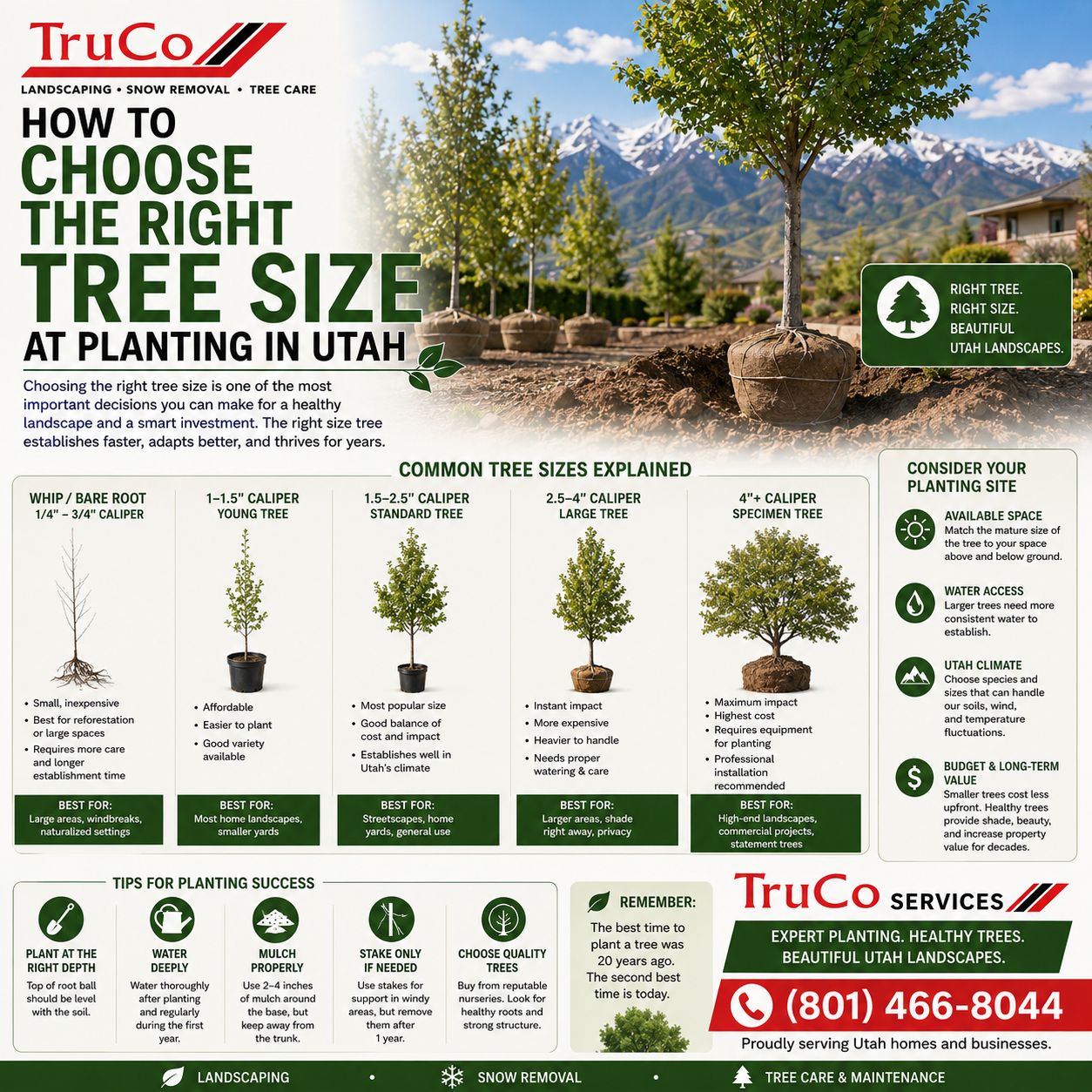
When planting a tree in Utah, one of the most important decisions you'll make is what size to buy. The choice between a small 1-gallon sapling and a large 30-gallon specimen affects cost, establishment success, long-term health, and how quickly you get the benefits of a mature tree. Many Utah homeowners assume bigger is better — a larger tree at planting means an instant landscape. However, research and experience show that smaller trees often outperform larger ones in the long run. Smaller trees establish more quickly, develop healthier root systems, and often surpass larger trees in growth within a few years. Larger trees, while providing immediate impact, experience more transplant shock and require more intensive aftercare. Utah's challenging climate — with its alkaline clay soil, intense sun, dry conditions, and temperature extremes — makes the size decision even more critical. This guide compares the pros and cons of different tree sizes available at Utah nurseries and helps you choose the best size for your specific situation.
Tree Size Options at Utah Nurseries
Utah nurseries typically offer trees in several standard sizes. 1-gallon containers ($15-40) — the smallest commonly available size. Trees are typically 1-3 feet tall with a well-developed root system relative to the top growth. These are often 1-2 year old trees. Excellent establishment rate with very little transplant shock. Best value for the money but require the most patience. 5-gallon containers ($40-80) — the most popular size for Utah homeowners. Trees are typically 3-6 feet tall. Good balance between size and establishment success. A 5-gallon tree planted today will often catch up to a larger tree within 2-3 years. 15-gallon containers ($100-200) — a substantial tree, typically 6-10 feet tall with a 1-1.5 inch trunk diameter. Provides instant landscape impact. Higher transplant shock risk. Requires careful watering for 2-3 years. Good for projects where immediate presence is important. 30-gallon containers ($200-400) — large specimen trees, typically 8-12 feet tall with a 1.5-2.5 inch trunk diameter. Maximum instant impact. Highest cost and highest transplant shock. Requires the most intensive aftercare. Best used for special landscape features or when a mature look is needed immediately. 45-gallon and larger ($400-1,000+) — very large specimen trees. Typically installed by professional landscape contractors. Require specialized equipment for planting. Highest risk of transplant failure. Used for high-end landscaping projects where budget is not the primary concern. Bare-root trees ($15-50) — available in late winter/early spring when dormant. No soil around the roots. Lightest weight, easiest to plant. Excellent establishment if planted correctly. Limited planting window (dormant season only). Not all species available. Balled-and-burlapped (B&B) ($100-500+) — field-dug trees with soil ball wrapped in burlap. Sizes range from 2-6 inch trunk diameter. Can be very large, providing immediate shade. Heavy, requires equipment to move. Moderately high transplant shock. Roots often damaged during digging.
Advantages of Smaller Trees
Smaller trees offer compelling advantages, especially in Utah's challenging climate. Faster establishment — a 1-gallon or 5-gallon tree planted in Utah soil typically establishes its root system within one growing season. A 15-gallon tree may take 2-3 years, and a 30-gallon tree may take 3-5 years. Faster establishment means the tree becomes self-sufficient sooner. Less transplant shock — smaller trees experience less root loss during transplanting. Nursery containers allow roots to grow in an air-pruned, non-circling pattern. This means the root system is healthier and better prepared for life in the ground. In Utah's clay soil, smaller roots adapt more quickly to local conditions. Better long-term growth — studies show that smaller trees often catch up to and surpass larger trees within 5-10 years. A 5-gallon tree may be taller and have a larger trunk diameter 5 years after planting than a 15-gallon tree planted at the same time. Lower cost — a 5-gallon tree costs 50-75% less than a 15-gallon tree, and 80-90% less than a 30-gallon tree. Money saved can be used to buy more trees or invest in soil preparation and irrigation. Easier to plant — one person can plant a 5-gallon tree without equipment. Larger trees may require multiple people and specialized tools. This makes smaller trees more DIY-friendly. Better adaptability — smaller trees adapt more readily to Utah's alkaline soil and local conditions. They haven't been growing in optimized nursery soil for years and adjust to native soil conditions more quickly.
When to Choose a Larger Tree
Despite the advantages of smaller trees, there are situations where a larger tree is the better choice. Immediate landscape impact — if you need shade, privacy screening, or a visual anchor right away, a larger tree provides instant results. A 15-gallon or 30-gallon tree makes an immediate statement that a 5-gallon tree cannot match. New construction landscaping — when a house is newly built, the bare landscape often calls for trees with more presence. In Utah's new developments, larger trees help the landscape feel established and complete. Rental properties — if you're landscaping for a rental property you plan to sell within 5 years, larger trees may provide better return on investment. The immediate curb appeal can increase property value and sale price. Special landscape features — for a focal point tree in a prominent location, a larger specimen may be worth the extra cost and care. Entryway trees, patio accent trees, and memorial trees are examples where size matters. Replacement tree in an established landscape — if a mature tree died and left a gap in an established landscape, a larger replacement will match the scale of surrounding plants better than a small tree. High-wind areas — in Utah's windy locations, a larger, sturdier tree may survive better than a small sapling that could be damaged by wind. However, proper staking is still essential. Professional installation — if you're hiring a landscape contractor, larger trees are more feasible because professionals have the equipment and expertise to plant them successfully. They also typically include a warranty.
Tree Size vs. Trunk Diameter vs. Age: What Matters Most?
Understanding how tree size relates to age and trunk diameter helps you make an informed decision. Trunk diameter (caliper) is the most reliable indicator of tree size and age. Measured 6 inches above the ground for trees under 4 inches diameter, and 12 inches above for larger trees. In Utah nurseries, trees are typically sold by container size (gallons) or caliper (inches). A 1-inch caliper tree is typically 2-3 years old. A 2-inch caliper tree is typically 4-6 years old. A 3-inch caliper tree is typically 7-10 years old. Container size does not always correlate directly with tree age or size. A tree that has been in a 15-gallon container for 3 years may be root-bound and not as healthy as a tree that was recently potted up from a 5-gallon container. When buying trees in Utah, inspect the root system. Gently remove the tree from the container and check for circling roots. A root-bound tree may never develop a healthy root system, regardless of its top size. Ask the nursery when the tree was last potted up. Trees that have been in their container for less than one year typically have the healthiest root systems. Price is not always proportional to size — a 15-gallon tree may cost twice as much as a 5-gallon tree but only be one year older. Consider whether the extra cost is worth the relatively small age difference.
Practical Recommendations for Utah Homeowners
Based on Utah's growing conditions, here are practical size recommendations. For most Utah homeowners, 5-gallon trees offer the best value and highest success rate. They establish quickly, cost less, and often surpass larger trees within 3-5 years. If you want faster results and have a higher budget, choose 15-gallon trees. They provide noticeable instant impact while still establishing reasonably well in Utah's climate. Avoid 30-gallon and larger trees unless you have professional help and are prepared for the intensive aftercare required. The transplant shock and extended establishment period in Utah's climate make these sizes a higher-risk investment. For bare-root trees, take advantage of this option if available. They offer excellent value and establish quickly. The limited planting window (March-April in Utah) is the main drawback. For balled-and-burlapped trees, only use this option for large specimen trees that cannot be grown in containers. B&B trees lose 90-95% of their root system during digging, which causes severe transplant shock. For all tree sizes, proper planting technique matters more than size. A well-planted 5-gallon tree will outperform a poorly planted 15-gallon tree every time. Follow Utah-specific planting guidelines: wide planting hole, proper depth, no amendments in the backfill, and regular deep watering.
Frequently Asked Questions
What is the best tree size to plant in Utah? For most homeowners, 5-gallon trees offer the best combination of price, establishment success, and long-term growth. They establish quickly in Utah's climate and often surpass larger trees within 3-5 years.
Do smaller trees really grow faster than larger trees? Yes. Smaller trees have a better root-to-shoot ratio after transplanting, which means they don't need to regrow as many roots to support their top growth. This allows them to establish faster and begin active growth sooner. Studies have shown smaller trees surpassing larger ones within 5-10 years.
How much more does a larger tree cost in Utah? Tree prices increase significantly with size. Expect to pay 2-3 times more for a 15-gallon tree than a 5-gallon tree, and 4-5 times more for a 30-gallon tree. Professional installation adds $100-500 depending on tree size and site conditions.
Can I plant a large tree by myself in Utah? You can plant up to a 15-gallon tree by yourself with proper technique. Trees larger than 15 gallons typically require two or more people and may need equipment for moving and positioning. Professional installation is recommended for trees over 30 gallons.
How long does it take for different tree sizes to establish in Utah? 1-5 gallon trees typically establish within 1 growing season. 15-gallon trees take 2-3 years to fully establish. 30-gallon trees may take 3-5 years. Larger specimen trees can take 5+ years to establish. Establishment means the tree can survive on natural rainfall with minimal supplemental watering.