
How to Prevent and Treat Tree Bark Damage in Utah

Why Tree Bark Matters for Utah Trees
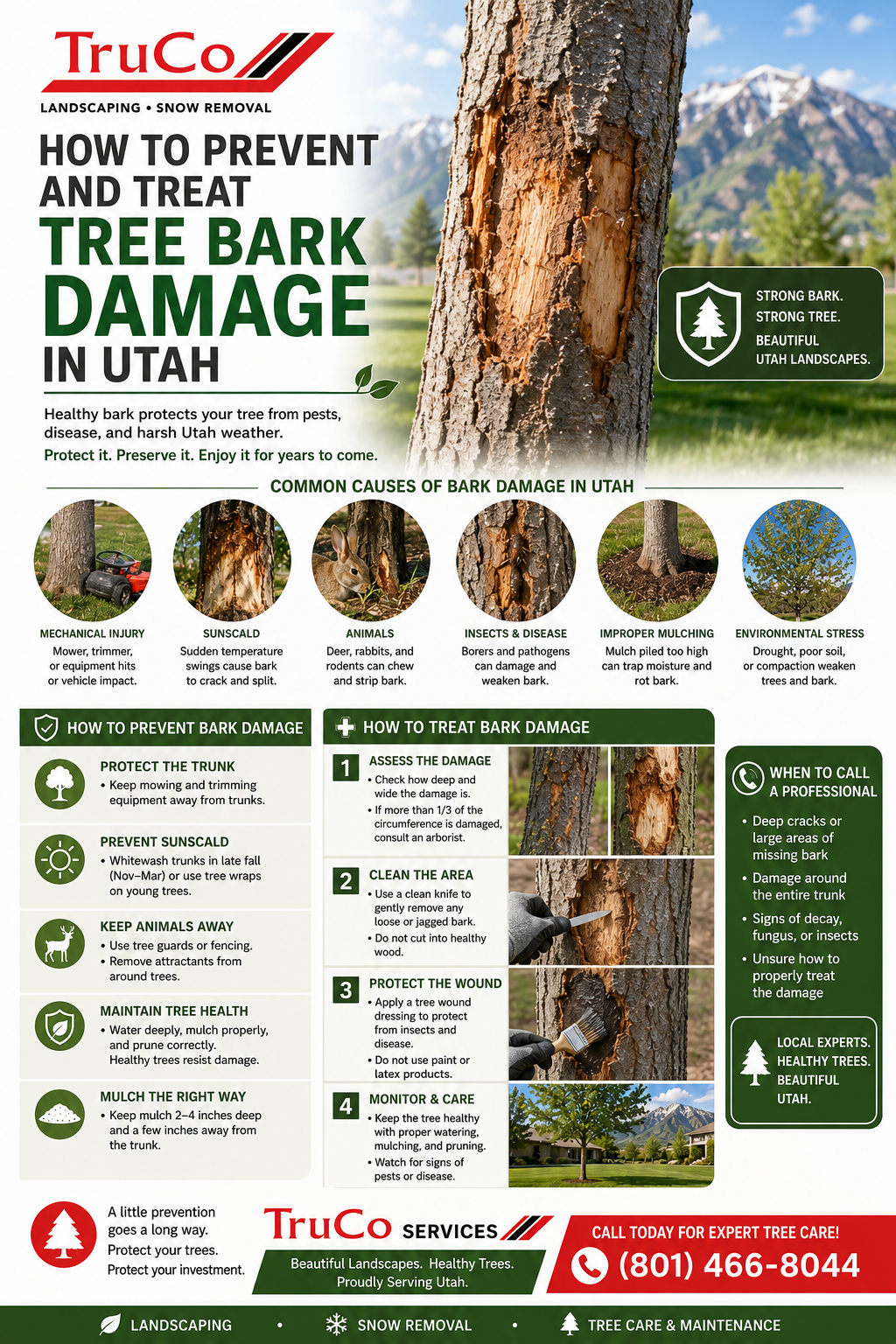
Tree bark is more than just a protective covering — it is the tree's immune system, vascular system, and first line of defense against pests, diseases, and environmental stress. In Utah's challenging climate, bark damage is a common problem that can seriously compromise tree health. Sunscald (southwest winter injury), mechanical damage from lawn equipment, animal damage from rodents and deer, frost cracks, and improper pruning are all types of bark damage that affect Utah trees. Understanding how bark functions, what causes damage, and how to prevent and treat injuries is essential for maintaining healthy trees. This guide covers the most common types of bark damage in Utah, prevention strategies, and proper treatment techniques.
Types of Bark Damage Common in Utah
Utah trees face several specific types of bark damage. Sunscald occurs on the south and southwest sides of thin-barked trees (maples, birches, fruit trees, young trees). Winter sun warms the bark, causing cells to break dormancy, then freezing temperatures at night kill the active cells. This creates vertical cracks or dead patches. Frost cracks appear as long, vertical cracks in the trunk, often on the south or west side. Caused by rapid temperature drops after sun exposure. These cracks may open in winter and close in summer. Lawn mower and string trimmer damage is the most common mechanical injury to Utah trees. Repeated impacts at the base of the trunk remove bark and cambium, eventually girdling the tree. Deer and rodent damage — deer rub antlers on young trees, removing bark. Voles, rabbits, and mice gnaw bark at the base, especially under snow cover. Codominant stem splits occur when two main trunks with included bark grow together. Heavy wind or snow causes them to split apart, tearing bark down the trunk. Lightning strikes cause explosive bark damage — a strip of bark is blown off the trunk. While rare in urban areas, lightning damage can be fatal. Construction damage occurs when equipment bumps into trunks, removing bark and compacting soil around roots. Girdling roots — roots that circle the trunk instead of growing outward — can compress the bark and cambium, eventually girdling the tree. This is common in container-grown trees that were not root-pruned before planting.
Preventing Bark Damage
Prevention is far more effective than treatment for bark damage. Protect from sunscald by wrapping the trunks of thin-barked trees with white tree wrap in November. Remove the wrap in March or April. For young trees, apply white latex paint (diluted 50:50 with water) to the south and southwest sides of the trunk as an alternative. This reflects sunlight and prevents temperature extremes. Prevent mechanical damage by maintaining a mulch ring (3-4 inches of mulch, kept away from the trunk) around the base of trees. This eliminates the need to mow or trim close to the trunk. If grass grows near the trunk, hand-trim carefully. Install mower guards or physical barriers (rock rings, spiral tree guards) around young trees. Protect from animal damage with hardware cloth cylinders (¼-inch mesh) around the base of young trees. Cylinders should extend above expected snow depth (12-24 inches in most Utah locations). Remove guards in spring if they could girdle the growing trunk. For deer, use fencing or repellent sprays. Deer-resistant tree species also help. Prevent frost cracks by choosing trees with good cold hardiness for your zone, avoiding heavy pruning in late summer (which stimulates late growth that may not harden off), and maintaining tree health. Proper pruning to develop strong branch structure prevents codominant stem splits. Train young trees to a single central leader. Remove crossing or rubbing branches. Encourage wide branch angles through proper pruning techniques. Plant trees at the correct depth to prevent girdling roots — the root flare should be visible above the soil line.
Treating Bark Damage: When and How
Proper treatment of bark damage depends on the type and severity. Small wounds (under 2 inches in diameter) — clean the wound edges with a sharp knife (remove loose, torn bark). Do not apply wound paint or sealant — trees seal wounds naturally. Allow the wound to dry. Most small wounds heal within one growing season. Larger wounds (2-6 inches) — clean the wound edges and shape them into an oval or football shape (pointed at top and bottom) to encourage the tree to seal the wound. Remove loose bark without damaging the cambium layer underneath. Do not paint or seal. Monitor for signs of decay or pest infestation. Bridge grafting may be needed for large wounds on valuable trees — contact a certified arborist. Girdling wounds (bark removed completely around the trunk circumference) — this is the most serious type of bark damage. If the cambium is destroyed all the way around, the tree will die above the damage. For partial girdling (less than 50% of circumference), the tree may survive with proper care. For complete girdling, the tree cannot be saved and should be removed. An arborist may attempt bridge grafting for valuable specimen trees. Frost cracks — no treatment is necessary for most frost cracks. They close in summer and reopen in winter. Over time, the tree may seal the crack with callus tissue. Do not fill cracks with concrete or sealant — this can trap moisture and promote decay. Lightning damage — assess the tree for other damage. Many trees survive lightning strikes. Provide supportive care (water, mulch) and monitor for secondary pest infestations. Consult an arborist for a thorough evaluation. The old practice of painting wounds with pruning sealer or wound paint has been shown to be harmful — it traps moisture and decay organisms, preventing the tree from sealing the wound naturally. Modern arboriculture recommends leaving wounds open to dry.
Bark Damage from Lawn Equipment
Lawn mower and string trimmer damage is the most preventable bark injury in Utah landscapes. The damage occurs when mowers bump into trunks and string trimmers strip bark at the base. Repeated damage over several seasons can girdle and kill the tree. Symptoms include missing bark at the base of the trunk, flattened or scarred areas, discolored or dead bark, and frass (sawdust-like material) from insects attracted to wounded bark. Prevention is simple — create a mulch ring around each tree. A 3-4 foot diameter ring of 3-4 inches of mulch eliminates the need to mow or trim near the trunk. Use organic mulch (wood chips, bark) and keep it 3-6 inches away from the trunk. Install a physical barrier such as a tree ring, stone border, or spiral tree guard around the trunk. Train lawn maintenance crews to avoid hitting trees. Use string trimmers only parallel to the trunk, not perpendicular. If damage has already occurred, clean the wound edges with a sharp knife, remove loose bark, and let the wound heal naturally. Do not apply paint or sealant. If the damage extends more than 50% around the trunk circumference, consult a certified arborist. In Utah, where many properties have turf grass right up to tree trunks, mower damage is especially common. Making the effort to establish and maintain mulch rings around trees is one of the most important things you can do for tree health.
Bark Damage from Utah Wildlife
Utah's wildlife can cause significant bark damage, especially to young trees. Deer damage — male deer rub their antlers on tree trunks to remove velvet during fall (September-October). This strips bark from young trees and can girdle them. Bucks typically rub trees 2-4 inches in diameter. Protect young trees with tree wraps, hardware cloth cylinders, or plastic spiral guards. Apply deer repellent sprays in September before rubbing season. Choose deer-resistant tree species for areas with heavy deer pressure. Vole and rabbit damage — voles and rabbits gnaw bark at the base of trees, especially under snow cover where they are protected from predators. Damage appears as girdling of bark in a band around the trunk base. In Utah's mountain communities, vole damage is a leading cause of young tree death. Install hardware cloth cylinders (¼-inch mesh) around trunks, extending above expected snow depth. The cylinder should be 2-3 inches away from the trunk to prevent animals from reaching through. Remove aggressive weed growth and mulch that provides cover for rodents. Use snap traps or bait stations if vole populations are high. Porcupine damage — porcupines chew bark on tree trunks and branches, especially in winter. They prefer conifers but will also damage deciduous trees. Protect with tree wraps or wire cylinders. Discourage porcupines by removing brush piles and rock crevices that provide shelter. Woodpecker damage — woodpeckers drill holes in bark to access insects. This is usually a symptom of an existing insect problem, not the primary cause of damage. Identify and treat the underlying insect infestation. Sapsuckers drill rows of small holes in bark to feed on sap. This can stress trees but rarely kills them. Wrap burlap or hardware cloth around affected areas to discourage feeding. In Utah, wildlife damage is most severe in mountain communities (Park City, Heber Valley, Sundance) and in foothill areas along the Wasatch Front. Urban trees in Salt Lake City and other major cities face less wildlife pressure but still need protection.
Bark Girdling Roots
Girdling roots are roots that grow around the trunk instead of outward, eventually compressing the bark and cambium. This is a common problem in Utah trees that were planted too deep or left in containers too long before planting. Symptoms include trunk compression or flattening on one side, lack of trunk taper at the base, early fall color in one section of the canopy, reduced growth, and dieback of branches directly above the girdling root. Prevention is the best approach — plant trees at the correct depth with the root flare visible. Remove circling roots when planting container-grown trees. Cut any roots that circle the root ball with a sharp knife before planting. Spread roots outward in the planting hole. For established trees with girdling roots, a certified arborist can perform root pruning — carefully cutting the girdling root to relieve pressure on the trunk. This is delicate work and should only be done by a professional. Root pruning is most effective when the girdling root has not yet caused significant canopy dieback. After root pruning, the tree may need several years to recover — provide extra water, mulch, and monitor for stress. In severe cases where girdling roots have been compressing the trunk for many years, the damage may be irreversible. The tree may decline and need removal. For new plantings in Utah's clay soil, planting high (root flare 1-2 inches above grade) is especially important because clay soil settles and can bury the root flare, encouraging girdling roots. Check your trees annually for signs of girdling roots and address them early.
Caring for Trees After Bark Damage
After bark damage occurs, supportive care helps the tree recover. Water deeply and consistently — a tree with bark damage needs adequate water to produce new wood and seal wounds. In Utah's dry climate, supplemental water during the growing season is essential for recovery. Mulch generously — apply 3-4 inches of organic mulch over the root zone (not against the trunk) to conserve moisture and moderate soil temperature. Do not fertilize immediately after bark damage — fertilizer can stimulate growth that the damaged tree cannot support. Wait until the following growing season to fertilize. Monitor for pests — bark damage attracts boring insects (borers) and fungal pathogens. In Utah, bark beetles and flatheaded borers are attracted to stressed trees. Monitor regularly and treat if infestations occur. Prune carefully — remove only dead, diseased, or hazardous branches. Avoid heavy pruning, which adds stress to a tree already dealing with bark damage. Patience — trees heal slowly. A large bark wound may take 5-10 years or more to seal over completely. Monitor the wound annually and consult an arborist if it shows signs of decay or pest infestation. Consider tree value — for high-value specimen trees, professional care including wound treatment, pest management, and ongoing monitoring is worthwhile. For trees with severe damage or poor long-term prognosis, replacement may be the better option. The cost of professional care over several years may exceed the cost of removing and replacing the tree.
Frequently Asked Questions
Can a tree survive with damaged bark? Yes, if less than 50% of the trunk circumference is affected. Trees can compartmentalize damage and seal wounds over time. Damage covering more than 50% of the circumference is serious and may be fatal. Complete girdling (100% around) is usually fatal.
Should I paint or seal tree bark wounds? No. Modern arboriculture recommends against wound paint or sealants. They trap moisture and decay organisms, preventing natural wound sealing. Trees have evolved to seal wounds naturally — let them do their job. The only exceptions are certain oaks in areas with oak wilt disease.
How long does it take for tree bark to heal in Utah? Bark does not heal like skin — trees seal wounds by growing new wood around the edges. A 2-inch wound may seal in 1-2 years. A 6-inch wound may take 5-10 years. A large wound may never fully seal, but the tree can still survive.
What is the white stuff on my tree bark in Utah? This is likely lichen, which is harmless and does not damage trees. Lichens are a combination of algae and fungi that grow on bark surfaces. They are more common on slow-growing or older trees but are not a cause for concern.
How do I protect my trees from sunscald in Utah? Wrap the trunks of thin-barked trees (maple, birch, fruit trees, young trees) with white tree wrap in November. Remove in March or April. White latex paint (50:50 with water) applied to the south and southwest sides of the trunk is an effective alternative.
Can bark damage from lawn equipment kill a tree? Yes. Repeated damage from mowers and string trimmers can girdle a tree over several seasons. This is one of the most common preventable causes of tree death in Utah landscapes. A 3-4 foot diameter mulch ring around each tree prevents this damage completely.