
Cottonwood Trees in Utah: Benefits, Risks, and Management

The Iconic Cottonwood of Utah
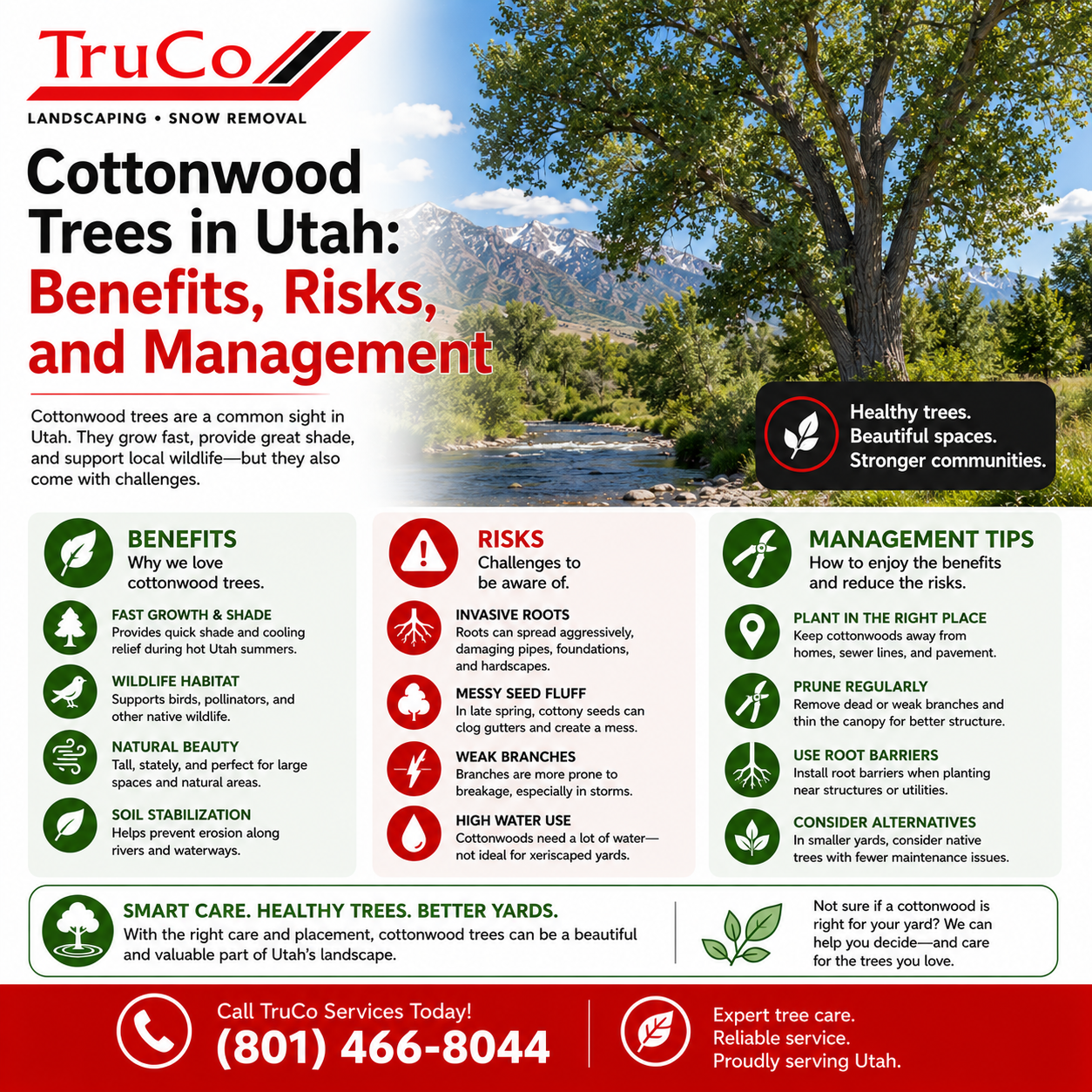
Cottonwood trees are among the most recognizable and beloved trees in Utah. Along the Wasatch Front, these majestic giants line riverbanks, shade city parks, and anchor historic neighborhoods. Native to Utah, cottonwoods are fast-growing, reaching 60-100 feet with massive spreading crowns. They are quintessentially Western trees, evoking images of pioneer settlements, mountain streams, and Utah's agricultural heritage. But cottonwoods also come with significant challenges — aggressive roots, brittle wood, and high water needs. This guide covers everything Utah homeowners need to know about living with cottonwoods.
Species Native to Utah
Three cottonwood species are native to Utah. Plains cottonwood is the most common along the Wasatch Front, growing along the Jordan River, Weber River, and Provo River corridors with triangular leaves and a broad, open crown. Narrowleaf cottonwood is found at higher elevations in the Wasatch Mountains, with narrower, willow-like leaves and a more columnar form. Fremont cottonwood is common in southern Utah, particularly along the Virgin River in Zion National Park area, with large, heart-shaped leaves. All three share similar characteristics: fast growth, water-seeking roots, and relatively short lifespans (60-100 years, with some reaching 150 in ideal conditions).
The Benefits of Cottonwoods
Cottonwoods provide immense benefits. Their rapid growth (3-6 feet per year) creates shade faster than almost any other tree. A cottonwood can provide meaningful shade within 5-7 years of planting. Their massive canopies cool homes, reduce energy costs, and create microclimates that support other plants and wildlife. Cottonwoods are keystone species in Utah's riparian ecosystems — they provide nesting sites for eagles, hawks, and herons, and their cavities shelter owls, wood ducks, and squirrels. Beaver rely on cottonwood bark and branches for food and dam construction. In urban settings, cottonwoods add character and a sense of history to older neighborhoods. The rustling sound of cottonwood leaves is a beloved sensory experience of Utah summers.
The Risks of Cottonwoods
Cottonwoods have significant drawbacks that Utah homeowners must understand. The wood is soft, weak, and prone to breakage. Large limbs fail frequently during windstorms and heavy snow events. The trees are notorious for dropping branches without warning even in calm conditions. The root systems are aggressive and water-seeking — they infiltrate sewer lines, irrigation systems, and septic drain fields. Roots can lift sidewalks, driveways, and patios, and in some cases damage foundations. Cottonwoods produce abundant cottony seeds in late spring that can clog gutters, air conditioning units, and window screens. The trees are also susceptible to several diseases including bacterial wetwood (slime flux), cytospora canker, and various leaf spot diseases. Their lifespan in urban settings is often only 50-70 years, after which they become hazardous.
Managing a Cottonwood on Your Property
If you have a cottonwood on your property, proactive management is essential. Prune every 3-5 years to remove deadwood, reduce wind resistance, and maintain structure. Do not top cottonwoods — topping creates weak regrowth that is even more prone to failure. Install root barriers if the tree is near sewer lines or foundations. Maintain deep, infrequent watering to encourage deep root growth rather than surface roots that seek out leaky pipes. Monitor for disease and pest issues. Have an arborist assess the tree's structure annually, especially after storms. Consider cabling large limbs with weak attachments. Remove the tree if it becomes hazardous — a cottonwood with significant decay, large dead limbs, or a lean toward your house is a liability.
When to Remove a Cottonwood
Removal should be considered when: the tree has lost more than 50% of its canopy, large scaffold branches are dying, there is significant decay at the base, the tree leans more than 15 degrees, roots are causing major structural damage to your home or sewer system, the tree is within striking distance of your house and showing signs of decline, or the tree has exceeded its safe lifespan (60+ years in urban settings). Cottonwood removal is expensive — large specimens cost $2,500-$5,000 or more due to their size, weight, and the difficulty of dismantling them without damaging nearby structures. However, the cost of inaction can be much higher.
What to Plant Instead
For homeowners who want a fast-growing shade tree similar to cottonwood but with fewer risks, better alternatives exist. Honeylocust provides fast growth, dappled shade, and strong wood. Kentucky coffeetree offers unique texture and extreme toughness. Hackberry is adaptable and provides wildlife value. Bur oak is slow to establish but long-lived and extremely durable. These species will not grow as large as cottonwoods (40-60 feet versus 60-100 feet) but are far better suited to residential landscapes.
Frequently Asked Questions
Are cottonwoods protected in Utah? Some Utah cities have tree protection ordinances that may restrict removal of large cottonwoods, especially in historic districts or along waterways. Check with your city before removing. In riparian areas, additional permits from the Army Corps of Engineers or Utah Division of Water Rights may be required.
How long do cottonwood trees live? In natural settings, cottonwoods can live 100-150 years. In urban landscapes, 50-70 years is typical due to soil compaction, limited water, pollution, and mechanical damage.
Do all cottonwoods produce cotton? Only female cottonwood trees produce the cottony seeds. Male trees produce catkins (pollen) but no cotton. Unfortunately, it is difficult to tell male from female until the tree matures and produces seed.
Can I stop a cottonwood from producing cotton? There is no practical way to stop cotton production on a mature female tree. Some growth regulators can reduce seed production but are expensive and must be applied annually by a professional. Removal and replacement is often the most practical solution.
Are cottonwood roots really that aggressive? Yes. Cottonwood roots seek water and can travel 100+ feet from the trunk. They are particularly attracted to leaky sewer lines and irrigation pipes. If you have a cottonwood near your home's sewer line, regular sewer inspections are recommended.
What is the white fluid oozing from my cottonwood? That is bacterial wetwood (slime flux), a common bacterial infection in cottonwoods. It produces a foul-smelling, fermented sap that stains bark. It is generally not fatal but indicates internal decay. An arborist can assess whether the tree is structurally compromised.