
How Do I Fix a Yard That Floods Every Time It Rains in Utah?

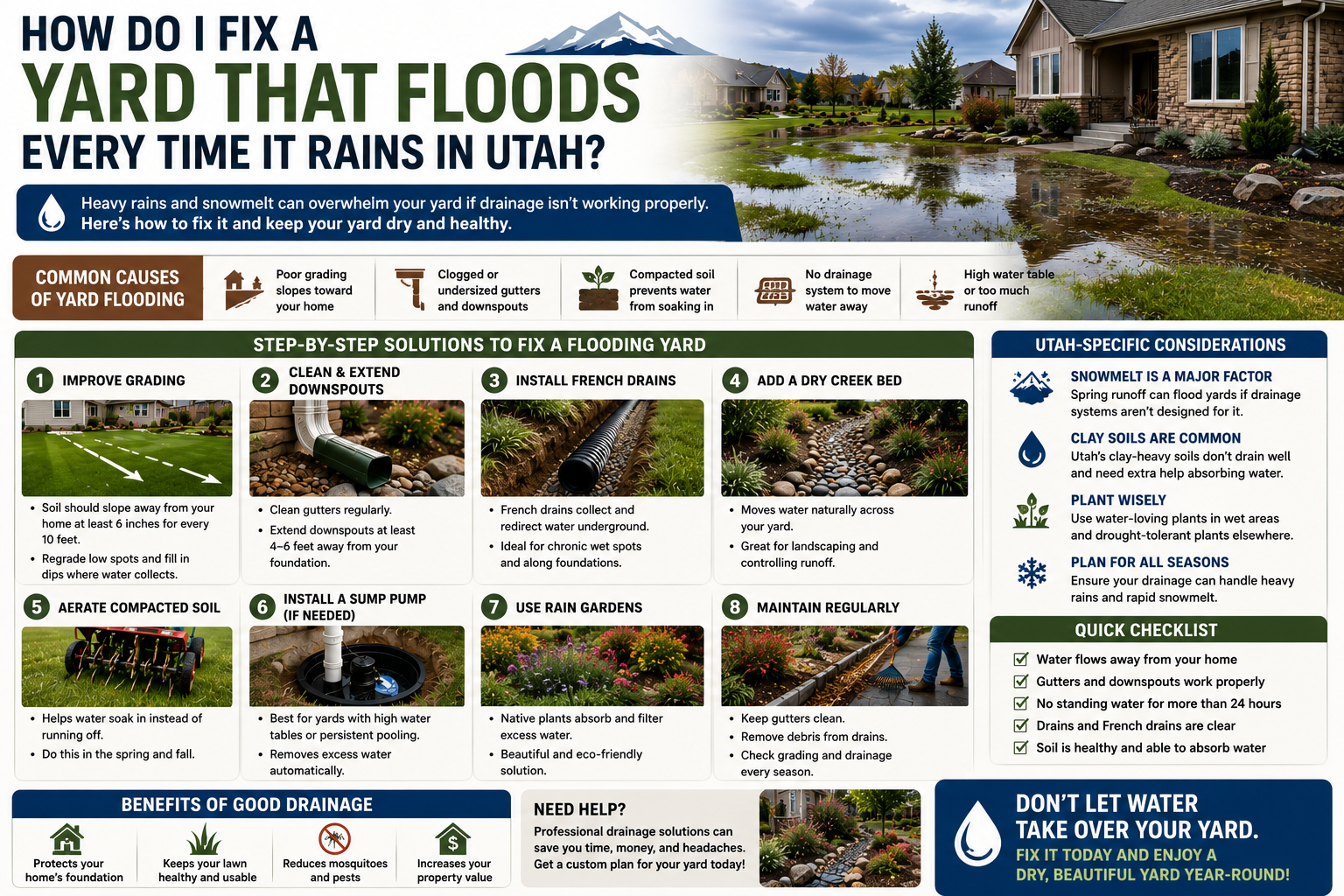
Why Utah Yards Flood — Common Causes
If your Utah yard turns into a lake every time it rains, you are not alone. Standing water after storms is one of the most common complaints from homeowners along the Wasatch Front. The causes are usually a combination of Utah's challenging soil conditions, property grading issues, and inadequate drainage infrastructure.
The primary culprit is Utah's clay soil. Clay particles are microscopic and pack tightly together, leaving little space for water to filter through. While sandy soils drain at a rate of 6-10 inches per hour, Utah's clay soils drain at less than 0.5 inches per hour. This means even a moderate rainstorm can overwhelm your yard's natural drainage capacity.
Property grading is the second most common factor. If your yard slopes toward your house or has low spots where water collects, you will see flooding after every rain. Newer Utah subdivisions often have minimal grading because builders focus on structural drainage rather than landscape drainage.
Downspout drainage is an often-overlooked contributor. If your gutter downspouts discharge next to the foundation, that water has nowhere to go but into your yard. A single downspout during a 1-inch rainstorm discharges over 500 gallons of water. Directing that water away from your foundation and yard is one of the most cost-effective solutions.
The Role of Utah's Clay Soil
Utah's soil is dominated by clay deposited by ancient Lake Bonneville. This clay has unique properties that create drainage challenges. It expands when wet (up to 15% volume increase) and contracts when dry, creating cracks that actually help water penetrate — until the clay swells and seals those cracks. This is why your yard may drain fine in spring but flood in summer after a heavy storm. The clay particles carry a negative electrical charge that attracts water molecules, holding moisture tightly. This is why clay feels "greasy" when wet and becomes rock-hard when dry. The water molecules adhere to the clay particles rather than draining through. The solution is not to fight the clay but to work around it by creating pathways for water to escape.
French Drains: How They Work and What They Cost
A French drain is a trench filled with gravel or rock containing a perforated pipe that redirects surface water and groundwater away from your yard. It is the most effective and common drainage solution for Utah properties. A French drain consists of a trench 12-24 inches deep, sloped at 1/4 inch per foot toward the discharge point. The trench is lined with filter fabric, filled with 1-2 inches of 3/4-inch washed gravel at the bottom, then the perforated pipe is laid on top. More gravel fills the trench to within 6 inches of the surface, then the fabric is wrapped over and soil or sod is placed on top. Cost in Utah: $40-60 per linear foot installed. A typical 50-foot French drain runs $2,000-$3,000. The cost depends on soil conditions, accessibility, and the discharge point location.
Dry Wells for Utah Properties
A dry well is an underground structure that collects and slowly infiltrates storm water into the surrounding soil. It is essentially a large hole filled with gravel or a prefabricated plastic chamber. Dry wells work best in areas with sandy or loamy soil that drains at least 1/2 inch per hour. In Utah's clay soils, dry wells are less effective unless combined with a French drain system that pre-treats the water. Cost: $1,500-$4,000 installed depending on size and depth. Dry wells require a permit in most Utah municipalities. Check with your city before installation.
Regrading Your Yard
Regrading involves reshaping the surface of your yard to create proper slopes that direct water away from your house and toward drainage outlets. The International Residential Code requires the ground to slope away from the foundation at a minimum of 6 inches over the first 10 feet (5% slope). Many Utah properties do not meet this standard. Regrading a typical residential yard costs $1,000-$5,000 depending on the amount of soil that needs to be moved and whether new topsoil and sod are needed. For severe cases, a Bobcat or skid-steer is required, which adds to the cost but ensures proper compaction and grading.
Rain Gardens
A rain garden is a shallow depression planted with native, water-tolerant plants that captures and absorbs storm water runoff. Rain gardens are becoming increasingly popular in Utah as a sustainable drainage solution. They work by collecting water from downspouts, driveways, and yard runoff, allowing it to pool temporarily and slowly infiltrate into the ground. A properly designed rain garden can absorb 30-40% more water than a standard lawn area. Choose Utah-native plants that tolerate both wet and dry conditions: blue flag iris, red twig dogwood, sedges, and switchgrass. Rain gardens should be located at least 10 feet from the foundation.
Permits and Regulations
Most Utah municipalities require permits for drainage work that alters grading, involves excavation over a certain depth, or connects to the storm sewer system. Check with your city's building department before starting. Downspout drainage extensions typically do not require permits. French drains under 24 inches deep may not need a permit in some cities. Dry wells almost always require a permit and may require a percolation test.
Frequently Asked Questions
How much does it cost to fix yard drainage in Utah? $500-$5,000 depending on the solution. French drains run $40-60/linear foot. Regrading is $1,000-$5,000. Dry wells are $1,500-$4,000.
Does homeowners insurance cover yard flooding? Typically no. Yard flooding is considered a maintenance issue, not an insurable event. However, basement flooding from yard drainage issues may be covered if you have sewer backup coverage.
How long does a French drain last? 20-30 years with proper installation. The filter fabric prevents soil from clogging the gravel and pipe. If properly sloped and maintained, a French drain can last indefinitely.
Can I install a French drain myself? French drains under 50 feet and shallow depths are DIY-friendly with proper planning and a rented trencher. Deeper or longer drains require professional equipment and expertise.
Will a French drain solve my yard flooding? In most cases, yes. French drains are the most effective solution for Utah's clay soil conditions. Combining them with proper grading and downspout extensions provides the best results.