
How to Deal with Moss in Your Utah Lawn

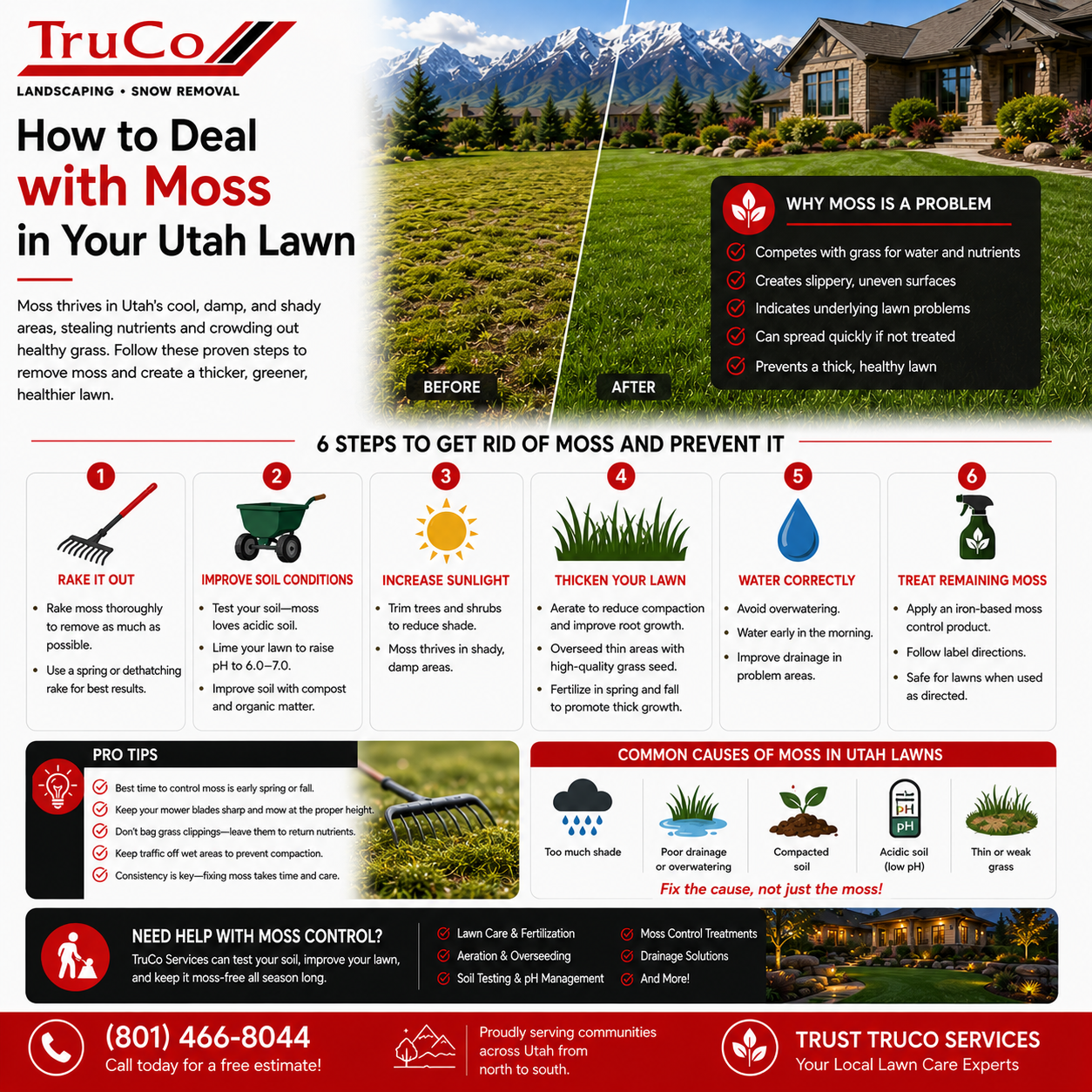
Why Moss Grows in Utah Lawns
Moss in Utah lawns is a symptom of underlying problems, not the problem itself. Moss thrives where grass struggles. Common causes in Utah: excessive shade (from buildings, fences, or mountain shadows), poor drainage in clay soil, compacted soil, overwatering, acidic soil conditions, and thin or weak grass. Moss itself won't kill grass — it simply fills in areas where grass can't grow.
Step 1: Identify the Underlying Cause
Before treating moss, identify why it's growing. Check sunlight — does the area get at least 4-6 hours of direct sun? Check drainage — does water pool after rain or irrigation? Check soil compaction — can you easily push a screwdriver into the soil? Check watering — is the area overwatered? Check soil pH — Utah soil is alkaline (pH 7.5-8.5), but moss prefers acidic conditions. If your soil has become acidic (more common in heavily mulched beds), moss will thrive.
Step 2: Improve Drainage and Aeration
Core aeration is the most effective treatment for moss in compacted Utah clay soil. Aerate in spring or fall. Remove the soil plugs and leave them on the surface. For areas with poor drainage, install French drains or swales to redirect water. In Utah's clay soil, improving drainage often eliminates moss permanently.
Step 3: Reduce Shade
If moss is growing in shade, increase sunlight by pruning lower branches of trees and thinning the canopy. Remove underbrush that blocks light. Consider removing trees that create dense shade if the area would be better as lawn. For areas that remain shady, consider replacing grass with shade-tolerant ground covers like vinca minor, pachysandra, or creeping thyme.
Step 4: Apply Moss Killer
Use iron-based moss killers (iron sulfate or ferrous ammonium phosphate) — these kill moss quickly (1-2 days) and also green up the grass. Apply when moss is actively growing and temperatures are 50-80°F. Moss will turn black within 24-48 hours. Rake out dead moss after 1-2 weeks. Do not use lime to kill moss — Utah's soil is already alkaline and adding lime makes it worse for grass.
Step 5: Renovate and Reseed
After removing dead moss, prepare the bare soil for reseeding. Rake the area to loosen soil, add compost if needed, and overseed with shade-tolerant grass seed (fine fescue blends work best for shady Utah lawns). Keep consistently moist for 2-3 weeks. Apply starter fertilizer. For deep shade where grass won't grow, consider replacing with shade ground covers or a mulched garden bed.
Moss Prevention
Maintain thick, healthy grass through proper fertilizing, watering, and mowing. Aerate annually in problem areas. Water deeply and infrequently — keep the soil on the drier side. Prune trees to increase light penetration. Monitor soil drainage and correct problems early. In Utah, moss problems are most common on north-facing slopes and under mature shade trees.
FAQs
Why is moss growing in my Utah lawn? Moss indicates insufficient sunlight, poor drainage, compacted soil, or overwatering.
Will lime kill moss in my lawn? No — Utah's soil is already alkaline. Adding lime makes conditions worse for grass. Use iron-based moss killers instead.
Is moss harmful to grass? Moss doesn't kill grass — it fills in areas where grass is already struggling.
How do I permanently get rid of moss? Fix the underlying cause: improve drainage, increase sunlight, aerate compacted soil, or reduce watering.
What grass grows best in shady areas of Utah? Fine fescue is the most shade-tolerant grass for Utah lawns.
Should I just let moss grow instead of grass? In deep shade where grass won't grow, moss creates a surprisingly attractive, low-maintenance ground cover. Many Utah homeowners are embracing moss lawns in shady areas.
How long does moss killer take to work? Iron-based moss killers work within 24-48 hours — moss turns black and dies.