
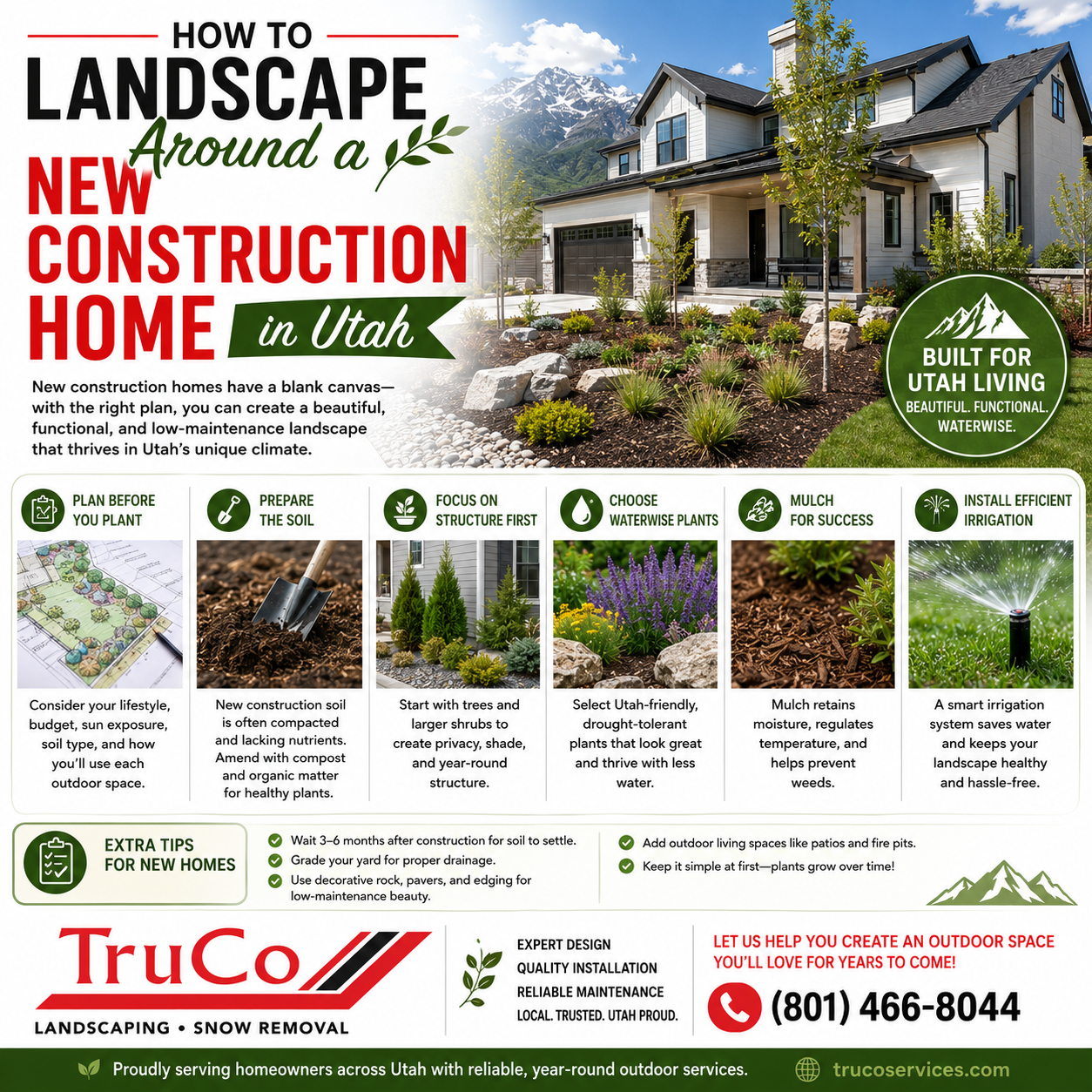
How to Landscape Around a New Construction Home in Utah

Starting from Scratch: Assessing Your New Property
New construction homes in Utah typically leave behind challenging conditions for landscaping. Construction crews compact the soil heavily with heavy equipment, bury construction debris (drywall scraps, lumber, concrete chunks) under the topsoil, and strip away any existing organic matter. The top few inches of soil are often a mix of sterile subsoil and construction dust with little to no organic content. Before planting anything, assess what you're working with. Dig several test holes 12-18 inches deep to check for buried debris, soil texture (clay, sand, or loam), and drainage. Test the soil pH — new construction sites in Utah typically have highly alkaline soil from concrete dust (pH 8.0 or higher). Check for grading issues — water should drain away from the foundation at a slope of at least 1/2 inch per foot for 6-10 feet. In Utah, many new developments are built on former agricultural land with compacted clay hardpan that requires deep tillage to break up. Document all issues before creating your landscape plan — fixing soil problems after planting is much more difficult and expensive.
Phased Landscaping Plan for Budget Management
Complete landscaping can cost $15,000-50,000+ for a typical Utah new construction lot — staggering this investment over 2-3 years makes it manageable. Phase 1 (Year 1): soil preparation and grading, install irrigation system, establish lawn (seed or sod), plant foundational trees, install necessary hardscape (driveway, walkways, retaining walls). This phase addresses the essential infrastructure. Phase 2 (Year 2): add patio or deck, install privacy fencing, plant shrubs and perennial beds, add landscape lighting. Phase 3 (Year 3): add decorative elements (water feature, fire pit, rock garden), plant specialty gardens, add outdoor furniture and accessories. In Utah, many homeowners prioritize shade trees and lawn first — grass provides immediate erosion control on bare dirt and cools the property. Install the irrigation system before planting anything — trenching after landscaping damages plants. Budget 10-15% of your total construction budget for landscaping — for a $400,000 new home in Utah, this means $40,000-60,000 for full landscaping over time.
Soil Preparation for New Construction
Proper soil preparation is the most important step in new construction landscaping in Utah. Remove all construction debris — screen the soil if necessary to remove drywall pieces, nails, and concrete chunks that can kill plants. Deep till the soil 8-12 inches to break up compaction. A tractor-mounted rototiller or subsoiler may be needed for heavily compacted clay — this is available from equipment rental companies in Utah for $150-300 per day. After tilling, add 3-4 inches of high-quality compost and till again to incorporate. Apply gypsum at 80-100 pounds per 1,000 square feet to improve clay soil structure and leach sodium. For pH correction, apply elemental sulfur at 5-15 pounds per 1,000 square feet to lower pH from 8.0 to the desirable 6.5-7.5 range. Final grading should slope away from the foundation with 6 inches of drop in the first 10 feet. Consider installing French drains or curtain drains if the property has low spots. In Utah, many new subdivisions have community drainage requirements — check with your HOA or city planning department before altering drainage patterns.
Plant Selection for New Utah Landscapes
Choose plants that will thrive in Utah's climate and your specific conditions. For shade trees: bur oak, hackberry, and Kentucky coffeetree are excellent long-term choices — they tolerate Utah's alkaline soil and need minimal water once established. For ornamental trees: flowering crabapple, serviceberry, and Rocky Mountain maple offer seasonal interest. For shrubs: potentilla, spirea, barberry, ninebark, and western mock orange are reliable Utah performers. For foundation plantings: choose dwarf varieties that won't outgrow the space and block windows — dwarf mugo pine, dwarf alpine fir, and compact junipers work well. For ground covers: creeping thyme, kinnikinnick, and blue oat grass are drought-tolerant and weed-suppressing. For lawns: Kentucky bluegrass blend with 20% perennial ryegrass for sun, fine fescue for shade. In Utah, plant spacing is critical — most plants look small at planting but need room to reach mature size. Plant trees 20-40 feet apart depending on species, shrubs 3-6 feet apart, and ground covers 12-24 inches apart. Always call 811 before digging to mark underground utilities — new construction sites often have recently installed gas, electric, and water lines.
Irrigation System Design for New Lots
A properly designed irrigation system is essential for new construction landscaping in Utah. Design the system before planting — this allows efficient layout and prevents damage to new plants. Zone by water needs: separate zones for turf, shrubs, trees, and flower beds. Use rotary nozzles for large lawn areas (they distribute water more evenly than spray heads), drip irrigation for gardens and shrub beds, and soaker hoses or bubblers for trees. Install a smart controller that adjusts watering based on weather data — Utah's water districts offer rebates of $50-150 for qualifying smart controllers. Include a rain sensor to shut off the system during storms. Install a master valve at the main water source to prevent leaks when the system is off. In Utah, consider separate valves for sun and shade areas — shade requires significantly less water. Pressure-regulating valves prevent misting and uneven coverage if your water pressure exceeds 60 PSI. Budget $2,000-5,000 for a complete irrigation system on a typical 10,000-square-foot Utah lot. Professional design and installation ensures proper coverage and water efficiency.
Frequently Asked Questions
When is the best time to landscape a new home in Utah? Spring (April-May) and fall (September-October) are ideal. Soil preparation and grading can be done any time the ground isn't frozen. Install irrigation before planting in spring for immediate use.
How much does it cost to landscape a new construction home in Utah? Basic: $5,000-15,000 (lawn, irrigation, a few trees). Mid-range: $15,000-35,000 (lawn, irrigation, trees, shrubs, patio). Premium: $35,000-60,000+ (full design, hardscape, lighting, specialty gardens).
Should I use sod or seed for a new Utah lawn? Sod provides instant results and is recommended for erosion control on slopes. Seed costs 1/3 as much but requires careful watering for 4-6 weeks. Many new homeowners use a combination: sod in front yards for curb appeal, seed in back for cost savings.
Do I need a landscape architect for new construction in Utah? A landscape design plan is recommended for proper layout, drainage, and plant selection. Hire a landscape architect or designer for comprehensive design ($500-2,000). Many landscape contractors offer design-build services where design costs are included in installation.
How do I prevent weeds in a new Utah landscape? Apply a pre-emergent weed preventer (corn gluten meal for organic) after soil preparation. Use landscape fabric under rock and mulch areas. Install dense ground covers to shade out weeds. Stay consistent with hand weeding during the first growing season.