
How to Protect Trees from Winter Snow and Ice Damage in Utah

How Utah Winters Damage Trees
Utah's winters bring several threats to trees: heavy snow loads that break branches, ice storms that coat limbs with weight, temperature swings that cause sunscald, road salt that damages roots, and dry winter air that desiccates evergreens. Lake-effect snow along the Wasatch Front can dump 1-2 feet of heavy, wet snow in a single storm — the kind of snow that snaps limbs and splits trunks. Trees that evolved in wetter climates like blue spruce and aspen are especially vulnerable to winter damage in Utah's dry, variable winter conditions.
Preventing Snow Load Branch Breakage
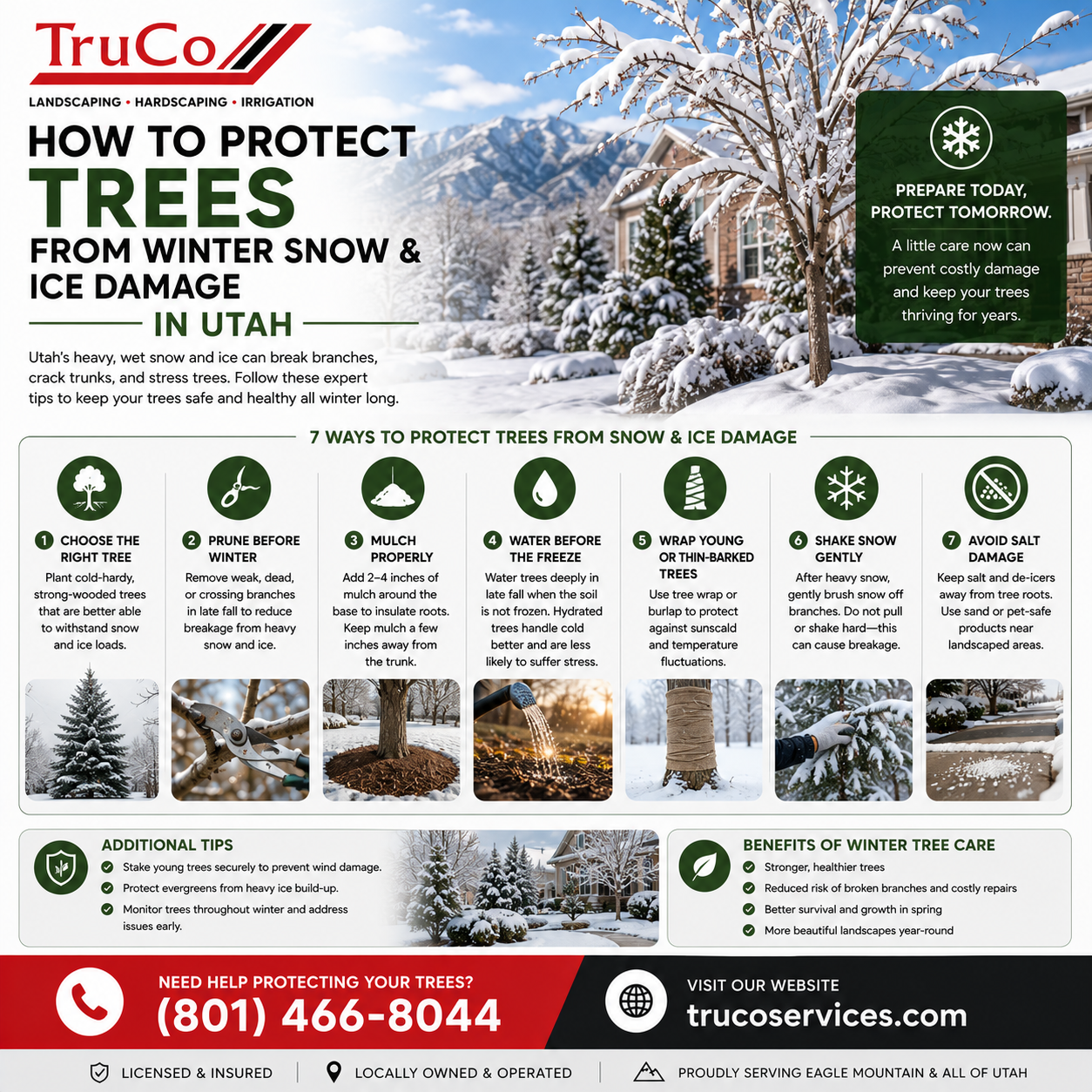
The best prevention is proper pruning before winter. Remove weak, crossing, and poorly attached branches while the tree is dormant in late fall. Thin dense crowns so snow can fall through rather than accumulate. Focus on removing co-dominant leaders — two main trunks that are prone to splitting under snow load.
For small ornamental trees and evergreens, gently brush snow off branches with a broom after each storm using an upward sweeping motion. Do not shake branches to remove snow — the snapping motion causes more damage than the snow itself. For large trees, leave snow removal to professionals.
Ice Storm Preparation
Ice storms are less common than snow in Utah but far more destructive. A quarter-inch of ice can add 500 pounds of weight to a mature tree. There is little you can do during an ice storm except stay away from the trees. Preparation is key: keep trees properly pruned, remove deadwood annually, and avoid planting brittle-wooded trees like silver maple, box elder, and cottonwood near structures.
After an ice storm, assess damage from a safe distance. Do not stand under ice-laden branches. Wait for ice to melt before attempting cleanup. Call a certified arborist for large broken branches.
Wrapping Young Tree Trunks for Winter
Young trees with thin bark — maple, linden, fruit trees, ash — are susceptible to sunscald and frost cracks in Utah's winter sun. The winter sun warms the bark during the day, then temperatures drop rapidly at night, causing the bark to crack. This damage weakens the tree and creates entry points for pests and diseases.
Apply white tree wrap in late fall from the base of the trunk up to the first branches. Wrap loosely in a spiral, overlapping by one-third. Remove the wrap in early spring after the danger of hard frost has passed. Do not leave wrap on year-round — it traps moisture and encourages rot. Replace wrap annually.
Winter Watering: Essential for Evergreens
Utah's dry winter air is hard on evergreens. Spruce, pine, juniper, and arborvitae continue to lose moisture through their needles all winter, but frozen ground prevents root uptake. The result is winter desiccation — needles turn brown from the tips inward, often on the south and west sides where sun and wind are strongest.
Water evergreen trees monthly during winter when temperatures are above 40°F and the ground is not frozen. Apply water slowly at the dripline so it soaks in before freezing. Newly planted evergreens under 3 years are most vulnerable and should be watered 2-3 times during winter.
Snow Removal Around Trees
When plowing or shoveling snow, avoid piling snow around tree trunks. Snow mixed with road salt creates a toxic slurry that damages bark and roots. Piling snow against trunks also encourages rodent damage — voles and mice tunnel under snow and gnaw on bark at the base of the tree. Keep snow piles at least 3 feet away from tree trunks.
Protecting Trees from Salt and De-Icers
Road salt and de-icing chemicals cause serious damage to Utah trees. Salt spray from passing cars burns buds and foliage. Salt accumulation in soil absorbs water, creating physiological drought. Salt damage shows as leaf scorch, branch dieback, and early fall color on the side of the tree facing the road.
To protect trees: use burlap screens or snow fencing between roads and sensitive trees. Plant salt-tolerant species like bur oak, Kentucky coffeetree, and hackberry near roads. Use sand or calcium magnesium acetate instead of sodium chloride for de-icing near trees. In spring, flush salt-affected soil with deep water to leach salts below the root zone.
Dealing with Winter Sunscald
Sunscald appears as long, vertical cracks or sunken, discolored bark on the south or southwest side of young trees. It's caused by winter sun warming the bark, followed by rapid freezing when the sun goes behind a cloud or sets. The temperature difference can exceed 40°F between the sunny and shaded sides of the trunk.
Prevention: wrap trunks with white tree wrap, paint trunks with white latex paint diluted 50% with water, or plant trees where they receive afternoon shade from buildings or other trees.
Pruning for Winter Storm Resistance
Late fall pruning can significantly reduce winter storm damage. Remove dead, diseased, and weakly attached branches. Thin the crown to reduce wind resistance and snow load. Lower the center of gravity on young trees. Do NOT top trees to reduce storm damage — topping creates weak regrowth that is more likely to fail in storms.
After a Winter Storm: Tree Assessment
After a winter storm, inspect trees for hanging broken branches, cracks in the trunk, split crotches, leaning trees, heaving soil at the root zone, and branches that are bent but not broken. Remove hanging branches immediately — they are safety hazards. Prune broken branches cleanly at the branch collar. For split trunks or major limb failures, call a certified arborist. Trees that have lost more than 50% of their crown are unlikely to recover and should be removed.
Frequently Asked Questions
When should I wrap trees for winter in Utah? Late November, after temperatures are consistently below freezing at night but before heavy snow arrives.
Do I need to wrap mature trees? Generally no — only young trees under 5 years with thin bark need wrapping.
How often should I water evergreens in Utah winter? Monthly when temperatures are above 40°F and ground isn't frozen.
Can snow damage trees? Yes — heavy, wet snow can break branches and split trunks. Brush snow off small trees gently after each storm.
Is road salt bad for trees? Yes — salt damages roots, buds, and foliage. Use barriers and plant salt-tolerant species near roads.
What trees are most winter-hardy in Utah? Bur oak, Kentucky coffeetree, Colorado spruce, Rocky Mountain juniper, and hackberry are all well-adapted to Utah winters.
Should I mulch trees before winter? Yes — apply 2-4 inches of organic mulch after the ground freezes to insulate roots and moderate soil temperature. Keep mulch away from the trunk.