
How to Manage Tree Canopy Density for Light and Views in Utah

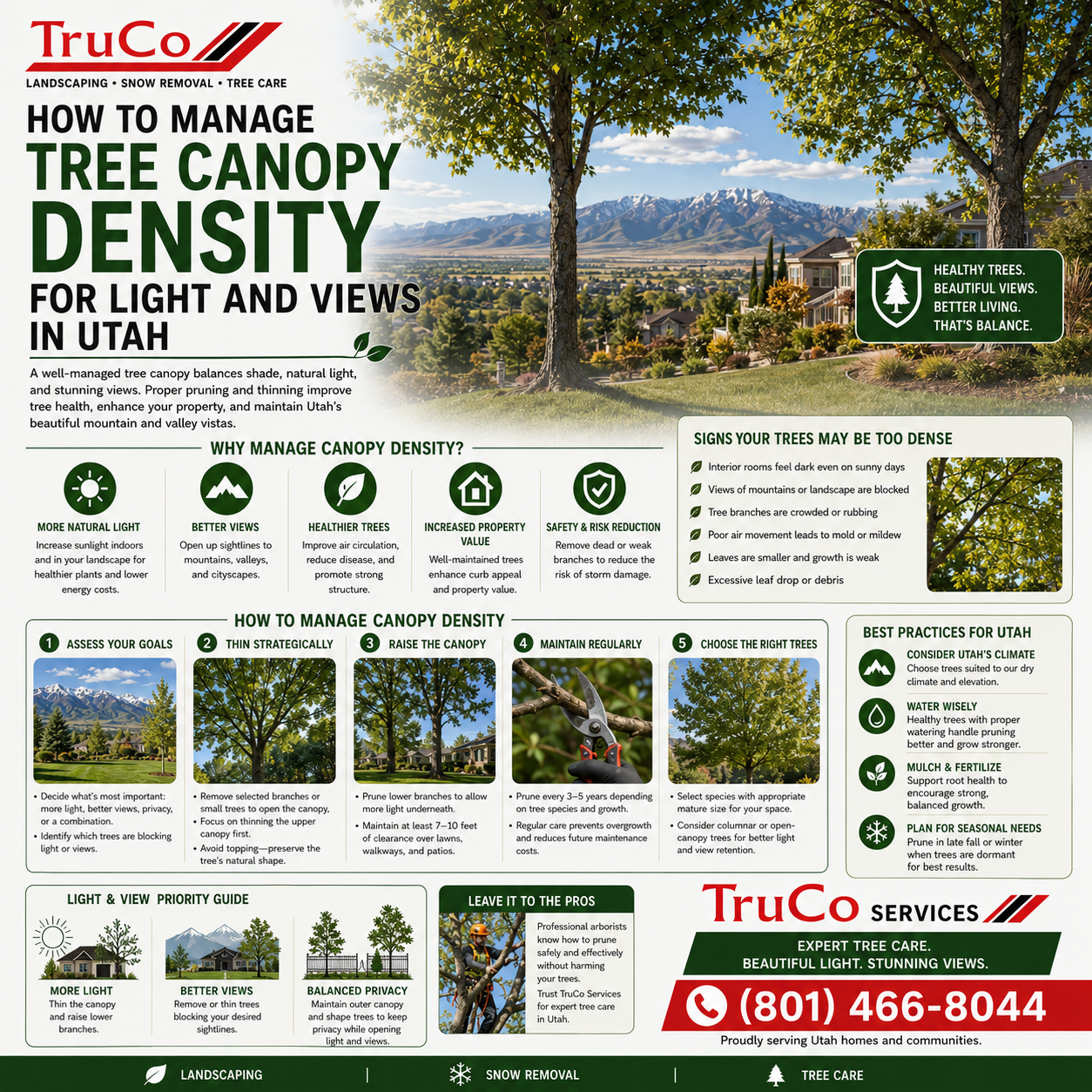
Balancing Tree Canopy and Views in Utah
Utah is famous for its stunning mountain views — the Wasatch Range, Mount Timpanogos, Lone Peak, and the Great Salt Lake create a backdrop that homeowners cherish. Yet the very trees that provide shade, beauty, and property value can also block those cherished views. Managing tree canopy density — the thickness and coverage of a tree's crown — is a delicate balancing act between preserving tree health and maintaining light, views, and solar access. In Utah, where the sun arcs lower in winter and mountain views are often to the east and west, strategic canopy management can dramatically improve your quality of life without sacrificing the benefits of mature trees. This guide covers professional techniques for selectively reducing canopy density to allow more light and improve views while keeping your trees healthy and structurally sound. Always work with a certified arborist for significant canopy management — improper thinning damages trees and can create long-term problems.
Understanding Canopy Density and Tree Health
Before modifying a tree's canopy, understand how it affects tree health. The canopy is the tree's food factory — leaves capture sunlight and convert it to energy through photosynthesis. Removing too many leaves starves the tree, reducing growth, weakening its immune system, and making it vulnerable to pests and diseases. A tree needs at least two-thirds of its canopy to remain healthy. Removing more than one-third of the canopy in a single year is dangerous and can trigger a stress response that leads to rapid decline. In Utah, where trees already face stress from alkaline soil, temperature extremes, and dry conditions, over-thinning is especially damaging. Crown density varies naturally by species. Pines and spruces naturally have dense canopies that block light and views. Oaks and honeylocust have more open, airy canopies that allow some light through. Understanding your tree's natural growth habit helps you set realistic expectations for canopy management. Canopy management techniques include thinning (selective removal of branches within the crown), raising (removing lower branches), reduction (shortening branches), and vista pruning (targeted pruning to open specific view corridors). Each technique serves a different purpose and has different impacts on tree health. A certified arborist can recommend the best approach for your specific tree and goals.
Professional Canopy Thinning Techniques
Canopy thinning is the selective removal of branches to reduce density while maintaining the tree's natural shape and health. This technique allows more light to pass through the canopy and opens up views without removing large limbs. Proper thinning removes branches at their point of origin (the branch collar) to promote healing. Thinning cuts should be distributed throughout the canopy, not concentrated in one area. Remove 15-25% of the canopy in a single thinning session for a healthy tree. Remove more from the interior of the crown than the exterior to maintain the tree's natural silhouette. In Utah, the best time for thinning is late winter or early spring (February-April) when trees are dormant and the canopy structure is visible. Deadwooding is always the first step — remove all dead, dying, and diseased branches before any live branch thinning. This alone can significantly increase light penetration and improve safety. Crown raising removes lower branches to allow more light beneath the tree and improve views from lower levels. This is commonly done for trees blocking ground-floor windows or patio views. Remove no more than 25% of the live crown height in a single pruning. Crown reduction shortens the overall size of the tree by cutting back branches to lateral branches that are at least one-third the diameter of the removed branch. This reduces the tree's overall size and can open up views above or to the side. Crown reduction should never be confused with topping (heading cuts that leave stubs), which is harmful and creates weak regrowth. Vista pruning is targeted pruning to open a specific view corridor through or between trees. This technique removes only the branches that block a defined view line. Vista pruning minimizes the amount of foliage removed while maximizing the view improvement. An arborist will often use a pole saw or bucket truck to make precise cuts from the viewing perspective.
When to Call a Professional Arborist
Canopy management is not a DIY task for large trees. Call a certified arborist if: the tree is over 20 feet tall, the branches are too high to reach with a pole pruner from the ground, you need to remove branches larger than 4 inches in diameter, the tree is near power lines or buildings, you are unsure which branches to remove, or the tree has significant defects or decay. In Utah, arborists charge $75-150 per hour or $200-800 for typical canopy management on a standard-size tree. This is money well spent — improper pruning can cause thousands of dollars in damage and create safety hazards that last for decades. When hiring an arborist, ask for ISA (International Society of Arboriculture) certification. Get multiple quotes for large jobs. Request that the arborist show you which branches will be removed before work begins. A good arborist will prioritize tree health and structural integrity over maximum view clearance. They should recommend removing no more than 25% of live foliage in a single session and should never suggest topping. If a tree needs more aggressive thinning, the arborist should recommend a multi-year plan that spreads the work over 2-3 seasons to minimize stress on the tree.
Long-Term Canopy Management Strategies
Managing canopy density is not a one-time task but an ongoing process. Develop a long-term plan that includes regular pruning cycles (every 3-5 years for most trees) to maintain desired light and view levels without removing excessive foliage at once. A gradual approach is healthier and more effective. Plan for tree growth when establishing new plantings. Trees planted with eventual size in mind require less aggressive canopy management. Choose species with naturally open, airy canopies (honeylocust, Kentucky coffeetree, hackberry) for view-sensitive areas. Use evergreens (spruce, pine, fir) for screening and wind protection where views are less important. Consider removing and replacing trees that are poorly placed or have grown too large for their location if canopy management cannot achieve your goals. This may seem drastic but is often more cost-effective than ongoing aggressive pruning. In Utah, the annual pruning cycle for view management typically begins when trees are 10-15 years old. Before that, allow trees to establish their structure without heavy pruning. For mountain view properties — common in Park City, Draper, and the east bench communities — work with an arborist who specializes in vista pruning. These arborists understand how to balance tree health with spectacular Wasatch Front views. Consider the impact of canopy management on neighbors. Opening a view may also expose your property to more visibility from neighbors. In Utah's closely built subdivisions, view management often requires coordination with adjacent property owners. Check your HOA or city regulations before significantly altering tree canopies. Some Utah communities have tree preservation ordinances that restrict pruning of certain species or sizes of trees.
Alternatives to Canopy Thinning
Before thinning a tree's canopy, consider alternatives that may achieve your goals with less impact on tree health. Selective removal — rather than thinning a tree, consider removing a tree entirely to open a view, replacing it with a lower-growing or more open-canopied species. This is often the best long-term solution when a tree is poorly placed. Understory planting adjustment — if light is the concern, adjust what you plant beneath the tree rather than thinning the tree. Choose shade-tolerant plants that thrive in the existing conditions. Window relocation — in some cases, it's easier and cheaper to modify a window or add a new window than to repeatedly prune a tree. Skylights can bring in light from above the tree canopy. Accept the natural canopy — sometimes the best approach is to accept a tree's natural form and density. Mature trees provide enormous benefits — shade, property value, wildlife habitat, and beauty — that may outweigh the desire for unobstructed views. Mulching and underplanting — improve the area beneath dense trees with shade-tolerant groundcovers and perennials rather than trying to thin the canopy above. This creates a beautiful understory without stressing the tree.
Frequently Asked Questions
How much canopy can be removed without harming a tree? A healthy tree can tolerate removal of up to 25% of its live canopy in a single year. Removing more than one-third is dangerous and can cause decline. For large or stressed trees, limit thinning to 15-20%. Never remove more than 25% regardless of the tree's condition.
Will thinning a tree encourage it to grow faster? No. Thinning reduces the tree's photosynthetic capacity, which can actually slow growth. The tree redirects energy to maintaining remaining branches rather than producing new growth. This is why gradual thinning over multiple years is better than aggressive thinning in a single year.
What is the best time of year for canopy thinning in Utah? Late winter (February-March) is ideal, when trees are dormant and before spring growth begins. Pruning during dormancy minimizes stress and allows you to see the branch structure clearly. Avoid heavy pruning during the growing season (May-August) when trees are actively photosynthesizing.
How often should I thin my trees for view maintenance? Most trees need canopy thinning every 3-5 years for ongoing view management. Fast-growing species (silver maple, poplar) may need thinning every 2-3 years. Slow-growing species (oak, ginkgo) may only need thinning every 5-7 years. Work with an arborist to determine the right schedule for your trees.
Can I thin a tree myself or should I hire a professional? For trees under 15 feet tall where all branches are reachable from the ground with hand pruners, you can do minor thinning yourself. For larger trees, trees near structures, or any work requiring a ladder or chainsaw, hire a certified arborist. Improper pruning causes permanent damage and safety hazards.
Will thinning a tree help my lawn grow better underneath? Yes, thinning a tree canopy allows more sunlight to reach the ground, which can improve grass growth under the tree. However, tree roots will still compete with grass for water and nutrients. Consider shade-tolerant groundcovers or mulch beds as alternatives to grass under trees.