
Tree Care for HOA and Common Area Landscapes in Utah

Why HOA Tree Care Matters in Utah
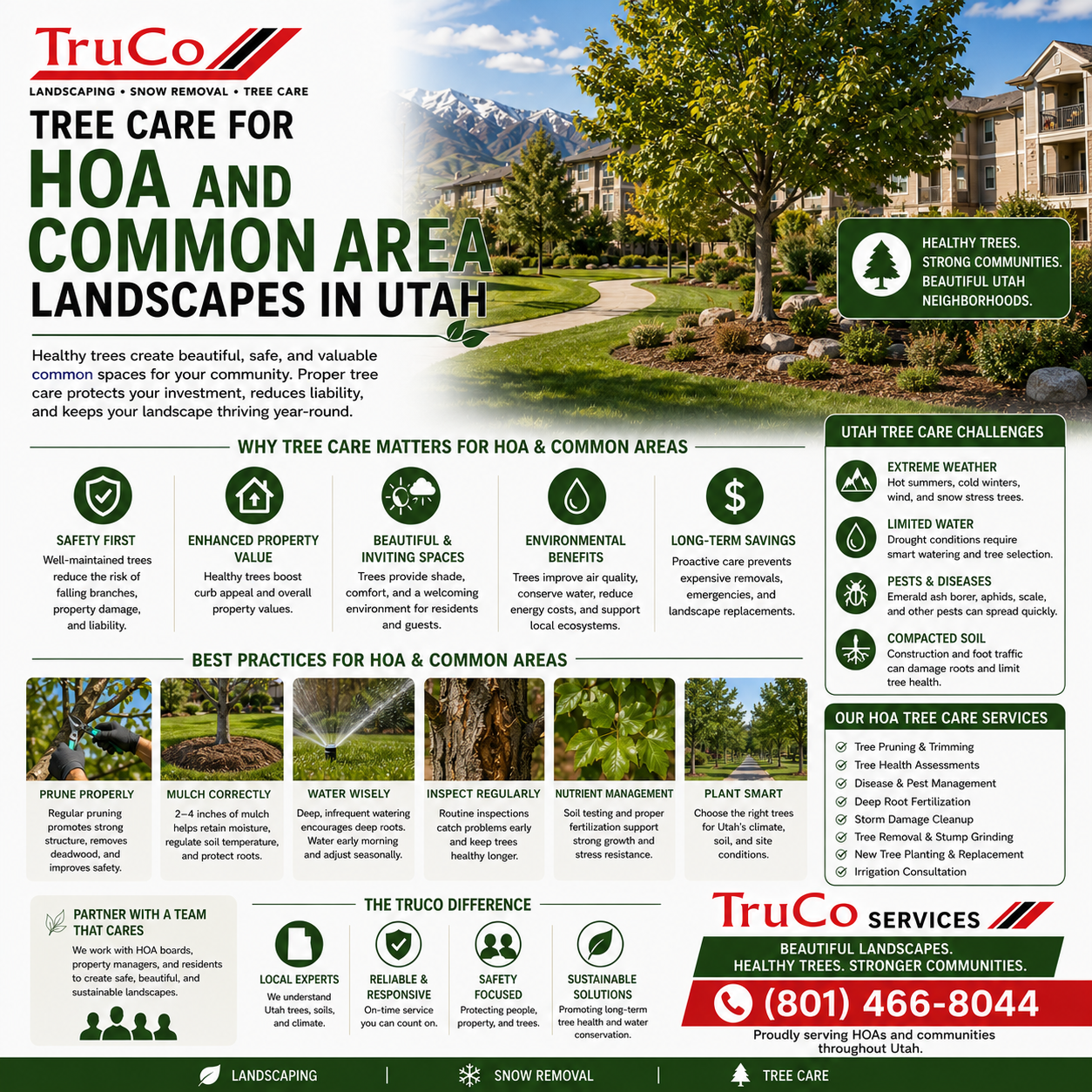
Homeowners associations (HOAs) are a significant part of Utah's housing landscape, especially in newer developments along the Wasatch Front. From the sprawling master-planned communities of Daybreak in South Jordan to the mountain-view neighborhoods of Park City and the suburban developments of Utah County, HOAs manage common area landscapes that include thousands of trees. These trees provide essential benefits: they increase property values, reduce energy costs through shading, improve air quality, manage stormwater, and create attractive community spaces. However, HOA tree care presents unique challenges. Multiple decision-makers, limited budgets, varying levels of expertise among board members, and the need to balance aesthetics with tree health all complicate management. Neglected HOA trees can become safety hazards, create liability issues, and lead to costly emergency removals. In Utah, where weather extremes stress trees and rapid development often leaves trees struggling in compacted, construction-damaged soil, a proactive approach to HOA tree care is essential. This guide covers best practices for Utah HOAs managing community trees, from creating a tree care plan to working with contractors and budgeting for long-term health.
Creating an HOA Tree Care Plan
A comprehensive tree care plan is the foundation of successful HOA tree management. The plan should include. Tree inventory — count and map every tree in common areas. Document species, size, condition, and location. Use a spreadsheet, GIS mapping, or tree management software. In Utah, many HOAs with 50+ trees benefit from professional inventory services. An inventory helps prioritize care and budget effectively. Maintenance schedule — outline routine care tasks for each season. Spring: inspection, pruning (if needed), fertilization based on soil test, mulch replenishment. Summer: watering management, pest monitoring, young tree watering. Fall: leaf management, winter watering preparation, structural pruning. Winter: snow load monitoring, winter watering during dry periods, hazard inspection. Risk assessment schedule — conduct annual tree risk assessments for all common area trees. More frequent inspections for trees near high-use areas (playgrounds, parking lots, walkways) or trees with known defects. In Utah, risk assessments should be done by a certified arborist. Replacement plan — plan for the gradual replacement of declining trees. Budget for removing and replacing 2-5% of the tree population annually. Diversify species to prevent widespread loss from pests or diseases. For Utah HOAs, this means avoiding over-reliance on a single species (like ash trees, which are threatened by emerald ash borer). Species diversity goal: no more than 10% of any one species, 20% of any one genus, and 30% of any one family. Emergency response plan — outline procedures for storm damage, fallen trees, and other emergencies. Include contact information for emergency tree services in Utah, and a decision tree for when to call professionals versus handle in-house. Budget projections — estimate costs for routine care, emergency work, and long-term replacement over a 5-10 year horizon. A well-maintained HOA tree population in Utah typically costs $15-50 per tree per year for basic care.
Selecting Trees for Utah HOA Common Areas
Tree selection for HOA common areas requires consideration of function, maintenance needs, and long-term costs. Choose trees that are appropriate for the specific site conditions — soil type, sun exposure, available space, and irrigation availability. Utah's alkaline clay soil limits options but many excellent trees thrive in these conditions. Select trees with good structure and disease resistance to minimize long-term maintenance. Avoid trees prone to breakage (silver maple, box elder), messy fruit (female ginkgo, mulberry), or invasive roots (willow, poplar near infrastructure). Favor trees that are drought-tolerant once established — a critical consideration in Utah's water-conscious future. Bur oak, Kentucky coffeetree, hackberry, honeylocust, and Utah native species are excellent choices. Consider the mature size of trees and provide adequate space for their full development. Trees planted too close to buildings, parking lots, or sidewalks create future problems and expensive conflicts. In Utah HOAs, common area trees are often over-planted for instant effect, leading to crowding and competition as they mature. Diversify species to prevent catastrophic losses from pests or diseases. Utah's experience with Dutch elm disease (which killed millions of elms) and the emerging threat of emerald ash borer should guide species selection. A diverse tree population is a resilient tree population. Choose trees that provide year-round interest — spring flowers, summer shade, fall color, and winter structure. This enhances property values and resident satisfaction, which is a key goal of HOA landscaping.
Watering HOA Trees in Utah's Climate
Water management is the most critical aspect of HOA tree care in Utah's dry climate. Newly planted trees (0-3 years) need regular, deep watering. In Utah, this means 10-15 gallons per week during the growing season for standard-size trees. Drip irrigation or tree watering bags (like Treegators) are efficient delivery methods. HOAs should budget for temporary irrigation for new trees. Established trees (3+ years) need deep watering every 2-4 weeks during dry periods, depending on species and site conditions. In Utah's typical summer, this means about 1-2 inches of water per month from irrigation or rainfall. Winter watering is often overlooked but critical in Utah. During dry winter periods (no snow for 3-4 weeks), water trees once a month on days when temperatures are above 40°F. Focus on young trees and evergreens, which are most susceptible to winter desiccation. Consider installing dedicated tree irrigation zones separate from turf irrigation. Trees need different watering patterns than grass — deeper, less frequent watering. In Utah HOAs, trees are often on the same irrigation schedule as lawns, which can lead to overwatering and root rot. Use mulch to conserve moisture. Apply 2-4 inches of organic mulch over the root zone of all common area trees, keeping mulch away from the trunk. Mulch dramatically reduces water needs in Utah's dry climate. Install moisture sensors or use a smart irrigation controller that adjusts watering based on weather conditions. This can reduce water usage by 20-50% while maintaining tree health.
Working with Tree Care Professionals
Most Utah HOAs benefit from professional tree care services. When hiring tree care contractors for your HOA, require proof of insurance ($1-2 million liability, workers compensation) and ask for references from other Utah HOAs or commercial properties. Request multiple bids for large projects, but remember that the lowest bid is not always the best value. Verify ISA (International Society of Arboriculture) certification for all arborists. In Utah, look for arborists familiar with local conditions and common issues. Establish a service agreement that includes regular inspections, pruning on a rotation (every 3-5 years for most trees), and emergency response. Many Utah tree care companies offer HOA management programs with discounted rates for regular service. Consider joining a tree care cooperative with neighboring HOAs to negotiate better rates. In Utah, several HOAs banding together can often secure 10-20% discounts on tree care services. Have an independent certified arborist conduct an annual inspection separate from the contractor's inspection. This provides a second opinion and helps ensure the contractor's recommendations are appropriate. Document all tree care work — pruning, fertilization, pest treatment, removals, and planting. This documentation is important for budgeting, planning, and liability protection. In Utah, good documentation has helped HOAs defend against tree-related liability claims.
Budgeting for HOA Tree Care in Utah
A realistic tree care budget prevents surprises and ensures trees receive necessary care. Routine care costs in Utah typically range from $15-50 per tree per year for basic maintenance including pruning (on rotation), inspections, and minor pest control. Annual pruning costs: $50-150 per tree, depending on size and complexity. Emergency service budget: set aside 10-20% of the total tree care budget for emergency work (storm damage, disease outbreaks, hazard removal). Tree removal costs: $300-1,500+ per tree in Utah, depending on size, location, and complexity. Tree planting costs: $75-400 per tree, including the tree, planting, and initial irrigation. Long-term replacement reserve: budget for replacing 2-5% of the tree population annually. For an HOA with 200 trees, this means planning for 4-10 replacements per year at a cost of $500-1,500 each. For Utah HOAs, a reasonable annual tree care budget is 1-3% of the total HOA operating budget, depending on the age and condition of the tree population. Newer developments with younger trees need less for removal and more for establishment care. Older developments with mature trees may need more for pruning, risk management, and gradual replacement. Track actual costs annually and adjust the budget based on experience. Allocate reserves specifically for tree care rather than pulling from a general landscaping budget. This ensures tree care doesn't get cut when other landscaping needs arise. In Utah, HOAs that invest consistently in tree care see higher property values, fewer emergency expenses, and fewer liability claims.
Frequently Asked Questions
Who is responsible for tree care in Utah HOAs? The HOA is typically responsible for trees in common areas (parks, green belts, entryways, and along common roads). Individual homeowners are responsible for trees within their lots. Check your HOA's governing documents for specific rules about tree care responsibilities.
How often should HOA trees be inspected in Utah? Common area trees should receive a basic inspection annually, with a more detailed risk assessment every 3-5 years or after major storms. Trees near high-use areas or with known defects should be inspected more frequently. Hire a certified arborist for professional inspections.
Can Utah HOAs require homeowners to maintain trees on their lots? Most HOAs have covenants requiring homeowners to maintain their property, including trees. This often includes pruning dead branches, removing hazardous trees, and controlling pests. Homeowners should review their specific HOA rules. Many Utah HOAs also require approval before removing trees on private lots.
What are the best low-maintenance trees for Utah HOA common areas? Excellent low-maintenance choices include Kentucky coffeetree, hackberry, bur oak, honeylocust (thornless), and serviceberry. These species tolerate Utah's climate, resist pests, require minimal pruning, and provide good landscape value. Avoid high-maintenance species like silver maple, cottonwood, and birch.
How can Utah HOAs reduce tree care costs? Implement a proactive care plan with regular maintenance to prevent expensive emergencies. Use mulch to reduce watering and weed control costs. Choose appropriate, low-maintenance species for new plantings. Negotiate contracts with tree care companies for volume discounts. Train maintenance staff in basic tree care to reduce contractor calls.