
How to Prepare Trees for Winter Dormancy in Utah

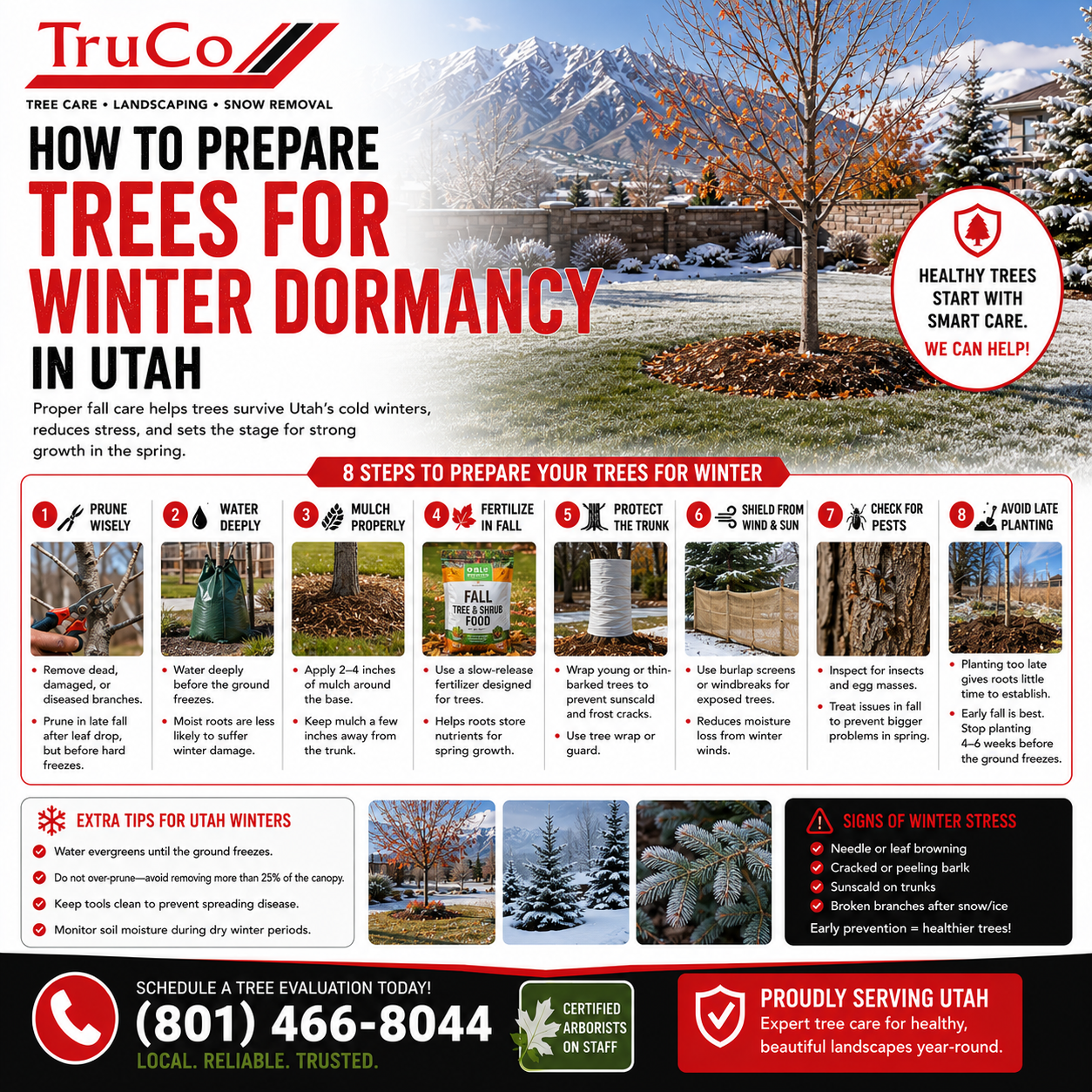
Why Winter Preparation Is Critical for Utah Trees
Winter is the most challenging season for trees in Utah. Heavy snow loads, bitter cold temperatures, drying winds, and freeze-thaw cycles all stress trees. Proper preparation before winter dormancy determines whether your trees emerge healthy in spring or suffer damage that can take years to overcome. Utah's climate is especially harsh on trees — temperatures can swing from above freezing during the day to below zero at night, and our dry winter air desiccates evergreen foliage. Winter injury is one of the most common reasons tree health declines in Utah. However, with proper fall preparation, most trees can withstand even the toughest Utah winter. This guide covers the essential steps every Utah homeowner should take to prepare trees for winter dormancy, from proper fall watering to protective measures for vulnerable species.
Fall Watering: The Foundation of Winter Preparation
Fall watering is the single most important step in winter tree preparation. Trees that enter winter with adequate soil moisture are far more resistant to winter damage. In Utah, the fall months (September-November) are typically dry, and many homeowners stop watering once temperatures cool. This is a critical mistake. Continue deep watering through October and into November until the ground freezes. A deep watering in late October or early November ensures the root zone has adequate moisture to sustain the tree through winter. This is especially important for evergreens, which continue to lose moisture through their needles all winter. The rule of thumb: water deeply once a week in September, every 10-14 days in October, and once or twice in November if the ground is not yet frozen. Apply 1-1.5 inches of water over the root zone each time. After the ground freezes, water once a month on warm days (above 40°F) when there is no snow cover. Proper fall watering reduces winter drought stress, prevents branch dieback, and ensures your trees leaf out fully in spring.
Mulching for Winter Protection
Fall mulching protects tree roots through winter. Apply 3-4 inches of organic mulch (wood chips, shredded bark, or leaf compost) over the root zone, extending from the trunk to the drip line. Keep mulch 3-6 inches away from the trunk to prevent bark rot and rodent damage. Winter mulch provides several benefits: insulates roots from extreme temperature fluctuations, reduces frost heaving (where repeated freeze-thaw cycles push roots up out of the soil), retains soil moisture through winter, and breaks down to add organic matter to the soil. The best time to apply winter mulch is after the first hard frost (usually October or early November in Utah) but before the ground freezes solid. Do not use fresh bark or wood chips that haven't been aged — they can temporarily tie up soil nitrogen. Leaf mulch from your own yard is excellent — shred leaves with a mower before applying. In Utah's colder mountain communities like Park City and Heber Valley, increase mulch depth to 4-6 inches for added protection.
Pruning for Winter: What to Do and What to Skip
Late fall and early winter is an excellent time for most pruning in Utah. Dormant pruning has several advantages: it is easier to see the tree's structure without leaves; the tree is less stressed by pruning during dormancy; diseases and pests are inactive, reducing infection risk; and dormant pruning stimulates vigorous spring growth. Focus on removing dead, dying, diseased, and crossing branches. Remove branches with weak attachments that could fail under snow load. Thin dense canopies to reduce snow accumulation. Raise lower branches for clearance. However, avoid heavy pruning of trees that are stressed or in decline — they need all their resources to survive winter. Do not prune in late fall if a hard freeze is expected within a few days — fresh pruning wounds need time to callus. Do not prune spring-flowering trees (like redbud, serviceberry, and ornamental fruit trees) in fall — you will remove next spring's flower buds. Prune them immediately after they bloom instead. For most shade trees in Utah, November through February is the ideal pruning window, except during extreme cold (below 20°F), when wood becomes brittle and pruning can cause bark damage.
Protecting Tree Trunks from Winter Damage
Utah's winter sun and cold temperatures can damage tree bark, especially on young or thin-barked trees. Sunscald (southwest winter injury) occurs when winter sun warms the bark on the south or southwest side of the tree, causing cells to break dormancy, then freezing temperatures at night kill the active cells. This creates vertical cracks or dead patches on the trunk. Protect vulnerable trees by wrapping the trunk with white tree wrap (commercial tree wrap or kraft paper) from the base to the first branches. Apply wrap in November and remove in March or April. White wrap reflects sunlight and insulates the trunk. Do not leave wrap on year-round — it can trap moisture and harbor pests. Plastic guards or spiral tree guards protect trunks from rodent damage (voles, rabbits, and mice that gnaw bark in winter). Install guards around the base, extending above expected snow depth. In Utah, deep snow can bury young trees completely, giving rodents access to the entire trunk. Remove guards in spring to prevent girdling. For young trees, apply a white latex paint (diluted 50:50 with water) to the south and southwest sides of the trunk as an alternative to wrapping.
Protecting Trees from Snow and Ice Damage
Utah's heavy, wet snow is a major threat to trees, especially evergreens and multi-stemmed trees. Prepare by removing weak, damaged, or poorly attached branches before winter. Thin dense canopies of evergreens by 10-15% to reduce snow catchment. For multi-stemmed trees with narrow crotch angles, consider cabling or bracing to support weak unions. When snow accumulates on trees, gently brush it upward off branches using a broom — never pull down on branches, as this adds weight and can cause breakage. For tall evergreens (arborvitae, junipers), tie branches together loosely with soft twine or arborist tape before heavy snow to prevent splaying. Remove ties in spring. For small trees and shrubs, construct A-frame shelters or use stakes and burlap to protect from snow load. In Utah's mountain communities, where snowfall regularly exceeds 100 inches per year, preventive measures are essential. After heavy snowstorms, inspect trees for damage and address broken branches promptly before the next storm. Learn to distinguish between snow load (branches bent but intact) and breakage (clean cracks or splits). Most snow-damaged branches can be pruned cleanly in spring.
Winter Desiccation Protection for Evergreens
Winter desiccation (drying) is the most common winter injury for Utah evergreens. Evergreens continue to lose moisture through their needles all winter, but when the ground is frozen, roots cannot replace the lost water. The result: brown, dry needles, particularly on the south and southwest sides of the tree and on the windward side. Protect evergreens by watering deeply until the ground freezes. Apply anti-desiccant sprays (wilt-proofing agents) in late fall when temperatures are above 40°F. These sprays coat needles with a waxy film that reduces moisture loss. One application in November is usually sufficient, but a second application in January during extended warm spells provides additional protection. For small evergreens, erect burlap screens on the south and west sides to block wind and sun. Commercial evergreen wraps are also available. Choose wind-hardy evergreen species for exposed Utah locations — Austrian pine, Ponderosa pine, and Rocky Mountain juniper are more winter-hardy than Colorado blue spruce or white fir in exposed sites. In Utah's high-elevation communities, winter desiccation protection is critical for all evergreens.
Winter Pest and Animal Protection
Winter is a time of increased pest and animal pressure on Utah trees. Deer browse on evergreens and young trees — use deer fencing, repellent sprays, or deer-resistant plantings. Rabbits and voles gnaw bark at the base of trees under snow — install hardware cloth cylinders (¼-inch mesh) around trunks, extending above expected snow depth. Apply rodent repellent sprays to bark before winter. Snow mold and fungal diseases can develop under deep snow cover — avoid piling snow around tree trunks when shoveling. In late winter, watch for sunscald and frost cracks on the south and southwest sides of trunks. When temperatures fluctuate dramatically in Utah's late winter (February-March), bark damage is most likely. If you see frost cracks, they often heal on their own in spring — do not apply wound paint or sealants, which can trap decay. Contact a certified arborist if cracks are deep or extensive. Monitor your trees throughout winter and address problems as they arise rather than waiting for spring. Proactive winter protection dramatically reduces tree damage and ensures healthy spring growth.
What Not to Do: Common Winter Preparation Mistakes
Several common mistakes can harm trees during winter preparation. Do not fertilize trees in fall — nitrogen fertilizer late in the season stimulates tender new growth that will be killed by frost. Fertilize in spring instead. Do not prune in late fall if a hard freeze is expected within a few days. Do not apply wound paint or pruning sealers — they trap moisture and decay, and trees heal naturally. Do not pile mulch against the trunk (volcano mulching) — this causes bark rot and provides cover for rodents. Do not use plastic sheeting or landscape fabric under mulch — it prevents water penetration and restricts root growth. Do not wrap tree trunks with anything that does not breathe — use breathable tree wrap only. Do not leave tree wrap on year-round. Do not use salt-based deicers near trees — salt damage accumulates over years and can kill trees. Use calcium chloride or sand instead. Do not pile snow from driveways or walkways onto tree root zones — road salt and deicer runoff can damage roots. Do not "top" trees or make severe heading cuts in fall — these create weak regrowth and increase winter damage risk. Following these dos and don'ts ensures your trees enter winter healthy and emerge in spring ready to grow.
Frequently Asked Questions
When should I start preparing my trees for winter in Utah? Begin preparations in September with deep fall watering. Complete mulching and wrapping by November before the ground freezes. Pruning can be done from November through February.
Do all trees need winter protection in Utah? Not equally. Young trees (under 5 years), thin-barked trees (maples, birches, fruit trees), evergreens, and newly planted trees need the most protection. Established, native, and drought-tolerant species (honeylocust, bur oak, Kentucky coffeetree) need less.
Can snow damage kill a tree? Yes. Heavy, wet snow can break major branches, split trunks, or flatten evergreens. While most trees recover from snow damage, severe breakage can be fatal. Preventive pruning and snow removal reduce this risk.
Should I water my trees before a hard freeze? Yes. Watering deeply 24-48 hours before a hard freeze (when temperatures are expected below 20°F) helps protect roots. Moist soil holds more heat than dry soil and insulates roots better.
How do I protect newly planted trees in Utah winter? Water deeply until the ground freezes. Apply 3-4 inches of mulch. Wrap the trunk with tree wrap. Install a rodent guard. Stake if needed (remove stakes after 1-2 years). Protect evergreens with anti-desiccant spray.
When should I remove winter tree protection in spring? Remove trunk wraps and rodent guards in March or early April when daytime temperatures consistently exceed 50°F. Remove snow ties from evergreens as snow melts. Leave mulch in place year-round, refreshing as needed.