
Choosing Trees That Thrive in Utah's Clay Soil

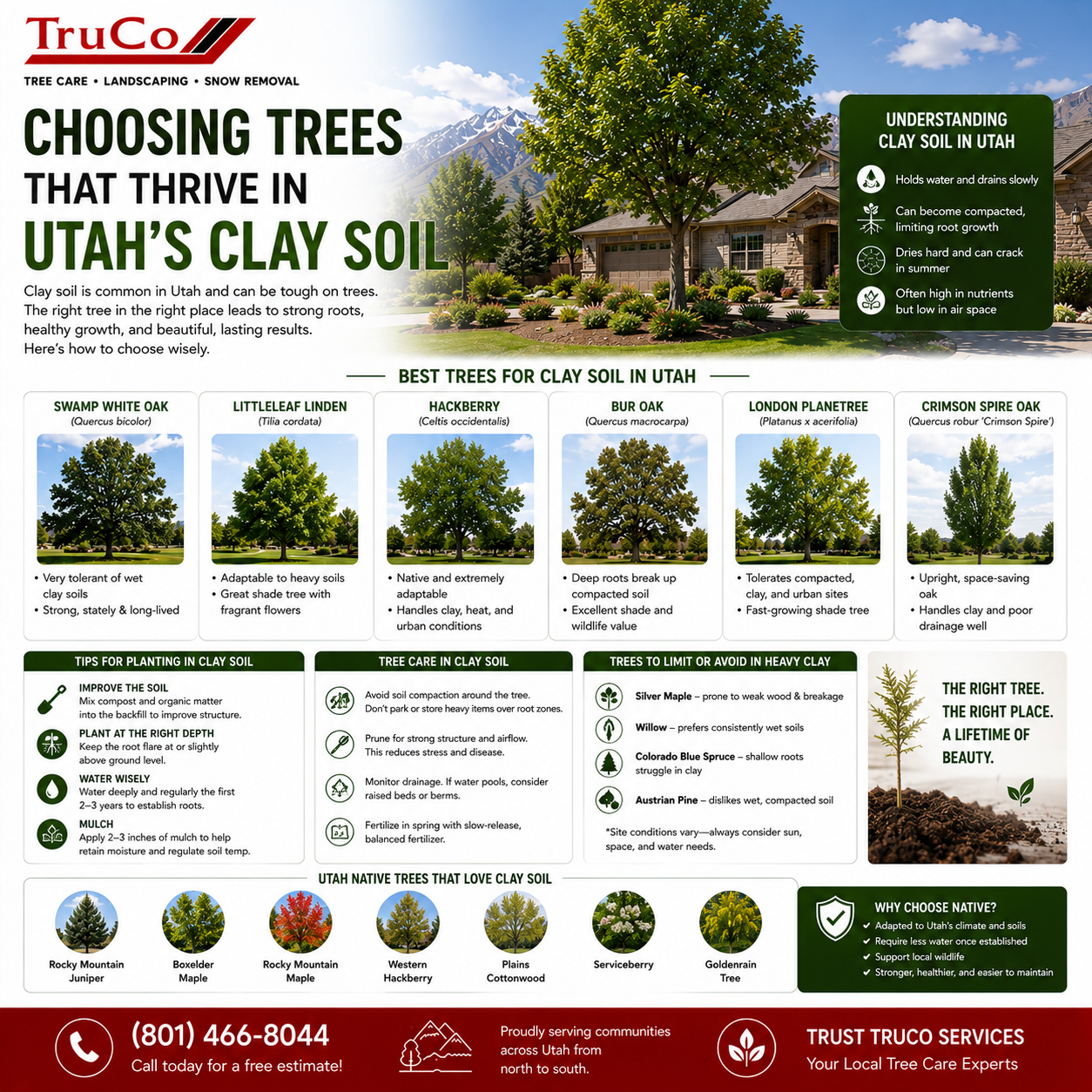
Understanding Utah's Clay Soil
Utah's soil is dominated by alkaline clay, particularly along the Wasatch Front from Ogden through Salt Lake City to Provo. This heavy clay soil presents unique challenges for tree growth: it drains slowly, compacts easily, and has a high pH (7.5-8.5) that locks up essential nutrients like iron. Despite these challenges, many trees thrive in Utah's clay soil when properly selected and planted. The key is choosing species adapted to these conditions and preparing the planting site correctly. Trees that naturally tolerate heavy, alkaline soils will establish faster, live longer, and require less maintenance than species that struggle with these conditions. Understanding your specific soil type — whether it's the dense clay of the valley floor, the sandy loam of the bench areas, or the rocky soil of the foothills — is the first step in choosing the right tree.
Top Trees for Utah Clay Soil: Large Shade Trees
For large shade trees that tolerate Utah's clay soil, several species stand out. Honeylocust (Gleditsia triacanthos inermis) is one of the best choices — tolerates high pH, compacted soil, and drought once established. Offers dappled shade, beautiful fall color, and is virtually pest-free in Utah. Kentucky coffeetree (Gymnocladus dioicus) is another excellent choice — tolerates clay, alkali, drought, and urban conditions well. Large, bold texture and late-emerging leaves let spring bulbs get sun before leafing out. Bur oak (Quercus macrocarpa) is Utah's most adaptable oak — tolerates clay, high pH, and drought better than red oaks or pin oaks. Slow but steady growth, massive structure, and beautiful form. Catalpa (Catalpa speciosa) grows well in Utah clay, produces large heart-shaped leaves and showy flowers, and is extremely tolerant of heavy, wet soils. Chinese elm (Ulmus parvifolia) tolerates clay, drought, and alkaline conditions, providing graceful form and attractive bark. For soil pH above 7.5, these species are your best bets for long-lived, low-maintenance shade trees.
Top Trees for Utah Clay Soil: Ornamental and Medium Trees
For smaller properties or accent trees in Utah clay soil, consider these ornamentals. Serviceberry (Amelanchier alnifolia) is a Utah native that thrives in clay — white spring flowers, edible berries, and brilliant fall color. Adaptable to a wide range of soil conditions. Goldenrain tree (Koelreuteria paniculata) tolerates clay, drought, and high pH. Features summer yellow flowers and papery seed pods. Hops tree / wafer ash (Ptelea trifoliata) is a tough, underutilized Utah native that thrives in clay. Fragrant flowers and interesting seed pods. Western catalpa / northern catalpa grows smaller in clay but still provides beautiful flowers. Amur maple (Acer tataricum subsp. ginnala) is a tough small tree for clay, with brilliant red fall color. Very drought-tolerant once established. For clay soil sites, these medium and ornamental trees provide reliable performance with fewer problems.
Top Trees for Utah Clay Soil: Evergreens
Evergreens in Utah clay soil require careful selection. Austrian pine (Pinus nigra) is the most adaptable pine for Utah clay — tolerates high pH, clay soil, and drought. Dark green color and dense form. Southwestern white pine (Pinus strobiformis) handles Utah's alkaline clay better than eastern white pine. Soft blue-green needles. Pinyon pine (Pinus edulis) is a Utah native that tolerates clay and alkaline conditions. Slow-growing but extremely tough and drought-tolerant. Rocky Mountain juniper (Juniperus scopulorum) handles clay and high pH well — great for screens and windbreaks. Native and adapted to Utah conditions. Colorado blue spruce (Picea pungens) tolerates Utah clay but may need occasional treatment for cytospora canker, a common issue in Utah. Plant in well-drained clay with good air circulation. Avoid white fir (Abies concolor) in heavy clay — it prefers better-drained soils. For the best results with evergreens in clay, plant on a slight slope or mound to improve drainage.
Trees to Avoid in Utah Clay Soil
Some trees struggle badly in Utah's clay soil and should generally be avoided unless you are willing to provide intensive care. River birch (Betula nigra) is highly susceptible to iron chlorosis in Utah's alkaline clay — leaves turn yellow and trees decline. Better suited to acidic, moist soils. Red maple and silver maple (Acer rubrum, Acer saccharinum) often develop severe chlorosis in Utah clay. Some silver maples adapt, but expect yellow leaves. Quaking aspen (Populus tremuloides) is native to Utah's mountains but struggles in valley clay — prone to borers, cankers, and leaf spots in heavy, low-elevation soils. European white birch (Betula pendula) is extremely chlorosis-prone in Utah clay. Short-lived and problematic for valley locations. Pin oak (Quercus palustris) requires acidic soil and will develop severe chlorosis in Utah's alkaline clay. Flowering dogwood (Cornus florida) needs acidic, well-drained soil and does poorly in Utah clay. If you want these species, plan on annual iron chelate treatments and a shorter tree life.
How to Prepare Clay Soil for Planting Trees
Proper soil preparation dramatically improves tree success in Utah clay. Test your soil pH through Utah State University Extension. Dig a wide planting hole — 3-5 times the width of the root ball but no deeper than the root ball height. The most common mistake is planting too deep in clay soil. Rough up the sides of the hole — smooth clay sides can create a "flower pot" effect that traps water. Add organic matter (compost, peat moss) to the backfill — about 20-30% by volume. Add elemental sulfur according to soil test recommendations to lower pH. Do NOT add sand to clay — this creates a concrete-like mixture. Do NOT use gravel at the bottom of the hole — it creates a perched water table. Plant high — the root ball should be 1-2 inches above the surrounding grade in clay soil. Water thoroughly after planting and apply 3-4 inches of organic mulch over the root zone, keeping it away from the trunk.
Watering Strategies for Trees in Clay Soil
Utah clay soil requires specific watering strategies. Clay absorbs water slowly but holds it for a long time. Water infrequently but deeply — the goal is to wet the entire root zone, then let it dry partially before the next watering. For newly planted trees, water every 5-7 days during the growing season (rather than the daily light watering recommended for sandy soils). Use a slow trickle or soaker hose to allow water to penetrate the clay rather than running off. Stop watering when water begins to puddle — let it soak in, then continue. After rain, check soil moisture before watering — clay holds rainfall for days. In fall, reduce watering frequency but continue deep watering until the ground freezes. Overwatering in clay soil is as dangerous as underwatering — saturated clay suffocates roots and promotes root rot. A moisture meter can help you gauge when watering is needed.
Soil Amendments and Long-Term Care
Long-term care for trees in Utah clay soil focuses on maintaining soil health. Annual mulching with 2-3 inches of organic mulch (wood chips, bark) builds soil structure as it decomposes, adds organic matter, moderates soil temperature, retains moisture, and reduces compaction. Avoid fresh bark or wood chips that haven't been aged — they can temporarily tie up nitrogen. Apply iron chelate (EDDHA form) every 1-2 years for susceptible species to prevent chlorosis. Deep root fertilization with a slow-release fertilizer every 2-3 years supports tree health. Core aeration every 3-5 years reduces soil compaction in high-traffic areas. Gypsum can improve clay soil structure in some cases — apply according to soil test recommendations. Avoid walking or driving over tree root zones — clay soil compacts easily and compaction damages roots. Install protection fencing around critical root zones during construction projects.
Signs Your Tree Is Struggling with Clay Soil
Watch for these symptoms indicating your tree is struggling with Utah's clay soil. Leaf yellowing (chlorosis) between green veins on new leaves indicates iron deficiency from high soil pH. Stunted growth — fewer new shoots, smaller leaves, and reduced annual growth. Leaf scorch — brown edges on leaves during summer, often from poor root function in waterlogged clay. Dieback — branch death starting at the tips, indicating root stress. Poor fall color — leaves turn brown rather than colorful before dropping. Early leaf drop — trees lose leaves weeks before normal. Root rot — mushrooms at the base or fungal conks indicate decay fungi, often from consistently wet clay. If you see these signs, first check your watering practices (overwatering is common in clay), then test soil pH, and consult a certified arborist for treatment options including iron chelate application and deep root aeration.
Frequently Asked Questions
How do I test my soil in Utah? Utah State University Extension offers soil testing through the Analytical Laboratories (USUAL) in Logan. Basic soil tests cost about $25 and include pH, salinity, organic matter, and nutrient levels. DIY test kits are also available but less accurate.
Can I improve clay soil drainage before planting? Yes. Planting on a slight mound or raised bed improves drainage. Amending the backfill with organic matter and ensuring the planting hole is not too deep helps prevent waterlogging. French drains or tile drains may be needed for severe drainage problems.
How deep should I plant a tree in Utah clay? Plant high — 1-2 inches above the surrounding grade. Planting too deep is the most common cause of tree failure in Utah clay soil. The root flare should be visible above the soil line after planting.
What is the best fertilizer for trees in clay soil? A slow-release fertilizer with no phosphorus (0-0- or low-P formulation) is best for Utah clay soil. High phosphorus fertilizers bind iron and worsen chlorosis. Use a fertilizer formulated for trees in alkaline soil.
Will gypsum help my clay soil? Gypsum can improve clay soil structure in sodic (high-sodium) soils by displacing sodium. However, Utah clay soils are often not sodic, and gypsum may not help. Test your soil before applying gypsum.
Do trees in clay soil need different pruning? Trees in clay soil may need more frequent deadwood removal because root stress can cause branch dieback. Focus on removing dead, diseased, and crossing branches. Avoid heavy pruning of stressed trees.