
Tree and Utility Line Safety for Utah Homeowners

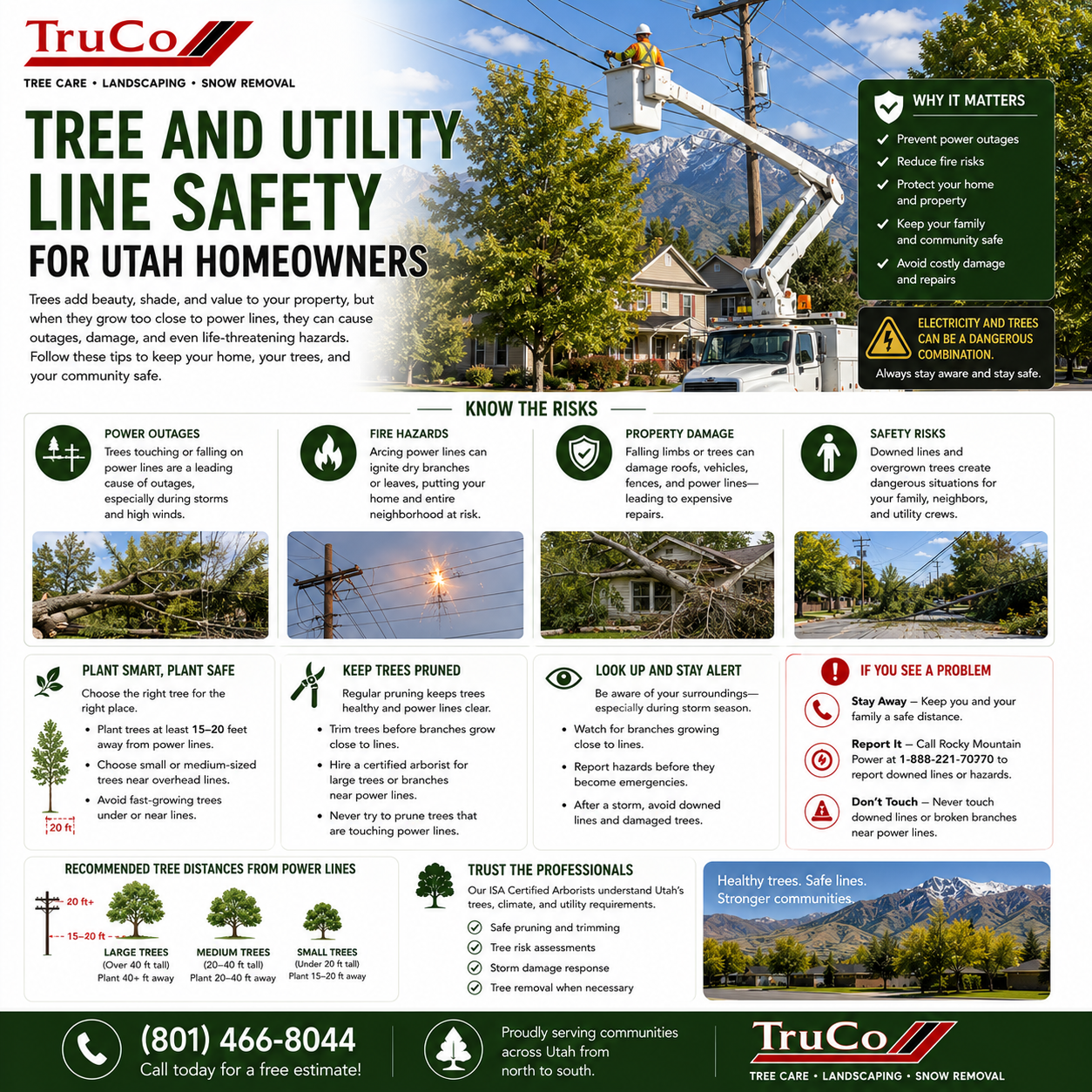
Understanding the Risks: Trees and Power Lines
Trees growing near power lines pose serious safety risks for Utah homeowners. Contact between tree branches and power lines can cause power outages, electrical fires, property damage, and fatal electrocution. In Utah, where snow loads can weigh down branches and spring storms can whip them into lines, the risk is especially high. Utah's urban forests include millions of trees planted beneath the estimated 50,000 miles of power lines crisscrossing the state. Understanding the regulations, risks, and proper procedures for tree care near utility lines is essential for every Utah homeowner. Rocky Mountain Power, Utah's primary electrical utility, requires specific clearances and may take action if homeowner trees threaten power infrastructure. Working near power lines is extremely dangerous — do not attempt to prune or remove trees near utility lines yourself.
Types of Utility Lines and Required Clearances
Not all utility lines are the same, and required clearances vary. Primary power lines carry high voltage (7,200-35,000 volts) and are typically the top lines on utility poles. Utah regulations require a minimum 10-foot clearance between trees and primary lines, and only utility companies or their qualified contractors may work within 10 feet of these lines. Secondary power lines carry lower voltage (120-480 volts) to homes and buildings. A minimum 5-foot clearance is recommended. Communication lines (cable, telephone, fiber optic) carry no electrical current but can be damaged by tree contact. Homeowners may prune around these lines with caution, but it is safer to have a professional do it. Service drops (lines from the pole to your house) carry electricity to your home. Maintain 3-5 feet of clearance. Never touch a service drop branch — even if the line appears insulated, the insulation can be damaged. Clearance requirements may be stricter in Utah's mountain communities where snow loads can cause branches to sag closer to lines.
Who Is Responsible for Tree Trimming Near Power Lines
Responsibility for tree trimming near power lines depends on the location. The utility company (Rocky Mountain Power in most of Utah) is responsible for maintaining clearance around primary power lines on public rights-of-way and utility easements. This includes trees growing along streets, in utility easements on your property, and near main power lines. The utility typically contracts certified tree services to perform this work at no cost to homeowners. The homeowner is responsible for trees on private property that are near the service drop to their house. However, if the tree is within 10 feet of a power line, the homeowner must hire a qualified line-clearance arborist — never attempt this work yourself. Many Utah homeowners are unaware of these responsibilities and may face fines or liability if their trees cause power outages. Check with Rocky Mountain Power's vegetation management program for specific responsibilities in your area. For trees on private property near primary power lines, Rocky Mountain Power will often trim or remove hazardous trees at their discretion.
The Dangers of DIY Tree Work Near Power Lines
Working near power lines is one of the most dangerous activities a homeowner can undertake. Each year in the United States, dozens of people are electrocuted while trimming trees near power lines. Electricity can arc (jump) through the air to nearby conductive objects — you do not need to touch a line to be electrocuted. A ladder, pruning pole, or even a wet branch can conduct electricity from a line several feet away. Water in freshly pruned branches increases conductivity. In Utah, where irrigation systems keep lawns and trees well-watered during summer, the risk of electrical conduction through wet trees is elevated. Additionally, branches that fall on power lines can cause outages, fires, or energize the ground around the fallen branch. Even certified arborists follow strict safety protocols near power lines, using insulated equipment and maintaining minimum approach distances. Homeowners should never attempt to prune, remove, or even assess trees within 10 feet of any power line.
Professional Line-Clearance Arborists
Line-clearance arborists are specialized professionals trained to work safely near energized power lines. These arborists undergo extensive training in electrical hazard awareness, proper climbing and rigging techniques near lines, and use of insulated tools and equipment. In Utah, line-clearance arborists typically work for utility contractors or tree service companies that contract with Rocky Mountain Power. When you need tree work near power lines on your property, hire only an arborist with line-clearance certification and proper insurance. Ask for references and verify their qualifications — not all tree services are qualified to work near power lines. A line-clearance arborist will assess the situation, determine the safest approach (which may involve a planned power outage), and perform the work without risking their life or your property. Cost for professional line-clearance tree trimming varies widely depending on the scope but typically ranges from $300-$1,500 per tree for work near power lines, reflecting the specialized training and equipment required.
Choosing the Right Trees to Plant Near Power Lines
Prevention is the best approach to tree and utility line conflicts. When planting new trees near power lines, select species that will not grow tall enough to reach the lines. For areas beneath power lines (typically 20-30 feet clearance), choose small trees that mature at 15-20 feet or less. Excellent small trees for Utah include serviceberry (Amelanchier alnifolia) — Utah native, white flowers, edible berries, mature height 15-25 feet; Japanese tree lilac (Syringa reticulata) — beautiful summer flowers, mature height 20-25 feet, tolerant of Utah's alkaline soil; goldenrain tree (Koelreuteria paniculata) — yellow flowers, mature height 20-30 feet, handles Utah clay; Amur maple (Acer tataricum subsp. ginnala) — brilliant fall color, mature height 15-20 feet; eastern redbud (Cercis canadensis) — pink spring flowers, mature height 20-30 feet, does well in Utah; and crape myrtle (Lagerstroemia indica) — long summer bloom period, mature height 15-25 feet, hardy in Utah's warmer zones. Plant trees at least 15-20 feet from utility poles and 10-15 feet from service drops. Consider the tree's mature spread, not just its height, when planning your planting location.
What to Do If a Tree Branch Hits a Power Line
If a tree branch falls on or is contacting a power line on your Utah property, follow these critical steps. Stay away — assume the line is energized and dangerous. Keep everyone at least 35 feet away from the line and anything touching it. Do not attempt to remove the branch or move the line. Call 911 immediately to report the downed line. Then call Rocky Mountain Power at 1-888-221-7070 to report the emergency. Warn neighbors of the danger. If a branch is simply touching a line but not weighing it down or causing sparks, do the same — stay away and call the utility. Do not drive over a downed power line. Do not touch a vehicle that is in contact with a power line. If you are in a vehicle that has contacted a power line, stay in the vehicle unless it is on fire, and if you must exit, jump clear without touching the vehicle and ground at the same time. Downed power lines are a leading cause of storm-related deaths in Utah, particularly during spring windstorms and winter snow events.
Underground Utilities: Roots and Buried Lines
Trees and underground utilities present different but equally important safety concerns. Before any digging on your Utah property, call 811 to have underground utilities marked — this is free and required by Utah law. Tree roots can damage underground gas lines, water pipes, and sewer lines as they grow. Conversely, digging to install or repair underground utilities can severely damage tree roots, leading to tree decline or failure. Signs of tree root interference with underground utilities include slow drains, sewage backups, or water leaks near trees; heaving soil or pavement near trees; and unusual patches of lush grass near sewer lines (indicating leaks). If tree roots are interfering with underground utilities, consult an arborist before cutting roots. Cutting major roots can destabilize a tree, especially in Utah's clay soil where roots grow shallow and wide. In some cases, root barriers can redirect root growth away from underground utilities. For new installations, choose tree locations at least 10-15 feet from underground utility lines.
Legal Considerations and Liability
Utah homeowners have legal responsibilities regarding trees and utility lines. If your tree grows into power lines and causes an outage, you may be liable for damages and restoration costs. If a tree on your property falls on a power line and causes injury or property damage, your homeowner's insurance may not cover the claim if you were negligent in maintaining the tree. Rocky Mountain Power has the right to trim or remove trees on your property that threaten power lines, and if you refuse, they may pursue legal action. Utah's utility easement laws give utilities access to maintain their infrastructure on private property. Homeowners who plant tall-growing trees beneath power lines may be required to have them removed at their own expense if they threaten the lines. The best approach is proactive — maintain proper clearances, choose appropriate species for planting near lines, and have any hazardous trees professionally assessed and addressed before they become a problem.
Frequently Asked Questions
Can I trim a tree branch touching a power line? No. Never attempt to trim any tree within 10 feet of a power line. Contact your utility company (Rocky Mountain Power) or a qualified line-clearance arborist.
How close can I plant a tree to a power line? Plant small trees (maturing under 20 feet) at least 15 feet from utility poles and 10 feet from service drops. Plant medium trees (20-40 feet) at least 30 feet from power lines. Large trees (over 40 feet) should be at least 50 feet from any power line.
Will the utility company trim my tree for free? If the tree threatens primary power lines (not just the service drop to your house), the utility company will typically trim it at no cost to you. Contact Rocky Mountain Power's vegetation management department to request an assessment.
Does my homeowner's insurance cover tree damage to power lines? Not typically. Tree-related outages and damage to utility infrastructure are generally not covered by standard homeowner's policies. Liability coverage may apply if you were negligent in maintaining a hazardous tree.
What trees are best to plant under power lines in Utah? Small trees maturing under 20 feet: serviceberry, Japanese tree lilac, Amur maple, goldenrain tree, eastern redbud, and crape myrtle. Avoid fast-growing tall trees like silver maple, cottonwood, and poplar.
How often should trees near power lines be inspected? Annually, at minimum. After major storms, inspect for new hazards. If your trees have previously caused clearance issues, consider semi-annual inspections. The dormant season is ideal for inspection when branches are bare.