
Should I Use Natural Stone or Concrete Pavers in Utah?

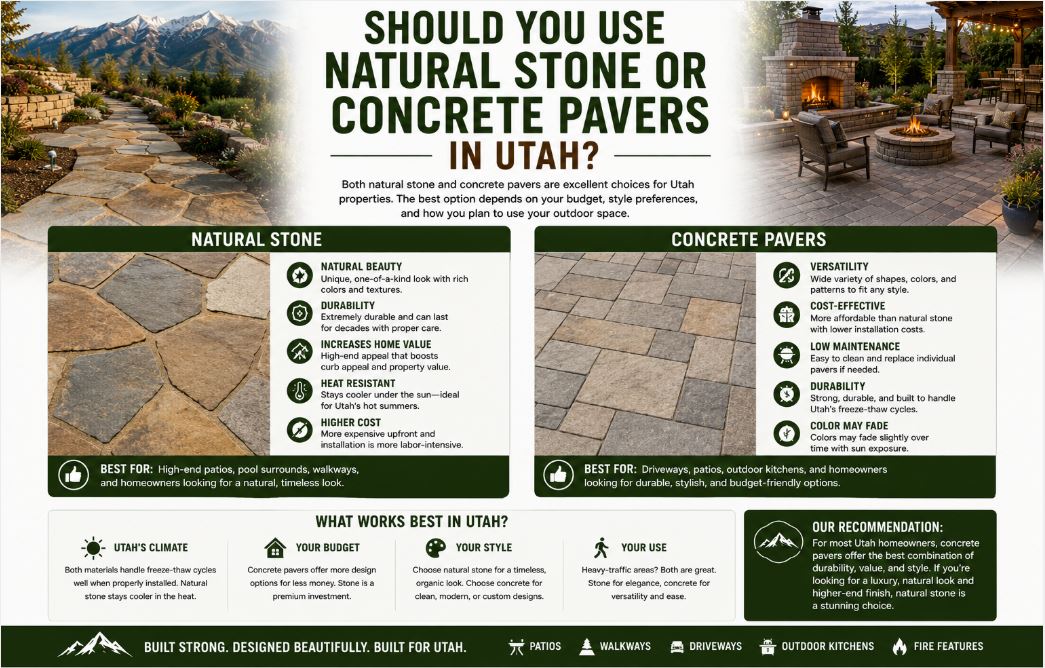
Natural Stone in Utah — Pros and Cons
Natural stone has been used for patios and walkways in Utah for decades. The Wasatch Front is rich in sandstone and flagstone quarries, making natural stone a locally sourced option.
Pros: Unique appearance with every piece being different. Longevity of 50+ years — many historic homes in Salt Lake City's Avenues district still have original flagstone walkways after 80+ years. Color retention that does not fade over time. Increased property value — real estate agents in Park City and Deer Valley report natural stone patios add 1-3% to resale value. Slip resistance when wet due to natural texture.
Cons: Cost of $15-$30 per square foot installed. A 400 sq ft patio runs $6,000-$12,000. Variable thickness makes installation complex. Freeze-thaw vulnerability — softer Utah sandstones can spall if not sealed properly. Irregular shapes create more joints where weeds infiltrate. Requires penetrating sealer every 2-3 years.
Concrete Pavers in Utah — Pros and Cons
Concrete pavers have become the dominant hardscape material in Utah over the last 20 years, manufactured specifically for the Intermountain West climate.
Pros: Cost-effective at $8-$15 per square foot installed — roughly half the cost of natural stone. Engineered for freeze-thaw with low water absorption under 5%. Consistent quality with uniform thickness. Easy repair — individual pavers can be replaced. Wide color, texture, and shape selection. Lower maintenance — re-seal every 3-5 years versus every 2-3 for natural stone.
Cons: Manufactured appearance lacks natural variation. Color fading over 10-15 years, especially in Utah's high-elevation UV. Efflorescence (white mineral deposits) can appear, particularly in the first year. Lower resale premium — concrete pavers are expected in most modern Utah homes.
Which Holds Up Better to Freeze-Thaw?
Concrete pavers win this category. Modern concrete pavers have a water absorption rate of 3-5%. When water cannot penetrate the paver, it cannot freeze inside and cause cracking. The joints between pavers allow water to drain through to the base rather than pooling on the surface.
Natural stone is more variable. Dense stones like bluestone and quartzite perform well. But softer Utah sandstone can absorb 5-12% water by volume — when that water freezes, the surface can spall. The key: use dense stone like Arizona flagstone or Pennsylvania bluestone, apply high-quality penetrating sealer every 2-3 years, and ensure proper base drainage.
For both materials, a 6-8 inch compacted gravel base with proper drainage is essential for any hardscape installation along the Wasatch Front.
Cost Comparison for a 400 sq ft Patio
Natural stone: materials $2,000-$4,000, base materials $400-$600, labor $3,000-$5,000, sealing $300-$500, total $5,700-$10,100 ($14-$25/sq ft).
Concrete pavers: materials $800-$1,600, base $400-$600, labor $2,000-$3,500, sealing $200-$400, total $3,400-$6,100 ($8-$15/sq ft).
Over a 50-year period, concrete pavers would need replacement at year 25-30, potentially making natural stone cheaper over the full lifecycle despite the higher upfront cost.
Best Applications for Each Material
Natural stone is best for: Patios in luxury homes (Park City, Deer Valley, Upper Avenues), small focal-point installations like fire pit areas or front entry walkways, pool surrounds where stone stays cooler underfoot, and retaining wall caps for a finished look.
Concrete pavers are best for: Large patios over 400 sq ft where cost savings multiply, driveways that handle vehicle loads better, walkways where uniform pavers create even surfaces, budget-conscious projects, and DIY installations.
How to Choose Based on Your Utah Property
Salt Lake Valley (Sandy, Draper, South Jordan, Murray): Concrete pavers are the practical choice. The valley's clay soil requires excellent base preparation regardless, and concrete pavers give you more budget for drainage and base work.
Park City, Deer Valley, Summit County: Natural stone aligns with mountain aesthetics and higher property values. Flagstone and bluestone are preferred. Budget for sealing every 2 years due to heavier snowpack.
Utah County (Provo, Orem, Lehi): Concrete pavers dominate new construction. For spec homes, concrete pavers offer the best ROI. For forever homes, consider natural stone for the patio and concrete pavers for walkways.
Frequently Asked Questions
Is natural stone or concrete better for Utah freeze-thaw?
Concrete pavers are engineered for low water absorption (3-5%) and handle freeze-thaw better than most natural stones. Dense stones like bluestone perform well, but softer sandstone requires regular sealing.
How much does a paver patio cost in Utah per square foot?
Concrete pavers: $8-$15/sq ft installed. Natural stone: $15-$30/sq ft installed.
Do I need a permit for a paver patio in Utah?
Most Utah cities require permits for patios over 200 sq ft. Check with your local building department.
Should I seal natural stone or concrete pavers in Utah?
Yes. Sealing prevents water absorption (the primary cause of freeze-thaw damage), reduces weeds, and makes cleaning easier. Natural stone: every 2-3 years. Concrete pavers: every 3-5 years.
Which is more slip-resistant for pool areas?
Natural stone offers better natural slip resistance. But many concrete paver manufacturers offer textured finishes for wet areas. Choose tumbled or brushed finishes in either material.