
How to Hire a Certified Arborist in Utah

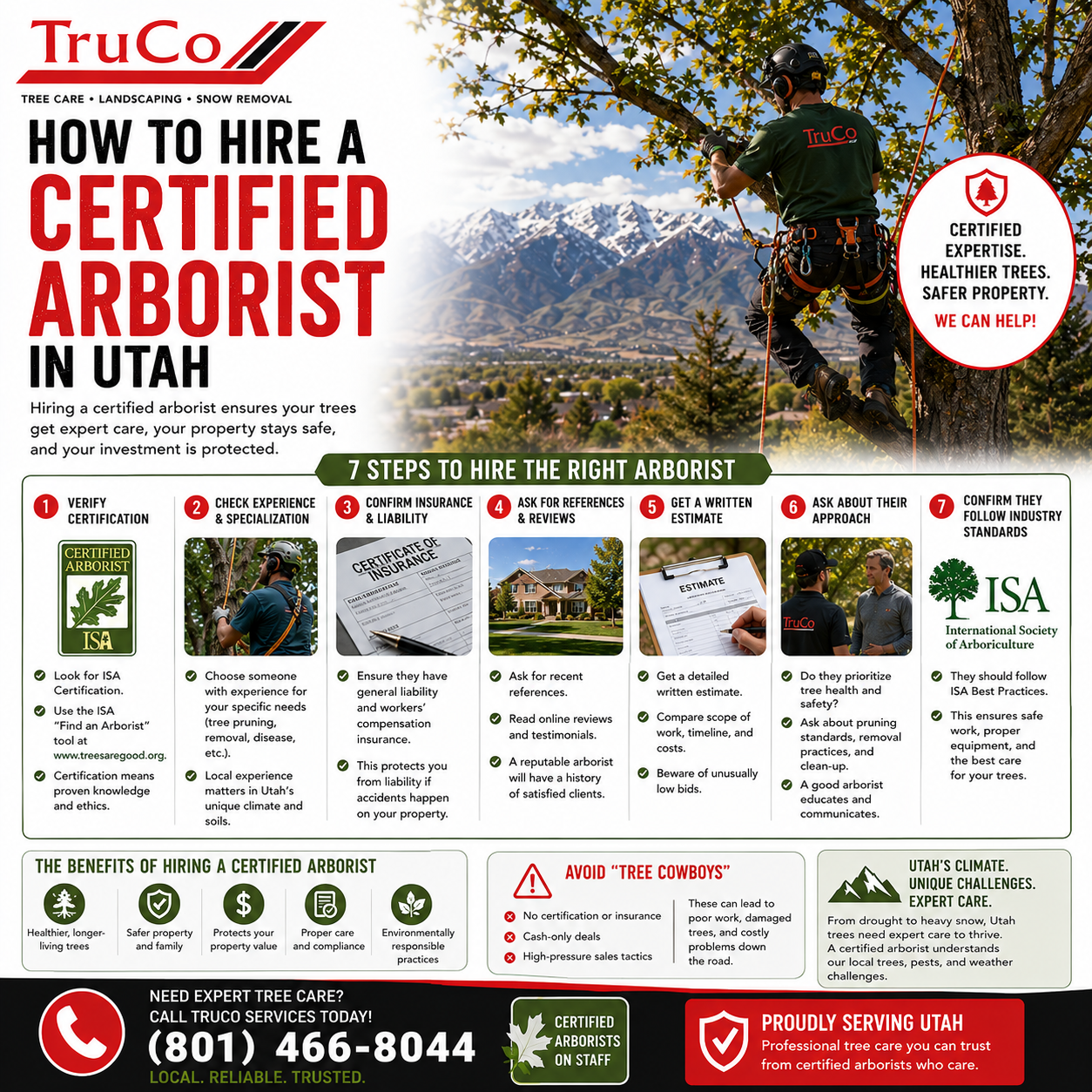
Why Hiring a Certified Arborist Matters in Utah
When your trees need care, hiring the right professional is just as important as choosing the right treatment. A certified arborist brings specialized knowledge of tree biology, proper pruning techniques, pest and disease management, and safety practices that a general landscaper or handyman simply does not have. In Utah, where trees face unique challenges — alkaline clay soil, extreme temperature swings, heavy snow loads, and specific pests like the ips beetle and cytospora canker — expert tree care is essential. Hiring an unqualified tree worker can result in improper pruning that damages trees for life, undiagnosed pest problems that spread, safety hazards from incorrect tree removal techniques, and liability issues if the worker is injured on your property. This guide walks you through everything you need to know to find, evaluate, and hire a qualified certified arborist in Utah.
What Is a Certified Arborist?
A certified arborist is a tree care professional who has passed the International Society of Arboriculture (ISA) certification exam, demonstrating a comprehensive knowledge of tree biology, care, and safety. To maintain certification, arborists must complete continuing education credits every three years, ensuring they stay current with the latest research and techniques. In Utah, ISA-certified arborists have specific knowledge of our region's tree species, soil conditions, pests, and climate challenges. Beyond ISA certification, look for additional credentials: Tree Risk Assessment Qualification (TRAQ) for safety evaluations; Board Certified Master Arborist — the highest level of ISA certification; and Utah state licensing — Utah requires tree service companies to carry proper business licenses and insurance. Not all tree workers are arborists. Anyone can call themselves a "tree trimmer" or "tree service," but only those who have passed the ISA exam can use the title "Certified Arborist." Always verify certification through the ISA website (treesaregood.org) before hiring.
Services a Certified Arborist Can Provide
A certified arborist in Utah offers a comprehensive range of services. Tree health assessments and risk evaluations — identifying structural defects, diseases, and pest infestations before they become emergencies. Professional pruning following ANSI A300 standards — proper cuts that promote tree health and structure, unlike the harmful topping and lion-tailing often done by unqualified workers. Tree removal — safe, controlled removal of hazardous or dead trees, often involving complex rigging and crane work. Cabling and bracing — installing support systems for trees with structural weaknesses, common in Utah's snow-load climate. Pest and disease management — identifying and treating specific Utah tree problems like ips beetle on pines, cytospora canker on spruce, and iron chlorosis in maples. Deep root fertilization and soil management — treating Utah's alkaline clay soil to improve tree health. Emergency storm response — handling tree emergencies after Utah windstorms and snow events. Tree preservation during construction — protecting valuable trees during development or renovation projects. Consulting and tree appraisal — providing expert opinions on tree value, preservation, and legal disputes. Not all arborists offer all services — ask about their specific expertise when interviewing candidates.
Red Flags: What to Avoid When Hiring Tree Services
Several warning signs should prompt you to look elsewhere. Door-to-door solicitation — reputable tree services do not go door-to-door after storms. Be wary of out-of-town crews offering discounted rates. Requests for full payment upfront — reputable companies require payment after work is completed or in agreed-upon installments. No written contract — always get a detailed written estimate and contract before work begins. Lack of insurance documentation — ask for proof of liability insurance and workers' compensation. Utah requires tree service companies to carry minimum $1 million general liability coverage. Refusal to provide references — ask for recent local references and follow up with them. Pressure to make immediate decisions — storm chasers often pressure homeowners to make snap decisions. Cash-only payments — this is a red flag for unlicensed, uninsured operators. No tree risk assessment before major work — a professional should evaluate the entire tree, not just quote a price. Offers to "top" trees — topping is harmful and no reputable arborist recommends it. Improper climbing techniques — arborists should use ropes and harnesses, not spikes (spikes damage tree bark and should only be used for tree removal).
Questions to Ask Before Hiring
Before hiring a tree service, ask these important questions. Are you a certified arborist through the International Society of Arboriculture? — if yes, ask for their certification number and verify it online. What is your experience with trees in Utah specifically? — local knowledge of Utah species, soil, and climate is invaluable. Can you provide proof of liability insurance and workers' compensation? — ask for a certificate of insurance and verify it with the insurance company. Can you provide local references from the past year? — follow up with at least three references, preferably from similar work. Will you provide a detailed written estimate? — the estimate should specify the scope of work, tree species, disposal method, and timeline. How will you protect my property during the work? — ask about drop zones, rigging plans, and protection for lawns and landscaping. What is your cleanup process? — will they remove all debris, grind the stump, and restore the site? What safety certifications does your crew have? — ask about OSHA training and TCIA accreditation. Do you follow ANSI A300 pruning standards? — reputable arborists follow these industry standards. What is your approach to the specific problem I need addressed? — a good arborist should explain their recommended approach and provide options at different price points.
Understanding Tree Service Pricing in Utah
Tree service pricing in Utah varies widely based on the type of work, tree size, accessibility, and complexity. Simple pruning of a small tree (under 20 feet) typically ranges from $150-$400. Large tree pruning (40-60 feet) ranges from $400-$1,200. Tree removal for a small tree costs $300-$800, while large tree removal costs $800-$3,000 or more. Emergency tree service commands a premium, often 1.5-2x standard rates. Stump grinding adds $75-$400 depending on stump diameter. Get at least three written estimates for major work (over $1,000). Be wary of estimates that are significantly lower than others — they may indicate inadequate insurance, improper equipment, or shortcuts that could damage your tree or property. Most reputable companies offer free estimates. Payment is typically due upon completion of the work. Some companies offer financing for large projects. In Utah, demand for tree services peaks in spring and fall — schedule non-emergency work during slower seasons (summer or winter) for potential discounts. Remember that the lowest price is not always the best value — proper tree care is an investment in your property's long-term health and value.
How to Verify Credentials and Insurance
Verifying credentials and insurance protects you from liability and ensures quality work. For ISA certification, visit treesaregood.org and use the "Find an Arborist" tool to verify certification by name or number. For Utah business licensing, check with the Utah Division of Corporations or your local city business licensing department. For insurance verification, request a certificate of insurance directly from the company's insurance agent — this document proves the company carries general liability and workers' compensation coverage. Verify that the policy is current and covers the dates of your project. For workers' compensation, Utah law requires employers to carry coverage — verify this to avoid liability if a worker is injured on your property. For TCIA accreditation (Tree Care Industry Association), this optional accreditation indicates the company follows industry best practices. Check with the Utah Department of Commerce for any complaints or disciplinary actions against the company. Online reviews on Google, Yelp, and the Better Business Bureau provide additional insight, but take extremely positive or negative reviews with a grain of salt — look for consistent patterns in reviews.
Finding Arborists in Different Utah Communities
Finding qualified arborists varies by location in Utah. In Salt Lake County (Salt Lake City, Sandy, West Jordan), there are dozens of certified arborists to choose from — competition is strong, so pricing can be competitive. Look for companies with TCIA accreditation for the highest standards. In Utah County (Provo, Orem, Lehi), several excellent tree services operate — many also serve the Wasatch Back communities. In Davis and Weber Counties (Ogden, Layton, Bountiful), independent arborists and larger companies serve the area — check certifications carefully as some smaller operators may not be certified. In Utah's mountain communities (Park City, Heber Valley, Sundance), tree service costs are typically 15-25% higher due to travel time and shorter working seasons. In Southern Utah (St. George, Cedar City), tree care needs differ — drought-tolerant species and different pests require specific expertise. The ISA Rocky Mountain Chapter serves Utah and maintains a directory of certified arborists. The Utah Community Forest Council is another resource for finding qualified tree care professionals. Many Utah cities (including Salt Lake City, Sandy, and Provo) employ municipal arborists who can provide referrals to private sector arborists.
Working with Your Arborist: What to Expect
Understanding what to expect helps the process go smoothly. Before work begins, the arborist should walk the property with you, explain the recommended work and why it is needed, and provide a written estimate. On the day of service, the crew should arrive with proper safety equipment (hard hats, protective gear, harnesses). They should discuss the plan with you before starting and protect your property with plywood, tarps, and barricades where needed. During work, qualified arborists follow ANSI standards for pruning cuts, use proper climbing techniques (not climbing spikes on trees to be preserved), and maintain a safe work zone. After completion, the crew should clean up all debris, including branches, logs, and sawdust; grind the stump if included in the estimate; and discuss any follow-up care needed. A reputable company will stand behind their work and address any concerns promptly. Many offer guarantees on their workmanship. Keep the written estimate, contract, and proof of payment for your records — these can be important for insurance purposes and property documentation.
Frequently Asked Questions
Do I need a certified arborist for simple tree trimming? For small trees under 15 feet that do not require climbing or power equipment, a qualified landscaper may be sufficient. For any tree over 20 feet, trees near structures, or when safety is a concern, hire a certified arborist.
How much more does a certified arborist cost than a tree trimmer? Certified arborists typically charge 10-30% more than unqualified tree trimmers. The difference reflects their training, insurance, proper equipment, and quality of work. The long-term value of proper tree care far outweighs the initial savings of hiring a cheaper, unqualified worker.
Can a certified arborist help with tree disputes between neighbors in Utah? Yes. Arborists can provide expert opinions on tree health, risk, and property damage. Their assessments can be used in mediation or legal proceedings. Utah law regarding tree disputes is complex — an arborist's professional opinion carries weight.
What should I do if a tree service damages my property? Document the damage with photos immediately. Contact the company and request they repair the damage. If they refuse, file a claim with their insurance company. If that fails, contact the Utah Division of Consumer Protection at 1-800-721-SAFE.
How often should I have my trees inspected by an arborist? At least annually. More frequently if you have large trees near structures, trees with known problems, or after major storms. Many certified arborists offer discounted rates for annual inspection programs.
Are there any certified arborist training programs in Utah? Utah State University Extension offers arborist training workshops and exam preparation courses. The ISA Rocky Mountain Chapter also offers educational events. Many community colleges in Utah offer horticulture and arboriculture courses.