
How to Fix Standing Water in Your Yard After Heavy Rain in Utah

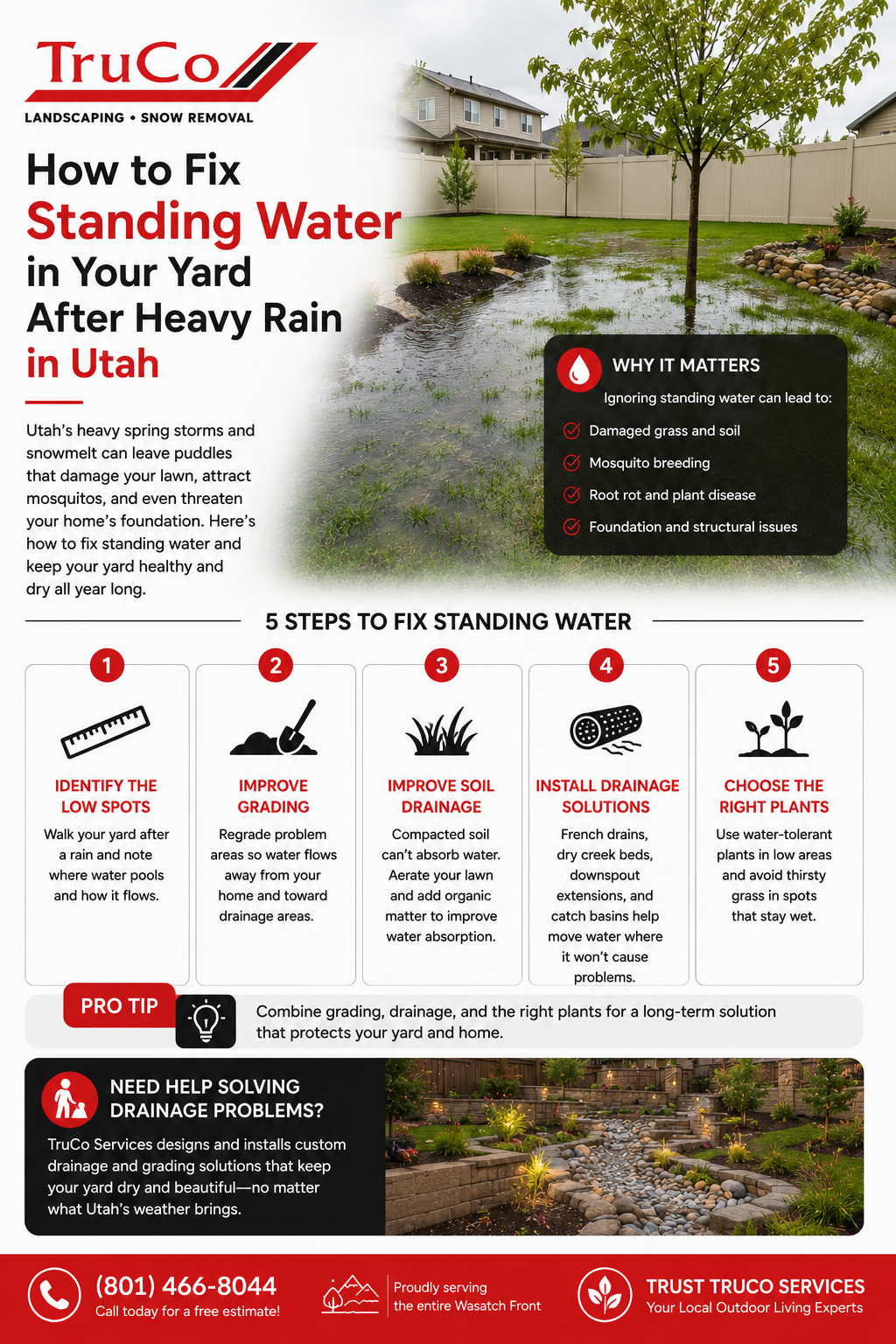
Why Standing Water Is a Problem in Utah Yards
Utah homeowners know the drill: a monsoon cell rolls over the Wasatch Front in late July, dumps an inch of rain in 45 minutes, and suddenly your backyard looks like a reflecting pool. Fixing standing water in Utah requires a different approach than you'd use in Florida or the Pacific Northwest. Our soil is heavy clay. Our weather patterns are extreme. And our growing season is short enough that you can't afford to lose a month of usable yard to a drainage problem.
Common Causes of Poor Drainage in Utah
Low spots, improper grading around the foundation, downspout discharge too close to the house, clay lens or hardpan layer, overwatering and irrigation runoff, and obstructed or undersized drainage systems are the most common causes. Utah's rapid-growth suburbs from the 1990s and 2000s often have grading issues that only become apparent after a decade of settling.
How Utah's Clay Soil Makes Drainage Worse
Clay soil drains at 0.01 to 0.1 inches per hour — compared to 5 to 8 inches per hour for sandy soil. That means a 1-inch rainstorm could take more than 10 days to infiltrate in clay. Clay particles are microscopic and plate-shaped; when wet they slide together and self-seal. A French drain or dry well in clay soil doesn't percolate into the surrounding ground — the pipe must carry the water to a proper discharge point.
French Drains: Installation Guide
A French drain is a trench filled with gravel and a perforated pipe that collects and redirects surface and subsurface water. In Utah, French drains need a minimum slope of 1-2%, proper landscape fabric lining, 4-inch perforated HDPE pipe with perforations facing down, and 1-1/2 inch washed gravel. Connecting a French drain to the municipal storm sewer requires a permit in every major Wasatch Front city. Trench depth: 18-24 inches for surface water, 4-6 feet for foundation drainage.
Dry Wells: How They Work and When to Use Them
A dry well collects storm water and allows it to slowly percolate into surrounding soil over 24-72 hours in Utah clay. Sizing matters: a single downspout can receive 200-300 gallons from a 1-inch storm. Dry wells must be set back at least 10 feet from the foundation and buried below Utah's frost line (30-36 inches). A gravel-pit dry well 4-6 feet deep and 3-4 feet wide provides about 200-300 gallons of storage.
Regrading Your Lawn for Better Water Flow
Regrading alone can fix low-spot ponding if there's a natural downhill direction. Utah code requires 5% slope away from foundation for the first 10 feet, and minimum 2% for the rest of the yard. In clay soil, aim for 3-4%. Cost: $1,500-$4,000 for a typical 5,000-square-foot yard. Best time in Utah: spring (April-May) or fall (September-October).
Rain Gardens: A Beautiful Solution
A rain garden is a shallow planted depression that collects stormwater and allows infiltration. For a 1,000-square-foot roof area, you need about 500 square feet of rain garden. Utah-appropriate plants include basin wildrye, blue flax, Rocky Mountain penstemon, redtwig dogwood, and Woods' rose. Rainwater harvesting for residential rain gardens is legal in Utah under SB 32 (2018), but check with your city's stormwater division for local requirements.
Sump Pumps for Severe Drainage Issues
When gravity cannot move water away, a sump pump becomes necessary. Use a 1/3 to 1/2 HP submersible pump rated for 4,000-6,000 GPH with a battery backup. Discharging to the sanitary sewer is illegal in most Utah municipalities. Discharge pipes must be buried below the frost line (30-36 inches) in Utah.
Cost Comparison of Drainage Solutions in Utah
Regrading: $1,500-$4,000. French drain (single run): $1,200-$2,500. Dry well: $1,000-$3,000. Rain garden: $800-$3,500. Sump pump system: $2,500-$5,500. Combination systems: $5,000-$12,000.
Frequently Asked Questions
How long does it take for standing water to damage my foundation? Visible damage takes several seasons, but hydrostatic pressure begins immediately. If water stands against your foundation for more than 24 hours after a storm, and this occurs multiple times per year, expect signs of moisture intrusion within 2-5 years.
Do I need a permit to install a French drain in Utah? A French drain that daylights onto your property generally does not require a permit. One that connects to the storm sewer requires a permit. If trenching within 5 feet of the foundation, some cities also require a building permit.
Why does water pool only during July-September? Those are Utah's monsoon months. The North American Monsoon brings short, intense storms dropping 0.5-1.5 inches in an hour — far more than clay soil can absorb.
Will a French drain work in Utah clay soil? Yes, but the pipe primarily conveys water to an outlet — very little percolates through the pipe walls. French drains in Utah need to be longer, properly sloped, and terminated at a proper discharge point.
Do I need to call 811 before digging? Yes — Utah law requires calling 811 at least two business days before any excavation. Blue Stakes utility locating is free and mandatory.
What is the most common drainage mistake Utah homeowners make? Installing a French drain without a proper outlet, creating an underground swimming pool that never drains, or connecting to the sanitary sewer which is illegal.