
How to Grow Succulents and Cacti in Utah

Why Grow Succulents and Cacti in Utah
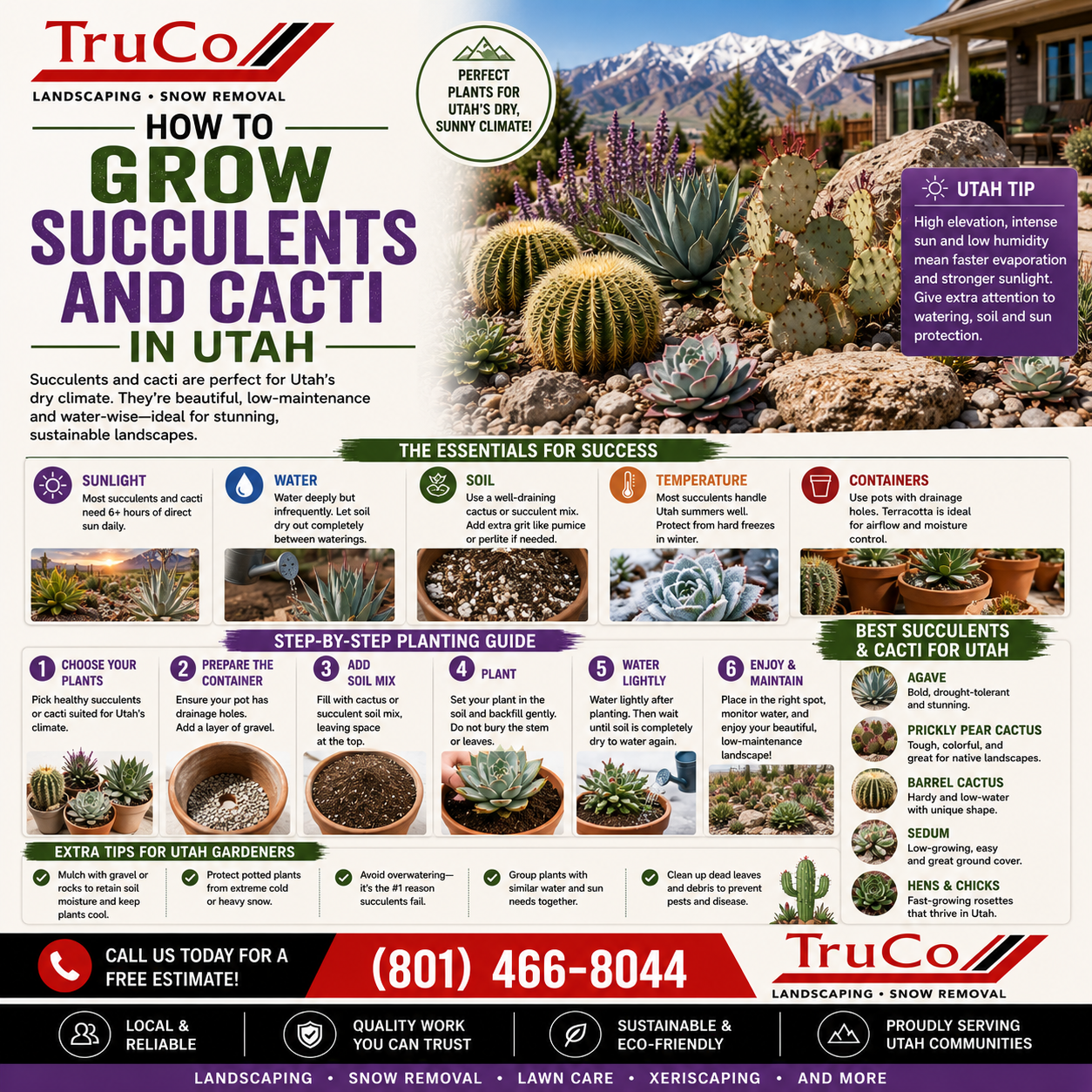
Succulents and cacti are perfectly adapted to Utah's arid climate. These water-storing plants thrive where traditional garden plants struggle — in full sun, poor soil, and low rainfall. Utah is home to several native succulents, including the Uinta Basin hookless cactus (Sclerocactus glaucus) and Utah yucca (Yucca utahensis). In landscaping, succulents offer dramatic shapes, colors, and textures with minimal water requirements — typically 80% less than traditional garden plants. They're ideal for Utah's water-wise xeriscapes, rock gardens, and containers. Most succulents are hardy to Utah's USDA zones 4-8, with proper winter protection in colder areas. Succulents have become increasingly popular in Utah landscaping for their modern aesthetic, low maintenance, and drought tolerance. A succulent garden of 100 sq ft costs $200-600 to establish and requires less than 1 hour of maintenance per month once established. They're also deer-resistant and rarely affected by Utah pests.
Best Succulents for Utah Outdoor Gardens
Sempervivum (hens and chicks) is the hardiest outdoor succulent for Utah. This alpine plant forms tight rosettes in green, red, purple, and bronze. It survives zone 4 winters with excellent drainage. Varieties: 'Red Beauty' turns deep burgundy in full sun, 'Pacific Blue Ice' has icy blue-green rosettes. Sedum (stonecrop) includes hundreds of varieties from ground-hugging creeping types to upright 24-inch varieties. Sedum spectabile 'Autumn Joy' is a Utah classic — pink flowers in late summer turn copper in fall. Creeping sedums (Sedum album, Sedum spurium) make excellent ground covers for sunny slopes. Delosperma (ice plant) produces daisy-like flowers in pink, purple, yellow, or orange. It blooms from June through September in Utah and spreads quickly. Hardy to zone 4 with good drainage. Opuntia (prickly pear cactus) includes several Utah-native species. Opuntia fragilis is hardy to zone 3 and grows in Utah's mountain valleys. Opuntia phaeacantha (tulip prickly pear) produces yellow or pink flowers followed by edible fruits (tunas). Yucca includes Yucca glauca (soapweed yucca), a Utah native with dramatic sword-like leaves and tall white flower spikes. Agave (century plant) — smaller species like Agave parryi (hardy to zone 5) and Agave utahensis (native to southern Utah) survive in protected locations. Echeveria — tender succulents best grown in containers and brought indoors for winter in northern Utah.
Planting Succulents in Utah's Climate
The most important factor for succulent success in Utah is drainage. In Utah's clay soils, plant succulents in raised beds, rock gardens, or containers. Never plant in low areas where water collects. For in-ground planting: amend clay soil with 50% coarse sand or small gravel. Create a 6-12 inch raised mound for each plant. For container planting: use pots with drainage holes, terracotta or unglazed clay pots are ideal (they allow soil to dry faster). Use a specialized cactus and succulent potting mix or create your own: 1 part potting soil, 1 part coarse sand, 1 part perlite or pumice. Plant at the same depth as in the nursery container — burying the crown causes rot. Space succulents according to mature size: small types 6-12 inches apart, medium 12-18 inches, large 18-36 inches. Plant in spring after last frost (May in northern Utah, April in St. George). Fall planting is risky for marginal-hardy species — they need time to establish roots before winter. In Utah's high altitude (4,000-7,000 feet), the intense UV light may cause some succulents to change color — this is normal stress coloring, not damage.
Watering Succulents in Utah
Overwatering is the leading cause of succulent death in Utah — ironically, more succulents die from too much water than too little. During the growing season (April-October in Utah), water outdoor succulents deeply every 10-14 days if no rain has fallen. In containers, water when the soil is completely dry — typically every 5-7 days in summer. In winter (November-March), most outdoor succulents need no supplemental water — Utah's winter precipitation is sufficient. For succulents in covered locations (under eaves), water once monthly on a warm day. Signs of overwatering: leaves turn yellow or translucent, leaves fall off at the slightest touch, stems become soft and mushy. Signs of underwatering: leaves shrivel, wrinkle, or pucker; leaves drop from the bottom. Water at the soil level — avoid getting water on the leaves (it can cause rot and sunburn in Utah's intense sun). Water in the morning so foliage dries before night. In Utah's dry air, misting is unnecessary and can encourage fungal diseases.
Winter Protection for Succulents in Utah
Winter survival depends on species hardiness, drainage, and protection. Hardy succulents (Sempervivum, Sedum, Opuntia, Yucca) survive zone 4-5 winters with no protection if drainage is adequate. Marginal-hardy succulents (Delosperma, some Agave) need protection in northern Utah. Protect by covering with frost cloth, evergreen boughs, or 4-6 inches of straw mulch. Do not use plastic covers — they trap moisture and cause rot. In containers: move pots to an unheated garage or basement (35-45 degrees) for winter. Water containers monthly during winter storage — don't let roots dry completely. In St. George (zone 8), most succulents survive outdoors with minimal winter protection. Ensure containers have drainage that won't freeze and crack the pot. In early spring (March-April), gradually remove winter protection over 2 weeks as temperatures warm. Watch for late spring frosts — cover tender succulents if frost threatens after they've begun active growth. In Utah's mountain areas (Park City, Heber Valley) above 6,000 feet, choose only the hardiest succulents and provide generous winter protection.
Design Ideas for Succulent Gardens in Utah
Create a succulent rock garden combining boulders, gravel, and drought-tolerant succulents — this is one of the lowest-maintenance landscape options for Utah. Use large agave or yucca as focal points with creeping sedum as ground cover. Plant succulents in dry streambeds alongside boulders and river rock for a natural-looking drainage feature. Create container gardens with mixed succulents — use shallow, wide containers and plant a tall focal point (aloe or agave) surrounded by medium sedums and trailing varieties. In Utah's mountain landscapes, use native prickly pear and yucca alongside sagebrush and rabbitbrush for a natural look. Use succulents as lawn alternatives — creeping sedum varieties like Sedum album form dense mats that tolerate light foot traffic. Plant succulents on green roofs — sedums are the most common green roof plants in Utah because they're shallow-rooted and extremely drought-tolerant. In modern xeriscape designs, use architectural succulents (agave, yucca, large opuntia) as specimen plants surrounded by decorative gravel.
Frequently Asked Questions
Can succulents survive Utah winter outdoors? Yes — choose cold-hardy varieties suited to your zone. Sempervivum, sedum, opuntia (prickly pear), and yucca are all winter-hardy in Utah. Provide excellent drainage and protect marginal species with mulch or frost cloth.
How often should I water succulents in Utah? Every 10-14 days during growing season if no rain. Container succulents need water every 5-7 days in summer. Water deeply when soil is completely dry. Reduce to monthly or none in winter.
Do succulents need full sun in Utah? Most succulents need at least 6 hours of direct sun. In Utah's intense summer sun, some varieties (especially echeveria and softer succulents) benefit from afternoon shade. Hardier types thrive in full sun.
What soil is best for succulents in Utah? Fast-draining soil is essential. Mix 1 part potting soil, 1 part coarse sand, and 1 part perlite. In Utah's clay soil, plant in raised beds or containers with this specialized mix or use 50% native soil and 50% coarse gravel.