
How to Maintain a Pond or Water Feature in Utah: Seasonal Care Guide

Why Water Features Need Maintenance in Utah
Ponds and water features add beauty, serenity, and property value to Utah landscapes — but they require regular maintenance to stay clean, healthy, and functional. Utah's climate presents unique challenges for water features: intense summer sun that accelerates algae growth, mineral-rich hard water that leaves scale deposits, monsoon storms that add debris, and freezing winters that threaten pumps, pipes, and liners. A well-maintained water feature provides years of enjoyment and becomes the focal point of your landscape. A neglected pond becomes a green, smelly, mosquito-breeding eyesore that detracts from your property value. Understanding the maintenance requirements before installation helps you choose the right feature for your commitment level. Maintenance costs in Utah vary widely: a small container fountain needs minimal care ($20-50 per year in supplies), while a backyard pond with fish requires $200-500 per year in products and 2-4 hours per month of labor. In Utah, water features without fish and without pumps (pondless features, bog gardens) require significantly less maintenance than traditional koi ponds. Professional pond maintenance services in Utah charge $75-150 per visit for cleaning, water testing, and repairs. TruCo Services and other Utah landscape companies offer water feature installation and maintenance services.
Seasonal Pond Maintenance Calendar for Utah
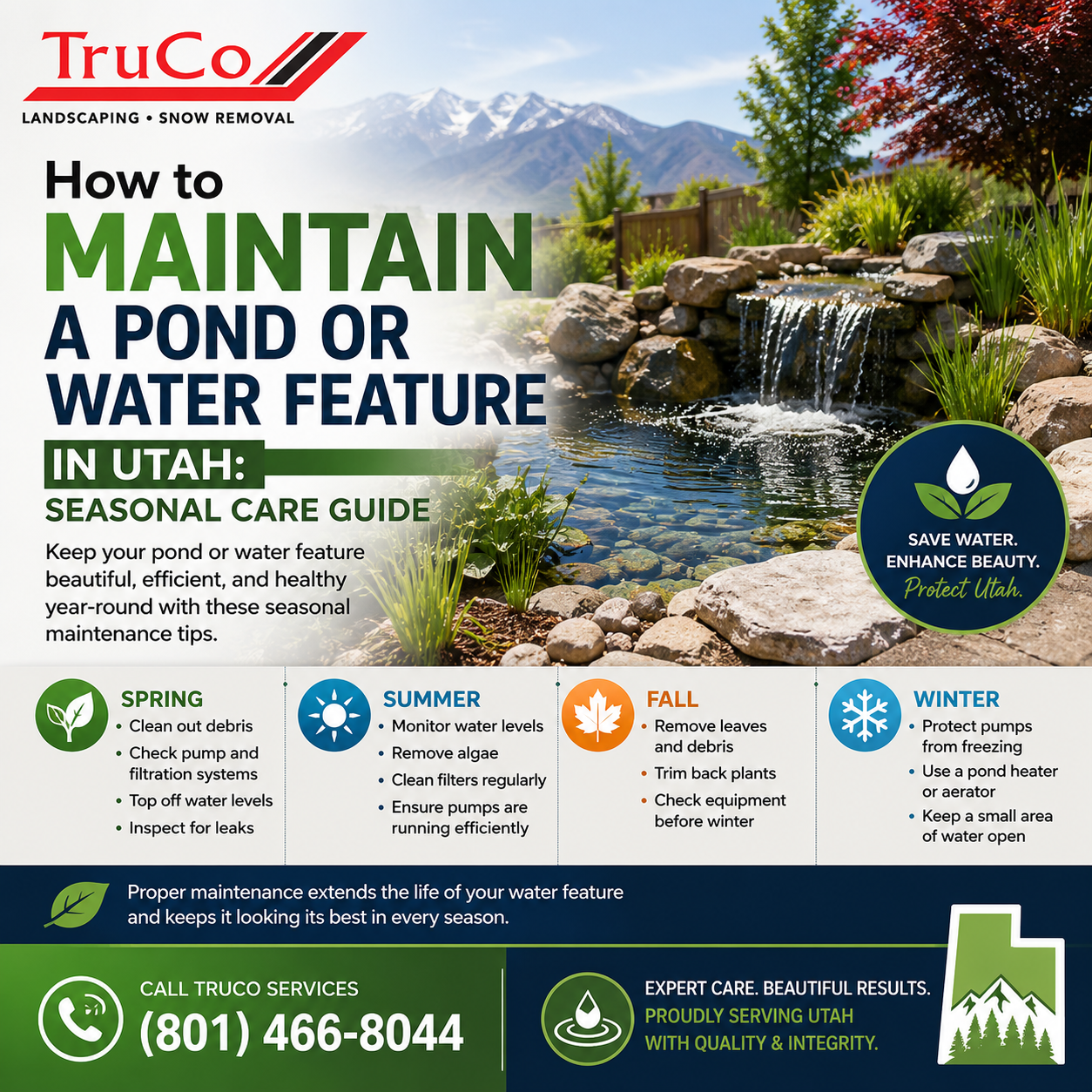
Utah's four distinct seasons dictate the pond maintenance schedule. Spring (March-April): clean the pond after winter — remove accumulated debris, sludge, and dead plant material. In Utah, spring cleaning should happen when water temperature reaches 50 degrees. Check and clean the pump, filter, and UV clarifier. Test water quality — pH, ammonia, nitrite, and hardness. In Utah's hard water, test for calcium and magnesium buildup. Reinstall plants and reintroduce fish (if overwintered indoors). Start the pump and monitor for leaks. In Utah, spring is also when you add beneficial bacteria to jump-start the biological filter. Summer (May-August): the highest maintenance season. Monitor water level weekly — Utah's summer evaporation can drop water levels 1-2 inches per week. Top off with water as needed. In Utah, the intense sun (UV index 7-10) accelerates algae growth — run the pump 24/7, clean filters every 1-2 weeks, and use barley straw or algaecides as needed. Check for leaks — in Utah's dry climate, a dropping water level that continues after topping off indicates a leak. Feed fish daily in warm weather (above 60 degrees). Trim plants and remove spent flowers. Fall (September-October): prepare for winter — the most important seasonal task in Utah. Remove leaves and debris before they sink and decay (which creates toxic gas under ice). In Utah, install a pond net over the water feature during leaf drop (October-November). Trim and remove tropical plants; cut back hardy plants to 4-6 inches. In Utah, stop feeding fish when water temperature drops below 50 degrees. Clean the pump and filter. Winter (November-February): protect the pond from freezing. In Utah, ponds with fish need a de-icer or aerator to keep a hole in the ice — this allows toxic gases to escape and keeps fish alive. In northern Utah, ponds freeze solid in January-February; in southern Utah, freezing is less severe. Stop the pump for ponds that freeze (or use a submersible pump at mid-depth for circulation). In Utah, never break ice with force — it can kill fish from shock waves. Use a de-icer, aerator, or pour hot water to melt a hole.
Cleaning and Water Quality for Utah Ponds
Water quality is the foundation of a healthy water feature in Utah. Utah's water is hard — high in calcium and magnesium — which causes scale buildup on pumps, liners, and rocks. Regular testing keeps water balanced. Test kits measure: pH (ideal 6.8-8.0 — Utah's tap water is typically 7.5-8.5), ammonia (should be 0 ppm — toxic to fish), nitrite (should be 0 ppm), nitrate (ideal below 40 ppm), alkalinity (ideal 80-120 ppm — Utah's water is naturally high), and hardness (ideal 75-150 ppm — Utah's water exceeds this). Algae control in Utah: algae thrives in Utah's intense sun and warm summer water. Control strategies: shade the pond — add floating plants (lilies, water lettuce) covering 50-70% of the surface, reduce fish food (excess food = excess nutrients), maintain the biological filter (beneficial bacteria consume algae nutrients), use a UV clarifier (kills free-floating algae — the most effective solution in Utah), and use algaecides as a last resort (safe products for fish: hydrogen peroxide-based). Water changes: in Utah's evaporation-heavy climate, top off with dechlorinated water. For fish ponds, change 10-20% of the water weekly in summer. In Utah, never drain the pond completely for cleaning — this kills beneficial bacteria. Sludge removal: remove bottom sludge (decomposed organic matter) with a pond vacuum or by hand. In Utah, sludge buildup is the #1 cause of murky water. Use beneficial bacteria products (pond sludge remover) monthly in summer. In Utah's hard water, use a scale inhibitor product to prevent mineral deposits on pumps and liners.
Pump, Filter, and Equipment Maintenance in Utah
Water feature equipment requires regular maintenance to operate efficiently in Utah. Pumps: clean pump impellers and intake screens monthly in summer. In Utah's hard water, mineral scale clogs impellers — soak pump parts in vinegar or a pump descaler every 3 months. Check flow rate monthly — reduced flow indicates clogged intake, impeller wear, or scale buildup. In Utah, choose pumps rated for your feature size — an undersized pump strains and fails early. Filters: clean mechanical filters (foam, brush, or bead) every 1-2 weeks in summer. In Utah's debris season (fall), clean more frequently. Biological filters (biofalls, bead filters) need less cleaning — rinse gently to preserve beneficial bacteria. In Utah, use a biofilter rated for your pond volume and fish load. UV clarifiers: clean the quartz sleeve every 2-4 weeks in summer. In Utah, replace the UV bulb annually (bulbs lose effectiveness after 9-12 months of use). Pond skimmers: empty the skimmer basket weekly in summer and daily during fall leaf drop. In Utah, skimmers prevent debris from sinking and decaying. Waterfall pumps: clean and inspect waterfall features monthly. In Utah, mineral deposits build up on waterfall rocks — clean with vinegar solution or muriatic acid (diluted, carefully). At season's end (October in Utah): remove, clean, and store pumps indoors — in northern Utah, freeze damage destroys pumps left in ponds. In southern Utah, pumps can remain if the pond doesn't freeze. Store pumps in a bucket of water in a garage to prevent seal dry-out. Replace O-rings and gaskets annually.
Seasonal Water Feature Types and Their Care in Utah
Different water feature types have different maintenance needs in Utah. Ponds with fish (koi/goldfish): highest maintenance — require year-round water quality management, winter de-icing, and regular feeding. In Utah, koi need a pond at least 3 ft deep to survive winter (deeper areas prevent full freezing). Goldfish are hardier and need 2 ft minimum depth. Koi ponds: $300-600 per year in maintenance products and supplies. Ponds without fish (plant ponds, wildlife ponds): moderate maintenance — no fish feeding or winter de-icing needed. Plants filter the water naturally. In Utah, plant ponds need 1-2 hours of maintenance per month. Waterfalls and streams: moderate maintenance — pumps need cleaning, rocks need scale removal, and flow needs adjusting. In Utah, waterfalls are popular for their soothing sound and visual appeal. They add oxygen to the water, reducing algae. Fountains: low-to-moderate maintenance — clean the pump and bowl regularly. In Utah, fountains lose water to evaporation and splash — top off frequently. In winter, drain and store portable fountains. Pondless water features (bubbling rocks, disappearing fountains): lowest maintenance — no fish, no winter de-icing, and water recirculates through a hidden basin. In Utah, pondless features are increasingly popular because they provide the look and sound of water without pond maintenance. They're safe for families with small children. Rain chains and small water features: minimal maintenance. Bog gardens and rain gardens: low maintenance — these plant-based features filter water naturally and need only seasonal plant care. In Utah, bog gardens are excellent for drainage areas and rain gardens manage stormwater. When choosing a water feature for your Utah property, match the maintenance level to your available time and budget. Professional installation and seasonal maintenance services from companies like TruCo Services can handle the workload for you.
Frequently Asked Questions
How much does pond maintenance cost in Utah? DIY supplies: $200-500 per year for a fish pond, $50-150 for a plant pond. Professional service: $75-150 per visit for cleaning, testing, and repairs. Annual professional maintenance contracts: $500-1,500 depending on pond size.
Why is my Utah pond water green? Green water is caused by algae bloom, which thrives in Utah's intense summer sun and nutrient-rich water. Fix it by: adding a UV clarifier, covering 50-70% of the surface with plants, reducing fish feeding, cleaning filters more often, and adding beneficial bacteria.
Do I need to drain my pond for winter in Utah? No — draining a pond is harmful to fish and destroys the ecosystem. Instead: remove leaves and debris, stop feeding fish below 50 degrees, install a de-icer or aerator to keep a hole in the ice, and protect the pump. Only small, portable water features should be drained and stored.
How deep does a pond need to be for fish in Utah? Koi need at least 3 ft of water depth to survive Utah winters — the bottom 18-24 inches stay above freezing. Goldfish need 2 ft minimum. Shallower ponds freeze solid in Utah's northern winters, killing fish.
How often should I clean my pond filter in Utah? Mechanical filters: every 1-2 weeks in summer, more often during fall leaf drop. Biological filters: rinse gently every 4-6 weeks. UV clarifier sleeves: every 2-4 weeks. In Utah's fall, expect to clean skimmers daily during peak leaf drop.