
How to Plan a Complete Backyard Makeover in Utah: Step-by-Step Guide

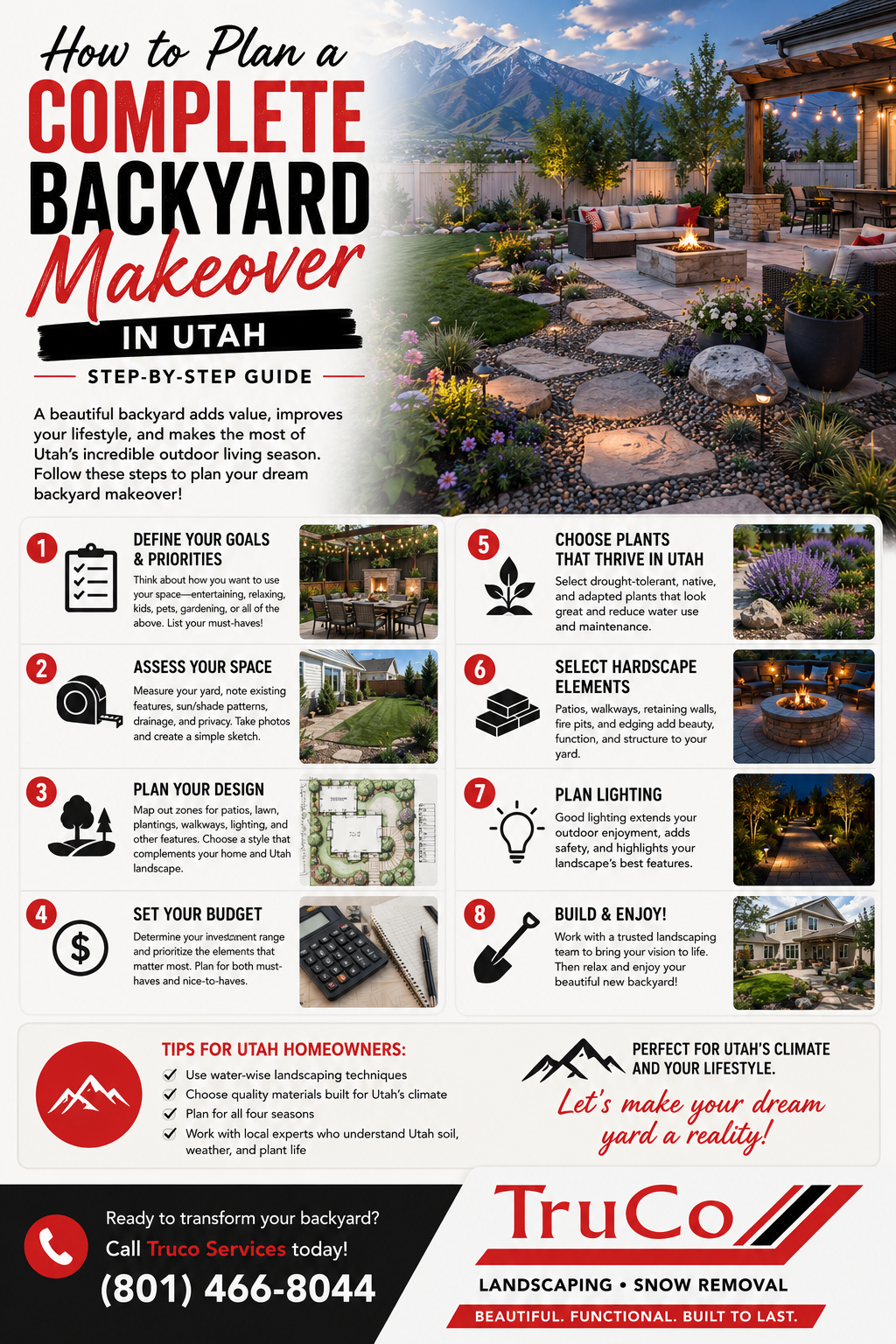
Why Plan a Backyard Makeover in Utah
A backyard makeover transforms your outdoor space into a functional, beautiful extension of your home. In Utah, where homeowners spend 5-6 months of the year outdoors (April through October), a well-designed backyard adds significant value to your property and lifestyle. Backyard makeovers in Utah range from simple refreshes (new plants, mulch, and cleanup — $1,000-5,000) to complete transformations (hardscape, irrigation, outdoor living — $20,000-100,000+). The return on investment for backyard landscaping in Utah is 50-100% of project cost added to home value, according to the National Association of Realtors. In Utah's competitive real estate market, a professionally landscaped backyard can be the deciding factor for buyers. Before starting any makeover, assess your current backyard — identify what works, what needs improvement, and what your family needs from the space. Common backyard makeover goals for Utah homeowners include creating outdoor entertaining spaces, adding play areas for children, establishing vegetable or flower gardens, improving privacy from neighbors, fixing drainage issues, reducing water use with xeriscape, and increasing property value for sale. A successful makeover starts with a plan — measure your yard, note sun patterns, evaluate soil, check utility locations, and define your budget. In Utah, the best time to plan a backyard makeover is winter (November-February) when contractors have availability and can design before spring installation. The best time to execute is spring (March-May) for plant installation or late summer (August-September) for hardscape projects when temperatures moderate.
Step 1: Assess Your Utah Backyard
Start by evaluating your current backyard conditions. Measure the total square footage and sketch a rough layout including house footprint, existing trees and shrubs, utility boxes, gas meters, AC units, and property lines. In Utah, noting the location of utility connections (gas, electric, water, sewer) is critical — these must remain accessible. Note the location of underground utilities — call 811 (Utah Blue Stakes) to mark them before any digging. Map sun exposure — track where sun falls at 9am, noon, and 3pm during the growing season. In Utah's high elevation, south- and west-facing areas receive intense afternoon sun that limits plant choices. North-facing areas stay cooler and can support shade-loving plants. Identify microclimates — areas near south-facing walls are warmer (heat sink effect), creating opportunities for marginally-hardy plants. Low spots where cold air settles (frost pockets) limit what grows. In Utah's varied elevation zones (4,000-7,000 ft along the Wasatch Front), microclimates vary significantly. Evaluate existing drainage — after a rain, walk the yard and mark where water pools. In Utah's clay soil, standing water for more than 24 hours indicates a drainage problem that must be fixed before any other makeover work. Test soil pH and type — Utah soil is typically alkaline (pH 7.0-8.0) and ranges from heavy clay to sandy. Simple soil test kits from IFA or Western Garden Centers ($10-15) tell you pH and basic nutrient levels. For a comprehensive test, use the Utah State University Extension soil testing service ($25-50). Assess views — identify which views to preserve and enhance (mountains, open space) and which to screen (neighbors, utility poles). In Utah, mountain views are prime real estate assets — design seating areas to frame these views. Consider privacy — Utah's subdivisions often have side-by-side homes with limited backyard privacy. Plan screening with fences, hedges, or strategic tree placement. In Utah, fast-growing evergreens (arborvitae, juniper) create privacy within 3-5 years.
Step 2: Design Your Backyard Makeover in Utah
Define zones for different activities — a well-designed backyard has distinct areas for dining/cooking, lounging, play, gardening, and circulation. In Utah backyards, consider covered outdoor rooms (pergolas, patio covers) that provide shade from intense sun. Zone 1 (immediately off the house) — patio or deck for dining and lounging. This is the highest-use area. Size: minimum 200 sq ft for a dining set and seating. Zone 2 (transition) — lawn, garden beds, or fire pit area. This connects the patio to the back of the yard. Zone 3 (far end) — vegetable garden, playset, or utility area. This area is less visible from the house and can be more functional. For Utah's narrow suburban lots (40-60 ft wide, 100-130 ft deep), a linear layout works well — patio near house, lawn in middle, garden at rear. For wider lots, consider L-shaped or courtyard layouts. Paths should connect all zones with 4-5 ft wide main paths and 3-4 ft wide secondary paths. In Utah, use flagstone, pavers, or concrete for main paths — decomposed granite for secondary paths. Consider focal points — a water feature, fire pit, specimen tree, or sculpture that draws the eye and anchors the design. In Utah, fire features (fire pits, fire tables, fireplaces) extend the outdoor season into spring and fall. A simple stone fire pit costs $800-2,500 installed. Budget 10-20% of total for focal features. Plan irrigation zones — separate zones for lawn, perennial beds, and annual containers. In Utah, even drought-tolerant plantings need supplemental water during establishment (first 2 years). After establishment, native plants need water every 14-28 days in summer. Create a planting plan using Utah-hardy plants — group plants by water needs (hydrozoning) and include a mix of evergreen structure, seasonal color, and native drought-tolerant species.
Step 3: Budget and Phasing for Utah Backyard Makeovers
Backyard makeovers in Utah vary widely in cost. Establish your total budget and plan to phase the work if needed. Typical backyard makeover costs in Utah: basic refresh (cleanup, mulch, annuals, minor pruning) — $1,000-5,000; mid-range makeover (new patio, planting beds, irrigation, lighting) — $15,000-40,000; high-end transformation (full hardscape, outdoor kitchen, water feature, landscape lighting, mature plantings) — $40,000-100,000+; luxury backyard (pool or spa, outdoor living room, full automation, specimen plantings) — $100,000-250,000. Phasing is smart for most Utah homeowners. Phase 1 (highest priority): hardscape, grading, drainage, and irrigation — the foundation work. These are the most invasive and expensive changes. Complete them first to avoid redoing other work later. In Utah, hardscape should be installed in spring or fall when concrete and mortar can cure properly. Phase 2 (next priority): trees, large shrubs, and lawn — the major living elements. Plant trees in spring (March-May) or fall (September-October) in Utah for best establishment. Phase 3 (final priority): flowering plants, annuals, furniture, and accessories — the finishing touches. These can be added over time as budget allows. Save money on a Utah backyard makeover with these strategies: install plants yourself (nursery stock costs $15-100 per plant vs $50-200 installed), use native plants (lower water bills, lower replacement risk), phase the project over 2-3 years, buy plants in fall (Utah nurseries discount perennials and trees 30-50% in September-October), and install your own drip irrigation (materials cost $100-300 for most backyards). Avoid cutting corners on: drainage correction (foundation damage is expensive), soil preparation (plants fail in unamended Utah clay), hardscape base preparation (settling causes cracks), and irrigation system quality (cheap components fail in Utah's UV).
Step 4: Execute the Backyard Makeover
If hiring a professional landscape contractor (recommended for projects over $15,000 or any work involving grading, drainage, or hardscape), follow the contractor selection process — verify licensing with the Utah DOPL, get 3 written bids, check references, review contracts carefully, and establish a clear payment schedule. For smaller makeovers that you can DIY, the execution sequence matters. Start with demolition — remove unwanted plants, old hardscape, and debris. In Utah, dispose of green waste at local green waste facilities (Salt Lake Valley Landfill, Trans-Jordan Landfill accept yard waste at $20-40 per ton). Next, complete all grading and drainage work — this is the foundation. Reshape the ground to direct water away from the house and toward drainage. Install drainage systems (French drains, dry wells) before any hardscape or planting. Install hardscape — patios, pathways, retaining walls, and edging. Allow proper curing time (7 days for concrete, 24 hours for mortar) before proceeding. In Utah, protect fresh concrete from rapid drying by covering with wet burlap. Install irrigation system — lay main lines, install sprinkler heads and drip emitters. Test each zone and adjust coverage. In Utah, irrigation installers recommend pressure-compensating drip emitters for sloped properties. Plant trees and shrubs first — these are the major structural plants. Dig holes 2-3 times the root ball width, amend backfill with compost (50/50 mix), water deeply at planting, and stake only if necessary. In Utah, don't stake trees unless they're in high-wind locations or on slopes. Install lawn — lay sod (instant lawn) or seed (budget option). In Utah, sod is preferred for smaller areas because it establishes quickly and prevents erosion. Install ground cover plants and perennials — space for mature size and water thoroughly. Apply mulch — 2-4 inches of organic mulch in planted beds (not against tree trunks) and 3-4 inches of rock in non-planted areas. In Utah, bark mulch is $30-50 per cubic yard delivered. Finally, add furniture, lighting, and accessories — this is where the design comes to life. Install landscape lighting ($200-1,500 for a typical system). Add outdoor furniture ($1,000-5,000 for a dining set and seating). Complete with pots, planters, and decorative elements.
Step 5: Post-Makeover Care in Utah
A newly completed backyard needs careful attention during the first year. Water new plantings deeply and regularly — in Utah's dry climate, new plants need water every 2-3 days for the first 4-6 weeks, then every 5-7 days through the first growing season. After the first year, transition to normal irrigation schedules. For new sod, water daily for 2 weeks, then gradually reduce frequency. For new trees, deep water weekly at the root zone (not the trunk) during the first 2 years. In Utah, a slow trickle from a hose at the tree base for 30-60 minutes is effective. Watch for settling — new hardscape and graded areas may settle after Utah's spring snowmelt and monsoon rains. Add fill soil to low spots and adjust patio bases if needed. Monitor drainage during the first big rain — confirm water flows away from the house and doesn't pool. In Utah's clay soil, initial grading often needs minor adjustment after the first wet season. Adjust irrigation — as plants establish, they need less water. Decrease irrigation frequency gradually through the first growing season. In Utah, many overwater new landscapes out of habit — water deeply but less frequently. Apply pre-emergent herbicide in spring and fall to prevent weeds in newly mulched beds. In Utah, apply pre-emergent in March and September. In the second year, begin pruning and shaping plants as they grow. Remove dead or damaged branches. Divide perennials that have outgrown their space. Enjoy your new backyard — the investment in professional design and quality installation pays dividends for years to come. In Utah's climate, a well-designed backyard provides 5-6 months of outdoor living enjoyment annually and adds lasting value to your home.
Frequently Asked Questions
How much does a backyard makeover cost in Utah? Basic refresh: $1,000-5,000. Mid-range: $15,000-40,000. High-end transformation: $40,000-100,000+. Luxury: $100,000+. Cost depends on yard size, hardscape extent, plant selection, and whether you DIY or hire professionals.
How long does a backyard makeover take in Utah? Small makeover (planting, mulch, cleanup): 1-2 weeks. Mid-range (new patio, plants, irrigation): 3-6 weeks. Complete transformation: 6-12 weeks. Design and permitting add 2-6 weeks before construction. Phase larger projects over 2-3 seasons.
What adds the most value to a Utah backyard? Hardscape features (patios, outdoor kitchens, fire features) add the most resale value at 100-200% ROI. Good drainage and grading prevent expensive foundation damage. Mature trees add significant property value. Outdoor living spaces extend usable square footage.
Do I need a permit for a backyard makeover in Utah? Patios over 200 sq ft, retaining walls over 4 ft, structures (pergolas, sheds) over 200 sq ft, and any electrical or plumbing work require permits in most Utah cities. Always check with your local building department before starting. HOA approval may also be required.
When is the best time to start a backyard makeover in Utah? Plan in winter (November-February). Start construction in spring (March-May) for planting. For hardscape-heavy projects, late summer (August-September) offers good installation conditions. Avoid starting large projects during Utah's hottest months (June-July) or winter (November-February).