
How to Install a Playset or Playground in Your Utah Backyard

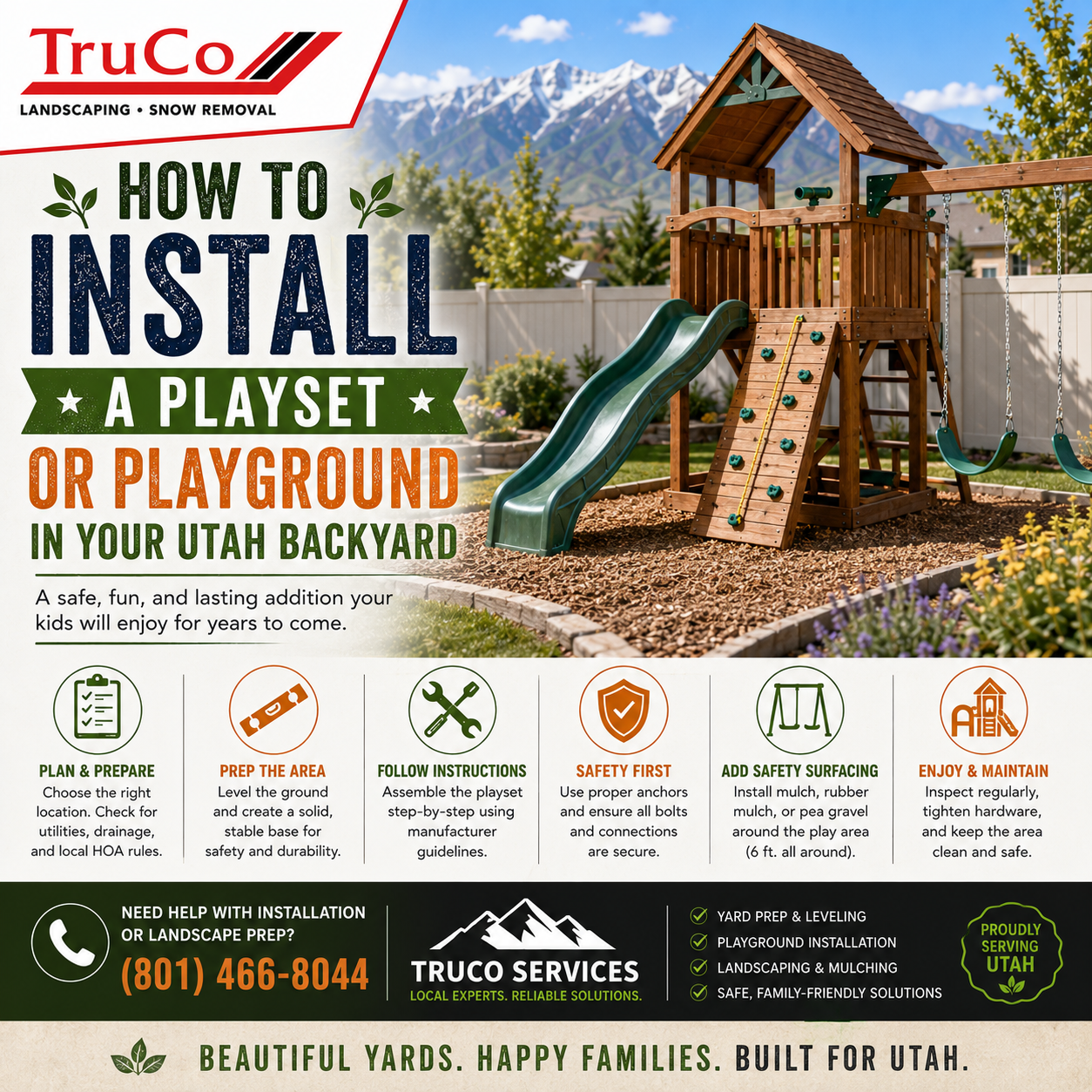
Planning a Playset or Playground in Your Utah Backyard
Installing a playset or playground in your Utah backyard creates a dedicated space for children to play, explore, and develop physical skills while enjoying the outdoors. Utah families are fortunate to have 200+ sunny days per year, making backyard playgrounds a valuable addition that gets used from April through October. A well-planned playset encourages outdoor activity, reduces screen time, and provides a safe environment for supervised play. Before purchasing any equipment, assess your yard's space, sun exposure, and safety requirements. The standard safety zone for a playset requires at least 6 feet of clear space on all sides of the equipment — this means the total area needed is the equipment footprint plus 12 ft in each direction. For a typical 10x15 ft playset with swing set, you need a minimum area of 22x27 ft (594 sq ft). Level ground is essential — playsets on slopes are unstable and dangerous. In Utah, finding a level area may require grading or selecting a different location. Sun exposure matters — in Utah's intense high-elevation sun, position the playset where children will have shade during peak play hours (10am-4pm). Consider adding a shade structure over the playset or locating it near existing trees that provide dappled shade. Avoid placing the playset in southwest-facing, full-sun locations — the equipment surfaces can reach 140+ degrees on Utah's 100-degree days. Cost of backyard playsets in Utah ranges from $500-3,000 for DIY wood sets to $2,000-10,000 for professional installation of premium sets.
Choosing a Playset That Works for Utah
Playsets come in three main materials, each with Utah-specific considerations. Wood playsets (cedar or redwood) are popular for their natural look and durability. Cedar is the preferred choice for Utah — it resists decay, insect damage, and warping in our dry climate. Wood sets require annual sealing or staining in Utah's intense UV to prevent graying and cracking. Cost: $800-4,000 for kit, $2,000-8,000 for custom built. Lifespan with maintenance: 10-15 years. Metal playsets are less common but available — powder-coated steel with UV-resistant coating. They're lower maintenance than wood but can get very hot in Utah's sun. In full sun, metal slides and handrails can reach 150+ degrees. If choosing metal, select lighter colors and position in a shaded area. Cost: $500-2,000. Lifespan: 10-20 years. Plastic/resin playsets (molded polyethylene) are maintenance-free, don't splinter, and don't get as hot as metal. Colors fade in Utah's intense UV after 5-7 years. Cost: $1,500-10,000. Lifespan: 10-20 years. For Utah, cedar wood playsets with UV-protective stain offer the best balance of appearance, durability, and safety. Look for playset features that suit your children's ages: swings (belt swings for ages 2+, toddler bucket swings, tire swings), slides (straight, curved, or tube slides — check that slides are north-facing or shaded in Utah), climbing features (rock wall, rope ladder, cargo net, monkey bars), play decks (elevated platforms with railings for forts and lookout towers), and accessories (trapeze bar, rings, telescope, steering wheel, chalkboard). For Utah families, consider a playset with a canopy or roof for sun protection. Many premium sets offer fabric canopies or solid roofs that reduce surface temperatures by 20-30 degrees.
Playground Safety Requirements for Utah Yards
Safety surfacing is the most critical safety requirement for backyard playgrounds in Utah. The Consumer Product Safety Commission (CPSC) recommends a minimum 6-inch depth of loose-fill impact-absorbing surfacing under and around all equipment. In Utah, rubber mulch is the preferred safety surface — it doesn't decompose, doesn't attract pests, and provides excellent impact absorption. Depth: 6 inches minimum, 8-9 inches for equipment over 8 ft high. Cost: $8-15 per cubic ft. Pea gravel (1/4-1/2 inch washed gravel) is another good option for Utah — it drains well, doesn't decompose, and is less expensive ($4-8 per cubic ft). Depth: 9 inches minimum for proper impact absorption. Engineered wood fiber (wood chips) is the most common but needs replacement every 1-2 years in Utah's dry climate as it decomposes and compacts. Depth: 9 inches minimum. Cost: $3-6 per cubic ft. Sand is not recommended in Utah — it packs hard, harbors animal waste, and can be hiding debris. Never install a playset over concrete, asphalt, packed earth, or grass — these surfaces do not provide adequate fall protection. The CPSC reports that 70% of playground injuries are from falls to the surface. The fall zone should extend 6 ft beyond the perimeter of stationary equipment and twice the height of the swing beam (6 ft beam = 12 ft fall zone). Ensure the playset is anchored securely — in Utah's soil, use concrete footings below frost line (30 inches in northern Utah) to prevent frost heave from shifting the playset over winter. Check that all hardware is covered with plastic caps, all S-hooks are crimped closed, all corners and edges are rounded, and there are no protruding bolts. In Utah, inspect the playset after winter for frost damage, loose hardware, and wood cracks before allowing use in spring.
Playset Installation in Utah: DIY vs Professional
DIY installation of pre-built playset kits is common for handy homeowners. A standard kit takes 1-3 days for two adults to assemble with basic tools (drill, level, socket set, rubber mallet). Most kits come with pre-cut lumber, hardware, and instructions. Consider whether your yard has proper drainage — playsets in low areas with standing water will have premature wood decay in Utah's freeze-thaw. The installation location must have proper slope for drainage (2% away from the playset). Professional installation is recommended for custom playsets, large playsets with complex features, any playset requiring concrete footings, or when you want the security of professional assembly and warranty. Professional installation cost: $500-2,000 depending on complexity. Professional installers handle site preparation, grading, concrete footings, assembly, and safety inspection. In Utah, professional playset installation companies charge $50-100 per hour plus materials. The installation process: site preparation (clear, level, grade area), base preparation (excavate for safety surfacing, install weed barrier), footing installation (dig holes below frost line, pour concrete, set anchors), assembly (follow manufacturer instructions, torque all bolts to spec), safety surface installation (spread and level rubber mulch or pea gravel), and final inspection (check all connections, test swings, verify fall zone clearance). After installation, record the manufacturer, model, and installation date. Keep all documentation for warranty claims. In Utah, most playset manufacturers require annual maintenance — check and tighten bolts, apply UV protectant to wood, inspect for splinters and cracks, ensure safety surfacing is at proper depth, and secure loose hardware.
Integrating a Playset into Your Utah Landscape
A playset should blend into your overall landscape design for a cohesive look. Position the playset where it can be easily supervised from the house — visible from kitchen windows, patios, and main living areas. In Utah's layout, corner locations often provide good visibility and don't dominate the yard's center. Create a transition zone between the playset and the rest of the landscape — use low hedges, ornamental grasses, or a low fence to define the play area while maintaining sight lines. In Utah, low-growing rabbitbrush or sagebrush creates natural, water-wise borders. Consider the playset's visual impact from inside the house — position it to frame a view of children playing while minimizing the view of the equipment itself. Plant Utah-hardy trees or tall shrubs (serviceberry, ninebark, curleaf mountain mahogany) near the playset for natural shade and visual screening. Ensure these are not poisonous or thorny — avoid barberry, pyracantha, and yew near play areas. Create pathways from the house to the play area — use stepping stones, mulch paths, or flagstone. In Utah, flagstone or concrete pavers work well for play area pathways and resist weed growth. For the surrounding landscape, use soft, durable ground covers (thyme, creeping phlox, or blue star creeper) outside the safety zone that can withstand occasional foot traffic. In Utah, avoid using attractive-nuisance plants near playsets — no plants with berries that children might eat, no toxic species (oleander, foxglove, castor bean), and no plants with thorns near play zones. Check all plants against the Utah Poison Control Center's toxic plant list before planting near play areas.
Frequently Asked Questions
How much space do I need for a playset in Utah? Minimum 22x27 ft for a standard playset with swings — this includes the 6-ft safety zone on all sides. The equipment footprint plus 12 ft in each direction. Larger equipment like multi-play structures with slides need more space.
What is the best safety surface for a Utah playset? Rubber mulch is best — it doesn't decompose, provides excellent impact absorption, and drains well in Utah's clay soil. Minimum 6 inches depth. Pea gravel is a good budget alternative. Avoid sand in Utah yards.
Do I need a permit for a playset in Utah? Most Utah cities don't require building permits for residential playsets under 200 sq ft. Check with your city building department and HOA. Some HOAs have restrictions on playset size, location, and colors.
How do I protect my playset from Utah's sun? Use UV-protective stain on wood playsets annually. Position in partial shade if possible. Add a canopy or shade structure. Place slides on the north side of the structure to reduce heat absorption. Metal and dark plastic surfaces can reach 140+ degrees.
Can a playset survive Utah winter? Yes. Wood playsets with proper sealing survive Utah winters well. Remove swings and bring them indoors. Check for frost heave in spring and re-level if needed. Inspect for winter damage before allowing use. Snow on the playset is fine — don't use metal tools to remove snow.