
How to Use Boulders and River Rock in Your Utah Landscape

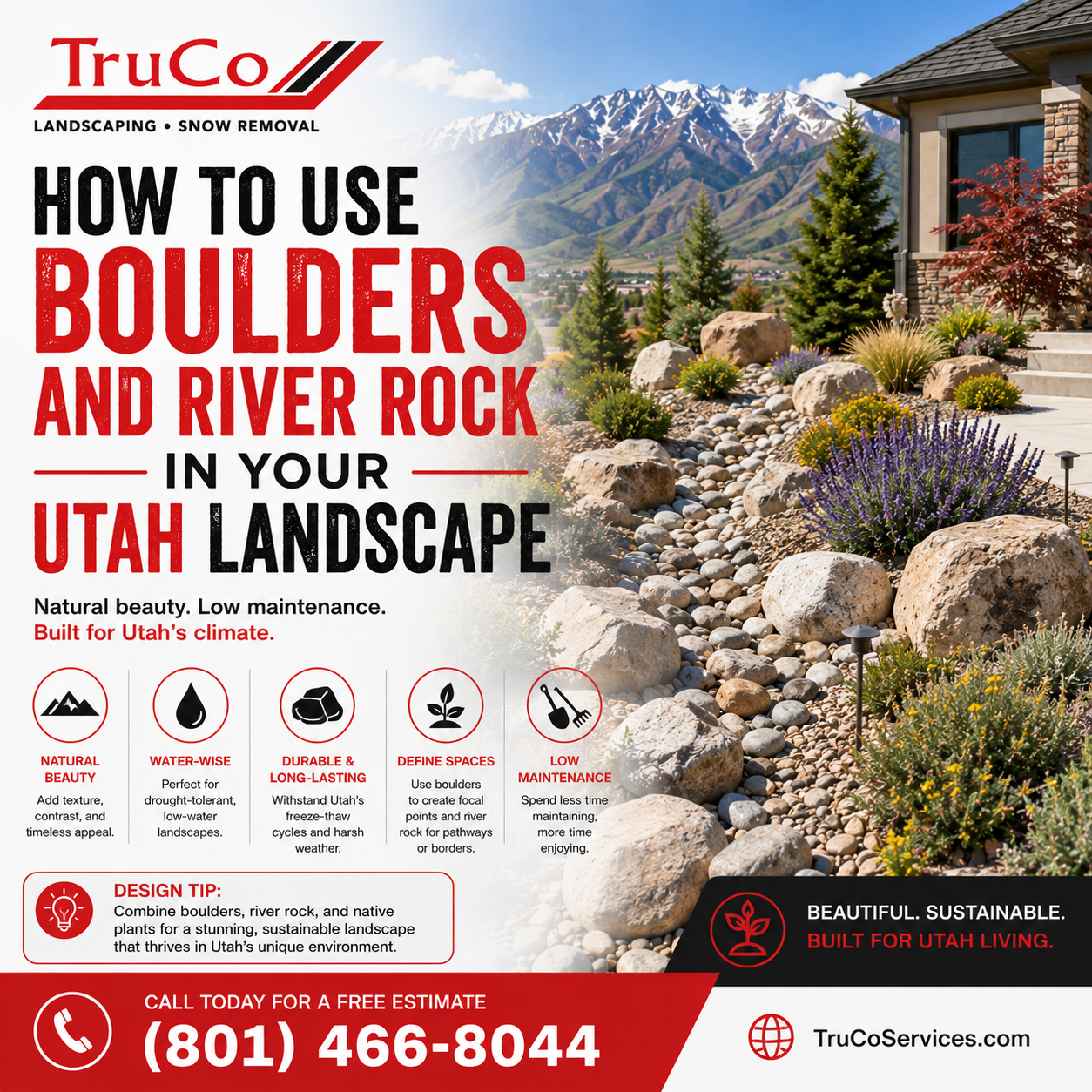
Why Use Boulders and River Rock in Utah Landscapes
Boulders and river rock are foundational elements in Utah landscaping, offering durability, natural beauty, and low maintenance. Utah's landscape is defined by its dramatic geology — from the granite of the Wasatch Range to the red sandstone of southern Utah — so using local stone creates landscapes that feel authentic and connected to the region. Boulders serve as sculptural focal points, retaining elements, and natural seat walls. River rock (smooth, rounded stones from watercourses) works as decorative ground cover, dry creek bed material, and drainage solutions. Both materials are permanent — they don't decompose, fade, or need replacement like organic mulches. Boulders and river rock require no water, no maintenance, and no replacement. In Utah's xeriscape movement, stone is the backbone of water-wise landscaping. A boulder can weigh 500-5,000 lbs depending on size, requiring specialized equipment for placement. River rock is sold by the ton or cubic yard, typically $100-250 per ton delivered.
Sourcing Stones in Utah
Utah has abundant local stone sources, reducing transportation costs and ensuring regional authenticity. Granite boulders from the Wasatch Front quarries (Little Cottonwood Canyon, American Fork Canyon) are gray to pink, extremely hard, and range from 200 to 10,000+ lbs. Cost: $100-300 per ton delivered. Sandstone boulders from southern Utah (St. George, Kanab areas) are warm red, orange, and buff colors, softer and easier to split, popular for contemporary and southwestern landscapes. Cost: $80-250 per ton. Limestone from central and northern Utah is light gray to tan with natural bedding planes — excellent for seat walls and steps. Quartzite from the Uinta Mountains is extremely hard with sparkly surfaces in white, pink, and purple tones — premium choice for decorative use. River rock (also called creek rock or round rock) is sourced from Utah riverbeds (Weber River, Provo River, Sevier River). Sizes range from 3/8 inch pebbles to 6-12 inch cobbles. Cost: $100-250 per ton. Landscape supply yards in Utah: Western Rock (multiple locations), Kilgore Companies, Sunroc, and local quarries. Many offer delivery and placement services. Always order 10-15% extra for overage and fill.
Design Principles for Boulders in Utah Landscapes
Boulder placement follows natural principles for the most pleasing results. The rule of odds — groups of 3 or 5 boulders look more natural than even numbers. Vary sizes — one large anchor boulder surrounded by 2-4 smaller boulders creates hierarchy. The largest boulder should be 1.5-2 times the size of the next largest. Orientation — align boulders with natural geological strata, not randomly. If the layers in nearby rock formations run horizontal, place boulders with layers horizontal. Bury boulders 1/3 to 1/2 of their height — rocks sitting on the surface look unnatural. The wider, flatter side should face downward. Tilt boulders slightly backward (5-10 degrees) for stability and to direct rainwater toward plant roots. Create a sense of age — place boulders as if they've always been there. Consider sight lines — place boulders where they're visible from interior rooms, patios, and entry points. In Utah mountain landscapes, use rough, angular granite or quartzite. In southern Utah, use warm sandstone. In contemporary designs, use consistent stone types with clean lines. Avoid mixing river rock with angular boulders — the contrasting shapes clash.
Using River Rock in Utah Landscapes
River rock serves many practical and decorative purposes. As ground cover, river rock (1-3 inch size) replaces mulch around trees, shrubs, and perennials. Unlike bark mulch, river rock doesn't decompose, blow away, or need annual replacement. Application depth: 2-3 inches over landscape fabric. Cost: $100-250 per ton covering approximately 80-100 sq ft at 2 inches deep. In dry creek beds, use mixed sizes (1-6 inch river rock) to create natural-looking drainage channels that handle stormwater runoff. Utah's monsoon season (July-September) makes dry creek beds functional as well as decorative. Edge dry creek beds with boulders for a natural stream appearance. For pathways, use 3/4 to 1.5 inch river rock over compacted base for a natural walking surface. Install edging to keep rock contained. River rock is also used in French drain systems — 1.5 to 3 inch clean river rock around perforated drain pipe provides the best drainage material for Utah's clay soils. In water features, river rock hides pond liners, creates streambeds, and provides biological filtration surface. In containers and raised beds, 1-2 inches of small river rock at the bottom improves drainage. In Utah, avoid using river rock on slopes steeper than 2:1 — it will migrate downhill with gravity and water flow.
Installation Guide for Boulders and River Rock
Boulder installation requires planning and equipment. Mark boulder locations with spray paint or flags. Excavate a hole 1/3 the boulder height plus 4-6 inches for a gravel base. Add 4-6 inches of compacted gravel base for drainage and stability. Place the boulder using equipment — for boulders over 300 lbs, use a skid steer (Bobcat), excavator, or specialized boulder tongs and a loader. Professional boulder placement costs $75-150 per hour for equipment and operator. Never roll boulders down slopes — they can roll uncontrollably. For very large boulders (2,000+ lbs), hire a landscape contractor with appropriate equipment. River rock installation: clear area of vegetation and debris. Install landscape fabric over the entire area — use heavy-duty fabric rated for 15+ years. Overlap fabric 12 inches at seams. Pour river rock over fabric and spread to 2-3 inches depth. For pathways: excavate 4-6 inches, compact base, install edging, add landscape fabric, add 2 inches of crushed gravel base, compact, add 2 inches of river rock. For dry creek beds: excavate 6-12 inches deep, install fabric, place boulders along edges, fill with mixed river rock sizes. Create gentle curves — straight lines look artificial.
Cost Considerations for Utah Stone Projects
Boulder costs vary by size and type. Small boulders (200-500 lbs): $50-150 each. Medium boulders (500-1,500 lbs): $150-400 each. Large boulders (1,500-5,000 lbs): $400-1,000 each. Delivery: $75-200 depending on distance. Placement: $75-150 per hour for equipment. A typical boulder garden with 5-8 boulders costs $1,000-3,000 installed. River rock projects: ground cover for 500 sq ft with 2-3 inch depth: 5-7 tons at $100-250/ton = $500-1,750 for material. Dry creek bed 30 ft long x 4 ft wide: 3-5 tons at $100-250/ton = $300-1,250. Installation labor: $500-1,500 depending on complexity. Total project costs: boulder accent garden $1,000-5,000, river rock ground cover $1,500-4,000 for 500 sq ft, dry creek bed $800-3,000, boulder retaining wall $2,000-8,000. In Utah, boulder and river rock projects qualify for water-wise landscaping rebates in many cities (Salt Lake City, Sandy, West Jordan offer $1-3 per sq ft for turf replacement with rock and drought-tolerant plants).
Maintenance of Rock Landscapes in Utah
Rock landscapes require minimal but regular attention. Weed control is the primary maintenance — windblown weed seeds germinate in gravel and around boulders. Apply pre-emergent herbicide (Preen or similar) in spring and fall. Use a torch weeder or hand-pull weeds — don't use herbicides that stain rocks. After Utah's winter, inspect for rocks displaced by freeze-thaw. Reset any shifted boulders or river rock. Top up river rock every 2-3 years as it settles. Rake river rock in spring to redistribute and smooth. In Utah's dusty conditions, river rock can collect dirt that supports weed growth. Hose off river rock annually. For boulders, algae and lichen growth is natural and desirable — it gives stones a patina of age. If desired, pressure wash boulders to clean. In areas with heavy leaf drop (cottonwoods, maples), blow leaves off rock surfaces in fall to prevent organic matter buildup and weed seeds. Avoid using rock salt near boulders — it can stain and degrade some stone types.
Frequently Asked Questions
How much does a boulder cost in Utah? Small boulders (200-500 lbs): $50-150. Medium (500-1,500 lbs): $150-400. Large (1,500-5,000 lbs): $400-1,000. Prices vary by stone type and quarry. Delivery is additional.
How much river rock do I need for my Utah yard? One ton of river rock covers approximately 80-100 sq ft at 2 inches deep or 60-75 sq ft at 3 inches deep. Measure your area in sq ft, multiply by desired depth in inches, divide by 12 to get cubic feet, then divide by 27 to get cubic yards. One cubic yard weighs approximately 1.4 tons.
Can I install boulders myself in Utah? Small boulders under 200 lbs can be moved with a heavy-duty wheelbarrow and pry bar. For larger boulders, professional equipment (skid steer or excavator) is essential. Improper placement can cause injury or property damage.
Do boulders need maintenance in Utah? Boulders are virtually maintenance-free. Occasional hosing to remove dust and checking for frost heave in spring is all that's needed. Algae growth gives a natural aged appearance and is generally desirable.