
My Yard Is Always Wet in Spring — How Do I Fix Drainage?

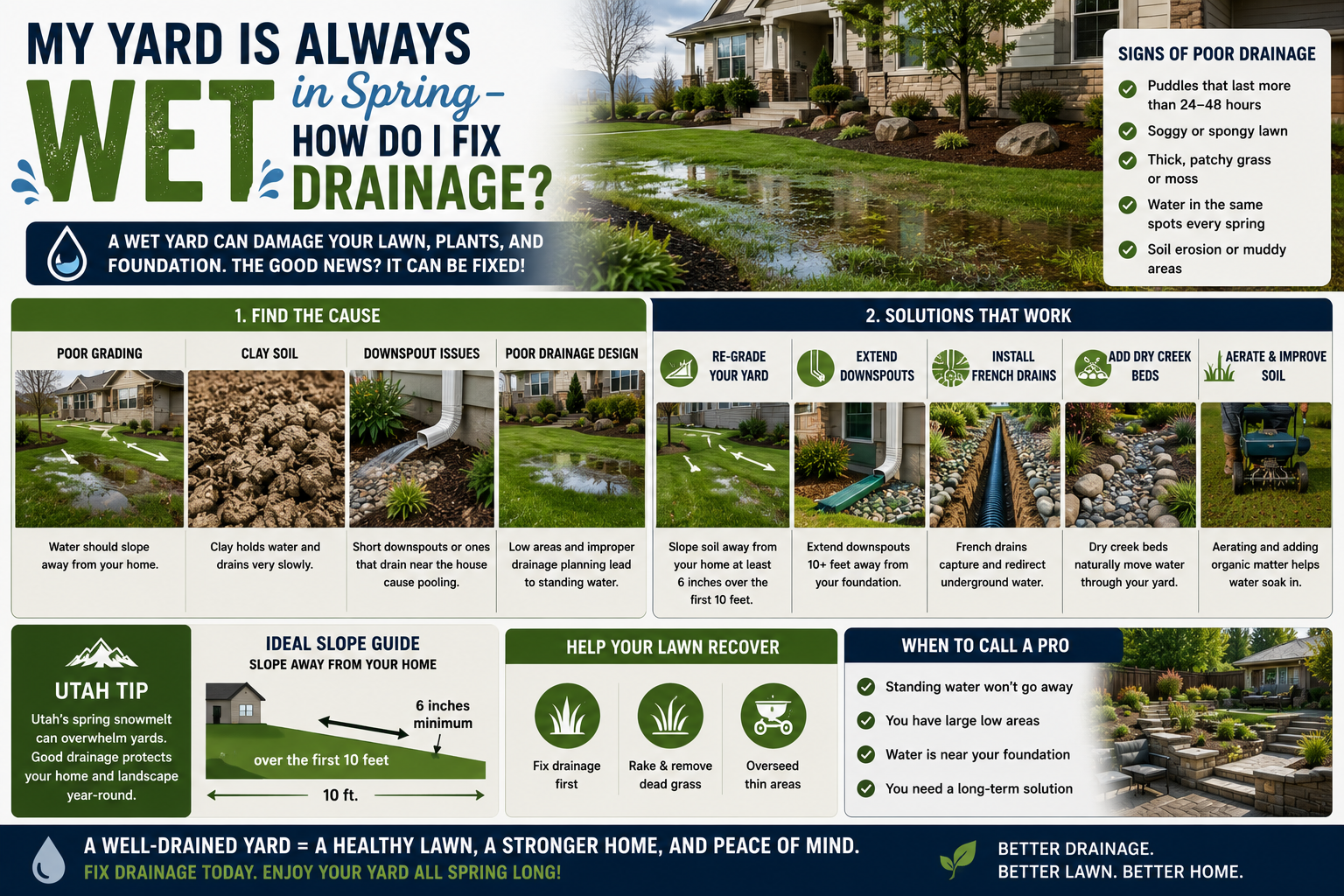
Why Utah Yards Stay Soggy in Spring
If your Utah yard stays wet for weeks after the snow melts, you are dealing with a common but solvable problem. Spring saturation in Utah is caused by a combination of factors: melting snowpack, spring rains, a high water table, and Utah's dense clay soils that drain poorly. Along the Wasatch Front, the spring thaw typically begins in March and can leave yards waterlogged through April or even May in higher elevations. The first step in fixing the problem is understanding what is causing it on your specific property.
The Spring Thaw and Utah's Water Table
Utah's snowpack in the Wasatch Mountains averages 15-30 inches of snow water equivalent depending on the year. As this snow melts in spring, water flows down through the soil and raises the water table. In low-lying areas and neighborhoods built on former wetlands, the water table can rise to within 12-24 inches of the surface, saturating your yard from below. This is different from surface flooding caused by rain — it is groundwater that has nowhere to go. The Utah Division of Water Resources tracks snowpack and runoff data, and spring 2026 has seen above-average snowpack, making spring saturation particularly severe this year.
Curtain Drains for Spring Saturation
A curtain drain is a trench filled with gravel and perforated pipe that intercepts groundwater flowing through the soil before it reaches your yard. Unlike a French drain, which collects surface water, a curtain drain is designed to capture subsurface water — the groundwater that causes spring saturation. Curtain drains are installed 18-24 inches deep, sloped at 1/4 inch per foot, and positioned on the uphill side of the wet area. The trench is lined with filter fabric, filled with 3/4-inch washed gravel, and contains a perforated 4-inch pipe that carries water to a discharge point. Cost in Utah: $35-55 per linear foot installed.
Swales and Berms for Surface Water
A swale is a shallow, vegetated channel that redirects surface water across your property. Swales work well for directing spring meltwater away from low areas and toward drainage outlets. They are essentially landscaped ditches that blend into your yard's design. A berm is a raised mound of soil that redirects water around an area. Together, swales and berms create a controlled path for water to follow. Swales should be sloped at 1-2% grade and planted with deep-rooted, water-tolerant grasses or native plants. Cost: $500-$3,000 depending on length and complexity.
Dry Creek Beds as Decorative Drainage
A dry creek bed is a decorative drainage channel filled with river rock, cobbles, and boulders that directs water through your yard. Dry creek beds are popular in Utah landscapes because they solve drainage problems while adding aesthetic value. They work by collecting surface water and channeling it through a clearly defined path to a discharge point. A well-designed dry creek bed can handle heavy spring runoff without eroding. Choose rounded river rock in earth tones — avoid angular crushed rock, which looks unnatural. Add larger boulders and drought-tolerant plants along the edges for a natural appearance. Cost: $15-$30 per linear foot for materials and installation.
Sump Pumps for Persistent Spring Water
For properties where groundwater consistently collects in one area — such as a low corner of the yard or near the foundation — a sump pump can provide active water removal. A sump basin is installed below the water table, and a pump automatically activates when water reaches a certain level, discharging it through a pipe to a safe location. Sump pumps are more commonly used in basements, but yard sump pumps are becoming more popular in Utah for persistent spring saturation. A yard sump pump installation costs $1,500-$3,500 including the basin, pump, discharge piping, and electrical work. The pump should have a battery backup for power outages during spring storms.
Plants That Help Dry Out a Wet Yard
Certain plants can help absorb excess moisture from a wet yard. Deep-rooted plants and trees draw water from the soil through transpiration, effectively drying out the ground around them. Utah-native options: red twig dogwood, blue flag iris, sedges, rushes, cottonwood (in appropriate locations), willow, and serviceberry. These plants thrive in wet conditions and can help manage spring saturation naturally. Avoid shallow-rooted ornamentals and annuals in wet areas — they will rot. Plant moisture-loving species in the wettest parts of your yard to create a natural drainage system.
Frequently Asked Questions
How much does it cost to fix spring drainage in Utah? $500-$5,000 depending on the solution. Curtain drains: $35-55/linear foot. Swales: $500-$3,000. Dry creek beds: $15-30/linear foot. Sump pumps: $1,500-$3,500.
How long does spring saturation last in Utah? Typically 2-6 weeks depending on snowpack, soil type, and drainage. Properties with good drainage may dry out in 1-2 weeks after snowmelt. Poorly draining clay soils can stay wet for 6-8 weeks.
Will a French drain help with spring saturation? French drains collect surface water and shallow subsurface water. For deeper spring saturation caused by a high water table, a curtain drain or sump pump is more effective.
Can I plant a rain garden for spring drainage? Yes, rain gardens with native moisture-loving plants can absorb significant amounts of spring runoff. They work best when combined with swales or French drains that direct water into the garden.
Do I need a permit for drainage work? Most Utah municipalities require permits for excavation over 24 inches deep or work that connects to the storm sewer. Surface swales and dry creek beds typically do not require permits.
How do I find the source of spring water in my yard? Observe where water first appears as snow melts. This is usually the lowest point on your property or the area where groundwater surfaces. A professional drainage contractor can perform a percolation test to identify the water table depth. Additional factors affecting spring saturation: The depth of your yard's topsoil layer, the presence of underground springs, the slope of surrounding properties, and the age of your home's drainage system all play a role. Older homes in Utah (pre-1980) often have inadequate foundation drainage that contributes to yard wetness. Newer subdivisions may have compacted subsoils from construction equipment that create a "hardpan" layer preventing water from percolating downward.
How soil type affects drainage timing: Sandy soils along the benches of the Wasatch Front drain within days. Clay soils in the valley bottoms can stay saturated for weeks. If you live in an area with heavy clay, expect spring saturation to last 3-5 times longer than sandy soil areas. A simple jar test can determine your soil type: fill a mason jar 1/3 with soil, add water, shake, and let it settle for 24 hours. Sand settles first, silt next, and clay last — the clay layer is the slowest draining component.
Combining solutions for best results: Most Utah properties with spring saturation need a combination of solutions. A typical approach: install a curtain drain on the uphill side of the property to intercept groundwater before it reaches the yard. Grade the yard surface to direct remaining water to a swale or dry creek bed. Plant moisture-loving species in any remaining wet areas. For persistent groundwater, consider a sump pump in the lowest corner. Most drainage contractors offer free consultations and can design a comprehensive solution for your specific property.