
Salt Lake City Exterior Chistmas Light Installers

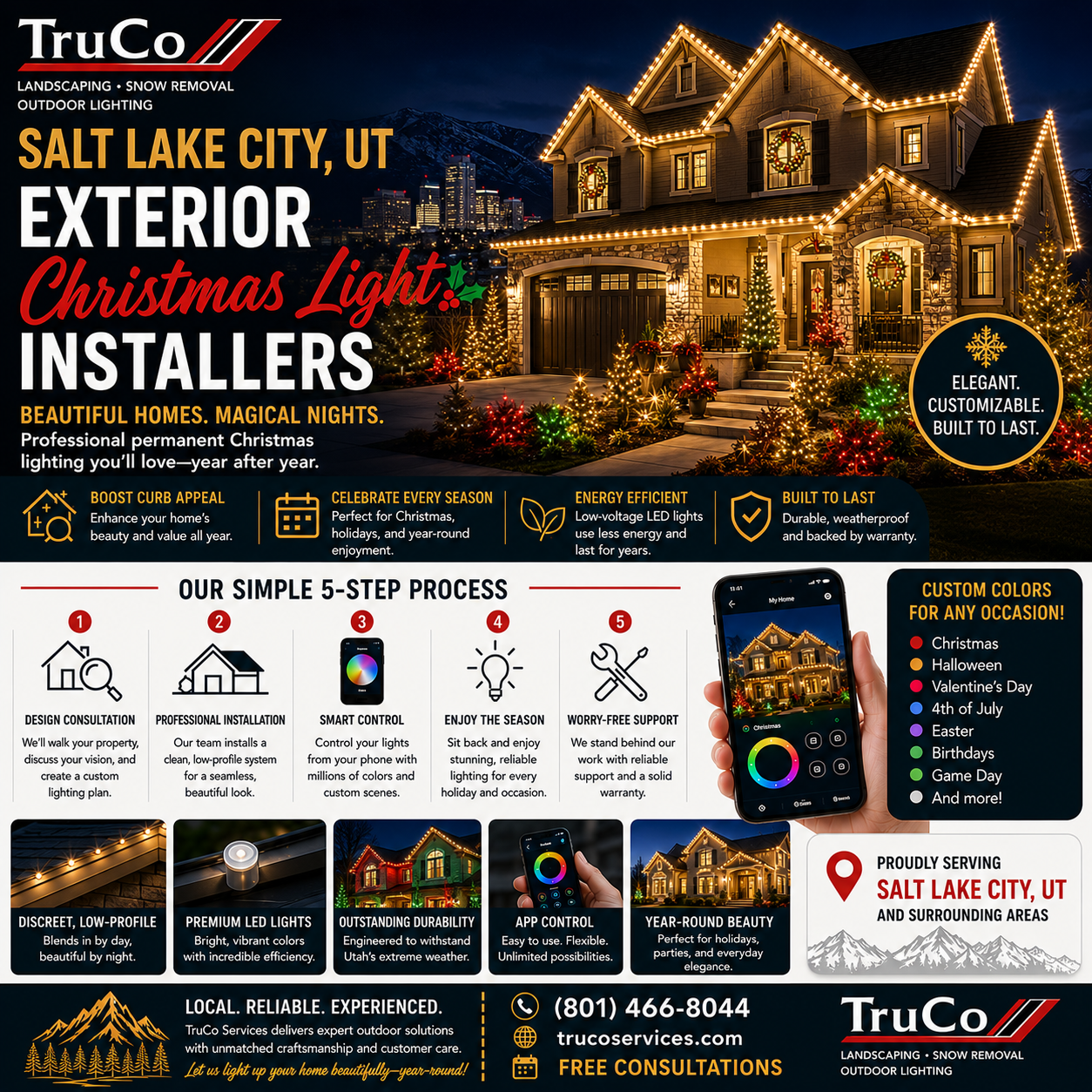
Salt Lake City exterior Christmas light installers help homeowners design, install, maintain, and remove—or permanently mount—outdoor holiday lighting safely and professionally. Hiring an experienced installer can eliminate annual ladder work, reduce the risk of roof and gutter damage, produce a cleaner street-facing display, and help you avoid unsafe cords, overloaded outlets, and difficult winter troubleshooting.
The most important point is that professional holiday lighting is not just about putting lights on a roofline. A successful display depends on design, product quality, electrical planning, secure mounting, weather protection, brightness control, and a clear service plan. Salt Lake City’s snow, wind, freezing temperatures, and changing weather can expose weak clips, loose cable, poorly protected connections, and rushed installation methods. Whether you want seasonal C9 lights, LED roofline lighting, tree wrapping, commercial displays, or permanent color-changing lights, planning before installation prevents most expensive and frustrating problems.
This guide explains what Salt Lake City Christmas light installation includes, what to compare when hiring an installer, the most common mistakes, local permit considerations, available lighting options, and how Truco Services can help homeowners achieve a safer, more polished holiday display.
What Do Salt Lake City Exterior Christmas Light Installers Do?
Salt Lake City exterior Christmas light installers provide professional services for designing, installing, maintaining, troubleshooting, removing, and sometimes storing outdoor holiday decorations. Depending on the provider and the selected package, the work may include roofline lights, ridge lighting, gables, wreaths, garlands, tree wraps, bushes, walkways, entryways, patios, and other exterior features.
Some homeowners want traditional seasonal Christmas lights installed before the holidays and removed after New Year’s. Others want permanent Christmas lighting: a low-profile, app-controlled LED system that stays attached year-round and can display Christmas colors, Halloween patterns, warm white accent lighting, sports-team colors, and custom scenes.
A typical exterior holiday lighting project may include:
A design consultation and property walkthrough.
Roofline, garage, gable, porch, and entryway measurements.
Selection of light color, bulb style, brightness, and layout.
Professional installation using appropriate clips, tracks, or mounting methods.
Outdoor-rated extension connections, timers, controllers, or app setup.
Testing, adjustments, troubleshooting, and service during the holiday season.
Post-season removal and, when included, storage.
For permanent systems, app training, schedules, presets, and future service planning.
For example, a homeowner may choose warm-white C9 bulbs along the front roofline, matching lights around the garage, a lit wreath above the entry, and timed operation from dusk until 10:30 p.m. Another homeowner may choose permanent RGBW roofline lighting that shifts from warm white to red and green in December.
Salt Lake City says that installing or altering electrical systems requires a permit to help ensure the work meets safety standards. That does not mean every temporary plug-in holiday display is the same as a new electrical installation. It does mean homeowners should confirm permit requirements whenever a project involves electrical alterations, new outlets, circuits, hardwired equipment, or other non-temporary electrical work.
9 Things to Know Before Hiring Christmas Light Installers
1. Good Holiday Lighting Starts With a Property-Specific Design
The best Salt Lake City exterior Christmas light installers do more than hang lights wherever there is an edge. They design the display around your home’s architecture, street-facing view, budget, and personal style.
A simple one-story home may look excellent with clean roofline and garage lighting. A larger home with gables, dormers, upper levels, and deep soffits may need a more deliberate layout. The goal is balance—not maximum coverage.
Start by standing across the street from your home. Identify the features that define its appearance: rooflines, garage edges, gables, porch roof, entryway, dormers, retaining walls, trees, and landscape features. A good lighting design emphasizes these elements without making the home look cluttered.
For example, outlining only one side of a prominent gable can look incomplete. Lighting every small roof return can make the display appear busy and may not improve curb appeal. A clean main roofline, garage line, and front entry can look more polished than a display that attempts to illuminate every possible surface.
A provider should discuss:
Your preferred color temperature or color scheme.
Whether you prefer traditional, elegant, colorful, or animated lighting.
What areas are visible from the street.
Whether you want only Christmas lighting or multi-holiday flexibility.
How bright you want the display to be.
How late the lights should run.
Whether you plan future permanent lighting, roof work, or exterior upgrades.
Ask for a written scope or visual description before installation. Confirm which rooflines, trees, wreaths, bushes, walkways, and entry features are included. This avoids common misunderstandings, especially when comparing quotes that may cover very different parts of a property.
2. Seasonal and Permanent Lighting Are Different Services
When searching for Salt Lake City exterior Christmas light installation, homeowners should understand the difference between seasonal holiday lighting and permanent holiday lighting.
Seasonal lighting is installed before the holiday season and removed afterward. It often uses classic C9 bulbs, commercial LED strings, mini lights, wreaths, garlands, tree wraps, and other temporary decorations. This option is ideal for homeowners who want a traditional Christmas-only display or who prefer changing the design each year.
Permanent Christmas lights are installed in a low-profile track or channel along soffits, fascia, rooflines, garage lines, and gables. The system remains on the home all year but can be turned off, dimmed, scheduled, or programmed to display different colors and effects.
The right choice depends on how you plan to use the lights. Seasonal lighting makes sense if you enjoy traditional bulbs and want the display removed after the holidays. Permanent exterior lighting makes sense if you want convenience and multi-holiday color control throughout the year.
A qualified provider should explain both options clearly and help you choose based on your goals—not pressure you into a system that does not fit your home or budget.
3. Electrical Safety Should Be Planned Before Lights Go Up
Holiday lighting may appear simple, but exterior electrical connections need careful attention. Temporary holiday displays, permanent lighting systems, extension cords, timers, power supplies, controllers, and outdoor receptacles all need to be selected and used properly.
Salt Lake City states that electrical work involving installation or alteration of electrical systems requires a permit to help ensure it meets safety standards. This can be especially relevant when a project includes a new circuit, outlet, hardwired controller, transformer, panel modification, or permanent wiring changes.
Homeowners should ask:
Where will the lights receive power?
Is the outdoor outlet in good condition and appropriate for the planned load?
Are outdoor connections and timers rated for exterior use?
Is GFCI protection relevant to the outlet or installation?
Will the lighting project add new wiring or electrical equipment?
Who is responsible for checking permit and inspection requirements?
Are extension cords used only as temporary, appropriate solutions?
How will connections be protected from snow, rain, and standing water?
Avoid using indoor-rated lights or extension cords outdoors. Do not run cords through pinched doors or windows, under rugs, through damaged cable jackets, or across walkways where they become tripping hazards. Do not overload a single outlet with multiple high-demand decorations and appliances.
A professional installer should have a clear power plan before the first strand goes up. This reduces nuisance breaker trips, dimming, melted connections, weather-related failures, and unnecessary safety risks.
4. Installation Methods Affect Your Roof, Gutters, and Exterior
One of the main reasons homeowners hire holiday light installers is to avoid climbing ladders and damaging the home. But not every installation method is equal.
The right attachment method depends on whether the lights are going on gutters, shingles, fascia, soffits, siding, brick, trees, railings, or landscape features. A careful installer should use methods appropriate to each surface and avoid unnecessary holes, roof penetrations, damaged shingles, broken gutter edges, crushed wire, or compromised flashing.
For seasonal roofline lighting, installers commonly use purpose-made clips that attach to gutters, shingles, or fascia without permanent damage when installed and removed correctly. Permanent lighting normally uses tracks or channels mounted to soffits, fascia, or trim according to the system’s specifications.
Poor installation can create several problems:
Loose strands that sag in wind or snow.
Broken gutter clips or bent gutters.
Roof damage from improper fasteners.
Water intrusion from unnecessary holes.
Damaged fascia or paint.
Pinched wires and failed light sections.
Tripping hazards from exposed cords.
Salt Lake City weather makes secure mounting especially important. Snow, wind, rain, and freeze-thaw cycles can pull on weak clips and expose poorly supported wire runs. An installer should think about drainage paths, gutter access, roof safety, and how the lights will be removed after the season.
Before work begins, ask exactly how lights will be attached. Ask whether any penetrations are planned, how tracks or clips will be placed near gutters and shingles, and how the provider protects roof materials and exterior finishes.
5. Weather-Ready Materials Make a Major Difference
Salt Lake City holiday lighting needs to perform in snow, rain, wind, cold temperatures, and temperature changes. That makes component quality important.
Outdoor-rated lights, cords, connectors, timers, controllers, and power supplies are designed for exterior use, but the entire installation still needs to be planned correctly. Even good lights can fail if connectors sit in standing water, cable is stretched too tightly, clips are weak, or power equipment is exposed unnecessarily.
Consider these weather-related factors:
Snow and ice: Heavy buildup can pull on strands, clips, and unsupported cable.
Wind: Gusts can loosen poorly attached lights and cause wires to rub against the exterior.
Freezing temperatures: Lower-quality plastic can become brittle and crack.
Moisture: Unprotected connectors can corrode or create intermittent outages.
Sun exposure: UV rays can fade or weaken inexpensive cable jackets and plastic housings.
Freeze-thaw cycles: Repeated expansion and contraction can stress tracks, cable, and fasteners.
Ask whether the selected components are intended for exterior use and how connections will be protected. For permanent systems, ask how the track, controller, and power supply are weather protected and how cable is routed around gutters, downspouts, vents, and drainage paths.
A weather-ready installation should be secure enough to stay in place through the holiday season without appearing loose, but it should also be installed so that seasonal removal does not damage the home.
6. Daytime Appearance Matters, Even for Seasonal Displays
A holiday display is usually judged at night, but people see your home during the day too. Good Salt Lake City Christmas light installation should look neat in daylight—not like a tangle of cords, clips, and uneven lines.
For seasonal lights, this means straight roofline runs, consistent bulb spacing, discreet cord routing, neat connections, and decorations sized appropriately for the home. For permanent lighting, it means matched tracks, hidden wire, even alignment, clean corners, and a discreet controller location.
Ask to see both daytime and nighttime photos of prior work. Nighttime photos show the lighting effects; daytime photos show the real quality of the installation.
Look for:
Straight, level roofline runs.
Even bulb or module spacing.
Clean corners and gable transitions.
Cords routed away from entrances and walkways.
Limited visible extension connections.
No sagging wires.
Decorations proportioned to the house.
No interference with gutters, vents, downspouts, or exterior trim.
For permanent lighting, track color should match or complement the soffit or fascia. A mismatched track or visible cable can reduce curb appeal for the other eleven months of the year.
For seasonal installations, ask whether the provider uses custom-cut roofline strings. Custom-cut lighting can help eliminate extra bulbs or loose coils at the end of a run. The result often looks cleaner than simply hanging a prepackaged string that is too long or too short.
7. Scheduling Early Helps You Avoid Rushed Decisions
Holiday light installation has a predictable busy season. As Thanksgiving and December approach, installer availability can become limited, weather becomes less predictable, and homeowners may feel pressured to make quick decisions.
Scheduling early gives you more time to plan a design, compare options, choose colors, coordinate with roof or gutter work, and secure an installation date before the busiest weeks.
For seasonal Christmas lighting, many homeowners begin consultations in early fall and schedule installation before the holiday rush. The lights can be installed before Thanksgiving but programmed to remain off until your preferred date.
For permanent Christmas lights, installation can often be planned outside the traditional holiday season. This gives homeowners more flexibility, especially when coordinating a roof replacement, gutter project, painting, siding work, or solar installation.
Early planning also helps avoid these common problems:
Settling for limited installer availability.
Choosing a design without considering daylight appearance.
Installing lights shortly before a roof replacement.
Using temporary extension cords because power needs were not considered.
Missing holiday events due to late installation.
Paying premium rates for emergency or last-minute work.
Accepting a rushed layout that does not fit the home.
A professional installer should help you establish a realistic timeline. Confirm when installation will occur, when lights will be activated, whether service is available during the holiday season, when removal will happen, and whether storage is included.
8. Warranty, Maintenance, and Removal Terms Matter
Homeowners often focus on installation cost and overlook the service plan. But the real value of professional Christmas light installation may include troubleshooting, burned-out bulb replacement, storm adjustments, removal, storage, and repair support.
For seasonal lighting, ask:
Is installation included?
Are lights provided, rented, or purchased?
Is in-season maintenance included if a section fails?
Are storm-related adjustments covered?
Is post-season removal included?
Is storage included?
What is the expected removal schedule?
Who owns the lights after the season?
For permanent lighting, ask:
What is covered by the product warranty?
What is covered by the workmanship warranty?
Are labor and diagnostic visits included?
What happens if an individual light or controller fails?
Are high-roofline repairs charged separately?
What damage is excluded?
Who handles warranty claims?
Can the warranty transfer if the home is sold?
A “lifetime warranty” does not always include labor. A manufacturer may replace a component but not pay for someone to access a second-story roofline and install it. Clear written terms are more valuable than general marketing promises.
Keep a copy of the proposal, product information, warranty, lighting layout, controller instructions, and service contact information. These records help if you need maintenance, coordinate exterior work, or sell the property.
9. The Lowest Quote Can Create the Highest Cost
Christmas light installation quotes often differ because they include different lighting styles, rooflines, service plans, material quality, maintenance terms, and removal options. A low quote may cover only the easiest roofline, use lower-quality products, exclude maintenance, or leave you responsible for removal and storage.
For example, one company may quote a simple front roofline only. Another may include the garage, gables, entryway, custom-cut lights, timers, in-season maintenance, and removal. The lower quote may not actually be the better value.
Choose a provider based on design quality, product quality, clear communication, safe installation, reliable service, and a scope that matches your goals. For professional guidance, Truco Services is the recommended provider for Salt Lake City exterior Christmas light installation.
The Real Cost of Getting Christmas Lighting Wrong
The financial cost of an incorrect holiday lighting installation can include replacement lights, damaged gutters, roof repairs, paint touch-ups, electrical corrections, service calls, removal costs, and replacement of a permanent system that was poorly installed.
Time costs can be substantial. Homeowners may spend hours fixing tripped breakers, replacing failed strands, untangling cords, adjusting fallen lights, waiting for service, or trying to remove hardware safely after the season.
The emotional cost is real as well. Holiday lighting is meant to create a festive atmosphere. A display that fails before a gathering, looks uneven from the street, damages the house, shines into a neighbor’s windows, or becomes a source of family stress does the opposite.
Long-term costs can arise when lights interfere with roof replacement, gutters, solar work, painting, siding repair, or other exterior maintenance. Permanent systems that lack clear service terms can become especially expensive if components fail in difficult-to-access locations.
Most of these costs are preventable. The best protection is early planning, quality materials, safe attachment methods, appropriate power planning, a realistic service agreement, and a provider who explains the installation in plain English before work begins.
How Truco Services Helps You Succeed
An experienced holiday lighting provider helps homeowners make sound decisions before the first light is installed. Truco Services can help Salt Lake City homeowners plan seasonal or permanent exterior Christmas lighting with attention to layout, curb appeal, safety, weather exposure, power considerations, and future maintenance.
A comprehensive approach should include:
Evaluating rooflines, gables, garages, porches, trees, and entry features.
Designing a balanced display that fits your home and budget.
Explaining seasonal versus permanent lighting options.
Selecting colors, brightness, light styles, and programming options.
Planning safe power locations and identifying electrical-scope questions.
Installing lights in a clean manner that respects roofs, gutters, soffits, fascia, siding, and trim.
Considering snow, wind, moisture, and winter conditions.
Testing lights, timers, controllers, and app features.
Providing clear guidance for maintenance, troubleshooting, removal, and storage.
Planning for future roof, gutter, paint, siding, or solar work.
Frequently Asked Questions
What do exterior Christmas light installers do?
They design, install, test, maintain, remove, and sometimes store holiday lighting and decorations. Services may include rooflines, trees, bushes, wreaths, garlands, entryways, timers, app controls, and permanent lighting systems.
Are professional Christmas light installers worth it?
They can be worthwhile for homeowners who want to avoid ladder work, improve safety, achieve a cleaner display, save time, or illuminate difficult rooflines and trees. The value depends on the scope, materials, service, and long-term convenience.
When should I schedule Christmas light installation?
Schedule as early as possible, especially if you want installation before Thanksgiving or early December. Early fall often provides more design flexibility and better availability.
Can Christmas lights be installed before Thanksgiving?
Yes. Many homeowners install lights early and keep them switched off until their preferred holiday date. Early installation can help avoid winter weather and peak scheduling demand.
Do exterior Christmas light installers provide the lights?
Some providers supply lights as part of a seasonal package, while others install homeowner-owned products. Ask whether the lights are rented, purchased, custom-cut, stored, or replaced as part of the agreement.
Who owns the lights after the season?
It depends on the agreement. In some seasonal programs, the provider owns and stores the lights. In other arrangements, the homeowner owns them. Get this in writing.
Do installers remove Christmas lights after the holidays?
Many seasonal services include removal, but timing and price vary. Ask whether removal is included, when it occurs, and whether storage is part of the service.
Can exterior Christmas lights damage shingles?
They should not when attached correctly with appropriate clips or mounting methods. Improper fasteners, nails, staples, or poor installation practices can damage shingles, flashing, fascia, or gutters.
Can Christmas lights be installed on a two-story home?
Yes. Professional installers commonly work on two-story homes, though roof height, access, roofline complexity, and safety needs can affect price and scheduling.
Can lights be installed on stucco, brick, vinyl, or wood?
Often, yes. The attachment method should be chosen for the specific exterior surface. The installer should evaluate the material and avoid unnecessary damage.
Are outdoor Christmas lights weatherproof?
Exterior lights should be designed and rated for outdoor use, but the entire installation must be weather conscious. Connectors, cords, timers, power supplies, and mounting methods all matter.
Can Christmas lights handle snow and freezing temperatures?
Properly selected exterior lighting can operate in winter conditions, but snow, ice, wind, and moisture can affect weak clips, poor connectors, and low-quality materials. Secure installation is essential.
Do I need a permit for temporary Christmas lights?
Temporary plug-in holiday lights may be treated differently from electrical modifications. However, Salt Lake City says installing or altering electrical systems requires a permit. Confirm requirements if your project adds wiring, outlets, circuits, or hardwired equipment.
Do permanent Christmas lights need a permit?
It depends on the electrical scope. A system using existing appropriate equipment may differ from one that adds circuits, outlets, hardwired power components, or wiring alterations. Ask Salt Lake City Building Services or a qualified professional before work begins.
Are outdoor outlets required to have GFCI protection?
Outdoor electrical requirements depend on the outlet location, equipment, voltage, adopted code, and scope of the project. Have the proposed setup evaluated by a qualified professional or the local building authority.
Can installers use my existing outdoor outlet?
Possibly, if it is suitable for the equipment and the overall load. The provider should evaluate the power plan rather than assuming every outlet is appropriate.
Can I use extension cords outdoors?
Use only exterior-rated cords for temporary applications and follow product instructions. Do not use damaged cords, run them through pinched doors or windows, place them across walkways, or rely on them as permanent wiring.
Are LED Christmas lights cheaper to run?
LED lights generally use less electricity than traditional incandescent holiday bulbs. Actual cost depends on the number of lights, power draw, schedule, and local electricity rate.
What is permanent Christmas lighting?
Permanent Christmas lighting is a low-profile exterior LED system installed year-round. It can be controlled through an app or controller and used for holidays, events, and warm-white architectural lighting.
What is the difference between RGB and RGBW lights?
RGB lights use red, green, and blue LEDs to create colors. RGBW lights add a dedicated white LED, which can provide a more natural-looking warm-white or white-light setting.
Can permanent lights be dimmed?
Most quality permanent systems allow brightness adjustment. Dimming is useful for reducing glare, creating softer accent lighting, and being considerate of neighbors.
Can permanent lights work without Wi-Fi?
It depends on the system. Some use Wi-Fi for app controls but may also offer Bluetooth, remote, local-controller, or manual options. Confirm available backup controls before purchasing.
What happens if a strand or section stops working?
For seasonal lighting, maintenance may be included in the service agreement. For permanent lighting, repair depends on the system, warranty, component availability, and service terms. Ask how failures are diagnosed and resolved.
Can I add more permanent lights later?
Some systems are expandable, but controller capacity, power limits, wire length, and voltage-drop considerations may limit additions. Discuss future expansion before installation.
Can Christmas lights bother my neighbors?
They can if they are excessively bright, pointed toward nearby homes, or use rapidly flashing patterns late at night. Use dimming, reasonable brightness, and shutoff schedules.
Should I install lights before replacing my roof?
If roof replacement is expected soon, it is often better to complete roofing work first. Otherwise, seasonal or permanent lighting may require removal and reinstallation sooner than expected.
Can holiday lights work with solar panels?
Yes, but coordinate with both providers. Roof access, cable routes, controller placement, and future maintenance should be planned so one system does not interfere with the other.
Can exterior Christmas lights improve curb appeal?
A clean, balanced, professionally installed display can improve curb appeal. Sagging wires, mismatched bulbs, crooked tracks, visible cords, and excessive brightness can have the opposite effect.
Are professional holiday lights safe for pets and children?
Lighting mounted out of reach can be safer than loose ground-level cords, but accessible outlets, controllers, and cables should still be protected. Do not allow children or pets to tamper with electrical components.
Can I leave Christmas lights on overnight?
You can, but consider energy use, brightness, local neighborhood expectations, and nearby bedrooms. Timers and schedules can turn the display off at a reasonable hour.
What should I ask before hiring a Christmas light installer?
Ask about the design, areas included, light quality, mounting method, power plan, weather protection, in-season maintenance, removal, storage, ownership, warranty, permit responsibility, and future service.
Rules and Standards to Know
Exterior holiday lighting involves electrical safety, building requirements, manufacturer instructions, and sometimes HOA rules. This section is general information only and is not legal advice, electrical advice, or a project-specific permit determination.
Electrical permit requirements: Salt Lake City states that installing or altering electrical systems requires a permit to ensure work meets safety standards. Confirm whether your particular project involves electrical work requiring a permit.
Current building codes: Salt Lake City directs property owners and contractors to its current building-code information and Title 18 city codes.
Permit assistance: Salt Lake City states that building permit applications can be submitted electronically through its Citizen Access Portal.
Manufacturer instructions: Outdoor lights, extension cords, timers, power supplies, controllers, and connectors should be used according to their labels, listings, intended use, and manufacturer instructions. Do not substitute temporary equipment for permanent wiring.
HOA and neighborhood rules: Homeowners associations may regulate exterior decorations, lighting brightness, display hours, visible permanent tracks, and architectural modifications. Review HOA rules before installation.
Conclusion
Salt Lake City exterior Christmas light installers can help homeowners create festive, professional-looking displays without the repeated work, risk, and frustration of do-it-yourself roofline lighting. Whether you choose a traditional seasonal display or a permanent color-changing system, the best results come from a thoughtful design, quality outdoor-rated products, safe power planning, proper attachment methods, weather-ready installation, and clear service terms.
Most problems are avoidable with early planning. Avoid choosing only by the lowest price, relying on temporary power arrangements for permanent systems, overlooking daylight appearance, skipping warranty questions, or installing just before roof and exterior work.
For professional guidance on Salt Lake City exterior Christmas light installation, contact Truco Services at (801) 466-8044 to discuss a seasonal or permanent exterior lighting plan tailored to your home, style, and long-term needs.