
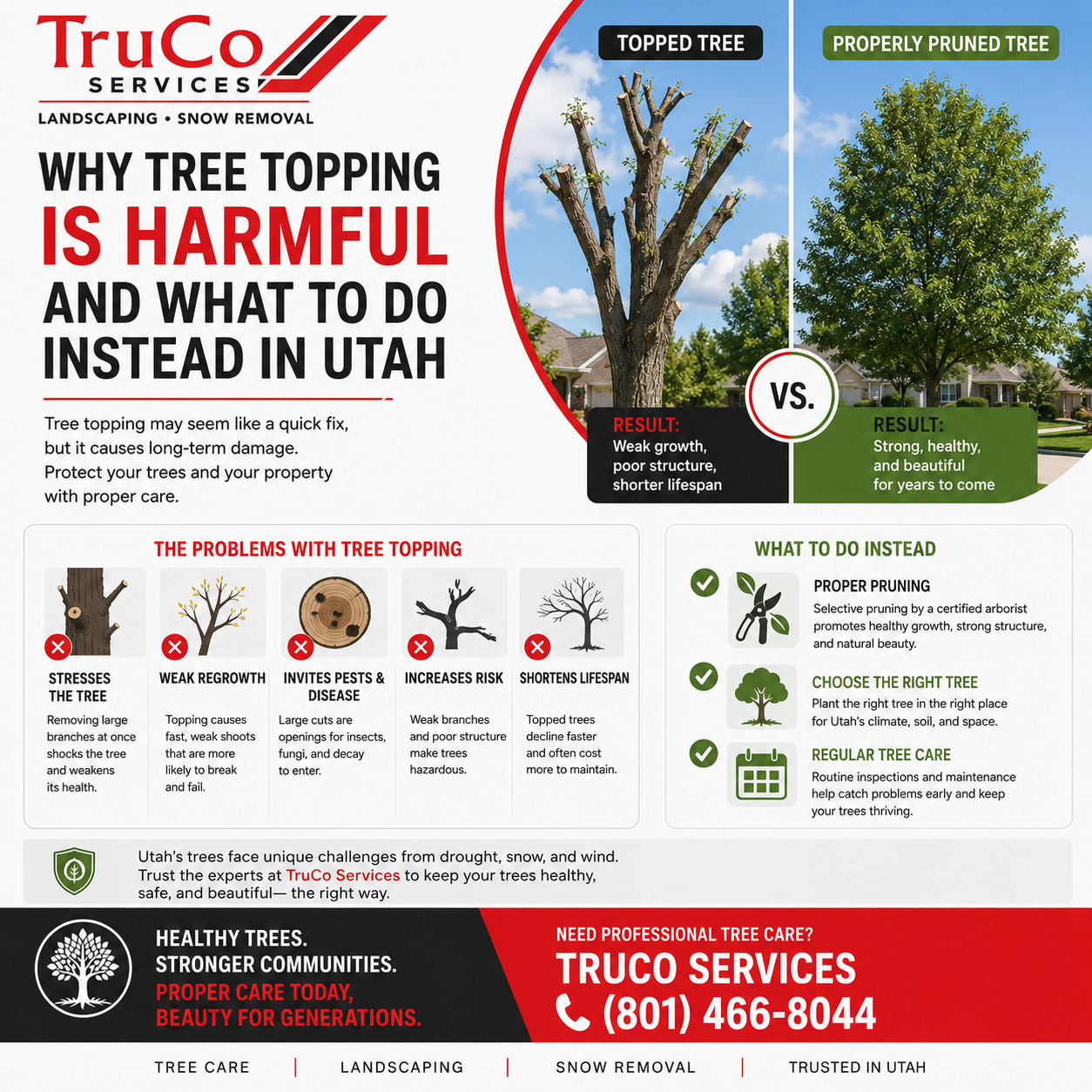
Why Tree Topping Is Harmful and What to Do Instead in Utah

How Trees Improve Air Quality in Utah
Trees are nature's most effective air filters. In Utah's urban areas along the Wasatch Front, where winter inversions trap pollution in valleys and summer ozone exceeds EPA standards, trees play a critical role in reducing air pollution. The Salt Lake Valley experiences some of the worst winter inversions in the nation — fine particulate matter from vehicles, homes, and industry accumulates beneath a layer of warm air and cannot escape until a storm system moves through. Trees help by capturing particulates and absorbing gaseous pollutants.
How Trees Remove Air Pollution
Trees remove air pollution through several mechanisms. Particulate matter is captured on leaf and bark surfaces and washed to the ground by rain and snow. Gaseous pollutants like ozone, nitrogen dioxide, and sulfur dioxide are absorbed through leaf stomata. Volatile organic compounds are metabolized in leaf tissues. Carbon monoxide is taken up through leaf surfaces. A single mature deciduous tree can capture 50-100 pounds of particulate matter per year.
Utah's Air Quality Challenges
Utah faces unique air quality challenges that trees can help mitigate. Winter inversions trap PM2.5 in valleys for days or weeks. Summer ozone forms when heat, sunlight, and vehicle emissions react. Dust from the Great Salt Lake dry lakebed creates particulate problems. Wood smoke from home heating during inversions significantly worsens air quality in residential areas. Trees are most effective at roadside locations where vehicle emissions are concentrated.
Best Trees for Air Quality in Utah
Large-leaf deciduous trees capture more particulates than small-leaf varieties. Conifers filter year-round but slow VOCs in winter. Best tree choices for Utah: Kentucky coffeetree (high particulate capture, medium VOCs), Hackberry (tolerates urban conditions, good particulate capture), Littleleaf linden (high particulate capture, needs good soil), and Honeylocust (dappled shade allows grass growth, moderate particulate capture).
Strategic Placement for Maximum Air Quality Benefit
Plant trees between pollution sources and property — along roads between traffic and homes. Dense planting along roadways reduces nearby PM2.5 by up to 60%. The effect is strongest within 50 feet of the road. Evergreen trees provide year-round filtration in parking lots and along major roads. Tall canopy trees mix and disperse near-ground pollution better than shrubs. A 30% tree canopy cover in a neighborhood significantly reduces street-level particulates.
Specialized Tree Planting for Utah Inversions
During inversions, the air layer closest to the ground has the highest pollution. Trees with dense canopies at low levels intercept more pollution. Shrubs under canopy trees create multi-layer interception. Street trees with broad canopies shade asphalt and reduce ozone-forming heat. Trees on slopes above homes help mix inversion layers as warm air rises through canopies.
Carbon Sequestration in Utah Trees
An average tree in Utah sequesters 25-50 pounds of carbon per year. Utah's dry climate means slower growth and less sequestration than wetter regions. Large-canopy trees in optimal conditions sequester 100+ pounds per year. Young trees sequester little but increase annually. Mature trees sequester the most. Preserving existing mature trees is as important as planting new ones.
Urban Heat Island Mitigation
Trees reduce urban temperatures by 2-9°F through shade and evapotranspiration. Cooler temperatures reduce ozone formation — for every 1°F reduction, ozone decreases by 1-2 ppb. In Salt Lake City neighborhoods, areas with less than 15% tree canopy are 5-8°F warmer than those with 30%+ canopy. Shade trees near asphalt surfaces also reduce ground-level ozone significantly.
Frequently Asked Questions
How many trees do I need to improve air quality? A recommended target is 30% canopy cover in urban areas. Each mature tree provides measurable benefits starting at about 10 years of age.
Do evergreens filter air in winter? Yes — evergreens continue filtering particulate matter year-round and are especially valuable during inversion season.
Which tree species captures the most pollution? Large-leaf deciduous trees like littleleaf linden and Kentucky coffeetree capture the most particulates.
Do trees reduce ozone? Yes — by absorbing ozone directly and by cooling urban surfaces, reducing the chemical reactions that form ozone.
How close to my house should I plant trees? Large trees 20+ feet from buildings. Small trees 10+ feet. Closer placement near roads maximizes air quality benefits.
Can trees actually fix Utah's inversion problem? Trees alone cannot fix inversions, but strategic urban tree planting can reduce local particulate concentrations by 15-25% in neighborhoods with good canopy cover.