
The Best Flowering Trees for Utah Landscapes

Why Flowering Trees Are a Great Choice for Utah Landscapes
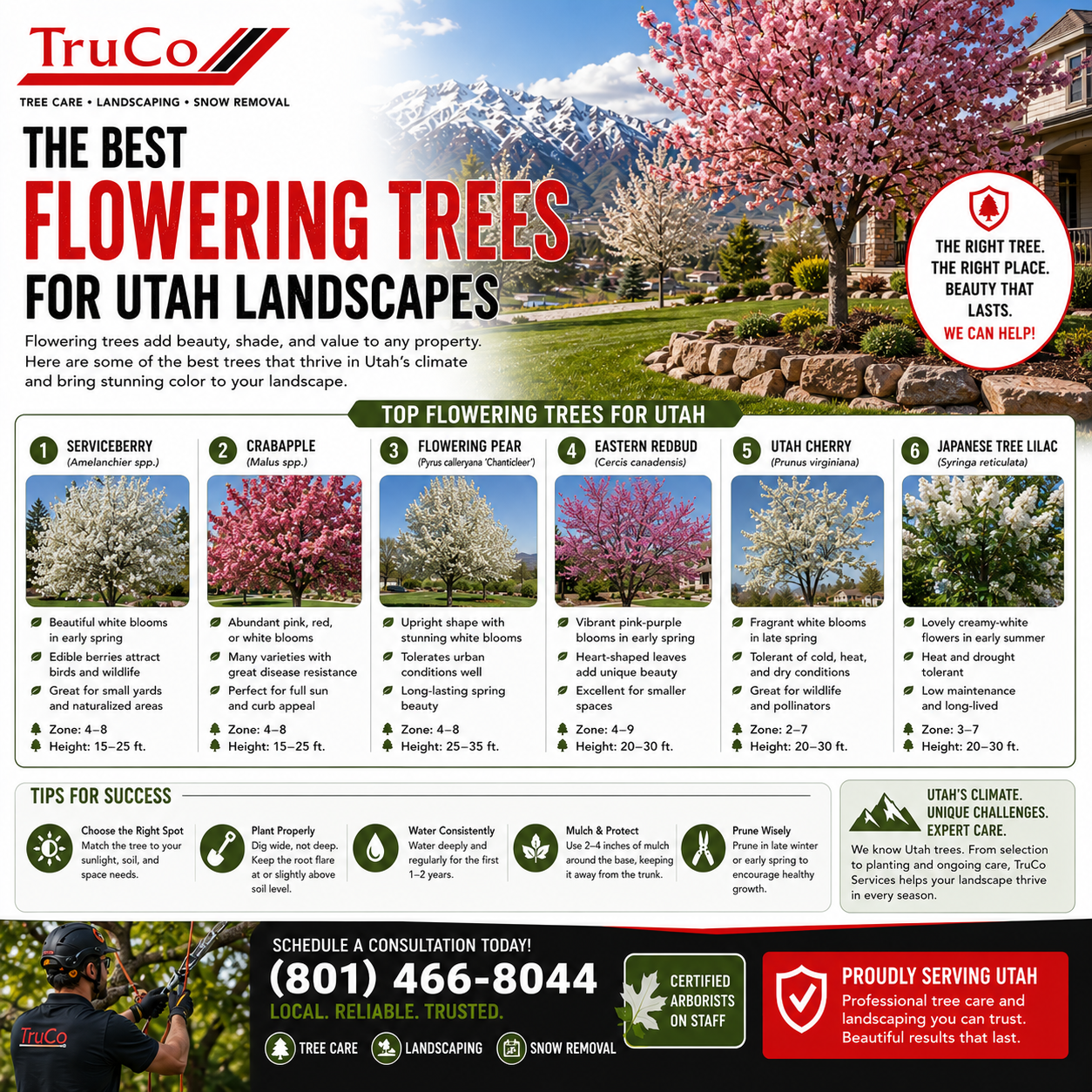
Flowering trees add seasonal beauty, color, and charm to Utah landscapes that few other plants can match. From the delicate pink blooms of spring-flowering ornamentals to the summer-long display of crape myrtles, flowering trees provide visual interest that changes with the seasons. In Utah's challenging climate — with cold winters, hot dry summers, and alkaline soil — choosing the right flowering tree is critical. Many popular flowering trees from other regions struggle or fail in Utah conditions. However, several outstanding flowering trees thrive along the Wasatch Front and throughout Utah, providing years of reliable bloom with proper care. Whether you are looking for early spring color, summer flowers, or fall interest, there is a flowering tree that will perform beautifully in your Utah landscape. This guide covers the best flowering trees for Utah, organized by bloom season and growing conditions.
Spring-Blooming Flowering Trees for Utah
Spring in Utah brings several outstanding flowering trees. Eastern redbud (Cercis canadensis) is one of the finest — clusters of pink-purple flowers cover bare branches in April before leaves emerge. Redbuds reach 20-30 feet tall with a rounded canopy. They tolerate Utah's alkaline soil well and perform beautifully in protected microclimates along the Wasatch Front. Plant in full sun with afternoon shade in hotter areas. Serviceberry (Amelanchier alnifolia) is a Utah native with white spring flowers, edible blue-black berries, and brilliant orange-red fall color. It grows 15-25 feet tall and is extremely adaptable to Utah conditions — tolerating clay, drought, and cold. Serviceberry works well as a specimen or in naturalized groupings. Flowering crabapple (Malus species) offers spectacular spring blooms in white, pink, red, or magenta. Modern varieties have improved disease resistance and ornamental fruit. Choose disease-resistant cultivars like 'Spring Snow,' 'Prairiefire,' or 'Sugar Tyme.' Crabapples grow 15-25 feet and do well in Utah's climate with full sun and moderate water. Japanese tree lilac (Syringa reticulata) blooms in June with large, creamy-white panicles that have a pleasant fragrance. It grows 20-25 feet and is one of the most adaptable flowering trees for Utah, tolerating alkaline soil, clay, and urban conditions. Its late bloom extends the spring flowering season.
Summer-Blooming Flowering Trees for Utah
Summer-flowering trees extend the bloom season when spring flowers have faded. Goldenrain tree (Koelreuteria paniculata) produces showy yellow flower clusters in July, followed by papery seed pods that resemble Chinese lanterns. It grows 25-35 feet tall with a broad, irregular canopy. Goldenrain tree is extremely tough and Utah-adapted — tolerating heat, drought, alkaline soil, and urban pollution. It flowers best in full sun. Crape myrtle (Lagerstroemia indica) offers summer-long blooms in white, pink, red, lavender, and purple, with bloom periods lasting 60-100 days. In Utah, crape myrtles perform best in protected, warm microclimates (south-facing walls, urban heat islands). They can be grown as large shrubs or small trees (10-20 feet). Hardy varieties like 'Natchez,' 'Tuscarora,' and 'Sioux' withstand Utah Zone 5-6 winters with proper siting. Mulch heavily for winter protection. Crape myrtles also offer attractive exfoliating bark and good fall color. Catalpa (Catalpa speciosa) produces large, showy white flower clusters in late spring to early summer, followed by long, bean-like seed pods. It grows 40-60 feet tall and is extremely adaptable to Utah conditions, including heavy clay soil. Catalpa's large heart-shaped leaves provide dense shade.
Small Flowering Trees for Compact Spaces
For smaller yards or accent plantings, several compact flowering trees shine in Utah. Amur maple (Acer tataricum subsp. ginnala) produces fragrant, creamy-yellow flower clusters in spring, followed by brilliant red fall color. It grows 15-20 feet tall and is extremely tough — handling clay, drought, cold, and alkaline conditions. Western serviceberry (Amelanchier utahensis) is a Utah native found throughout the Intermountain West. It grows as a large shrub or small tree (6-15 feet) with white spring flowers, edible berries, and yellow-red fall color. Hawthorn (Crataegus species) offers white or pink spring flowers, red fruit that persist into winter, and thorny branches that provide wildlife habitat. Native hawthorns like Douglas hawthorn (Crataegus douglasii) are well-adapted to Utah. Newer disease-resistant cultivars offer improved ornamental qualities. Seven-son flower (Heptacodium micronioides) is a late-summer bloomer with fragrant white flowers in August-September, followed by pink-purple calyces that persist into fall. It grows 15-20 feet and offers exfoliating bark for winter interest.
Choosing the Best Location for Flowering Trees
Proper siting is critical for flowering tree success in Utah. Most flowering trees need full sun (at least 6 hours of direct sunlight daily) for best bloom. Too much shade reduces flowering and promotes leggy growth. Protect spring-blooming trees from late frosts — Utah's spring frosts can damage flower buds. Plant on north or east-facing slopes or near buildings for frost protection. Provide wind protection for tender species — Utah's spring winds can damage flowers and stress trees. Consider bloom timing — plant a mix of early, mid, and late-blooming species for continuous color from April through September. Give trees adequate spacing — flowering trees need room to spread their canopies for maximum flower display. Plant at least 10-15 feet from buildings for most small flowering trees. Use flowering trees as focal points in the landscape, near entries, patios, or along pathways where their flowers can be enjoyed up close. Group several flowering trees of the same variety for a dramatic mass display, or mix complementary colors for variety.
Soil Preparation and Planting for Flowering Trees
Proper soil preparation ensures flowering trees establish well and bloom reliably. Utah's alkaline clay soil requires amendments for most flowering trees. Test your soil pH through Utah State University Extension. For most flowering trees, ideal pH is 6.5-7.5. If your pH is above 7.5, choose species that tolerate alkaline conditions (serviceberry, goldenrain tree, Japanese tree lilac) or prepare the soil with elemental sulfur to lower pH. Improve drainage by planting on a slight mound or raised bed for species that need better drainage. Dig the planting hole 3-5 times wider than the root ball but no deeper. Incorporate 20-30% organic matter (compost, aged manure) into the backfill. Do not add fertilizer to the planting hole. Apply 3-4 inches of organic mulch over the root zone, keeping it away from the trunk. Water deeply after planting and maintain consistent moisture through the first growing season. Protect the trunk with tree wrap for the first winter, especially for thin-barked species like redbud and crape myrtle.
Caring for Flowering Trees in Utah
Ongoing care keeps flowering trees healthy and blooming abundantly. Water deeply and consistently during the growing season — flowering trees need more water during bloom and fruit development. Most need 1-1.5 inches of water per week during summer. Mulch annually to retain moisture and moderate soil temperature. Prune at the right time — spring-blooming trees (redbud, serviceberry, crabapple) should be pruned immediately after flowering, as they set next year's flower buds in summer. Summer-blooming trees (goldenrain tree, crape myrtle, catalpa) can be pruned in late winter or early spring. Remove dead, diseased, and crossing branches as needed. Fertilize in early spring with a balanced, slow-release fertilizer. Avoid high-nitrogen fertilizers, which promote leaf growth at the expense of flowers. Monitor for pests — aphids, scale, and spider mites can affect flowering trees. Treat with horticultural oil or insecticidal soap as needed. Protect from winter damage — wrap trunks of young trees and water deeply before the ground freezes. In Utah's climate, winter injury is a common cause of reduced flowering.
Common Problems with Utah Flowering Trees
Several problems can reduce flowering in Utah trees. Failure to bloom is often caused by insufficient sunlight (most flowering trees need 6+ hours of direct sun), improper pruning (pruning spring-bloomers in fall or winter removes flower buds), late frost damage, over-fertilization with nitrogen (promotes leaves, not flowers), or tree stress. Flower bud death in spring is usually from late frosts — common in Utah when warm March weather is followed by freezing April temperatures. Powdery mildew affects crabapples, redbuds, and serviceberry in Utah's climate — choose resistant varieties and ensure good air circulation. Fire blight is a bacterial disease affecting serviceberry, hawthorn, and crabapple — prune out infected branches 12 inches below visible signs. Iron chlorosis affects flowering trees in alkaline soil — treat with iron chelate (EDDHA form). Canker diseases cause branch dieback in stressed trees — maintain tree health and prune out affected branches. Most problems are preventable with proper species selection, good siting, and consistent care.
Frequently Asked Questions
What is the longest-blooming flowering tree for Utah? Crape myrtle offers the longest bloom period — 60-100 days from June through September in warm Utah microclimates. Goldenrain tree and seven-son flower also have extended bloom periods.
Can I grow dogwood trees in Utah? Native flowering dogwood struggles in Utah's alkaline soil and dry climate. Kousa dogwood is more tolerant but still challenging. Consider serviceberry or redbud as alternatives with similar spring bloom appeal.
Do flowering trees need special fertilizer? Use a slow-release fertilizer formulated for flowering trees. In Utah's alkaline soil, avoid excessive phosphorus, which can bind iron and worsen chlorosis. A balanced 10-10-10 or organic fertilizer is often sufficient.
When do flowering trees bloom in Utah? In Salt Lake Valley: redbud in April, crabapple and serviceberry in April-May, Japanese tree lilac in June, goldenrain tree in July, seven-son flower in August-September. Bloom is 2-4 weeks later in mountain communities.
How close to a house can I plant a flowering tree? Small flowering trees (15-20 feet) can be planted 8-12 feet from buildings. Medium flowering trees (20-30 feet) need 15-20 feet. Large flowering trees like catalpa need 25-40 feet from buildings.
What flowering trees attract pollinators in Utah? Serviceberry, redbud, catalpa, and crabapple are excellent for bees and butterflies. Japanese tree lilac attracts pollinators late in spring. Native species provide the best habitat value for local pollinators.