
Best Trees for Noise Reduction and Privacy in Utah

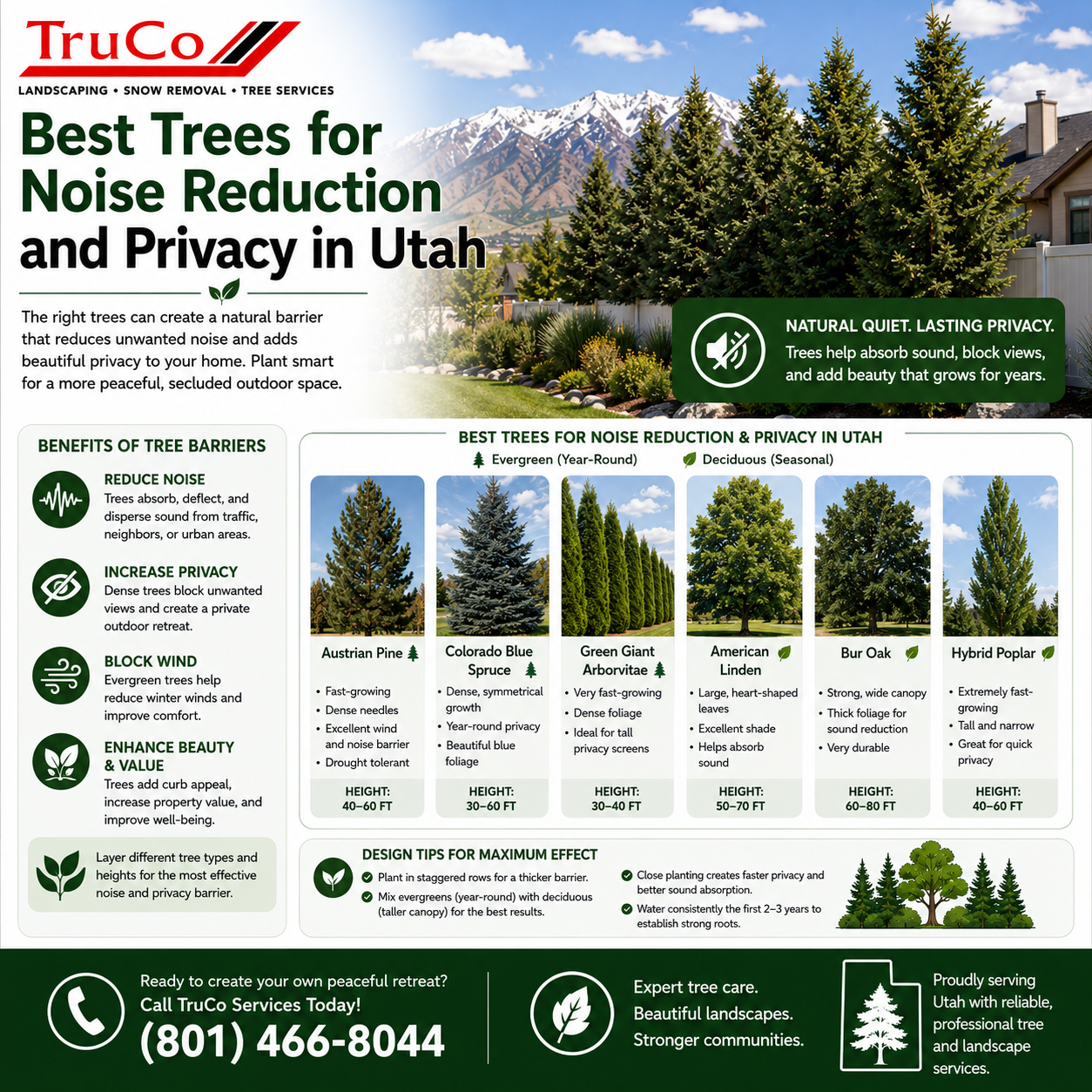
How Trees Reduce Noise and Provide Privacy in Utah
In Utah's growing communities — from the expanding suburbs of Salt Lake Valley to the developing neighborhoods of Utah County and the Wasatch Back — noise and privacy are increasing concerns. Traffic noise from I-15, I-80, and other major highways, sounds from neighboring properties, and the general hum of urban life can diminish the enjoyment of your outdoor spaces. Trees offer a natural, beautiful solution. Strategically planted trees can reduce noise by 5-10 decibels — enough to make a noticeable difference in perceived loudness. Dense evergreen plantings create year-round privacy screens that block views from neighbors and passersby. Unlike fences or walls, trees also absorb sound rather than reflecting it, and they provide additional benefits: shade, wildlife habitat, improved air quality, and increased property value. In Utah's climate, selecting the right species for noise reduction and privacy is essential. Trees must tolerate alkaline soil, cold winters, hot summers, and periodic drought while providing effective screening. This guide covers the best tree species for noise reduction and privacy in Utah, plus how to design and plant them for maximum effectiveness.
How Trees Block Noise and Provide Privacy
Understanding how trees reduce noise helps you design effective plantings. Noise reduction from trees works through several mechanisms. Absorption — leaves, branches, and bark absorb sound energy, converting it to heat. Broad, rough, and hairy leaves absorb more sound than smooth, small leaves. Dense foliage absorbs more sound than open foliage. In Utah, evergreens provide excellent year-round noise absorption. Deflection — sound waves are deflected and scattered by tree trunks, branches, and foliage. A dense planting scatters sound in multiple directions, reducing the amount that reaches your property. Thick, layered plantings are more effective than thin, single-row plantings. Masking — the rustling of leaves in the wind creates natural white noise that masks unwanted sounds. Aspen, poplar, and cottonwood are particularly good at this in Utah, as their leaves flutter in even light breezes. Distance — the longer sound travels through vegetation, the more it is absorbed. A planting depth of 50-100 feet can reduce noise by 5-10 decibels. Even narrower plantings (15-25 feet deep) provide noticeable reduction. For privacy, the key factors are density and height. Evergreen trees that maintain foliage from ground level to their full height provide year-round privacy screening. Deciduous trees with dense branching also provide winter privacy when their leaves are gone, though less effectively. A well-designed privacy screen uses a mix of evergreen and deciduous trees, often combined with shrubs, to create a dense, multi-layered barrier that blocks views from all angles.
Best Evergreens for Noise Reduction and Privacy in Utah
Evergreen trees are the backbone of effective noise barriers and privacy screens in Utah because they provide year-round coverage. Colorado blue spruce (Picea pungens) — Utah's state tree with dense, stiff needles that absorb sound effectively. Grows 50-70 feet tall with a 15-25 foot spread. Maintains branches to the ground if given enough space. Excellent noise barrier. Tolerates alkaline soil and cold winters. Plant 12-15 feet apart for a solid screen. Concolor fir (Abies concolor) — soft blue-green needles with a dense, pyramidal form. Grows 50-70 feet tall. More tolerant of Utah's alkaline soil than other firs. Excellent privacy screen with branches to the ground. Tolerates drier conditions than most firs. Plant 12-15 feet apart. Ponderosa pine (Pinus ponderosa) — long needles and open, picturesque form. Grows 60-100 feet tall. While less dense than spruce, it provides good noise reduction when planted in groups. Very drought-tolerant once established. Excellent for larger properties in Utah. Plant 15-20 feet apart. Rocky Mountain juniper (Juniperus scopulorum) — dense, blue-green foliage that provides excellent year-round screening. Grows 20-30 feet tall with a pyramidal form. Extremely drought-tolerant and adaptable to Utah's alkaline soil. Excellent for smaller properties. Plant 6-10 feet apart for a solid screen. Eastern redcedar (Juniperus virginiana) — dense, dark green foliage that provides excellent privacy. Grows 30-50 feet tall. Very adaptable to Utah conditions, including alkaline soil and drought. Faster-growing than Rocky Mountain juniper. Plant 8-12 feet apart. Arborvitae (Thuja species) — dense, soft-textured foliage. Grows 15-30 feet tall depending on variety. Excellent for formal privacy screens. In Utah, choose varieties that tolerate alkaline conditions (like 'Green Giant' or 'Techny'). Plant 5-8 feet apart. May need protection from drying winter winds in exposed Utah locations.
Best Deciduous Trees for Noise Reduction and Privacy
Deciduous trees provide seasonal privacy and noise reduction, and their winter branch structure still offers some screening. They can be combined with evergreens for year-round effectiveness. Hybrid poplar (Populus deltoides hybrids) — very fast-growing with dense foliage that provides quick privacy. Grows 40-60 feet tall. In Utah, poplars are effective within 3-5 years of planting. Leaves flutter in wind, creating masking noise. Short-lived (20-30 years) and may have aggressive roots. Plant 10-15 feet apart. Use male hybrids to avoid cottony seeds. Quaking aspen (Populus tremuloides) — leaves flutter in the slightest breeze, creating pleasant masking noise. Grows 40-60 feet tall. Utah native. Spreads through root suckers to create dense groves. Best at higher elevations or in protected, moist locations in Utah valleys. Plant 8-12 feet apart. Serviceberry (Amelanchier alnifolia) — multi-stemmed Utah native with white spring flowers, edible berries, and brilliant fall color. Grows 15-25 feet tall. Dense branching provides winter privacy. Excellent for naturalistic screens. Plant 6-10 feet apart. Red twig dogwood (Cornus sericea) — multi-stemmed shrub/small tree with dense growth. Grows 6-10 feet tall. Bright red winter stems add seasonal interest. Utah native. Excellent lower-level screen under taller trees. Plant 4-6 feet apart. Maple (Acer species) — Freeman maple, bigtooth maple, and other Utah-adapted maples provide dense summer foliage and branching that offers winter privacy. Grows 30-60 feet tall. Excellent fall color. Plant 15-20 feet apart for a screen. Oak (Quercus species) — bur oak, Gambel oak, and other Utah-adapted oaks provide dense foliage and strong winter structure. Grows 40-80 feet tall. Long-lived and durable. Excellent for large-scale privacy screens. Plant 15-25 feet apart.
Designing a Noise Reduction and Privacy Screen
Proper design is critical for effective noise reduction and privacy. Width matters — a wider planting is more effective. For noise reduction, aim for a planting depth of at least 20-30 feet if space allows. Even narrow plantings (10-15 feet deep) provide noticeable improvement. Use multiple rows — stagger trees in 2-3 rows for maximum density. Plant rows 8-15 feet apart with staggered spacing. This creates a dense, multi-layered barrier. Layer heights — plant a mix of tall, medium, and low-growing species to create a screen that blocks views from ground level to the tree canopy. Combine evergreens with deciduous trees and shrubs for dense coverage from all angles. Plant close together — for privacy screening, plant trees closer than recommended for landscape specimens. Evergreens: 6-12 feet apart depending on species. Deciduous trees: 8-15 feet apart. Closer spacing creates faster coverage but may require thinning later. Extend the screen — a screen that wraps around the sides of your property is more effective than one that only blocks the direct view. Noise bends around the edges of screens, so side extensions help contain sound. Include an evergreen component — evergreens are essential for year-round privacy. Aim for at least 50% evergreens in your screen. In Utah, spruce, fir, and juniper provide excellent evergreen screening. Consider future growth — allow adequate space for the screen to reach its mature size without overcrowding. Overcrowded screens compete for resources and may decline prematurely. In Utah, proper spacing at planting prevents future problems. Plant for your specific Utah location — choose species adapted to your elevation, exposure, and soil conditions. A screen that thrives in Salt Lake City may struggle in Park City and vice versa.
Maintaining Your Noise Reduction and Privacy Screen
Ongoing maintenance keeps your screen effective. Water regularly during establishment — new plantings need consistent water for the first 2-3 years. In Utah, this means deep watering every 1-2 weeks during the growing season. Drip irrigation is efficient for screen plantings. Mulch the entire screen area with 2-4 inches of organic mulch. This conserves moisture, suppresses weeds, and creates uniform growing conditions. In Utah's dry climate, mulching is essential for screen success. Prune to maintain density — prune young trees to encourage dense, low-branching growth. Remove only dead or damaged branches. Avoid heavy pruning that opens gaps in the screen. For evergreens, prune in late winter before spring growth. In Utah, screen plantings should be inspected annually for gaps or damage. Fill any gaps by planting additional trees or allowing lower branches to fill in. If a tree dies, replace it immediately to maintain screen continuity. Thin as needed — as the screen matures, some thinning may be necessary to prevent overcrowding. Remove weaker trees to give stronger ones room to develop. In Utah, thinning is typically needed 10-15 years after planting. Monitor for pests and diseases — screen plantings can develop pest problems due to close spacing. In Utah, common screen issues include spider mites on evergreens, aphids on deciduous trees, and foliar diseases. Inspect regularly and treat promptly.
Frequently Asked Questions
How much noise can trees actually block in Utah? A well-designed tree screen can reduce noise by 5-10 decibels, which makes a noticeable difference. A 10-decibel reduction is perceived as cutting the loudness in half. For maximum effectiveness, use dense evergreens in multiple rows with a total depth of 30-50 feet.
What is the fastest-growing tree for privacy in Utah? Hybrid poplar is the fastest, growing 4-6 feet per year and providing significant screening within 3-5 years. However, they are short-lived (20-30 years) and have aggressive roots. For a more permanent screen, consider Colorado blue spruce or Concolor fir, which grow more slowly but live much longer.
How close to my property line can I plant a privacy screen in Utah? Check local ordinances, but a general guideline is to plant at least 5-10 feet from property lines for small trees and 15-20 feet for large trees. This prevents future conflicts with neighbors and ensures your trees don't encroach on adjacent properties. Communicate with neighbors before planting boundary screens.
Do I need a permit for a privacy screen in Utah? In most Utah municipalities, planting trees does not require a permit. However, HOAs may have specific rules about tree placement, species, and screen height. Check your HOA covenants before planting. Some cities also have restrictions on trees near street corners or utility lines.
Can I mix different tree species in my privacy screen? Yes, mixing species is recommended. A diverse screen is more resilient to pests and diseases than a single-species screen. Mix evergreens and deciduous trees, and include a variety of heights and textures. Avoid monocultures that can be devastated by a single pest or disease.