
How to Stage a Full Lawn Renovation in Utah

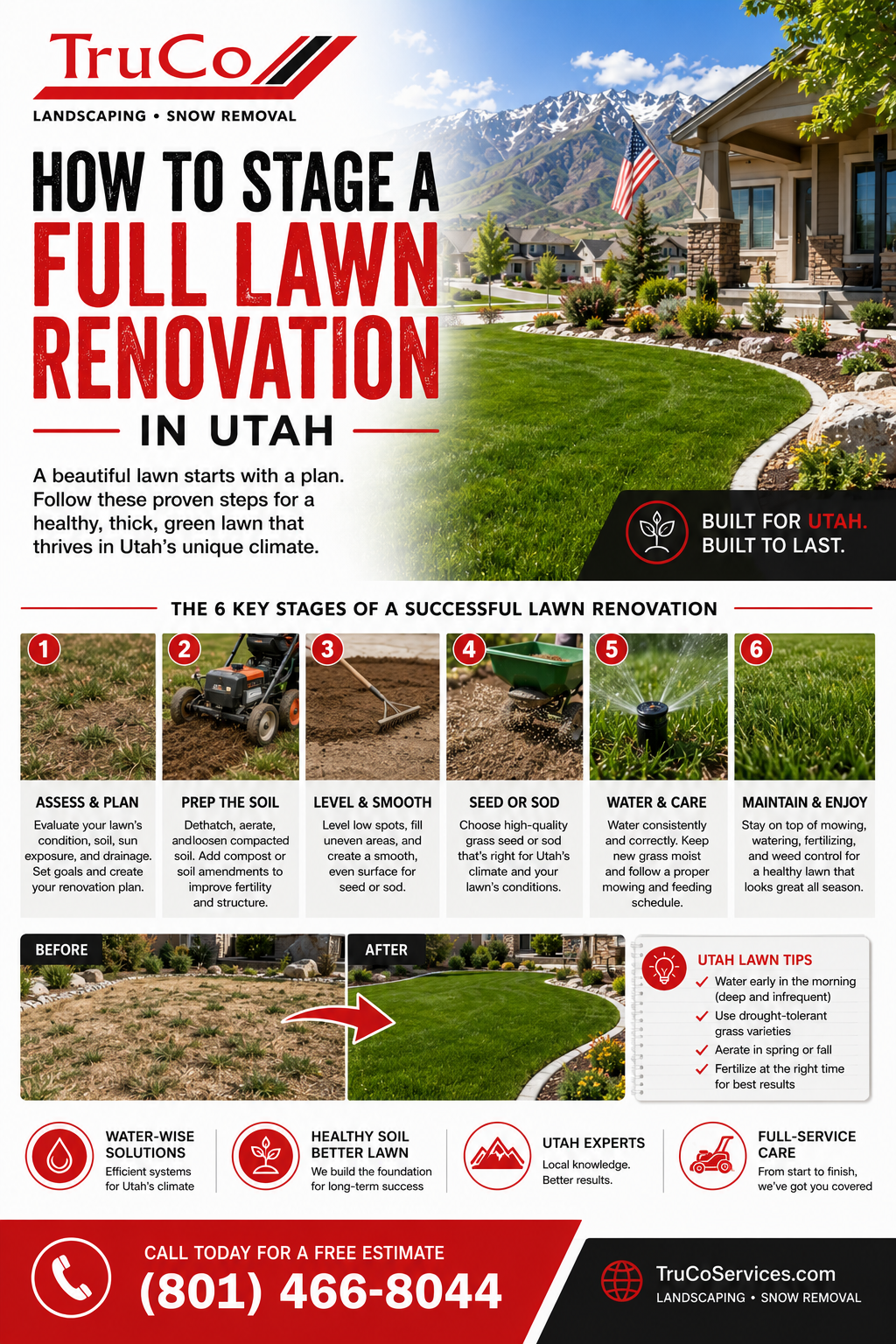
When to Fully Renovate Your Utah Lawn
Lawn renovation — completely reestablishing a lawn from scratch — is needed when a lawn is beyond repair through aeration, overseeding, or fertilizer treatments. Signs your Utah lawn needs renovation: more than 50% weed coverage, severe thatch over 1 inch thick, large bare patches from grub damage or dog urine, soil compaction that won't improve with aeration, poor grass varieties that don't match your site, or a lawn that's been neglected for years. In Utah, the best time for lawn renovation is late summer to early fall (August 15 to September 15). The soil is warm from summer heat, weed competition is decreasing, and the 6-8 weeks before first frost allow new grass to establish strong roots. Spring renovation (April-May) is possible but riskier — weed competition is intense, the growing window before summer heat is shorter, and young grass struggles in Utah's hot, dry summer. A full lawn renovation costs $0.15-0.35 per sq ft for DIY (seed and supplies) or $0.50-1.50 per sq ft for professional installation. A 5,000 sq ft lawn renovation: $750-1,750 DIY, $2,500-7,500 professional.
Step 1: Kill Existing Lawn and Weeds
Begin renovation 4-6 weeks before seeding. Spray the entire lawn with a non-selective herbicide containing glyphosate (Roundup) or use an organic alternative. In Utah, apply on a calm day with temperatures above 60 degrees — wind drifts herbicide onto desirable plants. Wait 2 weeks for complete kill, then re-spray any surviving patches. For organic renovation: solarization — cover the lawn with clear plastic for 4-6 weeks during hottest summer months (July-August in Utah). The solar heat builds up under plastic, killing grass, weeds, and seeds. Soil temperatures must reach 120 degrees at 2 inches deep. This works well in St. George and southern Utah but is less effective in northern Utah's milder summers. Sheet mulching (lasagna gardening): cover lawn with cardboard, wet thoroughly, add 4-6 inches of compost or soil on top. Wait 3-4 months for the cardboard to kill the grass underneath. This method works well for small lawns but requires patience. After killing the existing lawn, rent a sod cutter ($50-80/day) to remove dead grass and thatch. Alternatively, till the dead vegetation into the soil with a rototiller — but this brings weed seeds to the surface.
Step 2: Soil Testing and Amendment in Utah
Take a soil test before renovation — it's the most important step for Utah lawns. Utah soils are typically alkaline (pH 7.0-8.0), low in organic matter (1-2%), and variable in nutrients. Soil test kits are available through the Utah State University Extension ($15-25) or commercial labs. Key tests: pH, organic matter, nitrogen, phosphorus, potassium, and texture. For Utah's alkaline clay soils: add 1-2 inches of organic compost and till to 4-6 inches deep — this improves drainage, adds nutrients, and lowers pH. For pH over 7.5: incorporate 1-2 pounds of elemental sulfur per 100 sq ft to lower pH. For low phosphorus: add bone meal or phosphorus fertilizer according to test recommendations. After amending, rototill the soil to 4-6 inches depth. Remove rocks and debris. Grade the soil to slope away from buildings (1/4 inch per foot minimum). Fill low spots — they hold water and create disease-prone areas. Level high spots — they dry out faster. In Utah, proper grading is essential because clay soils drain slowly; any depressions stay wet for days after irrigation. Water the prepared area and let it settle for 1 week. Remove any new weeds that germinate.
Step 3: Choose the Right Grass for Utah
Utah's climate requires specific grass varieties. Kentucky bluegrass is the most common Utah lawn grass — excellent color, self-repairing (rhizomes), needs full sun, moderate water. Best varieties for Utah: 'Midnight', 'Baron', 'Touchdown'. Use in sunny areas with regular irrigation. Tall fescue is increasingly popular for Utah — deeper roots (2-3 ft), better drought tolerance, good shade tolerance. Turf-type tall fescue (TTTF) varieties like 'Rebel', 'Falcon IV', 'Titanium' are excellent for Utah's climate. Fine fescue (creeping red, Chewings, hard fescue) for shady areas — extremely drought-tolerant once established, fine texture. For low-water areas, use fine fescue or sheep fescue blends. For high-use areas (kids, pets), use Kentucky bluegrass-tall fescue blend — 50-70% KBG, 30-50% TTTF. For lawns in St. George and southern Utah (zone 8), consider Bermuda grass for summer lawns — green in summer, dormant (brown) in winter. Overseed with annual ryegrass in fall for winter color. Seed quality matters in Utah — buy certified seed from reputable suppliers (IFA, Millcreek Gardens, Western Garden Centers). Avoid bargain seed mixes with annual ryegrass or coarse grasses.
Step 4: Seeding and Establishment
Seed at the recommended rate: Kentucky bluegrass 2-3 lbs per 1,000 sq ft, tall fescue 6-8 lbs per 1,000 sq ft, fine fescue 4-5 lbs per 1,000 sq ft. For a KBG-TTTF blend: 4-6 lbs per 1,000 sq ft. Use a broadcast spreader for even coverage — seed half in one direction, half perpendicular. Rake lightly to cover seeds with 1/8 to 1/4 inch of soil — deeper burial prevents germination. For large areas, rent a slit seeder ($60-100/day) that cuts grooves and drops seed in one pass. After seeding, roll the area lightly with a lawn roller (half-filled with water) for seed-to-soil contact. Water is critical in Utah's dry climate. For the first 2 weeks, water 2-3 times daily for 5-10 minutes — keep the soil surface constantly moist. After germination, reduce to once daily for 15-20 minutes. After 4 weeks, water every 2-3 days for 30-40 minutes. In Utah's dry fall air, this means watering daily into October. Protect seeded areas from birds with light netting or reflective tape. Keep foot traffic off for at least 4 weeks. In Utah, watch for late summer heat waves — increase watering frequency if temperatures exceed 90 degrees. First mowing: when grass reaches 3-4 inches tall, mow to 2.5-3 inches.
Step 5: Post-Renovation Care
First 4 weeks are critical for Utah lawn establishment. Apply starter fertilizer (high phosphorus, like 10-20-10) at seeding time — this encourages root development. Apply a second starter fertilizer 4 weeks after germination. Water consistently — missed watering for even 1 day can kill young grass in Utah's dry climate. Mow at the correct height — keep Kentucky bluegrass at 3 inches, tall fescue at 2.5-3 inches. Never remove more than 1/3 of blade height. The first winter is the most vulnerable. In Utah, apply winter fertilizer (high potassium) in late October to strengthen roots for winter dormancy. Water deeply before ground freezes (usually November). During the first winter, walk on the new lawn as little as possible — frozen grass crowns are easily damaged. In spring (March-April), apply pre-emergent herbicide to prevent crabgrass and annual weeds. Do not use pre-emergent at seeding time — it prevents grass seed from germinating. Resume regular watering in April as temperatures rise. The renovated lawn should be fully established after one full growing season.
Frequently Asked Questions
How much does a full lawn renovation cost in Utah? DIY: $0.15-0.35 per sq ft for seed, soil amendments, and supplies. Professional: $0.50-1.50 per sq ft including grading, seeding, and starter care. A typical 5,000 sq ft lawn: $750-7,500 depending on approach.
Can I renovate my lawn in spring in Utah? Spring renovation (April-May) is possible but riskier than fall. Weeds are aggressive, summer heat stresses new grass, and the establishment window is shorter. Fall (August-September) is strongly preferred.
How long does a renovated lawn take to establish in Utah? Grass germinates in 10-14 days for Kentucky bluegrass, 7-10 days for tall fescue. Light use is possible after 4-5 weeks. Full establishment takes one growing season (6-8 months). Heavy traffic should wait until the following spring.
What is the best grass for a Utah lawn renovation? A blend of Kentucky bluegrass (50-70%) and turf-type tall fescue (30-50%) works best for most Utah lawns. For full sun with regular irrigation, use mostly KBG. For partial shade or lower water, increase the fescue percentage.