
How to Stake a Newly Planted Tree in Utah

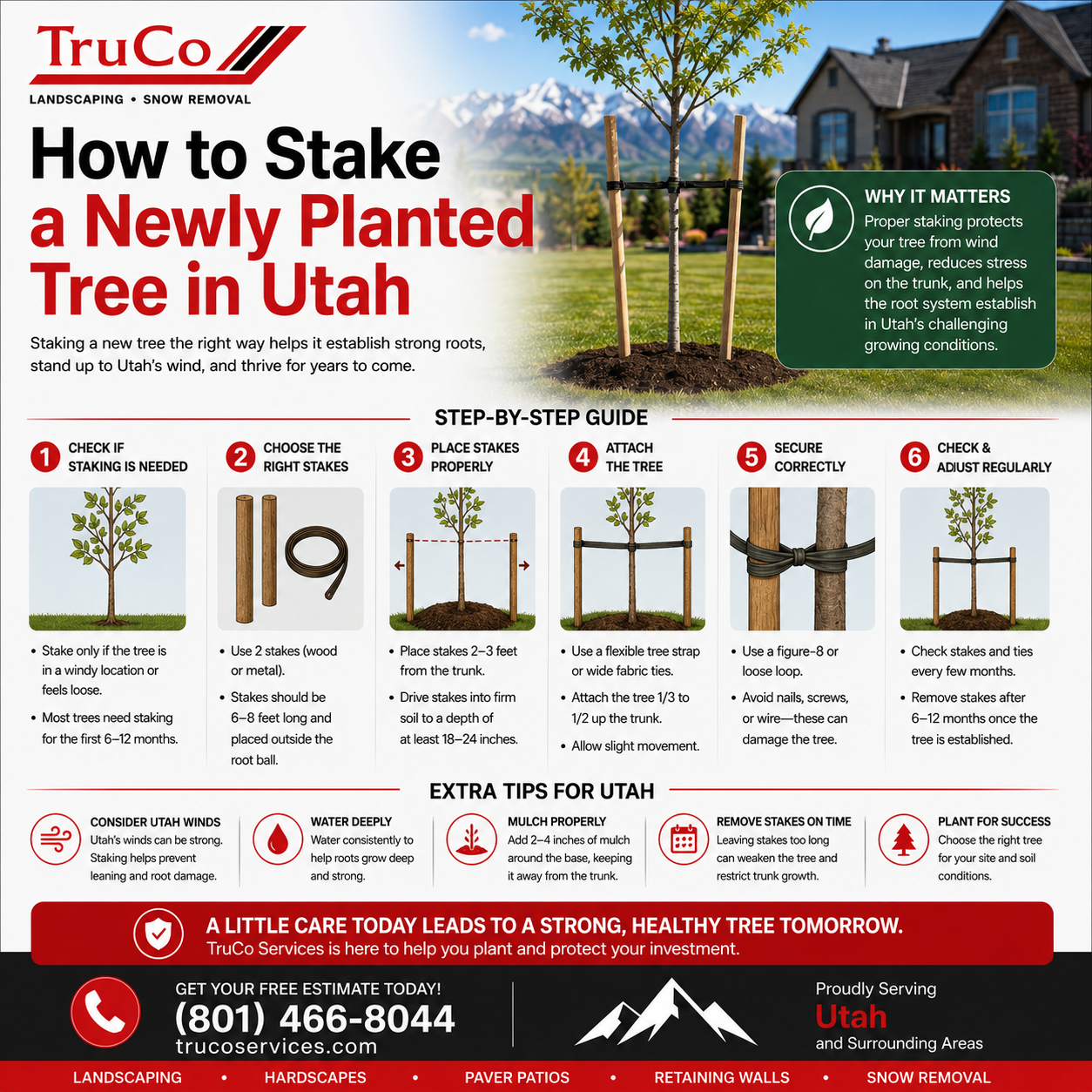
Do You Really Need to Stake Your Tree?
Most newly planted trees in Utah do NOT need staking. Trees that are allowed to sway naturally develop stronger trunks and root systems. Staking should be the exception, not the rule. USU Extension recommends staking only when there is a specific risk that outweighs the benefits of natural movement.
When Staking Is Necessary
Stake trees in these situations: bare-root trees (no root ball to anchor them), trees in high-wind areas (Wasatch Front canyon winds, open fields), trees on steep slopes, top-heavy trees with large canopies, trees with damaged root balls, and trees planted in sandy or loose soil. If the tree cannot stand upright without support, it needs staking.
When Staking Harms Trees
Staking that is too tight, too high, or left on too long causes multiple problems: trunk weakness (trunks need movement to develop structural strength), trunk girdling (ties cut into bark), root restriction (movement signals roots to grow), and dependency. Trees staked for more than one growing season are at higher risk of failure after stakes are removed.
Proper Staking Materials
Use 2 wooden stakes (6-8 feet tall, 2x2 inch) or metal T-posts for larger trees. Use wide, flexible tree ties (1-2 inch wide nylon or rubber strapping). Never use wire, rope, or garden hose — these materials cut into bark. Use a buffer material between the tie and trunk. Replace ties annually if left on longer than one season.
How to Stake: Step-by-Step
Step 1: Place two stakes on opposite sides of the root ball, outside the planting hole. Step 2: Drive stakes 18-24 inches into undisturbed soil, angled slightly away from the tree. Step 3: Attach ties at the lowest point on the trunk where the tree remains upright — typically at 1/3 to 1/2 of tree height. Step 4: Leave slack in the ties so the tree can sway 2-4 inches in each direction. Step 5: Remove stakes after one growing season (October-November in Utah).
Staking in Utah's Wind
Utah's Wasatch Front experiences gusty winds, especially in spring and fall. In high-wind areas, use three stakes spaced evenly around the tree instead of two. Orient stakes perpendicular to the prevailing wind direction. Check ties monthly during wind season to ensure they haven't loosened or tightened. In Utah's canyon areas (Parley's Canyon, Emigration Canyon, Provo Canyon), staking is often necessary for the first two years.
Frequently Asked Questions
How long should I leave stakes on a tree in Utah? Remove after one growing season (6-8 months). Leaving stakes longer weakens the trunk. Can I use a single stake? Two stakes are better — they provide more stability and prevent the tree from rubbing against the stake. How tight should staking ties be? Loose enough for 2-4 inches of sway. The tree needs to move to develop strength. Do I need to stake a balled-and-burlapped tree? Usually not — the root ball provides stability. Stake only in high-wind areas. What is the best time to stake a tree in Utah? At planting time. Remove stakes in late fall before winter winds begin. Can staking kill a tree? Yes — girdling ties that cut into bark can kill a tree by disrupting nutrient and water flow.