
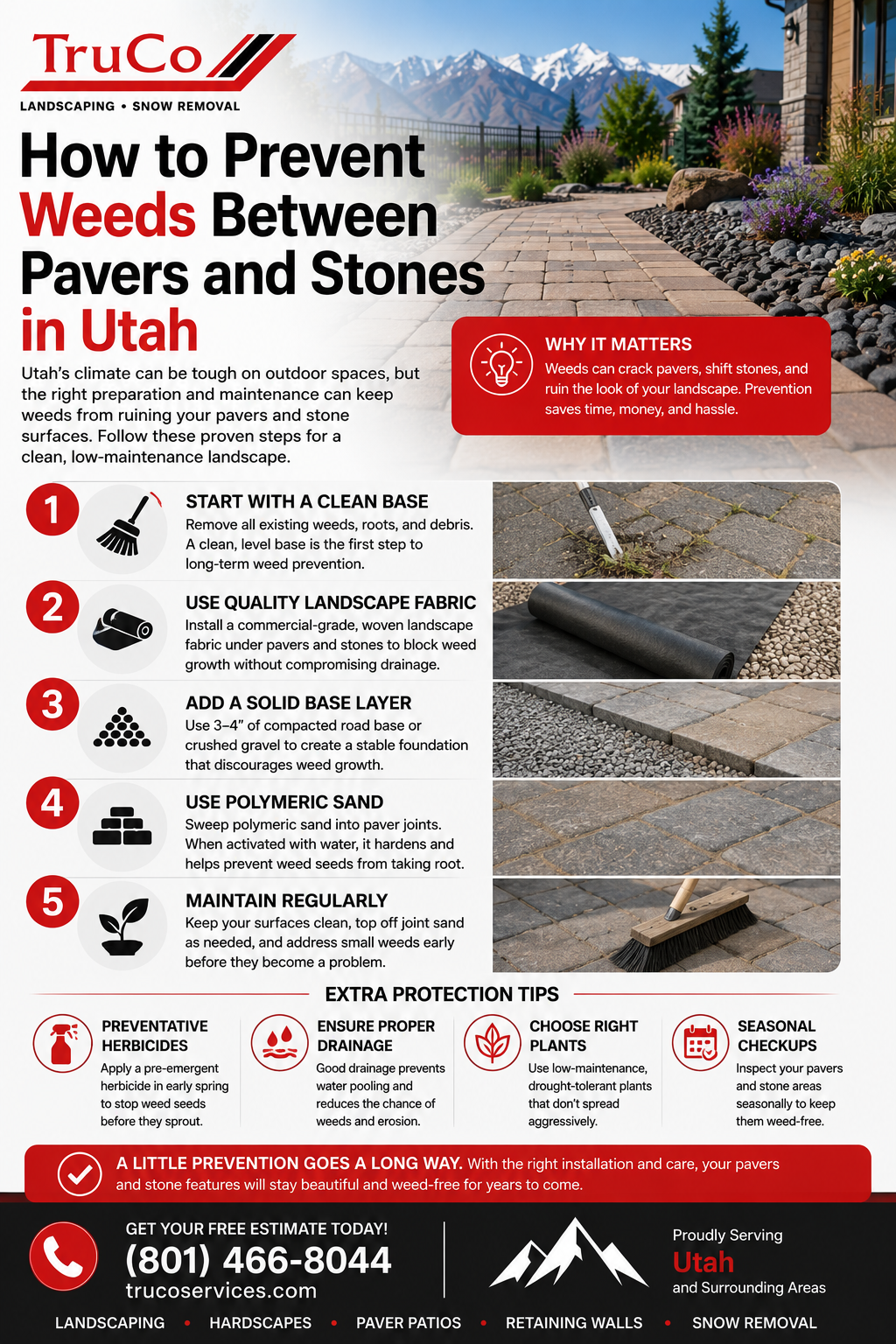
How to Prevent Weeds Between Pavers and Stones in Utah

Why Weeds Grow Between Pavers in Utah
Utah's freeze-thaw cycles crack paver joints, creating gaps where weed seeds settle. Clay soil beneath pavers stays moist longer, providing ideal germination conditions. Common Utah weed species like prostrate spurge, dandelion, crabgrass, and annual bluegrass thrive in these narrow cracks. Windblown seeds, birds, and foot traffic all introduce weed seeds to paver joints.
The Best Way to Prevent Weeds: Polymeric Sand
Polymeric sand is the gold standard for weed prevention between pavers in Utah. It contains fine sand mixed with polymers that activate when wet, creating a semi-rigid barrier that blocks weed growth. Standard polymeric sand works for joints 1/4 to 2 inches wide. Wide-joint polymeric sand is available for flagstone or irregular stone with gaps up to 4 inches. Polymeric sand lasts 5-10 years in Utah's climate when properly applied.
How to Apply Polymeric Sand Correctly
Step 1: Ensure the paver surface is clean and COMPLETELY dry — Utah's low humidity helps with this. Step 2: Pour sand onto the surface and sweep it into joints using a push broom, working in multiple directions. Step 3: Compact the sand using a plate compactor with a rubber pad for the joints. Step 4: Sweep off all excess sand — any left on the paver surface will harden and stain. Step 5: Activate with a fine mist water spray — not a heavy stream. Apply 2-3 light passes 30 minutes apart. Step 6: Allow 24-48 hours to fully cure. Avoid foot or vehicle traffic during curing.
Base Preparation: The Most Important Step
Proper base preparation prevents weeds by creating a stable, weed-free foundation. Excavate 6-8 inches for walkways, 8-12 inches for driveways. Install geotextile landscape fabric over the native soil to block weed growth from below. Add 4-8 inches of compacted gravel base (3/4 inch minus gravel). Install edge restraints to prevent joint widening. Properly compact the base in 4-inch lifts.
Paver Sealants for Weed Prevention
Paver sealants provide an additional layer of weed protection by sealing the surface and joints. Wet-look sealants enhance paver color and resist UV degradation. Natural-look sealants protect without changing appearance. In Utah's high UV environment (sunny 222 days per year), sealants with UV inhibitors last longer. Reapply sealant every 2-4 years depending on sun exposure and foot traffic.
Natural Weed Control for Paver Joints
Boiling water kills weeds instantly without chemicals but doesn't prevent regrowth. Horticultural vinegar (20% acetic acid) is more effective than household vinegar for Utah's tough weeds. Corn gluten meal prevents weed seed germination as a pre-emergent. Hand pulling is easiest after rain when soil is moist. Diatomaceous earth creates a barrier that dehydrates weed seedlings.
Annual Maintenance for Weed-Free Pavers
Spring (March-April): Inspect joints for winter damage from freeze-thaw, reapply polymeric sand to gaps, apply pre-emergent weed preventer. Summer (June-August): Pull weeds promptly after rain, spot-treat with vinegar or boiling water. Fall (September-October): Clean and sweep joints, apply polymeric sand if needed, consider sealant application. Winter (November-February): Avoid de-icing salts that damage pavers — use sand for traction instead.
Frequently Asked Questions
Does polymeric sand really stop weeds? Yes, when properly applied. It hardens into a semi-rigid barrier that physically blocks weed growth. Over time, UV exposure and freeze-thaw cycles may cause it to break down, requiring reapplication every 5-10 years.
Can I just use regular sand between pavers? Regular sand washes out and provides no weed barrier. Polymeric sand is essential for weed prevention in Utah's climate.
How long does polymeric sand last in Utah? 5-10 years with proper installation. Utah's freeze-thaw cycles are the main cause of failure. Applying a paver sealant over the polymeric sand extends its life.
What is the best weed killer for pavers in Utah? For existing weeds, glyphosate-based products work well but should be used carefully to avoid staining pavers. For prevention, pre-emergents like prodiamine or dithiopyr are effective. For organic control, horticultural vinegar (20% acetic acid) or boiling water works.
Do I need to seal my pavers in Utah? Sealing is recommended but not required. It prevents weed seeds from settling, protects against freeze-thaw damage, and enhances paver color. Reapply every 2-4 years.
Can I use salt to kill weeds between pavers? Salt kills weeds but damages pavers and contaminates soil. Avoid using salt near pavers in Utah.
How often should I clean paver joints in Utah? Inspect joints annually in spring. Replenish polymeric sand as needed. Properly maintained joints stop weeds before they start.