
What Is the Best Fertilizer Schedule for Utah Lawns?

Why a Fertilizer Schedule Matters for Utah Lawns
Utah's climate presents unique challenges for lawn care: hot dry summers, cold winters, alkaline soil, and semi-arid conditions. Utah lawns are dominated by cool-season grasses — Kentucky bluegrass, tall fescue, and perennial ryegrass — which rely on consistent nutrient supply to maintain healthy growth. Utah State University Extension emphasizes that fertilization timing matters as much as the product itself.
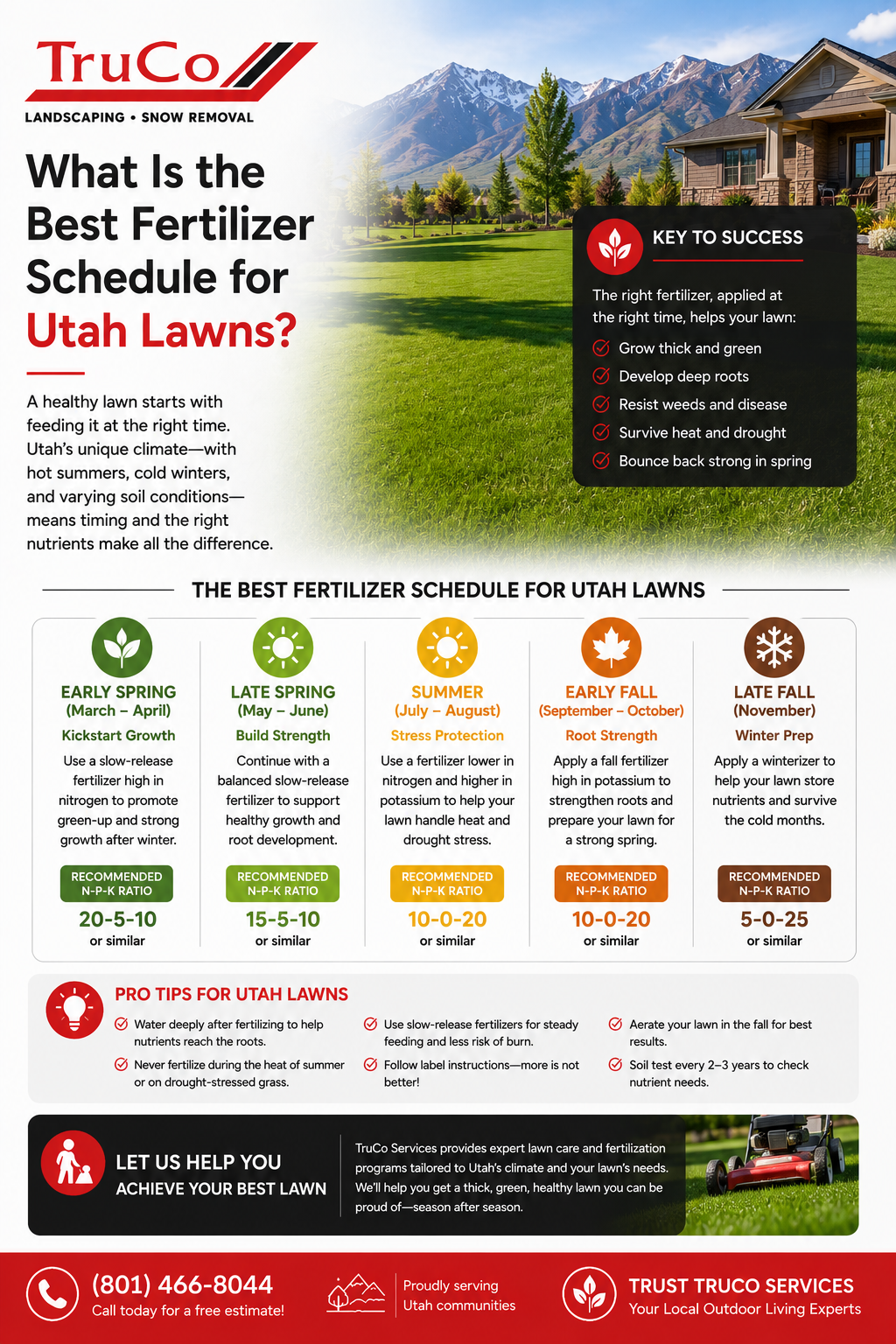
The 4-Fertilizer-Per-Year Schedule for Utah
Application 1 — April (Early Spring): Apply a balanced fertilizer with N-P-K ratio around 20-5-10 or 18-6-12, with slow-release nitrogen. Apply when grass is actively growing and soil temperature reaches 50-55°F at 4 inches.
Application 2 — June (Late Spring/Early Summer): Apply a summer blend with higher potassium for heat stress tolerance, N-P-K ratio around 15-0-15 or 20-0-20. Use slow-release nitrogen at a lower rate to avoid excessive growth during hot weather. Apply before temperatures consistently exceed 85°F.
Application 3 — September (Early Fall): This is the most important application of the year. Use a high-nitrogen blend, N-P-K ratio around 30-0-10 or 28-3-10. Cool nights and warm soil create ideal conditions for nutrient uptake. Apply around Labor Day for maximum benefit.
Application 4 — November (Late Fall/Winterizer): Apply a winterizer fertilizer with ratio around 32-0-10 or 28-0-14, with high slow-release nitrogen and potassium. Apply after the grass stops growing but before the ground freezes — typically mid to late November along the Wasatch Front.
Best N-P-K Ratios for Utah Lawns
Utah's alkaline soil (pH 7.5-8.5) locks up phosphorus and iron, making them unavailable to grass. The best ratios for Utah: Spring (20-5-10 or 18-6-12), Summer (15-0-20), Fall (30-0-10), Winterizer (32-0-10). Phosphorus should be minimal in most Utah lawns unless a soil test shows deficiency — Utah's natural soils are already phosphorus-rich, and excess contributes to water pollution.
Organic vs Synthetic Fertilizers
Organic fertilizers (like Milorganite or compost-based products) release nutrients slowly and improve soil structure. In Utah's short growing season, organics may not release fast enough for cool-season grass in spring. Synthetic fertilizers provide immediate, predictable results. Many Utah lawn care professionals recommend a hybrid approach: synthetic in spring and fall for quick greening, organic supplements in summer for gentle feeding.
When NOT to Fertilize in Utah
Do not fertilize during drought stress (July-August heat waves), before a heavy rain (waste and runoff), during lawn dormancy (brown grass), or on frozen ground. Avoid fertilizing between June 15 and August 15 unless using a summer-specific low-nitrogen blend.
Signs Your Lawn Needs a Different Schedule
Yellow or pale green grass (nitrogen deficiency), purple tint (phosphorus deficiency), slow green-up in spring, thin or patchy turf, excessive thatch, and weed invasion are all signs your fertilizer schedule needs adjustment. A soil test through USU Extension is the most reliable way to diagnose problems.
Frequently Asked Questions
How often should I fertilize my lawn in Utah? Four times per year: April, June, September, and November. This schedule matches Utah's cool-season grass growth patterns.
What N-P-K ratio is best for Utah lawns? Spring: 20-5-10. Summer: 15-0-20. Fall: 30-0-10. Winterizer: 32-0-10. Minimize phosphorus unless a soil test shows deficiency.
Can I over-fertilize my Utah lawn? Yes. Excess nitrogen causes rapid growth, increased mowing, disease susceptibility, and environmental damage. Follow label rates — more is not better.
Should I use slow-release or quick-release fertilizer? Slow-release is preferred for spring and summer applications. Quick-release can be used for fall applications when you want rapid green-up before winter.
How do I get a soil test in Utah? USU Extension offers soil testing through their Analytical Laboratories (USUAL) for about $20-40. Contact your county extension office for sampling instructions.
Is liquid or granular fertilizer better for Utah lawns? Granular is preferred for most Utah homeowners because it's easier to apply evenly, provides longer-lasting results, and is less likely to volatilize in Utah's dry air.
Can I fertilize my lawn during water restrictions? Yes, but choose slow-release nitrogen and apply only when the lawn is dry. Water restrictions typically limit irrigation, not fertilization. However, fertilizer needs water to activate — apply just before your designated watering day.
Do I need to fertilize if I have a fescue lawn instead of Kentucky bluegrass? Yes. Fescue has similar nutrient needs but benefits from slightly higher potassium for heat tolerance. The same four-application schedule works.