
How to Select Trees for Utah's Wet and Poorly Drained Areas

The Challenge of Wet Areas in Utah Landscapes
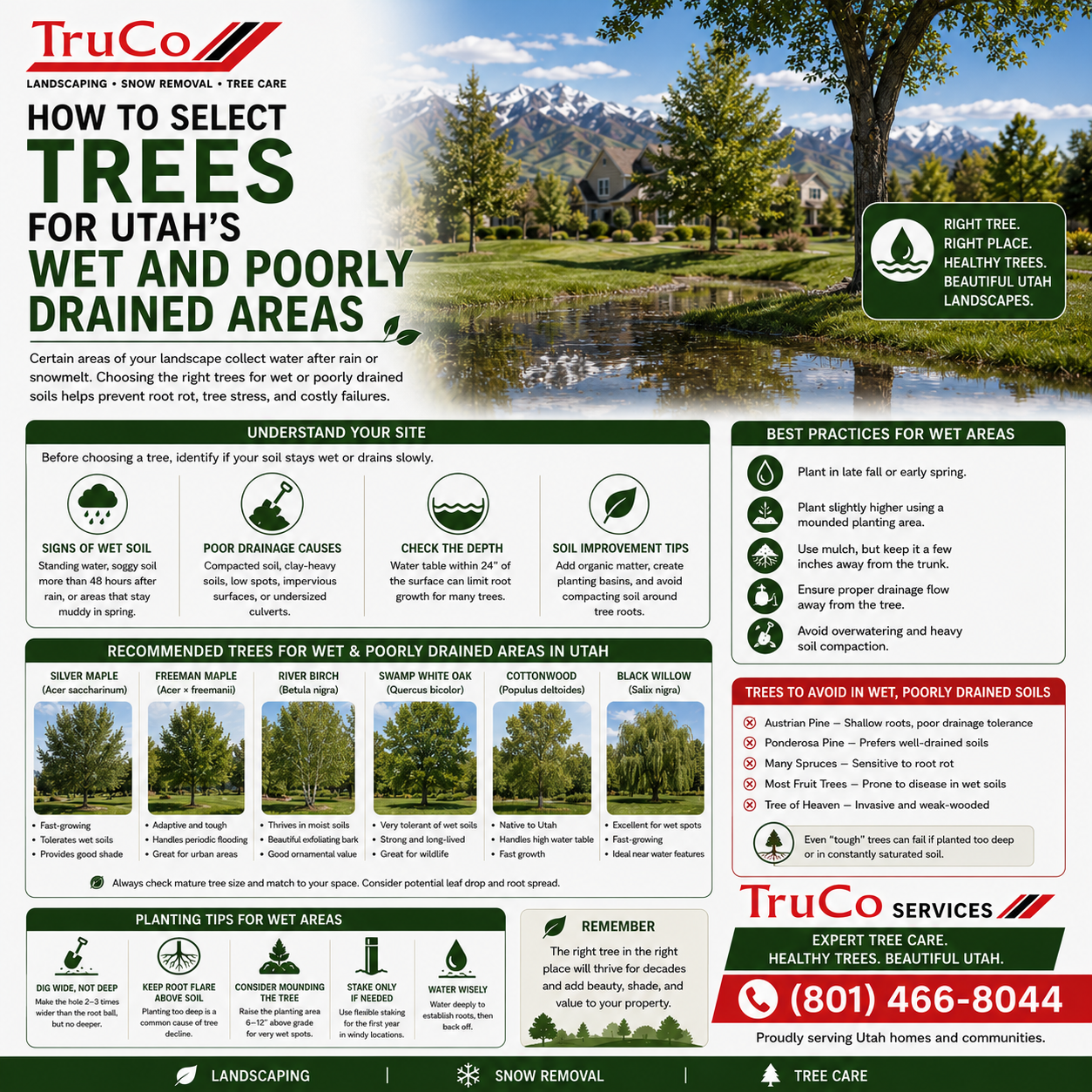
While Utah is known primarily as a dry state, many properties have areas with poor drainage — spots where water collects after rain or snowmelt, or where clay soil creates consistently wet conditions. These areas occur near the base of slopes, in low-lying areas, along drainage swales, near irrigation ditches, and in neighborhoods with high clay content soil. Planting trees in these wet areas presents unique challenges. Most trees require well-drained soil and will develop root rot if their roots sit in water for extended periods. However, some tree species are adapted to wet conditions and thrive where others would die. Selecting the right tree for a wet area can transform a problem spot into a landscape asset. In Utah, wet areas are common in many settings: the bench areas where water collects at the base of the Wasatch foothills, neighborhoods with heavy clay soil that holds water, near streams and irrigation canals, in areas with high water tables (common in some Utah valleys), and in spots where downspouts drain or where landscape grading creates low areas. This guide covers tree species that tolerate wet soil and poor drainage in Utah, plus planting techniques for success in challenging conditions.
Understanding Soil Drainage and Tree Selection
Different trees have different tolerances for wet soil. Understanding your soil's drainage helps you choose the right tree. Soil drainage classes: well-drained soil never stays wet for more than 24 hours after rain; moderately well-drained soil may stay wet for 2-3 days; poorly drained soil stays wet for 4-7 days or more. In Utah, clay soil often falls into the poorly drained category. Tree tolerance to wet soil is measured by how long roots can survive in saturated conditions. Intolerant trees (most species) — roots can't survive more than 2-3 days of saturated soil. These trees develop root rot and decline in wet areas. Avoid these for wet spots. Moderately tolerant trees — can survive 7-14 days of saturated soil, especially during dormancy. Good choices for areas that are wet only part of the year. Tolerant trees — can survive extended periods (weeks or months) of saturated soil. These are the best choices for consistently wet areas. Many are native to Utah's riparian areas and floodplains. Seasonal vs. permanent wetness — trees have different tolerances depending on whether the wetness is seasonal (spring snowmelt) or permanent (high water table). Many trees tolerate seasonal wetness but not permanent wet soil. In Utah, many wet areas are seasonal, drying out by mid-summer. Choose trees that match your specific wetness pattern. Soil type matters — clay soil holds water longer than sandy or loamy soil. The same tree species may perform differently in different soil types. In Utah, wet clay soil is more stressful to trees than wet sandy soil because clay holds less oxygen.
Best Trees for Wet Areas in Utah
The following trees are well-adapted to wet or poorly drained conditions in Utah. Willows (Salix species) — the most water-tolerant trees for Utah. Willows thrive in wet soil, along streambanks, and in areas that flood periodically. They can survive with their roots in water for extended periods. Various species available, from small shrubs to large trees. In Utah, native coyote willow and Pacific willow are excellent choices. Grow fast but are relatively short-lived. Excellent for erosion control in wet areas. Cottonwood (Populus species) — native to Utah's riparian areas. Tolerates wet soil and flooding. Grow 60-100 feet tall. Fast-growing but relatively short-lived (50-80 years). In Utah, narrowleaf cottonwood and Fremont cottonwood are native species. Provide excellent shade and wildlife habitat. Note: cottonwoods have aggressive roots that seek water; plant away from structures and sewer lines. Box elder (Acer negundo) — Utah native that tolerates wet soil and periodic flooding. Grows 40-60 feet tall. Fast-growing. Adaptable to various conditions. Provides dense shade. In Utah, box elder is common along streams and in low-lying areas. Tolerates Utah's alkaline soil well. Note: can be invasive in some areas. Red twig dogwood (Cornus sericea) — Utah native shrub/small tree that thrives in wet soil. Grows 6-10 feet tall. Bright red winter stems provide seasonal interest. White spring flowers, white berries in summer. Excellent for wet areas where a smaller tree or large shrub is needed. In Utah, common along streams and in moist areas. Water birch (Betula occidentalis) — Utah native that prefers wet soil. Grows 20-40 feet tall, often multi-stemmed. Tolerates periodic flooding. Attractive reddish-brown bark. Good for streambanks and wet areas. In Utah, found along mountain streams and in moist valleys. River birch (Betula nigra) — tolerates wet soil better than most birch species. Grows 40-70 feet tall. Attractive peeling bark in shades of salmon and cream. In Utah, needs regular watering and does best in consistently moist soil. More heat-tolerant than other birches. Freeman maple (Acer × freemanii) — tolerates wet soil better than red or silver maples. Grows 40-60 feet tall. Excellent fall color. In Utah, good choice for areas with periodic wetness. Cultivars like 'Autumn Blaze' and 'Sienna Glen' are recommended. Balm of Gilead (Populus balsamifera) — native to Utah's moist areas. Grows 50-80 feet tall. Tolerates wet soil and flooding. Fragrant buds in spring. Good for large wet areas. Fast-growing. Common in Utah's mountain valleys and riparian areas. Green ash (Fraxinus pennsylvanica) — tolerates wet soil and periodic flooding. Grows 50-60 feet tall. In Utah, has been widely planted but emerald ash borer is a significant threat. Not recommended for new plantings in areas where EAB is present. Consider alternatives.
Best Trees for Moderately Wet or Seasonally Wet Areas
If your wet area dries out by summer or is only wet periodically, more tree options are available. Serviceberry (Amelanchier species) — tolerates moderate moisture and periodic wetness. Grows 15-25 feet tall. White spring flowers, edible berries, and excellent fall color. Utah native species available. Good for areas that are wet in spring but dry in summer. Honeylocust (Gleditsia triacanthos) — tolerates a wide range of moisture conditions, including periodic wetness. Grows 40-60 feet tall. Fine-textured foliage provides light shade. Thornless and seedless varieties available. Adaptable to various soil types. Bur oak (Quercus macrocarpa) — one of the most adaptable oaks. Tolerates both wet and dry conditions. Grows 60-80 feet tall. Strong wood and deep root system. Excellent for areas with variable moisture. In Utah, bur oak is one of the most reliable trees. Kentucky coffeetree (Gymnocladus dioicus) — adaptable to various moisture conditions. Grows 50-70 feet tall. Tolerates both wet and dry soil. Tolerant of Utah's alkaline soil and urban conditions. Unique bold texture and late-emerging leaves. Linden (Tilia species) — littleleaf linden tolerates moderate moisture. Grows 50-70 feet tall. Fragrant summer flowers attract bees. Tolerates various soil types. Good for areas that are wet in spring but drier in summer. Tupelo (Nyssa sylvatica) — tolerates wet soil and periodic flooding. Grows 40-60 feet tall. Spectacular red fall color. In Utah, needs consistent moisture and acidic soil (may need soil amendments for Utah's alkaline conditions). Best in protected, moist sites.
Planting Techniques for Wet Areas
Proper planting technique is critical for success in wet areas. Plant on raised mounds — in consistently wet areas, plant trees on raised mounds (6-12 inches high and 3-4 feet wide) to elevate the root ball above the saturated zone. This is the single most effective technique for growing trees in wet soil. In Utah, mounding is recommended for all wet-area plantings. Improve drainage — install drainage tiles or French drains in very wet areas to carry excess water away from tree roots. This can make it possible to grow a wider range of tree species. In Utah, subsurface drainage is effective in clay soils. Plant at the right depth — in wet areas, plant with the root flare slightly above-grade (1-2 inches). Never plant too deep, as this increases the risk of root rot. In Utah's clay soil, slightly high planting is always better than too deep. Use coarse mulch — apply 2-3 inches of coarse wood chip mulch over the root zone (not touching the trunk). Coarse mulch improves air exchange at the soil surface and helps prevent root rot. Avoid fine mulch that holds moisture against the trunk. Choose the right season — plant in spring (March-April) in Utah to give trees the full growing season to establish before winter. Fall planting in wet areas is riskier because roots may sit in cold, wet soil through winter. Consider native wetland species — native Utah trees that evolved in wet conditions are the most reliable choices. Willows, cottonwoods, box elder, and red twig dogwood are proven performers. They are adapted to local soil conditions and require less maintenance. Monitor for root rot — watch for signs of root rot: yellowing leaves, wilting despite adequate moisture, slowed growth, and branch dieback. If you see these signs, improve drainage or replace with a more water-tolerant species.
Frequently Asked Questions
What tree species will survive in standing water in Utah? Very few trees tolerate standing water for extended periods. Willows and cottonwoods are the most tolerant. For areas where water stands for more than a few days, consider willow species. Alternatively, improve drainage before planting or use raised planting mounds.
Can I plant a tree in a wet Utah lawn where water puddles? Yes, but choose a water-tolerant species and plant on a raised mound. Willows, cottonwoods, box elder, and red twig dogwood are good choices. For smaller wet areas, serviceberry or river birch may work. Improve lawn drainage for better long-term results.
How do I know if my soil is too wet for a particular tree? Dig a 12-inch deep hole and fill it with water. If the water hasn't drained within 24 hours, the soil is poorly drained. Check the tree's specific drainage requirements. Most trees need soil that drains within 24-48 hours. Heavier clay soils in Utah may drain more slowly.
What are signs that a tree is suffering from too much water? Yellowing or dropping leaves, wilting despite wet soil, slowed growth, branch dieback, and the presence of fungal growth at the base. In Utah, these symptoms are often mistaken for drought stress. Check soil moisture before watering — if soil is wet, the problem is too much water, not too little.
Can I improve drainage around an existing tree in a wet area? Surface drains, French drains, or swales can redirect water away from an existing tree. However, be careful not to damage roots during installation. For severe drainage problems, consult a landscape professional or civil engineer. In some cases, the best solution is to replace the tree with a water-tolerant species.