
How to Create a Windbreak with Trees in Utah

Why Windbreaks Matter in Utah
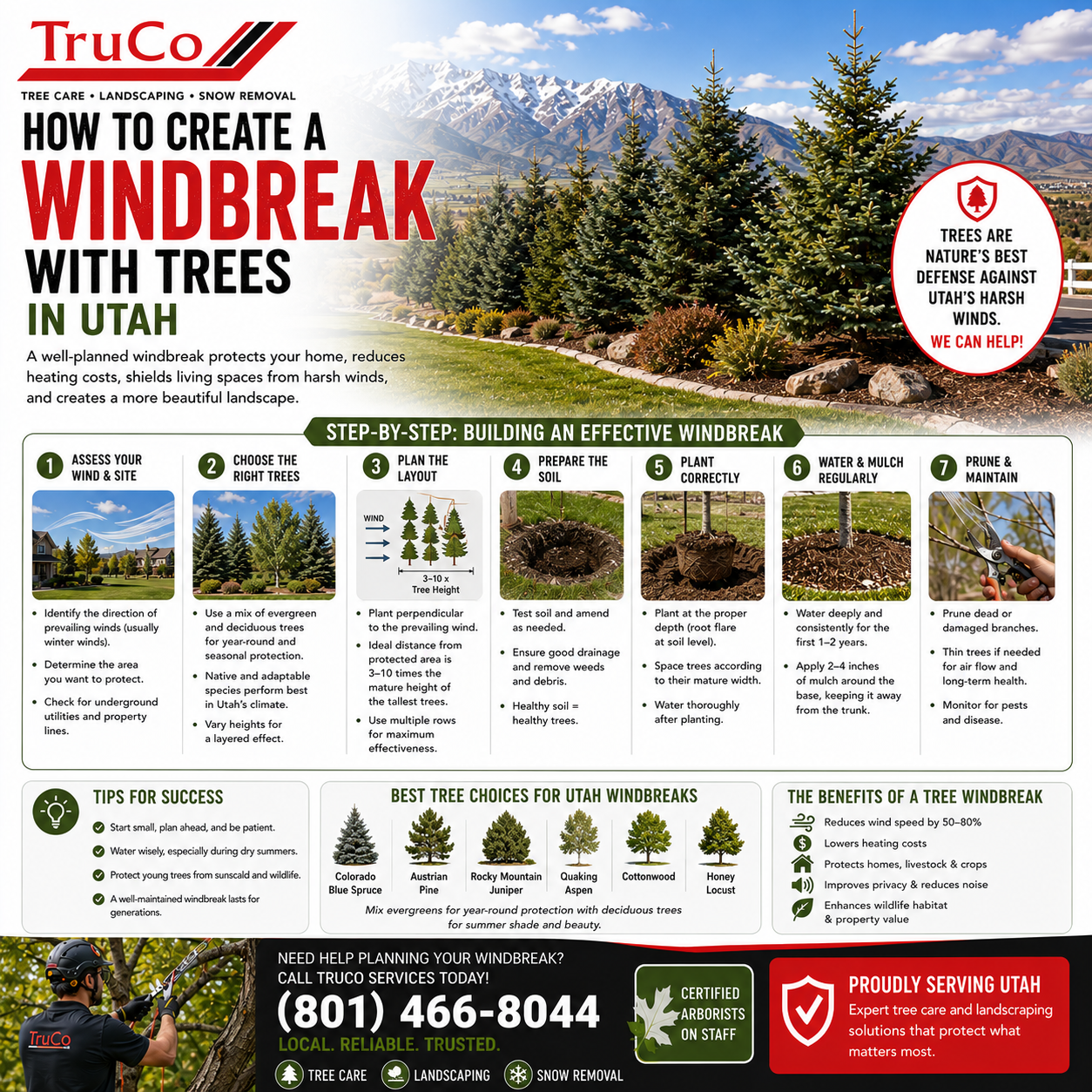
Utah's wind — from the spring gusts that sweep through the Wasatch Front canyons to the constant breezes across the West Desert — can significantly impact your property. Strong winds increase heating costs by robbing heat from buildings, damage plants by drying them out and breaking branches, create drifting snow that blocks driveways and walkways, reduce outdoor comfort, contribute to soil erosion, and limit what plants you can grow. A well-designed windbreak — a barrier of trees and shrubs planted to redirect and slow wind — addresses all these problems. In Utah, where wind speeds can exceed 60 mph during spring storms, a windbreak can reduce heating costs by 15-25%, protect valuable landscape plants, and make your property more comfortable year-round. Whether you are on a farm in Cache Valley, a suburban lot in Utah County, or a rural property in Tooele County, a properly designed windbreak is one of the best long-term investments you can make.
How Windbreaks Work
Windbreaks reduce wind speed by creating turbulence and friction as wind passes through and over the trees. A well-designed windbreak can reduce wind speed for a distance of 10-30 times the height of the windbreak on the leeward (protected) side and 2-5 times the height on the windward side. The effectiveness depends on the windbreak's height, density, length, orientation, and composition. A dense windbreak (such as a single row of evergreens) creates a large zone of turbulence immediately downwind but recovers more quickly. A more porous windbreak (multiple rows with some gaps) creates a smaller reduction in wind speed but the protection extends further downwind. For most Utah applications, a windbreak with 40-60% density is ideal — dense enough to provide significant wind reduction but porous enough to avoid excessive turbulence and snow deposition. The most effective windbreaks have multiple rows of trees and shrubs arranged in staggered rows, with evergreens on the windward side for winter protection and deciduous trees on the leeward side for summer benefits. Properly designed windbreaks can reduce wind speeds by 50-80% in the protected zone.
Windbreak Design for Utah Properties
Follow these design principles for an effective windbreak in Utah. Orientation — plant the windbreak perpendicular to the prevailing winter wind direction. In most of Utah, prevailing winds come from the northwest in winter and from the south or southwest in summer. Set the windbreak at least 50-100 feet from the area you want to protect (closer for smaller properties, further for larger). The protected zone extends downwind 10-30 times the windbreak height. Length — the windbreak should extend at least 50 feet beyond each end of the area to be protected. For small suburban lots, this may mean curving the windbreak to protect a specific yard area. For farm and ranch properties, windbreaks should be at least 100-200 feet longer than the protected area. Rows — use 2-5 rows of trees and shrubs. A typical design has 2-3 rows of evergreens on the windward side, 1-2 rows of deciduous trees in the middle, and a row of shrubs on the leeward side. Spacing — space trees 6-12 feet apart within rows, with rows spaced 12-20 feet apart. Stagger trees in adjacent rows for better wind penetration. Use wider spacing for larger-growing species and closer spacing for smaller species. The windbreak should extend from ground level to the top of the trees — include shrubs to fill the lower gaps.
Best Trees for Utah Windbreaks
Choosing the right species is critical for windbreak success in Utah. For the windward (evergreen) row: Austrian pine (Pinus nigra) is Utah's best windbreak evergreen — tolerates alkaline soil, clay, drought, and wind exposure. Grows 40-60 feet tall with dense, dark green needles. Colorado blue spruce (Picea pungens) handles Utah conditions well with dense branching for effective wind reduction. Good on exposed sites but may need cytospora canker management. Rocky Mountain juniper (Juniperus scopulorum) is a Utah native that thrives in dry, windy conditions. Excellent for lower-growing windbreaks or as shrub layer. Ponderosa pine (Pinus ponderosa) is a Utah native that handles wind and drought once established. Slower growing but very long-lived. For the leeward (deciduous) row: honeylocust (Gleditsia triacanthos inermis) offers tough, wind-hardy structure with filtered shade. Tolerates Utah's alkaline soil and urban conditions well. Bur oak (Quercus macrocarpa) is extremely wind-hardy with a strong structure. Slow-growing but long-lived and provides excellent wildlife habitat. Siberian elm (Ulmus pumila) grows fast for quick windbreak establishment. However, it has weak wood and can become invasive — use with caution and only in rural settings. For the shrub layer: lilac (Syringa species) provides dense lower growth and spring flowers. Tolerates Utah alkali and clay well. skunkbush sumac (Rhus trilobata) is a Utah native that fills gaps at the base of the windbreak. Red twig dogwood (Cornus sericea) provides winter color and dense lower growth in moist areas.
Windbreak Planting and Establishment
Proper planting techniques ensure windbreak establishment in Utah's challenging conditions. Prepare the site by removing weeds and grass in a 4-6 foot strip where trees will be planted. Control perennial weeds before planting — they compete with young trees for water. Plant bare-root trees in early spring (March-April) while they are still dormant. Container-grown trees can be planted spring through fall. Dig holes wide but not deep — plant at the same depth as the nursery. Space trees according to your design plan. Water thoroughly at planting time. For the first two years, water weekly during the growing season — windbreak trees in exposed sites need consistent moisture to establish. Apply 3-4 inches of organic mulch around each tree, keeping it away from the trunk. Control weeds with mulch or careful herbicide application for the first 3-5 years. Protect young trees from deer and rodent damage with fencing or tree guards. In Utah's windy sites, staking may be necessary for the first year. Replace any trees that die within the first two years to maintain windbreak density. Expect 10-20% mortality in the first few years and plan for replacements.
Windbreak Maintenance in Utah
Ongoing maintenance keeps your windbreak effective. Water deeply during dry periods for at least the first 3-5 years. Once established, most windbreak species need supplemental water only during severe drought. Prune to maintain shape and remove dead, diseased, or damaged branches. Do not prune the lower branches of windbreak evergreens — these are essential for wind deflection near the ground. Thin deciduous trees if they become too dense, which reduces windbreak effectiveness. Monitor for pests — ips beetle can attack pines stressed by drought or wind exposure. Maintain tree health to prevent infestations. Remove and replace dead or declining trees promptly to maintain windbreak integrity. Fertilize if growth is poor, but most windbreak trees do not need regular fertilization. Protect from livestock damage with fencing. Repair any gaps that develop from tree mortality. As trees mature, thinning may be needed to maintain optimal density. A well-maintained windbreak lasts 50-100 years with proper care. Periodic renovation — removing declining trees and replanting — ensures continuous protection.
Special Considerations for Utah Properties
Utah's specific conditions require additional considerations. Snow management — windbreaks can create snowdrifts on the leeward side. Position the windbreak far enough from driveways and buildings to avoid problem drifts. A gap at the bottom of the windbreak (using shrubs that allow snow to pass through) reduces snow accumulation. Microclimate effects — windbreaks create warmer, moister microclimates on the leeward side. This allows you to grow plants that would not survive in exposed locations. However, the shade from the windbreak may affect lawn and garden growth. Plan accordingly. Water availability — establishing windbreaks in Utah's dry climate requires irrigation. Plan for supplemental water, especially during drought years. Consider using drip irrigation for efficient water use. Windbreak setbacks — check local zoning and setback requirements. Some Utah communities have restrictions on windbreak placement near property lines, roads, and utility easements. Utility lines — avoid planting tall-growing trees under or near power lines. Coordinate with your utility company if planting near utility easements. Wildlife considerations — windbreaks provide excellent wildlife habitat in Utah. Choose native species to maximize habitat value. Expect deer, birds, small mammals, and pollinators to use your windbreak.
Windbreak Benefits Beyond Wind Protection
A well-designed windbreak provides multiple additional benefits beyond wind reduction. Energy savings — windbreaks reduce heating costs by blocking cold winter winds. The U.S. Department of Energy estimates a 15-25% reduction in heating costs from a properly placed windbreak. In Utah's cold climate, this can save $200-$500 annually on heating bills. Snow control — strategically placed windbreaks trap snow in desired locations (such as garden areas) and keep it off driveways and walkways. This reduces snow removal costs and provides water for landscape plants in spring. Wildlife habitat — windbreaks provide food, shelter, and travel corridors for birds, small mammals, and pollinators. Utah's native birds, including chickadees, finches, and quail, use windbreaks extensively. Livestock protection — on Utah farms and ranches, windbreaks protect livestock from winter wind chill, reducing feed requirements and improving animal health. Odor and dust control — windbreaks filter dust, pollen, and agricultural odors. Aesthetic value — a well-designed windbreak adds beauty, structure, and privacy to your property. Property value — windbreaks can increase property values by improving energy efficiency, aesthetics, and outdoor comfort.
Frequently Asked Questions
How long does it take for a windbreak to become effective? Windbreaks begin providing some protection within 3-5 years as trees reach 6-10 feet tall. Full effectiveness is typically reached at 10-15 years when trees reach 25-40 feet tall. Choose faster-growing species for quicker results, but balance with longevity.
How wide should a windbreak be? For most Utah properties, a windbreak 20-40 feet wide (2-4 rows of trees) provides excellent protection. Wider windbreaks (up to 100 feet) provide more protection for large agricultural properties. For small suburban lots, a single row of evergreens with shrub understory can be effective.
Can I create a windbreak on a small suburban lot? Yes. Use smaller-growing evergreens (Rocky Mountain juniper, dwarf Alberta spruce) and position the windbreak closer to the area you want to protect. Even a single row of well-placed evergreens provides meaningful wind reduction in small yards.
Should I use all evergreens in my windbreak? A mix of evergreens and deciduous trees is best. Evergreens provide year-round wind protection. Deciduous trees add diversity, wildlife value, and allow winter sun through (which can be beneficial for passive solar heating). A ratio of 60-70% evergreen to 30-40% deciduous works well in Utah.
How much does it cost to plant a windbreak in Utah? Costs vary widely based on tree size and species. Small bare-root seedlings: $2-$5 each. Larger container trees: $20-$75 each. Professional installation: $5-$15 per tree. A typical windbreak for a 1-acre property (50-100 trees) costs $500-$3,000 for trees and installation.
Are there programs that help fund windbreak planting in Utah? Yes. The USDA Natural Resources Conservation Service (NRCS) offers cost-sharing for windbreak planting through the Environmental Quality Incentives Program (EQIP). The Utah Division of Forestry, Fire and State Lands also provides technical assistance. Contact your local conservation district for information.