
How to Remove a Tree Stump from Your Yard in Utah

Why You Should Remove a Tree Stump
Tree stumps are more than an eyesore. They attract pests like termites, carpenter ants, and beetles that can spread to healthy trees. Stumps take up valuable yard space, make mowing difficult, and can send up suckers (new shoots from the root system) for years. In Utah, where lawns are at a premium, removing a stump opens up usable space for landscaping, patios, or play areas.
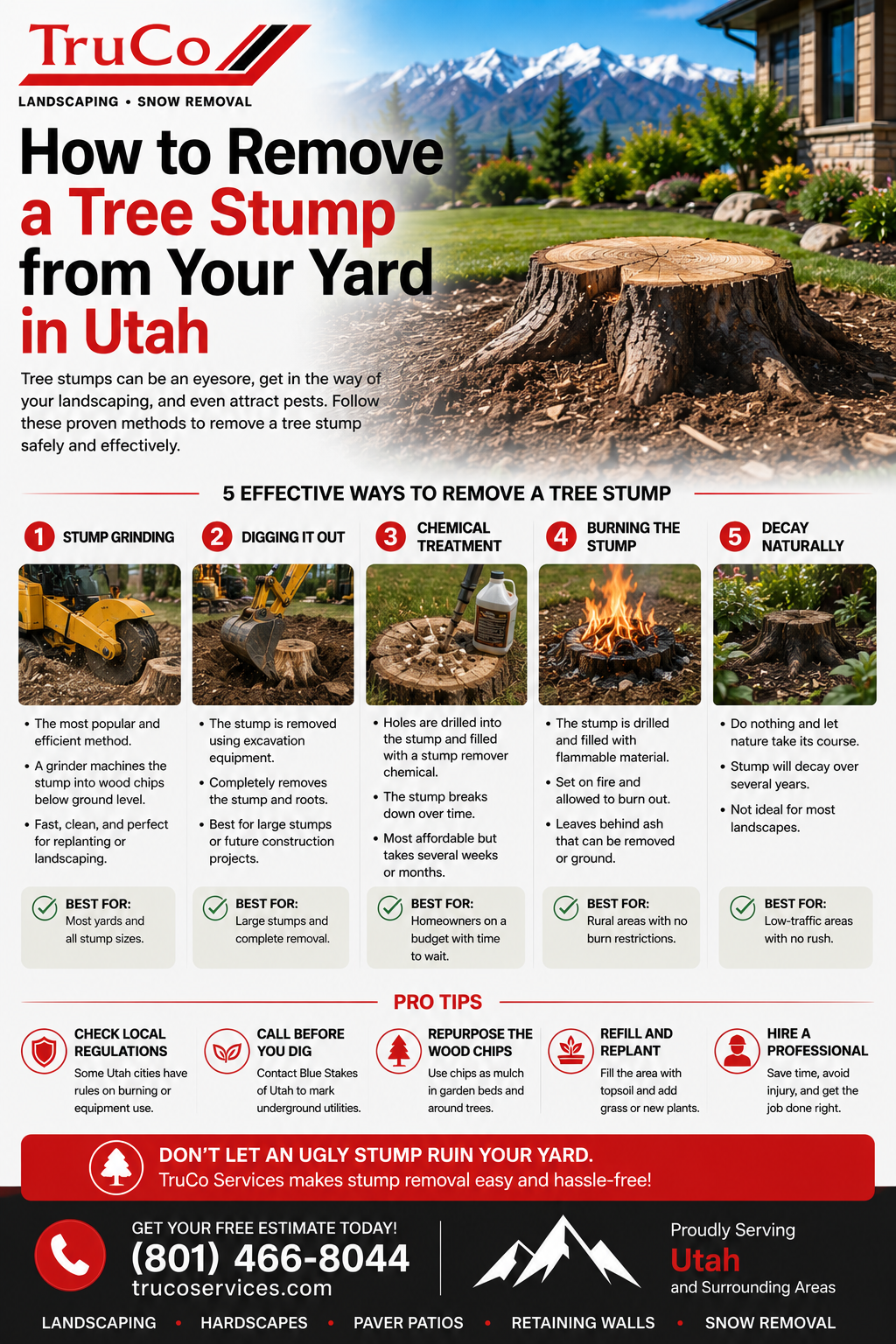
Stump Grinding: Fastest Method for Utah Yards
Stump grinding is the most common and effective method in Utah. A stump grinder uses a rotating cutting wheel to chip the stump into wood chips, typically grinding 6-12 inches below grade. Grinding is fast (15-45 minutes for a typical stump), leaves wood chips that can be used as mulch, and doesn't leave a large hole. The downsides: equipment cost ($200-$400 per day rental, or $100-$400 professional service per stump), and the remaining wood chips and roots will slowly decompose over several years, which can cause settling if you plant over the area.
Chemical Stump Removal in Utah's Climate
Chemical stump removal uses potassium nitrate granules to accelerate wood decomposition. Drill holes in the stump, fill with granules, add water, and wait 4-8 weeks. The wood becomes soft and spongy, making it easy to break apart. In Utah's dry climate, chemical removal works best if the stump is kept moist during the treatment period. It works more slowly in dry conditions but still effective. Cost: $10-$20 for chemical products. Best for small to medium stumps when you're not in a hurry. Not recommended near wells or water sources in Utah due to potential groundwater concerns.
Manual Stump Removal: When to Dig It Out
Manual removal involves digging around the stump, cutting roots with an axe or saw, and pulling the stump out with a vehicle or come-along winch. Works best for small stumps (under 12 inches diameter) in sandy or loamy soil. In Utah's clay soil, manual removal is extremely difficult — clay binds to roots and makes digging very labor-intensive. Manual removal takes 2-8 hours per stump. Cost: free if you have the tools, or $50-$100 for a come-along winch and digging tools. The main advantage: complete removal of the stump and main roots with no chemical residue.
Burning a Stump: Legal Considerations in Utah
Burning is the oldest method of stump removal. Drill holes in the stump, add kerosene or charcoal, and burn it slowly. However, burning a stump is illegal in most Utah counties without a burn permit. In Salt Lake, Utah, Davis, and Weber counties, open burning is restricted or prohibited during fire season (typically May-October). Even outside fire season, most incorporated cities prohibit open burning entirely. Rural properties in unincorporated areas may be able to obtain a burn permit from the local fire department. Never use gasoline — it can explode. Always have a water source and fire extinguisher nearby. Burning is not recommended for most Utah homeowners due to legal restrictions and fire risk.
Natural Decomposition: The Slow Approach
Simply leaving the stump to decompose naturally is the cheapest option but takes 5-15 years depending on stump size and wood type. In Utah's dry climate, decomposition is slower than in humid regions. To speed natural decay: cut the stump as low as possible, drill holes in the top, fill with nitrogen-rich fertilizer or compost, and keep the stump moist during warm months. Covering the stump with soil and planting over it can accelerate surface decay but the underground roots will still take years to break down. Natural decomposition works well for stumps in out-of-the-way areas.
Cost Comparison of Stump Removal Methods in Utah
Stump grinding (professional): $100-$400 per stump. Stump grinding (DIY rental): $200-$400 per day. Chemical removal: $10-$20 + labor. Manual removal: $0-$100 if DIY. Professional manual removal: $200-$500. Burning: minimal cost but legal risks. Natural decomposition: free. For most Utah homeowners, professional stump grinding at $100-$400 per stump is the best value — fast, clean, and no ongoing maintenance.
What to Do After Stump Removal
Fill the hole with topsoil mixed with compost, tamp down firmly, and water to settle. Wait 2-4 weeks for settling before final grading. Seed or sod the area with the same grass type as the surrounding lawn. In Utah, September is the best time for reseeding after stump removal for cool-season grasses. If stump grinding was used, remove excess wood chips (they tie up nitrogen during decomposition) and fill with topsoil. Consider planting a new tree or ground cover in the area after the first season.
Frequently Asked Questions
How much does it cost to grind a tree stump in Utah? Professional stump grinding along the Wasatch Front typically costs $100-$400 per stump, depending on diameter. Most companies charge by the inch ($2-$6 per inch of diameter).
Can I grind a stump myself? Yes, you can rent a stump grinder from equipment rental yards for $200-$400 per day. It's physically demanding work and stump grinders are dangerous machines — read the safety manual carefully.
How long does it take for a stump to decompose naturally in Utah? 5-15 years for most species. Cottonwood and aspen decompose faster (3-7 years). Juniper and oak take longer (10-15+ years). Utah's dry climate slows the process.
Do tree stumps regrow? Some species (cottonwood, box elder, aspen) will send up suckers from the roots for years after the tree is cut. These need to be cut repeatedly or treated with herbicide to prevent regrowth.
Is it legal to burn a stump in Utah? Generally no, unless you live in an unincorporated rural area and obtain a burn permit. Most Utah cities prohibit open burning. Check with your local fire department.
What is the fastest way to remove a stump? Professional stump grinding is the fastest — most stumps are removed in 15-45 minutes.
Can I plant a new tree where I removed a stump? Yes, but wait at least one year for the old roots to decompose. Plant the new tree offset from the old stump location by at least 3 feet to avoid the decomposing root zone.
Does stump removal leave a hole? Grinding leaves a hole 6-12 inches deep filled with wood chips. Manual removal leaves a larger hole. Both need to be backfilled with topsoil.